A cover is a load-bearing temporary protective system. This revision follows the opening from survey to later trade access and keeps protection effective while a cover is being removed or replaced.
Floor opening covers
This is reference content written and revised with AI. It has not been verified or approved by a professional. Review by a suitably qualified professional and site authorisation are required before use.
Stop work
Stop when a cover is loose, capacity or support is unknown, guarding is missing, drilling conflicts are unresolved or traffic exceeds the agreed load. Keep people out until the defect is controlled.
1. Legal and technical scope
| Basis | Application limits |
|---|---|
| HSE work at height FAQ | Official explanation read: work at height includes a fall through a floor opening. Do not treat two metres as a universal exemption from precautions. |
| HSE HSG150 | Official indexed paragraph 152 reviewed: covering an opening is an alternative protective approach to guarding where suitable. Full handbook and project design were not reviewed for this article. |
For Great Britain, identify the applicable Work at Height Regulations duties and competent design arrangements. Northern Ireland has separate legislation. HSE guidance is guidance; it is not approval of this cover.
2. Scope and required inputs
Included scope
Installation, replacement and handover of temporary covers over floor openings on construction sites. Identify every opening, people below, pedestrian and vehicle routes, materials and foreseeable point loads before selecting a cover.
Separate review
This example is not a structural design, scaffold design, lifting plan or confined-space entry permit. Fragile roofs, permanent gratings, pressurised manholes and vehicle-rated covers need their own specifications and assessment.
| Required input | What to verify |
|---|---|
| Survey and design | Opening ID and size · Load and span design · Support condition · Current service record |
| Prepare and move | Handling plan · Lifting gear condition · Panel identity · Clear staging area |
| Protect before opening | Guard secured · Lower area isolated · Safe access ready · Interface briefing |
| Remove old cover | Stable work position · Hands clear of pinch · Controlled landing area · Guard remains effective |
HSE public guidance and identified excerpt only. No paid British Standard, cover load calculation or project-specific temporary works approval was reviewed. Check the applicable current legal text with the responsible person.
3. Eight-stage JSA
| Job stage | Hazards and effects | Failure factors | Technical and procedural controls | Site verification | P | S | R | A |
|---|---|---|---|---|---|---|---|---|
| 1. Survey and design | 1. Fall through opening2. Cover overload3. Edge bearing failure4. Unknown service route | 1. Unmeasured span2. Unlisted wheel loads3. Weak supporting edge4. Outdated drawings | 1. Survey every opening2. Design for actual loads3. Specify sound bearing4. Check service drawings | 1. Opening ID and size2. Load and span design3. Support condition4. Current service record | ||||
| 2. Prepare and move | 1. Strain while carrying2. Dropped panel3. Sharp panel edges4. Blocked access route | 1. Heavy awkward panel2. No lifting points3. Damaged cover stock4. Poor staging layout | 1. Plan mechanical handling2. Use rated lifting points3. Inspect cover condition4. Keep access clear | 1. Handling plan2. Lifting gear condition3. Panel identity4. Clear staging area | ||||
| 3. Protect before opening | 1. Fall into opening2. Objects strike below3. Unprotected installer4. Unauthorised access | 1. Cover removed early2. Open lower floor3. No safe working position4. Tape used as barrier | 1. Install collective guard2. Exclude area below3. Provide protected access4. Brief adjacent trades | 1. Guard secured2. Lower area isolated3. Safe access ready4. Interface briefing | ||||
| 4. Remove old cover | 1. Fall during removal2. Trapped fingers3. Panel swings or drops4. Protection interrupted | 1. Standing on loose panel2. Hands under edges3. Uncontrolled lifting4. Guard moved for access | 1. Work from safe position2. Use designed handles3. Control lifting path4. Maintain edge protection | 1. Stable work position2. Hands clear of pinch3. Controlled landing area4. Guard remains effective | ||||
| 5. Check seat and fixings | 1. Edge breaks away2. Drill hits services3. Dust inhalation4. Inadequate anchorage | 1. Cracked bearing ledge2. Unknown embedded items3. Dry uncontrolled drilling4. Wrong fixing geometry | 1. Verify bearing design2. Approve drilling locations3. Use wet or extracted tools4. Follow fixing specification | 1. Sound bearing surface2. Service scan cleared3. Dust control working4. Fixing layout verified | ||||
| 6. Place and secure | 1. Panel tilts or slides2. Pinched hands3. Wind lifts panel4. Trips at raised edge | 1. Insufficient bearing2. Hands in closing gap3. No positive restraint4. Poor cover fit | 1. Set full designed bearing2. Use handling aids3. Fit specified restraint4. Provide safe surface level | 1. Bearing engagement2. Safe hand clearance3. Restraint installed4. No hazardous gaps | ||||
| 7. Inspect and mark | 1. Fall through weak cover2. Accidental displacement3. Unseen opening hazard4. Unauthorised traffic load | 1. Wrong material grade2. Fixings left incomplete3. Marking obscured4. Vehicle route changed | 1. Verify design conformity2. Inspect all restraints3. Identify cover and limits4. Release permitted loads | 1. Design matches cover2. Fixing inspection record3. Visible cover marking4. Traffic limits briefed | ||||
| 8. Maintain and hand over | 1. Cover removed by trade2. Progressive damage3. New load exceeds design4. Unprotected reopening | 1. No responsible custodian2. No condition checks3. Plant route changed4. Permit ends too early | 1. Assign cover custodian2. Inspect after changes3. Reassess changed loads4. Guard before reopening | 1. Named receiving person2. Inspection schedule3. Change review record4. Protection restored |
PDF A covers basic task controls; B focuses on technical failures; C covers supervision, records and handover. The article has eight stages with four items per main cell; each PDF has six key stages with three items per main cell. P/S/R/A, measurements, confirmations and signatures remain blank for actual site assessment.
4. Fictional scenario and failure mechanisms
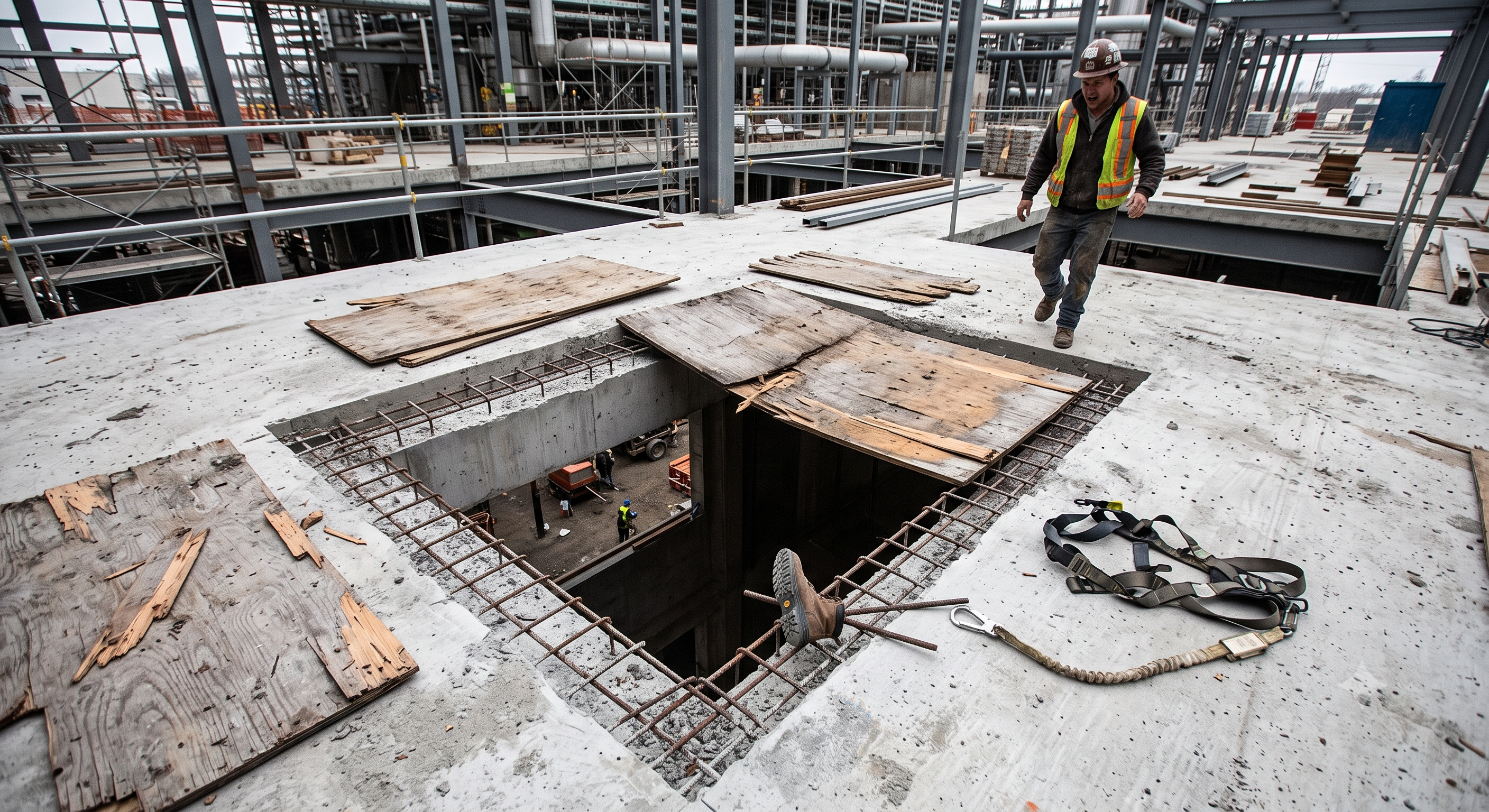
The original educational image is retained. It is not evidence of an actual incident or site suitability.
The scenario and record comparisons are fictional teaching examples, not records of real incidents, measurements, inspections, signatures or approvals.
| Item | Fictional scenario |
|---|---|
| Initial situation | Illustrative situation: a service trade needs access through a covered floor opening. |
| Changed condition | The crew treats an unmarked sheet as scrap and lifts it before guarding the opening. |
| Failure path | The missing restraint and absent access handover allow a person to approach an exposed edge. |
| Possible outcome | Stop access, install effective protection from a safe position and isolate the floor below. |
| Prevention barrier | Reopen only under an agreed access plan; inspect the restored cover and transfer custody. No real accident outcome is asserted. |
Failure mechanisms
A cover can rotate about a support edge when the applied moment exceeds the available support and restraint. It can also bend, break, slide or lift; these are separate failure modes. A four-corner fixing rule does not establish capacity for every geometry.
Material thickness or a timber grade alone cannot establish capacity. Span, bearing width, condition, point loads, wheel loads and fixing/substrate capacity must match the design. A kick, jump or hand check cannot replace this verification.
Collective prevention must remain effective during removal. Fall restraint prevents access to a fall edge; fall arrest requires suitable anchors, edge compatibility, clearance and rescue. Debris netting is not a personnel fall-arrest net. A net must have its required clearance and cannot be assumed effective when stretched directly under a cover.
Decision sequence
| Decision stage | What to verify |
|---|---|
| Known facts | Check opening dimensions, supporting structure and all foreseeable traffic. |
| Unresolved matters | If design or support condition is unknown, prohibit access and seek competent assessment. |
| Reason to hold | Establish guarding and a protected installation position before lifting the old cover. |
| Required evidence | A cover may be released only when capacity, bearing, positive restraint, marking and permitted use are verified. A warning sign alone is insufficient. |
| Restart decision | Any removal, impact, deterioration or changed load reopens the assessment and inspection process. Restore protection before closing the access task. |
5. Conditional decisions and common errors
| Condition | Action | Evidence | Proceed when |
|---|---|---|---|
| Vehicle access: Wheel and axle loads differ from foot traffic. | Use a design suitable for actual vehicle loading. | Vehicle-load design; Design owner. | Vehicle loads verified |
| Drilling: Embedded services or post-tensioning may be present. | Approve scans, locations and substrate before drilling. | Scan, substrate and drilling approval; Responsible engineer. | Drilling locations approved |
| Dust: Drilling may generate respirable silica. | Use suitable extraction or wet methods; assess respiratory protection. | Extraction/wet-method check and respiratory assessment; Supervisor. | Dust controls working |
| Fall arrest: Collective protection cannot fully control the task. | Select a complete compatible system and rescue plan. | System compatibility and rescue plan; Competent planner. | System and rescue ready |
Similar situations, different decisions
The scenario and record comparisons are fictional teaching examples, not records of real incidents, measurements, inspections, signatures or approvals.
| Comparison | Situation A | Situation B |
|---|---|---|
| Support | Loose panel spans an unknown gap. | Measured span and verified sound bearing. |
| Opening | Cover lifted while only warning tape is present. | Effective protection is established before removal. |
| Handover | Next trade assumes the sheet can be moved. | Named custodian controls later access and reinstatement. |
6. Roles and responsibilities
| Role | Responsibility |
|---|---|
| Work supervisor | Confirm load cases, support and fixing design; resolve changes before work. |
| Technical reviewer | Coordinate access, isolation below and hold points; stop uncontrolled removal. |
| Work crew | Install from a protected position and record the actual specified fixings. |
| Inspector / assessor | Inspect bearing, restraints, surface and marking against the design. |
| Release / handover authority | Accept custody after removing loose tools, offcuts and debris; control later trades, inspections and reopening. |
Supervision, records, handover
| Job stage | Technical and procedural controls | Site verification |
|---|---|---|
| Survey and design | 1. Assign design reviewer2. Record governing criteria3. Authorise handling plan | 1. Opening ID and size2. Load and span design3. Support condition |
| Protect before opening | 1. Coordinate lower floors2. Check guard readiness3. Release opening hold point | 1. Guard secured2. Lower area isolated3. Safe access ready |
| Remove old cover | 1. Nominate lifting lead2. Control trade access3. Track removed covers | 1. Stable work position2. Hands clear of pinch3. Controlled landing area |
| Place and secure | 1. Verify installer competence2. Record fixing completion3. Maintain guarded status | 1. Bearing engagement2. Safe hand clearance3. Restraint installed |
| Inspect and mark | 1. Arrange independent check2. Record permitted use3. Authorise safe release | 1. Design matches cover2. Fixing inspection record3. Visible cover marking |
| Maintain and hand over | 1. Name receiving custodian2. Log later access needs3. Close only after protection | 1. Named receiving person2. Inspection schedule3. Change review record |
7. Hold points and record comparison
| Hold point | Evidence before release | Confirmation / approval |
|---|---|---|
| Start | Installation, replacement and handover of temporary covers over floor openings on construction sites. Identify every opening, people below, pedestrian and vehicle routes, materials and foreseeable point loads before selecting a cover. | |
| HP-1 Protect before opening | Guard secured · Lower area isolated · Safe access ready · Interface briefing | |
| HP-2 Check seat and fixings | Sound bearing surface · Service scan cleared · Dust control working · Fixing layout verified | |
| HP-3 Inspect and mark | Design matches cover · Fixing inspection record · Visible cover marking · Traffic limits briefed | |
| HP-4 Maintain and hand over | Named receiving person · Inspection schedule · Change review record · Protection restored |
Complete after actual checks. Recheck after changes, defects or shift handover.
Record comparison examples
The scenario and record comparisons are fictional teaching examples, not records of real incidents, measurements, inspections, signatures or approvals.
The boxes are static record prompts, not interactive or saved approvals. A tick does not establish suitability or permission to restart. Record the evidence, person, time and unresolved issues; retain the change history.
| Record type | Insufficient record | Record checklist |
|---|---|---|
| Design | Looks strong enough. | □ Opening ID□ Span and bearing□ Actual load cases□ Design reference |
| Fixing | Four screws fitted. | □ Specified layout□ Substrate condition□ Installation record□ Inspection result |
| Access | Area signed. | □ Guard before opening□ Lower-floor exclusion□ Installer protection□ Adjacent trade briefing |
| Release | Job finished. | □ Cover identity□ Permitted load□ Receiving custodian□ Next inspection |
8. Site checklist and emergency response
| Check item | Result | Person / action |
|---|---|---|
| □ Survey and design: Opening ID and size | ||
| □ Prepare and move: Handling plan | ||
| □ Protect before opening: Guard secured | ||
| □ Remove old cover: Stable work position | ||
| □ Check seat and fixings: Sound bearing surface | ||
| □ Place and secure: Bearing engagement | ||
| □ Inspect and mark: Design matches cover | ||
| □ Maintain and hand over: Named receiving person | ||
| □ Release / handover authority |
Stop work
Stop when a cover is loose, capacity or support is unknown, guarding is missing, drilling conflicts are unresolved or traffic exceeds the agreed load. Keep people out until the defect is controlled.
Emergency response
Raise the site alarm, secure the area above and below and call the planned rescue service. Do not enter an unprotected opening or improvise a harness rescue. Preserve effective protection during recovery.
9. Sources and review limits
2026-10-08
| Source | Scope and limitations |
|---|---|
| HSE work at height FAQ | Official explanation read: work at height includes a fall through a floor opening. Do not treat two metres as a universal exemption from precautions. |
| HSE HSG150 | Official indexed paragraph 152 reviewed: covering an opening is an alternative protective approach to guarding where suitable. Full handbook and project design were not reviewed for this article. |
This is reference content written and revised with AI. It has not been verified or approved by a professional. Review by a suitably qualified professional and site authorisation are required before use.
10. PDF guidance and FAQ
PDF A covers basic task controls; B focuses on technical failures; C covers supervision, records and handover. The article has eight stages with four items per main cell; each PDF has six key stages with three items per main cell. P/S/R/A, measurements, confirmations and signatures remain blank for actual site assessment.
Content group ID
jsa-opening-covers
Decision sequence?
A cover may be released only when capacity, bearing, positive restraint, marking and permitted use are verified. A warning sign alone is insufficient.
Proceed when?
Any removal, impact, deterioration or changed load reopens the assessment and inspection process. Restore protection before closing the access task.
Separate review?
This example is not a structural design, scaffold design, lifting plan or confined-space entry permit. Fragile roofs, permanent gratings, pressurised manholes and vehicle-rated covers need their own specifications and assessment.
Scope and limitations?
HSE public guidance and identified excerpt only. No paid British Standard, cover load calculation or project-specific temporary works approval was reviewed. Check the applicable current legal text with the responsible person.
Has a professional verified or approved this document?
No. Public sources and editorial, layout and consistency checks were reviewed using AI. No site inspection or professional technical approval has been performed. Obtain appropriate professional review before use.
11. Revision history and authorship
This is reference content written and revised with AI. It has not been verified or approved by a professional. Review by a suitably qualified professional and site authorisation are required before use.
| Date | Version | Change | Review status |
|---|---|---|---|
| 2026-09-15 | Original version unmarked | Original preserved | No professional approval |
| 2026-10-08 | 1.1 | Decisions, records, JSA and PDFs revised | No professional approval |
The original preparation, handling, removal, installation, marking and housekeeping controls are retained. Fixed four-corner anchoring, universal timber thickness, universal load multipliers and unsupported accident or expert-review claims are replaced by verified scope and site-specific design requirements.