A pump can stand level while its support is inadequate, and a stopped pump can still contain trapped pressure. Establish the support and electrical envelope before unfolding, keep people clear during priming and restart, and treat a blockage as a stop condition rather than a reason to increase pressure.
Ground → support → boom envelope → line → controlled pour → blockage → cleaning → handover
This is reference content written and revised with AI. It has not been verified or approved by a professional. Review by a suitably qualified professional and site authorisation are required before use.
Stop work
Stop for support movement, an uncertain power-line envelope, damaged pipe/clamp, interrupted flow with rising pressure, air at the outlet, lost communication, formwork movement or a failed guard. Clear the hose danger zone. Do not force a blockage or open a coupling to test for pressure.
1. Legal and technical scope
| Basis | Application limits |
|---|---|
| HSE - CDM contractor duties | Official guidance on planning, management, monitoring and competence; no certification of this document. |
| HSE - overhead power lines | Avoid, divert or isolate where practicable; consult the line owner for site precautions. Covers or observers do not authorise contact. |
| VDMA safety manual, 04/2024 Rev20 | Manufacturer-hosted technical reference, sections 2.4-2.8. Not UK legislation or the operating manual of the actual pump. |
Great Britain: HSE guidance explains CDM planning and electrical precautions. Northern Ireland has separate legislation. BS 8476, BS 5975 and BS EN 1263-1 in the original were not obtained in full; their mention is not evidence of legal or product compliance.
2. Scope and required inputs
Included scope
Truck-mounted concrete pump setup, boom and delivery-line checks, mixer interface, placement, abnormal-stop response and controlled cleaning and withdrawal.
Separate review
Ground engineering, formwork design, electrical isolation and specialist pressure-system repairs need separate competent planning. This article does not calculate bearing-pad dimensions, electrical clearance or a universally safe placing rate.
| Required input | What to verify |
|---|---|
| Site | Locate trenches, backfill, voids, buried services and overhead lines. Obtain evidence of bearing capacity and support reactions for the proposed boom position. |
| Plant | Identify pump, permitted support configuration, inspection status, boom limits, delivery pipes, hoses, clamps, restraints and pressure rating. |
| Pour | Agree concrete supply, priming and restart procedure, formwork loading/rate limits, protected access, electrical protection and skin/eye washing arrangements. |
| People | Name operator, signaller, hose crew and formwork observer; agree a stop signal, blockage isolation, cleaning exclusion and emergency contacts. |
Use the actual pump manual, support reactions and working envelope, ground assessment, line pressure ratings, concrete mix information and formwork pour plan. No generic two-person hose rule, fixed edge distance or single placing rate establishes safety. Air cleaning is a separately planned specialist activity, only where the exact system permits it.
3. Eight-stage JSA
| Job stage | Hazards and effects | Failure factors | Technical and procedural controls | Site verification | P | S | R | A |
|---|---|---|---|---|---|---|---|---|
| 1. Plan the pour | 1. Vehicle strike2. Electric shock3. Formwork failure4. Wrong equipment | 1. Unknown services2. No pour plan3. Unclear signals4. Wrong pump model | 1. Survey site and services2. Agree pour sequence3. Brief stop signal4. Check exact manual | 1. Site plan2. Pour limits3. Crew roles4. Pump identity | ||||
| 2. Set supports | 1. Pump overturn2. Ground collapse3. Crushed person4. Unstable boom | 1. Weak backfill2. Undersized pads3. Wrong extension4. Hidden void | 1. Assess bearing and loads2. Fit designed supports3. Use permitted setup4. Exclude support zone | 1. Ground evidence2. Pad arrangement3. Support extension4. Level and movement | ||||
| 3. Boom and line | 1. Electrocution2. Pipe burst3. Falling line4. Struck worker | 1. Unchecked envelope2. Worn pipe or hose3. Loose clamp4. Missing restraint | 1. Confirm electrical controls2. Check rated components3. Secure joints and line4. Keep swing area clear | 1. Safe envelope2. Wear and ratings3. Clamps and supports4. Exclusion boundary | ||||
| 4. Feed and prime | 1. Reversing crush2. Hopper entanglement3. Hose whip4. Concrete splash | 1. Person in blind spot2. Guard bypassed3. Air in line4. Empty hopper | 1. Use agreed vehicle signals2. Keep guards effective3. Clear hose danger zone4. Prime by exact procedure | 1. Mixer route2. Guard and stop test3. Crew position4. Supply continuity | ||||
| 5. Place concrete | 1. Formwork collapse2. Fall at edge3. Cement burn4. Electrical injury | 1. Excess placing rate2. Open edge or hole3. Wet cement contact4. Damaged vibrator cable | 1. Follow designed pour rate2. Protect edges and access3. Use skin and eye protection4. Use suitable protected supply | 1. Pour sequence2. Edge protection3. Washing provision4. Cables and supply | ||||
| 6. Monitor changes | 1. Pump overturn2. Hose strike3. Overloaded formwork4. Delayed stop | 1. Support settles2. Flow becomes erratic3. Local concrete pile4. Signal lost | 1. Watch support movement2. Stop abnormal flow3. Distribute planned loads4. Stop on lost signal | 1. Ground and pads2. Flow and pressure trend3. Formwork condition4. Communication | ||||
| 7. Isolate blockage | 1. Pressure ejection2. Hose whip3. Unexpected restart4. Crushing | 1. Trapped pressure2. Forced blockage3. Remote enabled4. Unsafe access | 1. Stop and exclude people2. Isolate hazardous energy3. Use permitted relief4. Verify before opening | 1. Affected line section2. Isolation record3. Relief verification4. Restart decision | ||||
| 8. Clean and stow | 1. Projectile discharge2. Moving pipe3. Boom strike4. Alkaline waste | 1. Air cleaning improvised2. Unrestrained line3. Early support removal4. Uncontrolled washout | 1. Use permitted cleaning2. Secure line and catcher3. Stow before withdrawal4. Contain washout | 1. Cleaning and exclusion2. Residual pressure check3. Boom and supports4. Defects and waste |
PDF A covers basic task controls; B focuses on technical failures; C covers supervision, records and handover. The article has eight stages with four items per main cell; each PDF has six key stages with three items per main cell. P/S/R/A, measurements, confirmations and signatures remain blank for actual site assessment.
4. Fictional scenario and failure mechanisms
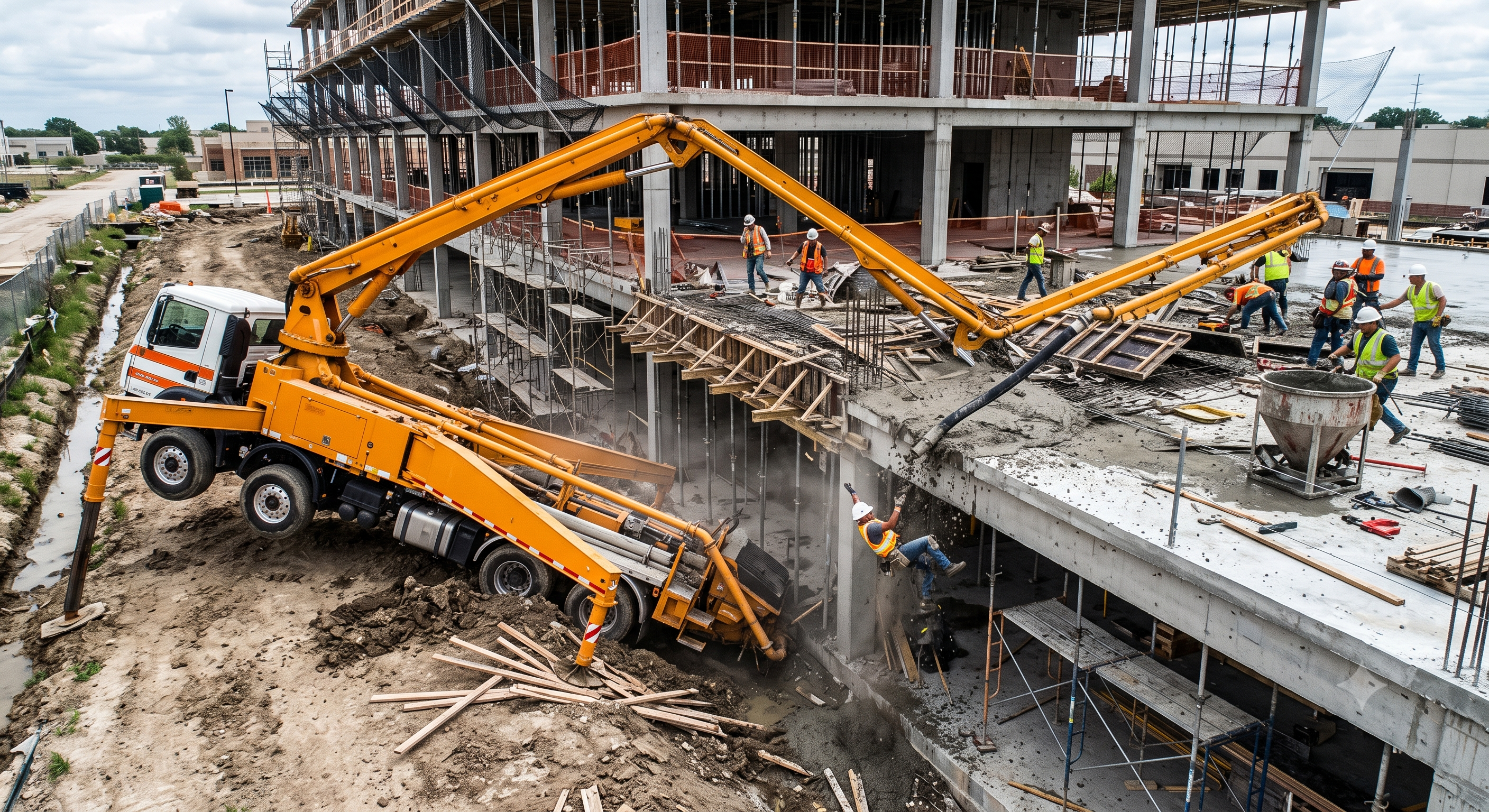
The original educational image is retained. It is not evidence of an actual incident or site suitability. The production method, including possible AI generation, and any real-incident origin have not been verified.
The scenario and record comparisons are fictional teaching examples, not records of real incidents, measurements, inspections, signatures or approvals.
| Item | Fictional scenario |
|---|---|
| Initial situation | Fictional pour: a pump stands beside a recently backfilled trench. |
| Changed condition | The boom moves towards maximum reach while concrete delivery is interrupted. |
| Failure path | Support settlement reduces stability; air or a blockage can make the end hose move violently on restart. |
| Possible outcome | People trying to restrain the hose may be struck or fall at the slab edge. |
| Prevention barrier | Stop, exclude people and reassess support and line condition independently before authorised restart. |
Failure mechanisms
Vehicle level is an observation, not proof of bearing capacity. Boom position changes support reactions. A pad spreads load only if its size, stiffness, contact and underlying ground can sustain that load; hidden voids or an excavation edge can invalidate the setup.
Compressed air and elastic deformation can store energy in a delivery system. A blockage may isolate pressure from the pump gauge. Pump shutdown or a zero reading alone is not proof that every section is depressurised. Follow the model-specific relief and verification procedure before opening.
During priming, interrupted supply or restart, air can leave the hose abruptly. Holding the hose with more people or improvised ropes is not a reliable barrier. Establish the manufacturer-defined danger zone, clear it and resume only by the controlled start procedure.
Formwork pressure and local slab loading depend on the mix, temperature, placing sequence and rate. A normal pump pressure does not prove formwork stability. Inspect from a protected position; do not place an observer under a possible collapse.
Decision sequence
| Decision stage | What to verify |
|---|---|
| Known facts | Observed: support is close to backfill and flow has become irregular. |
| Unresolved matters | Unknown: bearing evidence, trapped air and the location of a possible blockage. |
| Reason to hold | Hold: continuing may combine overturning and hose-whip exposure. |
| Required evidence | Obtain support assessment, plant/line checks and a documented relief and restart sequence. |
| Restart decision | Restart only after both support and line controls are accepted, people are clear and the pour team is briefed. |
5. Conditional decisions and common errors
| Condition | Action | Evidence | Proceed when |
|---|---|---|---|
| Support moves | Stop and exclude | Ground and support reassessment | Stable setup accepted |
| Flow interrupted | Clear hose zone | Supply and restart checks | Controlled restart ready |
| Blockage suspected | Stop; isolate | Verified relief and fault review | Defect resolved |
| Air cleaning | Separate planning | Permitted method and exclusion | Specialist controls ready |
Similar situations, different decisions
The scenario and record comparisons are fictional teaching examples, not records of real incidents, measurements, inspections, signatures or approvals.
| Comparison | Situation A | Situation B |
|---|---|---|
| Support | Truck is level | Ground and support evidence accepted |
| Meaning | Tilt is not observed | Load path has been assessed |
| Pressure | Pump gauge reads zero | Affected sections verified safe to open |
6. Roles and responsibilities
| Role | Responsibility |
|---|---|
| Site lead | Coordinates ground evidence, electrical interface, traffic and the authorised pour sequence. |
| Pump operator | Checks the exact configuration and line; controls start, stop and relief without bypassing guards. |
| Signaller / placing crew | Maintains agreed signals, protected access and separation from the hose danger zone. |
| Formwork reviewer | Defines and reviews loading, rate, inspection and stop conditions. |
| Cleaning / handover lead | Controls the separate cleaning method, personnel clearance, stowage, defects and waste. |
Supervision, records, handover
| Job stage | Technical and procedural controls | Site verification |
|---|---|---|
| Agree pour | 1. Assign evidence owners2. Plan mixer access3. Name stop authority | 1. Site and support plan2. Delivery schedule3. Briefing record |
| Accept setup | 1. Check support evidence2. Confirm network controls3. Accept plant inspection | 1. Ground and pads2. Electrical agreement3. Plant identity |
| Release start | 1. Require clear hose zone2. Confirm guards3. Test communication | 1. Priming plan2. Guard check3. Start instruction |
| Control pour | 1. Track pour sequence2. Control access changes3. Brief replacement crew | 1. Placing log2. Edge condition3. Handover time |
| Approve restart | 1. Record stop and cause2. Verify isolated sections3. Authorise controlled restart | 1. Fault record2. Relief evidence3. Restart briefing |
| Close and hand over | 1. Approve cleaning method2. Confirm stowage3. Handover restrictions | 1. Cleaning record2. Personnel clearance3. Defect and waste log |
7. Hold points and record comparison
| Hold point | Evidence before release | Confirmation / approval |
|---|---|---|
| Start | Truck-mounted concrete pump setup, boom and delivery-line checks, mixer interface, placement, abnormal-stop response and controlled cleaning and withdrawal. | |
| HP-1 Set supports | Ground evidence · Pad arrangement · Support extension · Level and movement | |
| HP-2 Feed and prime | Mixer route · Guard and stop test · Crew position · Supply continuity | |
| HP-3 Isolate blockage | Affected line section · Isolation record · Relief verification · Restart decision | |
| HP-4 Clean and stow | Cleaning and exclusion · Residual pressure check · Boom and supports · Defects and waste |
Complete after actual checks. Recheck after changes, defects or shift handover.
Record comparison examples
The scenario and record comparisons are fictional teaching examples, not records of real incidents, measurements, inspections, signatures or approvals.
The boxes are static record prompts, not interactive or saved approvals. A tick does not establish suitability or permission to restart. Record the evidence, person, time and unresolved issues; retain the change history.
| Record type | Insufficient record | Record checklist |
|---|---|---|
| Support | Pads fitted | □ Ground evidence□ Support reactions□ Pad arrangement□ Boom envelope |
| Start | Hose held | □ Priming method□ People clear□ Supply continuity□ Stop signal |
| Blockage | Pressure zero | □ Affected section□ Relief method□ Verification evidence□ Restart authority |
| Closure | Pump cleaned | □ Permitted cleaning method□ Exclusion and catcher□ Line/boom stowed□ Waste and defect handover |
8. Site checklist and emergency response
| Check item | Result | Person / action |
|---|---|---|
| □ Plan the pour: Site plan | ||
| □ Set supports: Ground evidence | ||
| □ Boom and line: Safe envelope | ||
| □ Feed and prime: Mixer route | ||
| □ Place concrete: Pour sequence | ||
| □ Monitor changes: Ground and pads | ||
| □ Isolate blockage: Affected line section | ||
| □ Clean and stow: Cleaning and exclusion | ||
| □ Release / handover authority |
Stop work
Stop for support movement, an uncertain power-line envelope, damaged pipe/clamp, interrupted flow with rising pressure, air at the outlet, lost communication, formwork movement or a failed guard. Clear the hose danger zone. Do not force a blockage or open a coupling to test for pressure.
Emergency response
Stop the pump from a safe position and keep people away from an unstable boom or charged line. For suspected electrical contact, prevent approach and obtain isolation from the network operator before rescue. Use the site emergency response; for concrete exposure remove contaminated clothing and use the planned washing/medical response. Record the affected line, support and work area before restart review.
9. Sources and review limits
2026-10-08
| Source | Scope and limitations |
|---|---|
| HSE - CDM contractor duties | Official guidance on planning, management, monitoring and competence; no certification of this document. |
| HSE - overhead power lines | Avoid, divert or isolate where practicable; consult the line owner for site precautions. Covers or observers do not authorise contact. |
| VDMA safety manual, 04/2024 Rev20 | Manufacturer-hosted technical reference, sections 2.4-2.8. Not UK legislation or the operating manual of the actual pump. |
This is reference content written and revised with AI. It has not been verified or approved by a professional. Review by a suitably qualified professional and site authorisation are required before use.
10. PDF guidance and FAQ
PDF A covers basic task controls; B focuses on technical failures; C covers supervision, records and handover. The article has eight stages with four items per main cell; each PDF has six key stages with three items per main cell. P/S/R/A, measurements, confirmations and signatures remain blank for actual site assessment.
Content group ID
jsa-concrete-placing
Does a level truck prove safe support?
No. Verify bearing conditions, pad arrangement and support reactions for the actual boom envelope. Reassess settlement or weather changes.
Can two people prevent hose whip?
No. People and improvised guide ropes do not replace exclusion during priming or restart. Use the exact manufacturer procedure.
Can a zero gauge authorise opening a clamp?
No. A blockage may isolate trapped pressure. Verify the affected sections by the permitted relief procedure and prevent restart.
Is a catch basket sufficient for air cleaning?
No. Confirm that air cleaning is permitted for this system, remove or configure end components as instructed, secure the line and exclude people under specialist supervision.
Has a professional verified or approved this document?
No. Public sources and editorial, layout and consistency checks were reviewed using AI. No site inspection or professional technical approval has been performed. Obtain appropriate professional review before use.
11. Revision history and authorship
This is reference content written and revised with AI. It has not been verified or approved by a professional. Review by a suitably qualified professional and site authorisation are required before use.
| Date | Version | Change | Review status |
|---|---|---|---|
| 2026-07-26 | Original version unmarked | Original preserved | No professional approval |
| 2026-10-08 | 1.1 | Decisions, records, JSA and PDFs revised | No professional approval |
Retained ground support, boom/electrical separation, reversing control, hopper guarding, formwork monitoring, fall/electrical protection and pressure-safe cleaning. Removed invented risk scores, automatic legal-compliance promises, universal two-person/rope hose control and generic rates or clearances. Gauge zero and pump reversal are not blanket proof of zero trapped pressure. Original references remain in the recovery copy; unpaid standards and the actual pump manual were not verified in full.