This is reference content written and revised with AI. It has not been verified or approved by a professional. Review by a suitably qualified professional and site authorisation are required before use.
Revision: the master JSA is organised into eight stages with four prompts in each main cell. Short conditional release criteria and sixteen record prompts separate evidence from approval. Three six-stage PDFs use task, technical-failure and supervision viewpoints; actual evaluation fields remain blank. Valid prior explanations, sources and history are retained. This is an editorial revision, not professional technical verification.
1. Legal and technical scope
Review update, 12 October 2026: the entries below identify the official material rechecked for this revision and its specific scope. Earlier source notes and dates are retained as revision history; they do not mean that every cited provision was reverified today. Full paid standards, actual equipment manuals, site calculations and approvals were not supplied or verified. Resolve their current applicability with a qualified reviewer before use.
| Source | Scope and limitations |
|---|---|
| SafeWork NSW — Codes of practice | The current register explains the NSW approved-code duty from 1 July 2026: comply or provide equivalent or higher protection. Check the code applicable to the actual work. A JSA does not replace a required SWMS. |
| SafeWork NSW — Tunnels and shafts in construction (August 2026) | The code states commencement on 28 August 2026 and replacement of the 2006 code. Selected sections 10.4 and 17.3 were reviewed for ground/support assessment and ventilation after blasting. Re-entry requires effective fume clearance, assessed air quality and other applicable release conditions; elapsed time alone is insufficient. The listed post-blast contaminants include CO, NO, NO2 and ammonia, plus other substances identified by assessment. This is not a full-code or full AS 2187.2 review. |
A. Australian scope and NSW application
This guide uses Australian English and addresses civil drill-and-blast tunnel construction. Its specific legal references apply to New South Wales, consistent with the fictional Snowy Mountains setting in the source content.
Australia does not have one universally applicable state explosives licensing system. Safe Work Australia develops national policy and model guidance; it is not the workplace regulator. Before using this guide elsewhere, identify the applicable Commonwealth, state or territory laws, adopted codes, regulator and licence conditions. Mining, quarrying, compressed-air work and operational railway interfaces require separate assessment where relevant.
B. NSW WHS duties and mandatory SWMS
The Work Health and Safety Act 2011 establishes duties including the PCBU’s primary duty, officer due diligence, worker duties and consultation between affected dutyholders and workers.
Under the Work Health and Safety Regulation 2025:
• Section 291(g)(ii) includes construction work in or near a tunnel as high risk construction work.
• Section 291(h) includes construction work involving explosives.
• Sections 299–303 address preparation, implementation, provision, review and retention of Safe Work Method Statements.
• Section 300 requires work that departs from its SWMS to stop immediately, or as soon as it is safe to do so, and resume only in accordance with the statement.
A JSA can inform a SWMS, but its title or risk matrix does not establish compliance. A SWMS must explain the work, hazards, controls and how those controls will be implemented, monitored and reviewed in the actual workplace.
Sources: NSW WHS Act 2011 and NSW WHS Regulation 2025.
C. Current codes and commencement dates
The WHS Regulation 2025 generally commenced on 22 August 2025; its silica worker register provisions commenced on 1 October 2025.
Section 26A of the WHS Act commenced on 1 July 2026. A PCBU must comply with an applicable approved code of practice or manage the hazards and risks through an alternative providing an equivalent or higher standard of health and safety.
The NSW Tunnels and shafts in construction Code of Practice commenced on 28 August 2026 and replaced the 2006 code. It must be considered alongside other relevant approved codes. It is not merely an optional checklist.
Sources: SafeWork NSW legislation updates, approved codes and section 26A and 2026 tunnelling code.
D. Explosives legislation and AS 2187
Apply the Explosives Act 2003 and Explosives Regulation 2024, as amended. The Regulation commenced on 1 September 2024. Verify authorised products, the actual licence scope, security clearance requirements, storage, transport, supervision and recordkeeping arrangements.
Section 72 addresses supervision of explosives set to explode, including failed shots and misfires, subject to its stated mining exception. Do not leave an unresolved civil-tunnelling misfire without the required supervision and control.
AS 2187.2-2006 concerns the use of explosives. Standards Australia’s public catalogue labels it “Pending Revision”. This review checked the title, publication information, status and public contents listing, not the paid operative clauses.
Australian Standards are not automatically legislation. However, statutory incorporation and licence conditions can make particular requirements binding. The NSW Explosives Regulation expressly references AS 2187 for specified activities, including disposal under section 76. Determine the relevant provision, licence condition and applicable edition rather than treating the whole series as either universally mandatory or entirely voluntary.
Sources: NSW Explosives Regulation 2024 and Standards Australia — AS 2187.2-2006.
E. Permits have different functions
• JSA: structured task risk assessment supporting the site’s control documents.
• SWMS: statutory documentation and implementation requirements for the applicable high risk construction work.
• Permit to Tunnel: coordination of excavation, observed ground behaviour and support against the approved design.
• Blasting permit or release: project authorisation under the blasting management arrangements; it does not replace explosives licensing.
• Confined space entry permit: a statutory requirement under section 67 where the confined-space provisions apply.
A tunnel is not automatically a legally defined confined space solely because it is underground. Assess the actual space against the definition and relevant provisions. None of these documents exempts the work from legislation, manufacturer restrictions, engineering requirements or outstanding hold points.
2. Scope and required inputs
This revision is a safety analysis for authorised tunnel work. It covers the specialist plan, competence, custody, ignition-source restrictions, exclusion and evacuation, ventilation, atmospheric testing, ground stability and documented re-entry. Explosive formulations, charge calculations, detonator wiring, initiation-system construction, detailed blast patterns and misfire dismantling are outside this content. A suspected misfire means continued exclusion and referral to the authorised specialist, not a general-worker recovery task. Elapsed time alone never releases entry.
A. Work covered
The assessment covers planning and handover, previous-round status, ground examination, surveying, jumbo movement, drilling, explosives logistics, specialist blasting work, ventilation, restricted inspection, mucking and release for the next excavation cycle.
B. Project and engineering documents
• Applicable legal register, licence conditions, approvals and notification requirements.
• WHS management plan where required, task SWMS and consultation records.
• Geological model, face mapping, groundwater information and approved excavation/support design.
• Permit to Tunnel arrangements and Trigger Action Response Plans (TARPs), defining responses to changing conditions.
• Blast management plan and competently prepared blast design, including affected persons, structures and services.
• Ventilation control plan, occupational hygiene arrangements and atmospheric monitoring strategy.
• Emergency response, evacuation, rescue and personnel-accountability plans.
C. Equipment, explosives and personnel evidence
• Jumbo model, manufacturer instructions, maintenance history and defect status.
• Relevant explosives licences, security clearances, product documentation and custody records.
• Initiation-system instructions and manufacturer-specified equipment compatibility.
• Role-specific training, competence and written appointments.
• Applicable plant licences and inspection records for the actual equipment selected.
• Gas-monitor sensor configuration, calibration and function-check records.
• RPE selection, fit-testing records for tight-fitting facepieces and relevant health monitoring.
D. Silica documentation
Assess processing of crystalline silica substances under the applicable NSW provisions. High-risk processing requires the specified controls, training, monitoring and planning.
Under section 529CB(3), a separate silica risk control plan is not required where the processing is also high risk construction work and a SWMS prepared before the work satisfies the specified silica-plan requirements. A generic silica paragraph is insufficient. Check silica worker register obligations under Part 8A.4.
Sources: WHS Regulation 2025, Chapter 8A and NSW respirable crystalline silica code.
E. Documents for each round
Record the heading, chainage, round, shift, document revisions, previous-round anomalies, support status, atmospheric conditions, explosives reconciliation, permit validity and named release authorities. No site-specific engineering limits or licence conditions were supplied with the original content.
3. Eight-stage JSA
| Job stage | Hazards and effects | Failure factors | Technical and procedural controls | Site verification | P | S | R | A |
|---|---|---|---|---|---|---|---|---|
| 1. Plan and handover | 1. Unreleased heading2. Unfound misfire3. Water inflow4. Lost emergency access | 1. Previous status omitted2. Specialist authority unclear3. Changed ground ignored4. No personnel count | 1. Review previous-round status2. Verify competent roles3. Review ground and water4. Plan escape and accounting | 1. Design and SWMS review2. Competence and permits3. Ground and water review4. Emergency and count plan | ||||
| 2. Inspect protected | 1. Rockfall at face2. Oxygen or gas hazard3. Falling support4. Unknown old hole | 1. Unprotected approach2. No valid air assessment3. Support defect ignored4. Face status unconfirmed | 1. Inspect from protected place2. Assess air before access3. Secure ground by design4. Refer suspect holes to blaster | 1. Ground inspection record2. Air results and instrument3. Support acceptance4. Specialist face clearance | ||||
| 3. Set drill jumbo | 1. Crushed by boom2. Vehicle collision3. Electrical contact4. Hose or cable damage | 1. Shared travel route2. Weak standing area3. Unprotected services4. Controls not checked | 1. Separate plant and people2. Check footing and stabilisers3. Protect feeds and services4. Test controls per manual | 1. Route and exclusion2. Plant standing check3. Service and cable condition4. Communication and stop test | ||||
| 4. Drill and stop | 1. Rotating rod entanglement2. Dust and noise exposure3. Ground change4. Stored energy injury | 1. Entry near moving rods2. Dust control ineffective3. Unexpected void or water4. Maintenance without isolation | 1. Exclude rotating equipment2. Control dust and exposure3. Stop for ground anomalies4. Isolate before intervention | 1. Drill-zone inspection2. Exposure-control records3. Ground-change report4. Isolation and restart check | ||||
| 5. Specialist handover | 1. Unauthorised explosive work2. Uncontrolled ignition source3. Lost material custody4. Conflicting nearby work | 1. Qualifications not checked2. Unapproved work interface3. Custody record incomplete4. Other trades remain | 1. Hand over to licensed team2. Control ignition sources3. Maintain specialist custody4. Suspend conflicting work | 1. Specialist authorisation2. Ignition-control check3. Custody and area record4. Interface release | ||||
| 6. Clear and secure | 1. Person in danger area2. Public enters zone3. Missed warning4. Premature return | 1. Count not reconciled2. Access unguarded3. Failed communication4. Authority unclear | 1. Verify evacuation and count2. Guard defined boundaries3. Check warning communication4. Keep control with specialist | 1. Evacuation record2. Boundary and guard check3. Communication confirmation4. Specialist decision record | ||||
| 7. Ventilate and assess | 1. Toxic post-event fumes2. Oxygen hazard3. Gas in blind heading4. Tester enters danger | 1. Time used as clearance2. Damaged ventilation duct3. Unrepresentative sampling4. Unprotected testing route | 1. Keep general access closed2. Restore planned ventilation3. Use competent air assessment4. Plan protected restricted checks | 1. Ventilation status2. Air results and location3. Instrument verification4. Restricted-entry authority | ||||
| 8. Inspect and release | 1. Loose rock or support2. Suspected misfire3. Loader strikes worker4. Hazard passed to next shift | 1. Visual check only2. Unresolved suspect material3. Shared mucking route4. Release not recorded | 1. Obtain specialist clearance2. Keep suspect area isolated3. Inspect ground and traffic4. Record next-task release | 1. Ground and support record2. Misfire-status handover3. Traffic and air checks4. Release and restrictions |
PDF A covers basic task controls; B focuses on technical failures; C covers supervision, records and handover. The article has eight stages with four items per main cell; each PDF has six key stages with three items per main cell. P/S/R/A, measurements, confirmations and signatures remain blank for actual site assessment.
4. Fictional scenario and failure mechanisms
A. Simulation notice
The following case is a fictional simulation for training and risk assessment. It does not represent an actual accident, a government investigation or an incident involving a particular company or hydro-electric project.
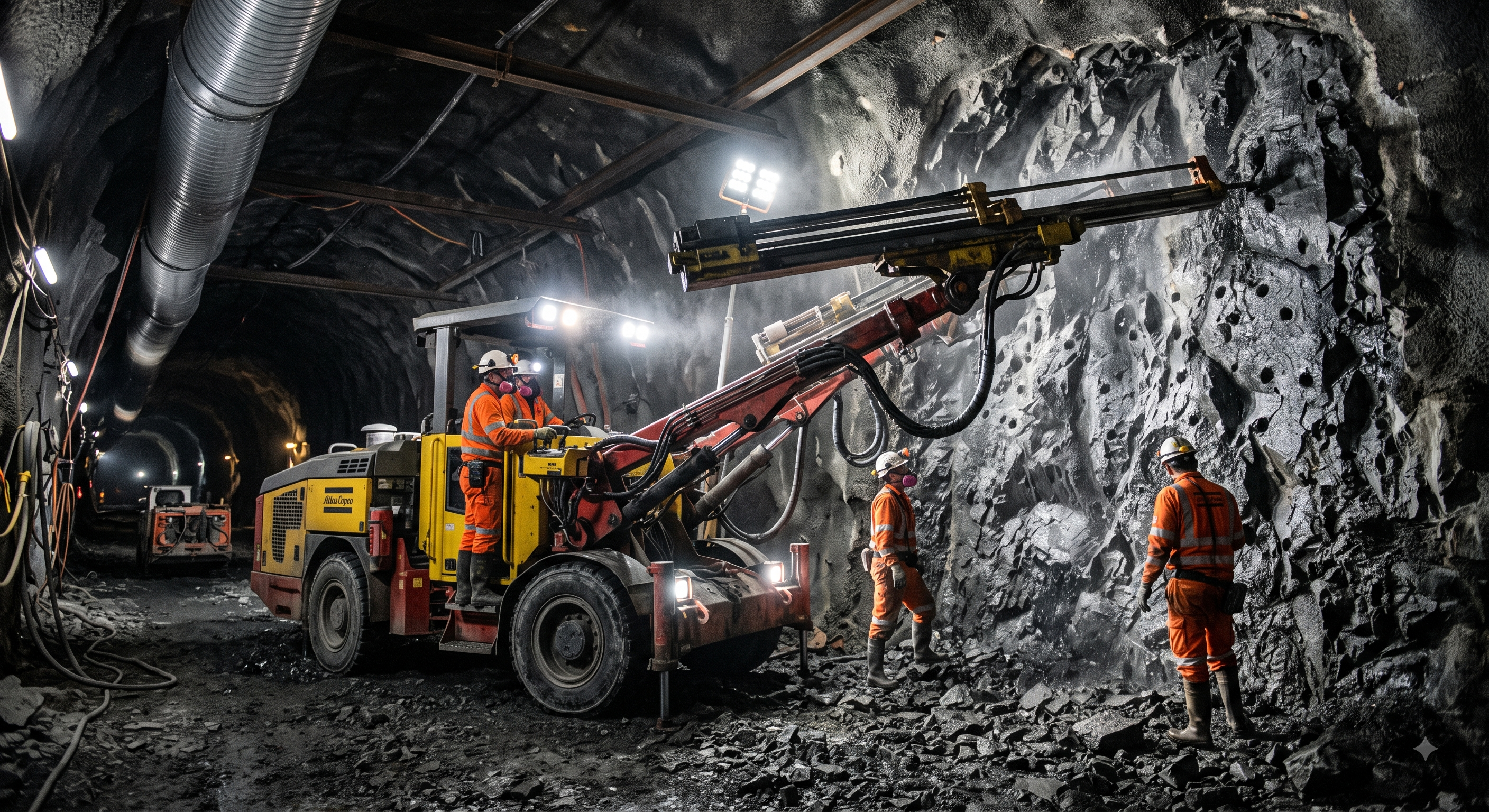
The supplied illustration is not evidence of an accident, a verified machine configuration or an approved working method.
B. Initial situation
A fictional night shift is preparing the next excavation round in a hydro-electric tunnel in the Snowy Mountains, NSW. Previous-round records contain an unresolved discrepancy. A remnant hole, commonly called a butt or socket, is visible near the intended drilling area.
The remnant hole does not itself establish the presence or absence of explosives. For this simulation, assume residual packaged explosive and an initiation component remain, although the crew has not established their location or condition.
C. Changing conditions and missed controls
Recent rain has increased water ingress and worsened footing. A damaged ventilation duct has reduced confidence in heading conditions. Handover is shortened under programme pressure, and the new shift treats the face’s appearance as sufficient evidence to proceed.
These changes require reassessment. Rainfall alone does not establish an initiation mechanism. Cleaning the face, had it occurred, would not by itself prove that residual explosives were absent.
D. Hypothetical incident development
The jumbo starts drilling before the unresolved explosives condition and drilling hold point have been properly addressed. Mechanical disturbance of residual explosive material is a plausible initiating event.
An unintended local explosion could damage the drill assembly and project rock or equipment fragments towards the operator’s cab and a nearby surveyor. Fatal injuries are a credible outcome, but the extent of boom damage, glazing failure and casualties cannot be established from the illustration.
Secondary hazards could include unstable rock, damaged services, impaired ventilation and exposure of workers attempting an unplanned rescue. No SafeWork NSW investigation or finding is claimed.
E. Structural and mechanical analysis
• A local explosive event could transmit loads through the rock, drill assembly and surrounding air. Geometry, confinement and material behaviour influence the actual response.
• Rock joints, excavation damage, in-situ stresses and support condition influence the potential for secondary falls or spalling.
• The boom position, machine support reactions and floor condition influence load paths; they do not establish a predictable overturning sequence.
• Standard cab glazing, rollover protection or falling-object protection must not be assumed to provide blast protection.
• Hydraulic pressure, electrical current or a level indicator does not demonstrate structural integrity or safe ground conditions.
Without blast records, equipment data, ground observations and appropriate calculations, the proposed failure sequence remains a training hypothesis.
F. Failed protective barriers
| Barrier | Assumed failure | Evidence or action needed |
|---|---|---|
| Previous-round handover |
|
|
| Explosives assessment |
|
|
| Ground and support control |
|
|
| Drilling authorisation |
|
|
| Exposure reduction |
|
|
| Emergency response |
|
|
G. Core lesson
Reliable handover, competent explosives assessment, ground control and enforceable work release must operate together. A washed face, completed JSA or low risk score cannot replace those barriers.
5. Conditional decisions and common errors
| Condition | Action | Evidence | Proceed when |
|---|---|---|---|
| Air or ground not released | Restrict entry; arrange protected assessment of ventilation, atmosphere and support. | Representative gas readings, instrument checks and ground inspection. | Atmosphere and ground accepted for entry. |
| Drill jam or damaged hose | Stop and isolate; use the competent maintenance procedure. | Energy-isolation check, defect disposition and equipment inspection. | Defect resolved; guards and isolation checks complete. |
| Unreconciled person count | Maintain exclusion and locate everyone through the control system. | Entry/exit count, guard reports and clear escape routes. | Everyone accounted for; exclusion secured. |
| Suspected misfire or abnormal result | Keep the area closed; refer to the authorised specialist and preserve handover. | Specialist disposition, atmosphere and ground checks, release record. | Specialist release and all re-entry conditions satisfied. |
A. Butts, sockets and suspected misfires
Do not drill into old holes. Establish restrictions around suspect locations through the approved blast management and misfire arrangements. This guide supplies no universal drilling clearance distance.
• Stop affected drilling, excavation, scaling and mucking when residual explosives are suspected.
• Control access and notify the competent, appropriately authorised explosives specialist.
• Maintain supervision and security required by the applicable law and procedure.
• Do not probe, extract, flush out or improvise treatment of a suspected misfire.
• Use only an assessed face-cleaning method; high-pressure washing is not presented as a universally mandatory or inherently safe misfire control.
B. Ground stability and Permit to Tunnel
The ground-control process must compare actual face conditions, groundwater, monitoring and installed support with the approved design. A Permit to Tunnel cannot modify that design. Conditions outside its assumptions require the prescribed TARP response and, where necessary, formal design change before further advance.
Scaling, support installation and access must follow a coordinated sequence that respects explosives restrictions. Mechanised scaling and EWPs require task-specific selection rather than automatic application.
C. Jumbo and mobile plant
• Verify the actual model, attachment configuration, working envelope and manufacturer’s limits.
• Assess floor bearing conditions and gradient; “solid rock” alone does not establish safe support.
• Use segregation as the primary traffic control where practicable. A spotter, reversing alarm or camera does not eliminate blind spots or crushing zones.
• Control stored hydraulic and electrical energy before intervention. Do not improvise hydraulic tests or structural modifications.
• Confirm that operators and spotters understand agreed signals and stop when communication is lost.
D. Explosives and initiation-system compatibility
Electric, electronic and non-electric systems require their own verified precautions.
• Establish RF, static electricity, stray-current and lightning controls from the relevant product instructions, applicable standard and specialist assessment.
• Retain an effective, compatible emergency communication method when equipment restrictions apply.
• Select tools and PPE for the actual products and conditions; “wooden”, “plastic” or “anti-static” is not a complete specification.
• Do not treat an exploder and a circuit tester as interchangeable. Only manufacturer-specified equipment and authorised specialist checks may be used.
• Do not infer safe handling or testing procedures from this publication.
E. Blast exclusion and third-party protection
The exclusion arrangement must address flyrock, pressure pathways, connected headings, portals, cross-passages, services and affected people or structures. Do not assume a circular radius protects every tunnel arrangement.
Storage separation distances, personnel exclusion boundaries, environmental vibration criteria and structural damage limits serve different purposes. Apply the most restrictive genuinely comparable requirement and obtain specialist resolution of incompatible conditions.
F. Post-blast ventilation and gas monitoring
Verify effective ventilation and safe oxygen conditions before inspection access. The NSW tunnelling code identifies CO, NO, NO₂ and ammonia for post-blast monitoring, together with other contaminants identified by the assessment.
• Check actual sensor capability. A typical multi-gas instrument may not measure NO, NO₂ or ammonia.
• Establish representative sampling locations, suitable ranges, response times, calibration and function checks.
• Define safe testing access; do not send an unprotected worker into an unknown atmosphere to establish whether it is safe.
• Record airflow performance and atmospheric results, and maintain monitoring appropriate to changing conditions.
• Suspend access when ventilation, monitoring or communications fail.
• Treat atmospheric release, explosives clearance and ground release as separate evidence requirements.
The applicable exposure standards, their averaging periods and any peak limitations must inform the assessment. A single instantaneous reading or an eight-hour average does not independently establish safe re-entry.
G. Silica, diesel exhaust, noise and RPE
Select source dust suppression or extraction appropriate to the drilling system, maintain ventilation and verify exposure controls through competent assessment. Consider diesel exhaust and other contaminants separately from silica.
For NSW high-risk crystalline silica processing, address the written assessment, silica risk control plan or qualifying SWMS, training, air monitoring, health monitoring and register requirements as applicable. If the PCBU cannot determine whether the processing is high risk, section 529CA treats it as high risk until determined otherwise.
RPE selection must consider the contaminant, exposure, task, duration and wearer. Tight-fitting RPE requires fit testing. A generic P2/P3 instruction does not establish adequate protection, and particulate filters do not protect against oxygen deficiency or all blast gases. Engineering noise controls and exposure management precede reliance on hearing protection alone.
H. Current and forthcoming airborne exposure requirements
As at the verification date, apply the legally operative workplace exposure standards. Safe Work Australia identifies a transition to Workplace Exposure Limits from 1 December 2026, following implementation in the relevant jurisdiction. Do not describe that future list as already operative on 19 September 2026. Recheck the applicable NSW provisions and approved list before the transition and before later use.
Source: Safe Work Australia — WES to WEL transition.
6. Roles and responsibilities
A. PCBU and officers
The PCBU must provide and maintain effective systems, resources and controls within its duties. Officers must exercise due diligence. Appointing a shotfirer or engaging a contractor does not transfer all WHS duties.
B. Principal contractor and tunnel management
Coordinate the WHS management plan, contractor interfaces, SWMS arrangements, access control, ground-control process, ventilation and emergency response. Ensure changes are communicated and unresolved conditions prevent release.
C. Designers and ground-control specialists
Establish design assumptions, support requirements, monitoring criteria and responses to changed ground behaviour. Review departures within their competence and delegated authority. A supervisor’s permit signature does not replace required design assessment.
D. Shotfirer and explosives personnel
Verify the actual NSW blasting explosives user’s licence, authorised activities, restrictions and required security clearances. Assign responsibility for explosives custody, specialist assessment, firing decisions and post-blast explosives status.
A licence, training certificate, employer appointment and professional registration have different functions. A general high risk work licence or construction induction card does not itself authorise shotfiring. The shotfirer’s explosives release does not alone establish safe ground or air quality.
E. Ventilation and occupational hygiene personnel
Establish and verify ventilation performance, monitoring coverage, exposure controls and interpretation of results. Define who can approve restricted inspection access and when ongoing monitoring or withdrawal is required.
F. Permit authorities, operators and workers
Permit issuers must verify the evidence relevant to their authorisation. Operators must follow the released work package, report changes and stop unsafe work. Workers and health and safety representatives must be consulted as required.
G. Emergency personnel
Maintain practised arrangements for evacuation, communication, accountability and rescue. Escape equipment must match the assessed hazards. Escape equipment does not automatically authorise rescue entry into a hazardous atmosphere.
Supervision, records, handover
| Job stage | Technical and procedural controls | Site verification |
|---|---|---|
| Plan ownership | 1. Verify assigned authority2. Review previous-round status3. Plan escape and accounting | 1. Design and SWMS review2. Competence and permits3. Ground and water review |
| Team and equipment | 1. Record equipment evidence2. Separate plant and people3. Test controls per manual | 1. Route and exclusion2. Plant standing check3. Service and cable condition |
| Stage release | 1. Hold stage release2. Hand over to licensed team3. Suspend conflicting work | 1. Specialist authorisation2. Ignition-control check3. Custody and area record |
| Energy control | 1. Record energy controls2. Exclude rotating equipment3. Isolate before intervention | 1. Drill-zone inspection2. Exposure-control records3. Ground-change report |
| Inspection closure | 1. Close inspection defects2. Keep general access closed3. Plan protected restricted checks | 1. Ventilation status2. Air results and location3. Instrument verification |
| Shift handover | 1. Transmit limits and issues2. Obtain specialist clearance3. Record next-task release | 1. Ground and support record2. Misfire-status handover3. Traffic and air checks |
7. Hold points and record comparison
A. Distinct authorisations
The following project hold points coordinate the SWMS, explosives controls, ground-control process and entry arrangements. They are not a prescribed national blasting permit.
Where the confined-space provisions apply, the section 67 entry permit remains a separate statutory requirement. Project documents may be coordinated, but all applicable content, issue, supervision and recordkeeping duties must still be satisfied.
| Hold point | Evidence required before release | Responsible authority |
|---|---|---|
| HP1 — Work package and SWMS |
| Relevant PCBU and designated project authority. |
| HP2 — Face and drilling release |
| Designated explosives, ground-control and access authorities. |
| HP3 — Specialist explosives work |
| Appropriately authorised explosives specialist. |
| HP4 — Firing authorisation |
| Appointed shotfirer with the project’s clearance authority. |
| HP5 — Restricted inspection access |
| Designated entry authority with relevant specialist input. |
| HP6 — General work resumption |
| Responsible tunnel management following specialist releases. |
| HP7 — Closure and next-cycle handover |
| Responsible supervisor and receiving-shift authority. |
B. Permit to Tunnel interface
Link excavation and support release to current face observations, monitoring and the approved design. If conditions fall outside the permitted envelope, implement the TARP and obtain the required design review. Updating a permit cannot itself approve a design change.
C. Suspension and revalidation
Suspend affected work for suspected explosives, abnormal ground movement, unplanned water ingress, failed ventilation, unsuitable readings, communication failure or a material change in scope. Reassess and revalidate through the relevant authorities before restart. A favourable risk score cannot close an unresolved hold point.
Record comparison examples
The scenario and record comparisons are fictional teaching examples, not records of real incidents, measurements, inspections, signatures or approvals.
The boxes are static record prompts, not interactive or saved approvals. A tick does not establish suitability or permission to restart. Record the evidence, person, time and unresolved issues; retain the change history.
| Record type | Insufficient record | Record checklist |
|---|---|---|
| Plan and handover | “OK” | □ Design and SWMS review□ Competence and permits□ Ground and water review□ Emergency and count plan |
| Drill and stop | “OK” | □ Drill-zone inspection□ Exposure-control records□ Ground-change report□ Isolation and restart check |
| Clear and secure | “OK” | □ Evacuation record□ Boundary and guard check□ Communication confirmation□ Specialist decision record |
| Inspect and release | “OK” | □ Ground and support record□ Misfire-status handover□ Traffic and air checks□ Release and restrictions |
8. Site checklist and emergency response
A. Recording method
Record each result, supporting evidence, checker, time and corrective action. An unresolved safety-critical item prevents release. “Not applicable” requires a reason.
B. Work package and competence
• Confirm heading, chainage, round, shift and document revisions.
• Verify the SWMS is available, understood and reflects actual work.
• Check licences, authorisations, appointments and relevant training.
• Review previous-round anomalies and restrictions.
C. Ground, access and plant
• Verify face observations, support status and Permit to Tunnel conditions.
• Check groundwater changes, escape routes and pedestrian segregation.
• Verify the jumbo’s pre-start inspection and safety-critical defect status.
• Confirm safe access equipment and service protection.
D. Explosives and exclusion
• Confirm product identity, custody and required permissions.
• Verify specialist control of butts, sockets and suspected misfires.
• Check system-specific equipment and ignition-source restrictions.
• Verify exclusion coverage, warnings, guards and personnel accounting.
E. Atmosphere and occupational health
• Confirm ventilation performance and the response to failure.
• Verify instrument sensors, measurement criteria and recordkeeping.
• Check dust, diesel-exhaust and noise controls.
• Confirm applicable silica planning, training, monitoring and register arrangements.
• Verify suitable RPE and fit testing where required.
F. Emergency readiness and release
• Test the agreed communication arrangements.
• Confirm evacuation, rescue and standby resources where required.
• Verify evidence for every applicable hold point.
• Ensure workers understand stop-work triggers and reporting arrangements.
9. Sources and review limits
Review update, 12 October 2026: the entries below identify the official material rechecked for this revision and its specific scope. Earlier source notes and dates are retained as revision history; they do not mean that every cited provision was reverified today. Full paid standards, actual equipment manuals, site calculations and approvals were not supplied or verified. Resolve their current applicability with a qualified reviewer before use.
| Source | Scope and limitations |
|---|---|
| SafeWork NSW — Codes of practice | The current register explains the NSW approved-code duty from 1 July 2026: comply or provide equivalent or higher protection. Check the code applicable to the actual work. A JSA does not replace a required SWMS. |
| SafeWork NSW — Tunnels and shafts in construction (August 2026) | The code states commencement on 28 August 2026 and replacement of the 2006 code. Selected sections 10.4 and 17.3 were reviewed for ground/support assessment and ventilation after blasting. Re-entry requires effective fume clearance, assessed air quality and other applicable release conditions; elapsed time alone is insufficient. The listed post-blast contaminants include CO, NO, NO2 and ammonia, plus other substances identified by assessment. This is not a full-code or full AS 2187.2 review. |
A. NSW primary legislation
• Work Health and Safety Act 2011: duties, consultation and section 26A.
• Work Health and Safety Regulation 2025: high risk construction work, SWMS, confined spaces, plant, airborne contaminants and crystalline silica provisions.
• Explosives Act 2003 and Explosives Regulation 2024: relevant licensing, security, handling, supervision and associated requirements.
B. NSW approved codes and regulator information
• Tunnels and shafts in construction — August 2026: commenced 28 August 2026; relevant topics include conventional tunnelling, Permit to Tunnel and blast-fume control.
• Construction work code: construction risk management and SWMS guidance.
• Managing risks of respirable crystalline silica code.
• Confined spaces requirements.
• Approved codes and their legal status.
• Explosives and fireworks licences and blasting explosives user licence guide.
C. National guidance and standards
• Safe Work Australia — tunnelling and Guide for tunnelling work: national guidance, read with applicable jurisdictional requirements.
• Standards Australia — AS 2187.2-2006: public catalogue status “Pending Revision”; paid operative clauses were not verified.
• SafeWork NSW — Australian Standards and other Standards: interaction between standards, legislation and codes.
• Safe Work Australia — exposure-standard transition: distinguish current requirements from the planned WEL commencement.
D. Applying requirements together
Applicable law, statutory permissions and binding licence conditions cannot be waived by a JSA, SWMS or permit. Apply relevant approved codes in accordance with section 26A. Reconcile incorporated standards, manufacturer instructions, approved designs and site controls before work.
Use the most restrictive applicable condition only where requirements are genuinely comparable. Different averaging periods, operating modes, structural functions or exposure pathways cannot be reduced to a simple numerical comparison.
E. Verification scope and source dates
The relevant current NSW legislative provisions were read directly through the official legislation website. Regulator publications and the public Standards Australia listing were also checked. This is a targeted review of the subject matter, not certification of every obligation affecting a specific project.
The dates of publication, amendment, commencement and access have different meanings. Earlier guidance may retain references to the superseded WHS Regulation 2017; use the operative 2025 provisions and subsequent amendments. Reconfirm code status, standard revisions, licence conditions and future exposure-limit changes before use.
10. PDF guidance and FAQ
PDF A covers basic task controls; B focuses on technical failures; C covers supervision, records and handover. The article has eight stages with four items per main cell; each PDF has six key stages with three items per main cell. P/S/R/A, measurements, confirmations and signatures remain blank for actual site assessment.
The three PDF sheets are complementary extracts, not a complete work sequence. Apply all eight body stages and the applicable site procedure. PDF HP-0 to HP-4 are worksheet labels: match each to its event, evidence and responsible authority, not to the same number in a different permit or table. An omitted PDF stage is not permission to omit its controls.
A. Proposed project data
The following are suggested integration requirements. Their implementation in Smart JSA Bridge has not been verified.
• Country AU, language en-AU and the actual state or territory.
• Project, heading, chainage, round and shift identifiers.
• SWMS, blast plan, design, Permit to Tunnel and ventilation-plan revisions.
• Licence scope, appointments and relevant competence evidence.
• Equipment model and manufacturer document references.
• Explosives status, ground observations and unresolved restrictions.
• Atmospheric results, instrument identity and sensor configuration.
• Silica assessment and applicable control-plan or SWMS references.
• Hold-point evidence, signatories, timestamps and permit validity.
• P, S, R and A fields left blank until authorised site assessment.
B. Proposed workflow controls
• Prevent administrative progression when required evidence or approval is missing.
• Route suspected explosives, abnormal ground conditions and failed ventilation to the responsible specialists.
• Require reassessment when critical documents, work conditions or personnel change.
• Record the distinction between restricted inspection access and general work release.
• Retain revision history and an auditable record of decisions.
C. Automation limits
No verified capability is claimed to calculate a universally safe blast radius, ventilation time, gas limit or drilling clearance. These require applicable legal, manufacturer and engineering inputs.
Administrative workflow rules are not physical barriers, safety-rated interlocks or proof of compliance. Automated text must not release a hold point, certify a design or replace field verification.
D. Platform reference
Smart JSA Bridge is the intended documentation platform reference. Claims about real-time risk analysis, calibrated blasting algorithms, one-click technical approval or guaranteed statutory compliance have not been verified.
Does tunnel drilling and blasting require a SWMS in NSW?
Construction work in or near a tunnel and construction work involving explosives are high risk construction work under section 291 of the NSW Work Health and Safety Regulation 2025. A SWMS must be prepared before that work starts. A generic JSA does not automatically satisfy the SWMS requirements.
Are a JSA, Permit to Tunnel and confined space entry permit interchangeable?
No. A JSA supports task risk assessment. A Permit to Tunnel coordinates excavation and ground-support controls against the approved design. A confined space entry permit is required where the relevant NSW confined-space provisions apply. None replaces the SWMS, explosives permissions or specialist release decisions.
Does washing the face prove that an old blasthole is safe?
No. A butt or socket is a remnant hole and does not establish whether explosives remain. Cleaning and visual inspection alone cannot prove that the face is free of residual explosives. Suspected explosives require affected work to stop, access to be controlled and the competent, appropriately authorised explosives specialist to assess the situation.
What must be checked before post-blast re-entry?
The approved re-entry arrangements must address ventilation performance, safe oxygen conditions, relevant blast contaminants, explosives status and ground stability. The NSW tunnelling code identifies CO, NO, NO2 and ammonia for post-blast atmospheric monitoring, together with other contaminants identified by risk assessment. Restricted inspection access and general work resumption are separate releases.
Can Smart JSA Bridge automatically approve blasting limits or statutory compliance?
No such capability has been verified for this guide. Blast exclusion arrangements, equipment limits and atmospheric release criteria require applicable legal, manufacturer and competent engineering inputs. Suggested integration fields and workflow rules are proposals and do not replace site verification or authorised approval.
Has a professional verified or approved this document?
No. Public sources and editorial, layout and consistency checks were reviewed using AI. No site inspection or professional technical approval has been performed. Obtain appropriate professional review before use.
11. Revision history and authorship
A. Origin and purpose
This document is a technical draft generated through the automated engineering-content workflow for Smart JSA Bridge. It supports publication and preparation of a site-specific assessment. It is not an issued SWMS, blasting instruction, Permit to Tunnel or work authorisation.
B. No implied professional approval
No verifiable professional signature or review record was supplied. This document must not be represented as written, reviewed, certified or approved by an engineer, safety professional, explosives manufacturer, SafeWork NSW or another government authority.
C. No physical inspection
The system has not physically inspected the equipment, ground, structures, explosives, ventilation, monitoring instruments, worksite or actual conditions. The illustration does not verify any of those matters.
D. Documents and duties not replaced
This draft does not replace legal advice, manufacturer procedures, blast or structural calculations, statutory inspections, qualification evidence, site risk assessments or work approvals.
Before operational use, appropriately qualified where required, competent and authorised persons for the relevant jurisdiction and site must review, adapt and approve the applicable work documents. Publication of this guide does not authorise the work.
E. Unverified project inputs and platform functions
No actual licence, blast design, manufacturer manual, geological record, instrument specification, inspection record or signed professional review was supplied for this rewrite. Project-specific limits and approvals must therefore be established in the controlled work package.
The proposed integration fields and administrative blocking rules are suggestions, not confirmation of implemented or validated platform functionality.
F. Actual professional review record
Any review actually performed must be recorded separately with:
• Reviewer’s name and organisation.
• Qualifications and formal delegation of authority.
• Scope of review.
• Equipment and documents reviewed.
• Review date and signature.
• Limitations and exclusions.
• Required amendments.
• Conditions under which approval remains valid.
Legal and source verification date: 19 September 2026. Recheck current legislation, commencement and transitional provisions, approved codes, standards, licence conditions and manufacturer instructions before use.
2026-10-12 · v2026.10.12
Revision: the master JSA is organised into eight stages with four prompts in each main cell. Short conditional release criteria and sixteen record prompts separate evidence from approval. Three six-stage PDFs use task, technical-failure and supervision viewpoints; actual evaluation fields remain blank. Valid prior explanations, sources and history are retained. This is an editorial revision, not professional technical verification.
This is reference content written and revised with AI. It has not been verified or approved by a professional. Review by a suitably qualified professional and site authorisation are required before use.
This revision is a safety analysis for authorised tunnel work. It covers the specialist plan, competence, custody, ignition-source restrictions, exclusion and evacuation, ventilation, atmospheric testing, ground stability and documented re-entry. Explosive formulations, charge calculations, detonator wiring, initiation-system construction, detailed blast patterns and misfire dismantling are outside this content. A suspected misfire means continued exclusion and referral to the authorised specialist, not a general-worker recovery task. Elapsed time alone never releases entry.