Covers access selection, ladder inspection, electrical isolation, removal, replacement, testing and handover of a light fitting. Select a safer platform when duration, reach, weight or two-handed force makes ladder work unsuitable.
Stepladder access for light replacement
This is reference content written and revised with AI. It has not been verified or approved by a professional. Review by a suitably qualified professional and site authorisation are required before use.
Stop work
Stop for unknown feeds, failed dead testing, damaged ladder, insecure footing, people entering the zone, overreach or unsupported fitting. A wall switch or a non-contact detector alone does not establish safe isolation.
1. Legal and technical scope
| Basis | Application limits |
|---|---|
| Safe Work Australia · Electrical safety | Public guidance on electrical risk management; no site isolation test performed. |
| HSE · Ladder types and safe use | Access, standing position and contact guidance; not Australian law. |
Australia: Safe Work Australia electrical guidance is a model reference; confirm state or territory rules, electrical licensing and the actual access equipment. HSE ladder advice is foreign technical guidance.
2. Scope and required inputs
Included scope
Covers access selection, ladder inspection, electrical isolation, removal, replacement, testing and handover of a light fitting. Select a safer platform when duration, reach, weight or two-handed force makes ladder work unsuitable.
Separate review
Live electrical work, specialist access systems and structural alteration need separate competent arrangements. This sheet does not authorise electrical work or prove a circuit is dead.
| Required input | What to verify |
|---|---|
| Select access method | Task and duration · Access equipment selection · Circuit identification · Fitting weight and support |
| Inspect and position | Ladder identification · Feet steps and stays · Floor and door controls · Work-zone barriers |
| Isolate and prove dead | Isolation record · Test instrument checks · Point-of-work test · Restart authority |
| Ascend and transfer | Climbing contact · Tool retention · Load transfer method · Exclusion maintained |
| Remove old fitting | Fitting support · Waste container · Isolation still effective · Reach and posture |
| Clear and hand over | Waste record · Ladder post-use condition · Storage restraint · Test and handover record |
Use the exact ladder's instructions for load, opening, restraint and permitted standing level. Do not impose a universal top-two-step rule on every platform design. State or territory electrical licensing and applicable safety requirements must be checked; paid standards and actual manuals were not read.
Use sound footwear, tool retention and suitable eye and hand protection. A fibreglass ladder is not electrical isolation. A helper does not make overturning impossible or justify an unsuitable access method.
3. Eight-stage JSA
| Job stage | Hazards and effects | Failure factors | Technical and procedural controls | Site verification | P | S | R | A |
|---|---|---|---|---|---|---|---|---|
| 1. Select access method | 1. Fall while reaching2. Dropped luminaire3. Shock-induced fall4. Muscle strain | 1. Task needs both hands2. Work too long for ladder3. Wrong circuit identified4. Heavy fitting unsupported | 1. Assess safer work platform2. Match task and access height3. Identify all energy sources4. Plan handling and support | 1. Task and duration2. Access equipment selection3. Circuit identification4. Fitting weight and support | ||||
| 2. Inspect and position | 1. Ladder collapses2. Feet slide3. Door strikes ladder4. Person hit below | 1. Damaged stiles or steps2. Uneven contaminated floor3. Uncontrolled traffic4. Spreader not locked | 1. Remove defective ladder2. Use firm level support3. Secure doors and exclusion4. Open and lock as designed | 1. Ladder identification2. Feet steps and stays3. Floor and door controls4. Work-zone barriers | ||||
| 3. Isolate and prove dead | 1. Electric shock2. Arc burn3. Unexpected energisation4. Stored-energy release | 1. Wall switch only2. Backfeed not identified3. Tester not proved4. Capacitor energy retained | 1. Use qualified electrical worker2. Isolate all relevant feeds3. Prove dead at work point4. Manage stored energy | 1. Isolation record2. Test instrument checks3. Point-of-work test4. Restart authority | ||||
| 4. Ascend and transfer | 1. Fall while climbing2. Dropped tools3. Overbalance with fitting4. Ladder moves | 1. Hands occupied2. Damaged footwear grip3. Bulky load carried4. Person moves occupied ladder | 1. Face ladder and maintain grip2. Secure tools for transfer3. Use planned material handling4. Keep ladder stationary | 1. Climbing contact2. Tool retention3. Load transfer method4. Exclusion maintained | ||||
| 5. Remove old fitting | 1. Fitting drops2. Cuts from metal or glass3. Unexpected live conductor4. Sideways overturn | 1. Fixings released unsupported2. Sharp fragments exposed3. Isolation boundary incomplete4. Overreaching or force | 1. Support before releasing2. Contain sharp waste3. Stop on unexpected wiring4. Descend and reposition | 1. Fitting support2. Waste container3. Isolation still effective4. Reach and posture | ||||
| 6. Install replacement | 1. Loose fitting falls2. Wiring defect3. Overloaded ladder4. Loss of balance | 1. Wrong replacement parts2. Connection not inspected3. Excess weight on steps4. Two-hand forceful work | 1. Match specified components2. Use qualified installation3. Respect total rated load4. Change access if unsuitable | 1. Part compatibility2. Fixings and connections3. Total load and standing level4. Task stability | ||||
| 7. Inspect and restore | 1. Shock on re-energising2. Fire from connection3. Person beneath test area4. Unexpected lamp operation | 1. Testing omitted2. People still exposed3. Lock removed without control4. Fault left unresolved | 1. Complete required testing2. Account for people and tools3. Restore under authorised process4. Hold unresolved defects | 1. Electrical test record2. Area-clear check3. Controlled restoration4. Defect closure | ||||
| 8. Clear and hand over | 1. Glass cuts2. Finger trapped in stays3. Stored ladder falls4. Fault recurs | 1. Waste mixed with rubbish2. Careless folding3. Unsecured storage4. Record not transferred | 1. Dispose by material type2. Use safe folding points3. Secure ladder storage4. Record replacement and tests | 1. Waste record2. Ladder post-use condition3. Storage restraint4. Test and handover record |
PDF A covers basic task controls; B focuses on technical failures; C covers supervision, records and handover. The article has eight stages with four items per main cell; each PDF has six key stages with three items per main cell. P/S/R/A, measurements, confirmations and signatures remain blank for actual site assessment.
4. Fictional scenario and failure mechanisms
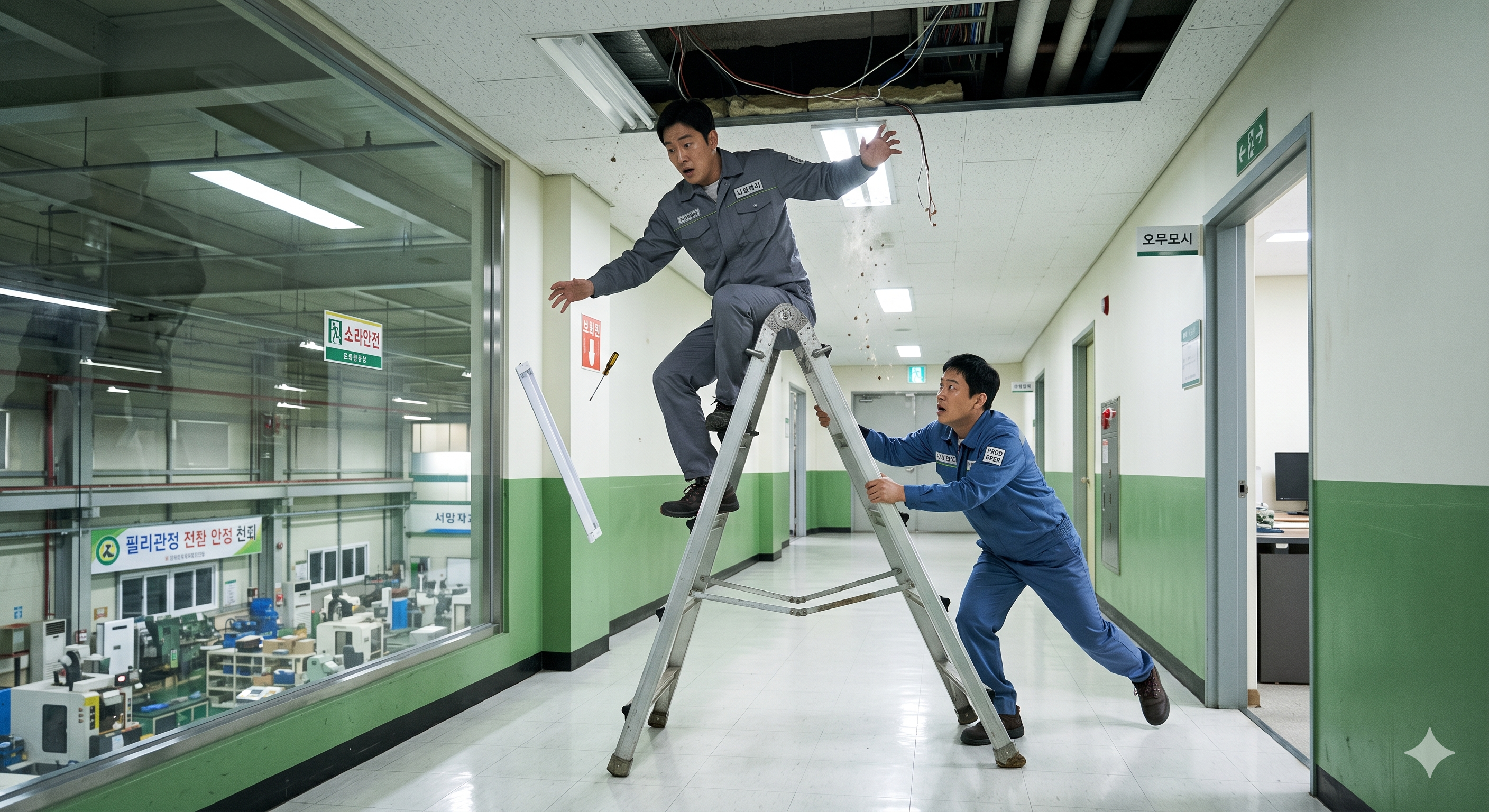
Retained educational illustration; not evidence of an actual incident.
The scenario and record comparisons are fictional teaching examples, not records of real incidents, measurements, inspections, signatures or approvals.
| Item | Fictional scenario |
|---|---|
| Initial situation | A fictional worker prepares to replace a ceiling light from a stepladder. |
| Changed condition | The wall switch is off, but another supply has not been identified and the fitting needs two hands to support it. |
| Failure path | Unexpected voltage can cause shock, while reaching and supporting the weight can overturn the ladder. |
| Possible outcome | A helper holding the feet cannot remove these electrical and access failures. |
| Prevention barrier | Hold work, select suitable access and handling, isolate relevant feeds and verify dead at the work point before release. |
Failure mechanisms
Safe isolation requires identifying all relevant sources, preventing reconnection and verifying dead with a suitable instrument whose function is checked before and after testing. Stored energy also needs control.
Climbing contact and a safe working posture are different questions. If the task needs sustained two-handed force or overreach, change the access arrangement.
Total load includes the person, fitting and tools. Stand only on manufacturer-permitted steps or platforms; the top cap is not a work platform unless designed as one.
Decision sequence
| Decision stage | What to verify |
|---|---|
| Known facts | A fictional worker prepares to replace a ceiling light from a stepladder. |
| Unresolved matters | The wall switch is off, but another supply has not been identified and the fitting needs two hands to support it. |
| Reason to hold | Unexpected voltage can cause shock, while reaching and supporting the weight can overturn the ladder. |
| Required evidence | Isolation record · Test instrument checks · Point-of-work test · Restart authority |
| Restart decision | Hold work, select suitable access and handling, isolate relevant feeds and verify dead at the work point before release. |
5. Conditional decisions and common errors
| Condition | Action | Evidence | Proceed when |
|---|---|---|---|
| Circuit uncertain | Hold and identify all feeds | Circuit and isolation records | Isolation verified |
| Both hands under load | Change access and handling | Task assessment and support plan | Stable work position available |
| Ladder defect | Remove from service | Inspection and replacement record | Suitable ladder confirmed |
| Re-energisation | Test and clear people | Test results and restoration authority | Controlled restoration authorised |
Similar situations, different decisions
The scenario and record comparisons are fictional teaching examples, not records of real incidents, measurements, inspections, signatures or approvals.
| Comparison | Situation A | Situation B |
|---|---|---|
| Isolation | Wall switch off | Prove dead at the work point after full isolation. |
| Helper | Feet held firmly | Select equipment suitable for the whole task. |
| Standing level | Same rule for all ladders | Follow the actual design and instructions. |
6. Roles and responsibilities
| Role | Responsibility |
|---|---|
| Work supervisor | Assess safer work platform · Match task and access height · Identify all energy sources · Plan handling and support |
| Technical reviewer | Remove defective ladder · Use firm level support · Secure doors and exclusion · Open and lock as designed |
| Work crew | Face ladder and maintain grip · Secure tools for transfer · Use planned material handling · Keep ladder stationary |
| Inspector / assessor | Match specified components · Use qualified installation · Respect total rated load · Change access if unsuitable |
| Release / handover authority | Dispose by material type · Use safe folding points · Secure ladder storage · Record replacement and tests |
Supervision, records, handover
| Job stage | Technical and procedural controls | Site verification |
|---|---|---|
| Select access method | 1. Check Task and duration2. Record Access equipment selection3. Brief Circuit identification | 1. Access equipment selection2. Circuit identification3. Fitting weight and support |
| Inspect and position | 1. Check Ladder identification2. Record Feet steps and stays3. Brief Floor and door controls | 1. Feet steps and stays2. Floor and door controls3. Work-zone barriers |
| Isolate and prove dead | 1. Check Isolation record2. Record Test instrument checks3. Brief Point-of-work test | 1. Test instrument checks2. Point-of-work test3. Restart authority |
| Remove old fitting | 1. Check Fitting support2. Record Waste container3. Brief Isolation still effective | 1. Waste container2. Isolation still effective3. Reach and posture |
| Inspect and restore | 1. Check Electrical test record2. Record Area-clear check3. Brief Controlled restoration | 1. Area-clear check2. Controlled restoration3. Defect closure |
| Clear and hand over | 1. Check Waste record2. Record Ladder post-use condition3. Brief Storage restraint | 1. Ladder post-use condition2. Storage restraint3. Test and handover record |
7. Hold points and record comparison
| Hold point | Evidence before release | Confirmation / approval |
|---|---|---|
| Start | Covers access selection, ladder inspection, electrical isolation, removal, replacement, testing and handover of a light fitting. Select a safer platform when duration, reach, weight or two-handed force makes ladder work unsuitable. | |
| HP-1 Select access method | Task and duration · Access equipment selection · Circuit identification · Fitting weight and support | |
| HP-2 Isolate and prove dead | Isolation record · Test instrument checks · Point-of-work test · Restart authority | |
| HP-3 Install replacement | Part compatibility · Fixings and connections · Total load and standing level · Task stability | |
| HP-4 Inspect and restore | Electrical test record · Area-clear check · Controlled restoration · Defect closure |
Complete after actual checks. Recheck after changes, defects or shift handover.
Record comparison examples
The scenario and record comparisons are fictional teaching examples, not records of real incidents, measurements, inspections, signatures or approvals.
The boxes are static record prompts, not interactive or saved approvals. A tick does not establish suitability or permission to restart. Record the evidence, person, time and unresolved issues; retain the change history.
| Record type | Insufficient record | Record checklist |
|---|---|---|
| Plan | Only OK | □ Task and duration□ Access equipment selection□ Circuit identification□ Fitting weight and support |
| Load | Only OK | □ Isolation record□ Test instrument checks□ Point-of-work test□ Restart authority |
| Discharge | Only OK | □ Part compatibility□ Fixings and connections□ Total load and standing level□ Task stability |
| Handover | Only OK | □ Waste record□ Ladder post-use condition□ Storage restraint□ Test and handover record |
8. Site checklist and emergency response
| Check item | Result | Person / action |
|---|---|---|
| □ Select access method: Task and duration | ||
| □ Inspect and position: Ladder identification | ||
| □ Isolate and prove dead: Isolation record | ||
| □ Ascend and transfer: Climbing contact | ||
| □ Remove old fitting: Fitting support | ||
| □ Install replacement: Part compatibility | ||
| □ Inspect and restore: Electrical test record | ||
| □ Clear and hand over: Waste record | ||
| □ Release / handover authority |
Stop work
Stop for unknown feeds, failed dead testing, damaged ladder, insecure footing, people entering the zone, overreach or unsupported fitting. A wall switch or a non-contact detector alone does not establish safe isolation.
Emergency response
Secure the area and call the site emergency response. Do not touch an electrically exposed person before the supply is safely controlled. Any rescue at height needs a planned safe method. Reassess after the event before restarting.
9. Sources and review limits
2026-10-12
| Source | Scope and limitations |
|---|---|
| Safe Work Australia · Electrical safety | Public guidance on electrical risk management; no site isolation test performed. |
| HSE · Ladder types and safe use | Access, standing position and contact guidance; not Australian law. |
This is reference content written and revised with AI. It has not been verified or approved by a professional. Review by a suitably qualified professional and site authorisation are required before use.
10. PDF guidance and FAQ
PDF A covers basic task controls; B focuses on technical failures; C covers supervision, records and handover. The article has eight stages with four items per main cell; each PDF has six key stages with three items per main cell. P/S/R/A, measurements, confirmations and signatures remain blank for actual site assessment.
Content group ID
jsa-stepladder-work
Does fibreglass make electrical work safe?
No. It does not replace isolation, verification or qualified work.
Is a non-contact detector enough?
No. Use the approved dead-testing procedure and suitable verified instrument.
Must a helper always hold the ladder?
Controls depend on the risk assessment and instructions; a helper cannot correct unsuitable access.
Can the fitting be energised immediately?
Only after required inspection and testing, accounting for people and tools, and controlled authorisation.
Has a professional verified or approved this document?
No. Public sources and editorial, layout and consistency checks were reviewed using AI. No site inspection or professional technical approval has been performed. Obtain appropriate professional review before use.
11. Revision history and authorship
This is reference content written and revised with AI. It has not been verified or approved by a professional. Review by a suitably qualified professional and site authorisation are required before use.
| Date | Version | Change | Review status |
|---|---|---|---|
| 2026-06-26 | Original version unmarked | Original preserved | No professional approval |
| 2026-10-12 | 2026.10.12 | Decisions, records, JSA and PDFs revised | No professional approval |
Kept inspection, exclusion, safe climbing and handover. Removed universal helper, capacity, slope and top-step claims, invented reflex timings and assertions that non-conductive material prevents shock. Electrical testing is performed by appropriately qualified people.