This revision retains traffic control, truck docking, paving, rolling, hand finishing and plant cleaning from the original. It separates pre-start inspection from operation and makes access for pavement testing, energy isolation and road handover explicit. A reversing alarm or camera is one aid within a controlled movement system; neither proves that the hopper gap or roller path is empty.
Control the truck-paver interface and stop plant before foot access
This is reference content written and revised with AI. It has not been verified or approved by a professional. Review by a suitably qualified professional and site authorisation are required before use.
Stop work
Stop when a person enters the moving envelope, guide contact is lost, a required visibility or braking control fails, tipping ground moves, guards are missing, fumes impair visibility or wellbeing, or the isolation state is uncertain. Secure the affected plant and revise the plan before release.
1. Legal and technical scope
| Basis | Application limits |
|---|---|
| WorkSafe Queensland: moving vehicles | Reviewed the incident alert and prevention section on traffic plans, pedestrian separation, visibility and plant interaction. Queensland regulator guidance; not proof of an investigation outcome or a national statutory distance. |
| INRS: bitumen prevention | French technical reference reviewed for bitumen/tar distinction, source control and product-specific assessment. It is not local legislation or a substitute for the supplied SDS. |
Australian state or territory WHS requirements and the road manager’s temporary traffic requirements must be selected for the actual location. The Queensland source is a jurisdiction-specific regulator example. A SWMS requirement depends on whether the actual work is high-risk construction work under the applicable regime; this JSA does not replace it.
2. Scope and required inputs
Included scope
Asphalt delivery to a paver, placement, hand finishing, pavement testing, rolling, cleaning and transport loading within an agreed road-work zone.
Separate review
Separate assessments are needed for milling or silica-generating cutting, tack-coat spraying, confined or enclosed locations, lifting, electrical work and work beside live utilities. Identify any radioactive density gauge and apply its separate licensing and handling procedure.
| Required input | What to verify |
|---|---|
| Traffic and site plan | Road category, traffic authority requirements, taper and barrier layout, pedestrian diversion, lighting and emergency access. |
| Plant and delivery | Model-specific instructions; brakes, visibility aids, guards, burner and screed supports; truck tipping ground, overhead utilities and agreed signals. |
| Mix and cleaning product | Supplier temperature window and SDS; extraction capability, wind, noise, heat load and cleaner compatibility. |
| Quality and handover | Protected test location and entry procedure; acceptance criteria, unfinished edges, restraints for transport and authority to reopen the road. |
No machine model, mix SDS, ground bearing capacity, exposure results or site traffic approval was supplied. Obtain those inputs before setting temperatures, exclusion dimensions, respirator selection, loading limits or risk scores. The forms cannot certify compliance.
Select high-visibility clothing, protective footwear, heat-resistant gloves and eye/face protection for the actual splash and contact risk. Assess noise and hearing protection without weakening agreed signals. Particle filters such as N95 alone do not control vapours; select respiratory protection from the exposure assessment, SDS and applicable programme. Provide water, shaded recovery and breaks for heat load. PPE does not replace separation, guards or extraction.
3. Eight-stage JSA
| Job stage | Hazards and effects | Failure factors | Technical and procedural controls | Site verification | P | S | R | A |
|---|---|---|---|---|---|---|---|---|
| 1. Set traffic layout | 1. Traffic intrusion2. Worker struck3. Blocked escape4. Poor night visibility | 1. Wrong taper layout2. Unprotected sign placement3. Public route intersects plant4. Glare obscures routes | 1. Implement agreed traffic plan2. Separate people and plant3. Protect setup and escape routes4. Position lights without glare | 1. Road authority plan2. Pedestrian route3. Traffic-control briefing4. Lighting at work boundary | ||||
| 2. Inspect and prepare plant | 1. Unexpected movement2. Burner fire3. Access fall4. Heat stress | 1. Brake or alarm defect2. Fuel leak3. Guard missing4. Breaks not planned | 1. Check brakes and visibility aids2. Test guards and stop functions3. Prepare stable access and lighting4. Plan water shade and breaks | 1. Pre-start inspection2. Heater and fuel condition3. Guard and stop test4. Heat-rest arrangements | ||||
| 3. Reverse and unload | 1. Crushing at hopper2. Truck overturn3. Overhead contact4. Sudden load release | 1. Guide lost from view2. Soft or sloping ground3. Body raised into obstruction4. Material sticks in body | 1. Exclude people from docking gap2. Stop when signals are lost3. Check tipping ground and clearance4. Stop and use approved release method | 1. Driver-guide contact2. Discharge area condition3. Body and overhead clearance4. Stuck-load procedure | ||||
| 4. Lay asphalt | 1. Hot-mix burns2. Fume exposure3. Auger entanglement4. Contact burns | 1. Person inside moving envelope2. Extraction obstructed3. Hand enters moving auger4. Temperature assumed safe | 1. Keep clear of hopper and auger2. Use specified mix and extraction3. Isolate before clearing material4. Verify mix limits from supplier | 1. Guard position2. Mix and ventilation settings3. Safe clearing procedure4. Supplier temperature limits | ||||
| 5. Finish and test mat | 1. Worker hit by roller2. Hot splash3. Muscle strain4. Fume exposure | 1. Testing overlaps rolling2. Worker crosses blind zone3. Heavy repetitive shovelling4. Worker stays in exhaust plume | 1. Hold conflicting plant movements2. Agree protected entry and exit3. Use tools and thermal protection4. Plan position clear of traffic and fumes | 1. Plant held for entry2. Worker exit confirmation3. Tools and PPE assessment4. Wind and worker position | ||||
| 6. Compact pavement | 1. Run-over at reversal2. Roller overturn3. Vibration exposure4. Noise exposure | 1. Uncontrolled pedestrian entry2. Unsupported pavement edge3. Unsafe pass or speed4. Signals masked by noise | 1. Separate passes from foot work2. Set edge limits from ground check3. Use belt with rollover protection4. Use tested agreed communications | 1. Clear roller route2. Edge support condition3. Belt and protection condition4. Noise and communication check | ||||
| 7. Isolate and clean | 1. Stored-energy movement2. Burns and fire3. Cleaner exposure4. Unexpected restart | 1. Stop mistaken for isolation2. Hot surface ignites cleaner3. Raised screed unsupported4. Key control unclear | 1. Isolate and verify before access2. Cool and use specified cleaner3. Support raised components4. Assign isolation and key control | 1. Isolation and restart control2. Cleaner SDS and temperature3. Mechanical support condition4. Named isolation controller | ||||
| 8. Load and hand over | 1. Ramp slip or overturn2. Unsecured transport load3. Premature traffic entry4. Public trip or skid | 1. Ramp or deck unsuitable2. Tie-down points unverified3. Barriers removed too early4. Unfinished edge or loose material | 1. Use rated stable loading route2. Restrain plant to transport plan3. Inspect before staged reopening4. Check surface edges and debris | 1. Ramp and trailer check2. Restraint plan3. Road handover release4. Surface and edge inspection |
PDF A covers basic task controls; B focuses on technical failures; C covers supervision, records and handover. The article has eight stages with four items per main cell; each PDF has six key stages with three items per main cell. P/S/R/A, measurements, confirmations and signatures remain blank for actual site assessment.
4. Fictional scenario and failure mechanisms
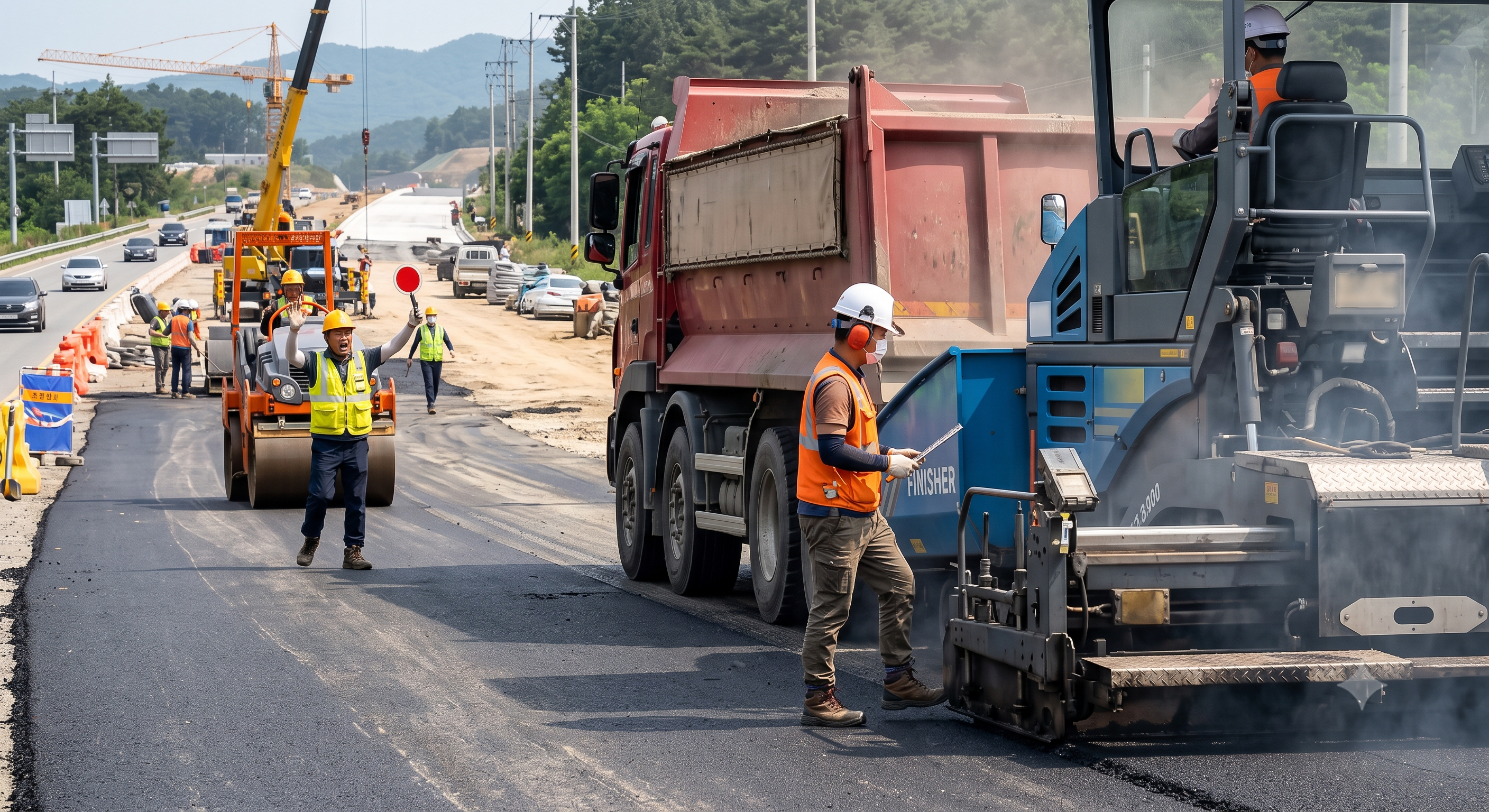
The original educational image is retained. Its production method, including possible AI generation, has not been verified. It is not evidence of a real incident or approved site arrangement.
The scenario and record comparisons are fictional teaching examples, not records of real incidents, measurements, inspections, signatures or approvals.
| Item | Fictional scenario |
|---|---|
| Initial situation | A quality technician is scheduled to check the mat between the paver and roller. A delivery truck waits outside the discharge position. |
| Changed condition | Dust obscures a camera and the radio exchange is incomplete as the roller changes direction. |
| Failure path | The operator assumes that a sounding alarm means the technician will stay clear. The technician assumes that the inspection request stopped the plant. |
| Possible outcome | If both act on those assumptions, the technician can enter the roller path or be trapped at the truck-paver interface. No actual injury or measurement is asserted. |
| Prevention barrier | Hold the conflicting movements, establish a protected route, confirm the technician has left and positively reauthorise the next movement. |
Failure mechanisms
The rear of a roller and the truck-paver gap move relative to a person. Visibility changes with steering, the raised body and the paver geometry. A camera image has blind areas and can be obscured; sounding an alarm is not an empty-zone check.
Hot mix and heated components can burn by splash or contact. Mix temperature also affects emissions, but a lower permitted working temperature does not eliminate exposure. Apply the supplier range and functioning extraction; assess remaining exposure.
A stopped conveyor, auger or screed can still move from stored energy or an unintended restart. Safe clearing requires the machine isolation procedure, verification and support of raised parts; an emergency stop alone is not proof of isolation.
Decision sequence
| Decision stage | What to verify |
|---|---|
| Known facts | A foot inspection is requested; the truck is waiting; camera visibility and the radio exchange are inadequate. These are observations in the fictional example, not completed site records. |
| Unresolved matters | Who owns the plant hold, whether the entry route is clear and whether every operator received the instruction remain unresolved. |
| Reason to hold | Keep the technician outside the movement zone and hold the truck and roller. Do not treat the inspection request, alarm or PPE as permission to enter. |
| Required evidence | Record the agreed hold, inspect the route, restore and test the required visibility aid and communications, then confirm the protected entry and named release authority. |
| Restart decision | Allow the inspection only under the agreed hold. Resume conflicting movement after the technician exits, the guide confirms a clear route and the responsible operator acknowledges the release. |
5. Conditional decisions and common errors
| Condition | Action | Evidence | Proceed when |
|---|---|---|---|
| Camera obscured or signal lost | Stop the affected manoeuvre and restore the planned visibility and communication controls. | Functional check and clear route. | Visibility and contact restored |
| Truck tilts or load sticks | Stop tipping; secure the vehicle and follow the approved recovery method. | Ground review and supplier/plant procedure. | Stable approved unloading |
| Technician needs mat access | Hold conflicting plant and agree protected entry and exit. | Operator acknowledgements and exit check. | Plant held; route protected |
| Auger or conveyor blocked | Isolate, release stored energy and verify before clearing. | Isolation proof and raised-part support. | Verified safe access |
| Density result accepted | Inspect surface, edges and traffic layout before barrier removal. | Quality evidence plus road-release decision. | Road handover accepted |
Similar situations, different decisions
The scenario and record comparisons are fictional teaching examples, not records of real incidents, measurements, inspections, signatures or approvals.
| Comparison | Situation A | Situation B |
|---|---|---|
| Alarm | It sounds: a component functions. | The guide also confirms an empty route and the driver acknowledges the movement. |
| Mix temperature | A lower temperature within the supplier range reduces one exposure driver. | Contact, fume and heat-load controls still depend on the actual task. |
| Cleaner | A product is described as biodegradable. | Its SDS, hot-surface compatibility and ignition risks have been checked. |
| Pavement acceptance | A density test meets its specified criterion. | Surface, edges, access and traffic controls are also ready for the authorised reopening. |
6. Roles and responsibilities
| Role | Responsibility |
|---|---|
| Work supervisor | Coordinate deliveries, rolling and test access; assign one lead guide, hold owners and the road handover authority. |
| Operator and guide | Inspect plant, agree signals and safe guide position, stop on lost contact and acknowledge each controlled release. |
| Technical / safety reviewer | Review machine instructions, mix and cleaner SDS, exposure assessment, ground support and the proposed isolation method. |
| Quality technician / road representative | Request protected test access; record actual results and exit. Keep pavement acceptance separate from authority to reopen traffic. |
Supervision, records, handover
| Job stage | Technical and procedural controls | Site verification |
|---|---|---|
| Set traffic layout | 1. Approve traffic layout2. Assign setup protection3. Brief pedestrian route | 1. Road authority plan2. Pedestrian route3. Traffic-control briefing |
| Inspect and prepare plant | 1. Record plant defects2. Assign repair decision3. Release only after retest | 1. Pre-start inspection2. Heater and fuel condition3. Guard and stop test |
| Reverse and unload | 1. Nominate one lead guide2. Agree stop signal3. Assign delivery waiting area | 1. Driver-guide contact2. Discharge area condition3. Body and overhead clearance |
| Finish and test mat | 1. Book protected test access2. Confirm plant hold owner3. Record worker exit | 1. Plant held for entry2. Worker exit confirmation3. Tools and PPE assessment |
| Isolate and clean | 1. Assign isolation owner2. Record energy release3. Approve cleaner and support | 1. Isolation and restart control2. Cleaner SDS and temperature3. Mechanical support condition |
| Load and hand over | 1. Review pavement acceptance2. Assign barrier removal order3. Record road authority handover | 1. Ramp and trailer check2. Restraint plan3. Road handover release |
7. Hold points and record comparison
| Hold point | Evidence before release | Confirmation / approval |
|---|---|---|
| Start | Asphalt delivery to a paver, placement, hand finishing, pavement testing, rolling, cleaning and transport loading within an agreed road-work zone. | |
| HP-1 Reverse and unload | Driver-guide contact · Discharge area condition · Body and overhead clearance · Stuck-load procedure | |
| HP-2 Finish and test mat | Plant held for entry · Worker exit confirmation · Tools and PPE assessment · Wind and worker position | |
| HP-3 Isolate and clean | Isolation and restart control · Cleaner SDS and temperature · Mechanical support condition · Named isolation controller | |
| HP-4 Load and hand over | Ramp and trailer check · Restraint plan · Road handover release · Surface and edge inspection |
Complete after actual checks. Recheck after changes, defects or shift handover.
Record comparison examples
The scenario and record comparisons are fictional teaching examples, not records of real incidents, measurements, inspections, signatures or approvals.
The boxes are static record prompts, not interactive or saved approvals. A tick does not establish suitability or permission to restart. Record the evidence, person, time and unresolved issues; retain the change history.
| Record type | Insufficient record | Record checklist |
|---|---|---|
| Set traffic layout | Traffic checked. | □ Traffic plan revision□ Pedestrian route□ Briefing record□ Lighting check |
| Reverse and unload | Truck guided. | □ Lead guide name□ Discharge ground condition□ Raised-body clearance□ Stuck-load procedure |
| Finish and test mat | Test completed. | □ Plant hold acknowledgement□ Technician exit confirmation□ PPE selection□ Worker position |
| Load and hand over | Road ready. | □ Loading ramp condition□ Restraint plan□ Road-release decision□ Surface inspection |
8. Site checklist and emergency response
| Check item | Result | Person / action |
|---|---|---|
| □ Set traffic layout: Road authority plan | ||
| □ Inspect and prepare plant: Pre-start inspection | ||
| □ Reverse and unload: Driver-guide contact | ||
| □ Lay asphalt: Guard position | ||
| □ Finish and test mat: Plant held for entry | ||
| □ Compact pavement: Clear roller route | ||
| □ Isolate and clean: Isolation and restart control | ||
| □ Load and hand over: Ramp and trailer check | ||
| □ Release / handover authority |
Stop work
Stop when a person enters the moving envelope, guide contact is lost, a required visibility or braking control fails, tipping ground moves, guards are missing, fumes impair visibility or wellbeing, or the isolation state is uncertain. Secure the affected plant and revise the plan before release.
Emergency response
Stop the interacting machines if safe, prevent further traffic entry and call the site emergency response with the exact road section and access point. Do not enter a crushing gap or go beneath an unsupported component to attempt rescue. Competent responders control stored energy and use the site rescue plan; preserve the scene after immediate protection.
9. Sources and review limits
2026-10-11
| Source | Scope and limitations |
|---|---|
| WorkSafe Queensland: moving vehicles | Reviewed the incident alert and prevention section on traffic plans, pedestrian separation, visibility and plant interaction. Queensland regulator guidance; not proof of an investigation outcome or a national statutory distance. |
| INRS: bitumen prevention | French technical reference reviewed for bitumen/tar distinction, source control and product-specific assessment. It is not local legislation or a substitute for the supplied SDS. |
This is reference content written and revised with AI. It has not been verified or approved by a professional. Review by a suitably qualified professional and site authorisation are required before use.
10. PDF guidance and FAQ
PDF A covers basic task controls; B focuses on technical failures; C covers supervision, records and handover. The article has eight stages with four items per main cell; each PDF has six key stages with three items per main cell. P/S/R/A, measurements, confirmations and signatures remain blank for actual site assessment.
Content group ID
jsa-road-pavement
Does a reversing alarm permit the manoeuvre?
No. Check the actual route, exclusion arrangements and the agreed driver-guide communication. Stop if the planned controls fail.
Is one exclusion distance suitable for every paver?
No. Determine the moving envelope, tipping footprint, ground and pedestrian separation from the machine and site plan, while meeting applicable local minima. A sample distance is not a universal clearance.
Can one dust mask control asphalt fumes?
No universal filter choice is given here. Assess particles and vapours, source controls and residual exposure, then select protection under the applicable respiratory programme.
Can traffic reopen after the density test passes?
Not on that result alone. Confirm surface and edge condition, remove plant safely, change traffic control in the agreed order and obtain the authorised road handover.
Has a professional verified or approved this document?
No. Public sources and editorial, layout and consistency checks were reviewed using AI. No site inspection or professional technical approval has been performed. Obtain appropriate professional review before use.
11. Revision history and authorship
This is reference content written and revised with AI. It has not been verified or approved by a professional. Review by a suitably qualified professional and site authorisation are required before use.
| Date | Version | Change | Review status |
|---|---|---|---|
| 2026-07-26 | Original version unmarked | Original preserved | No professional approval |
| 2026-10-11 | 1.1 | Decisions, records, JSA and PDFs revised | No professional approval |
The original useful separation, signaller, PPE, guarding and cleaning controls are retained and refined. Unsupported fixed temperatures, universal exclusion distances, automatic legal-compliance claims and any implied expert approval are removed. The teaching scenario is expressly fictional; no investigation finding or completed assessment is invented. Original text, references and image are preserved in the recovery files.