For Australian work, identify the state or territory requirements and project support design. A tied reinforcement cage is not automatically stable in its temporary condition. Plan the full route from delivery through cutting, bending, lifting and erection, with a specific hold before releasing the crane. Provide safe access and protection against exposed ends before people enter the work area. Keep support effective through inspection and handover.
Machine isolation, protected projections and stability before unhooking
This is reference content written and revised with AI. It has not been verified or approved by a professional. Review by a suitably qualified professional and site authorisation are required before use.
Stop work
Stop for a missing guard, uncontrolled bar sweep, uncertain isolation, damaged lifting gear, people under a load, unstable storage, missing projection protection or any cage movement. Do not unhook while braces, anchors or release authority remain unverified. Stop and reassess changed wind, load or access conditions.
1. Legal and technical scope
| Basis | Application limits |
|---|---|
| WorkSafe Victoria: reinforcement collapse | Alert read: construction-stage support design, installed-condition checking and controlled changes. Victoria-specific context. |
| Safe Work Australia: plant model code | Official publication page identified; model-code status only, not a claim that the entire code or local adoption was checked. |
| BG BAU: Bewehrungsschutz | 2026 article read for projection protection options; foreign technical context, not a Canadian or Australian product certification. |
| Multiquip MB25A | Manufacturer product page for this electric bender only; not proof of the actual site machine. |
| Multiquip MB25A manual, Rev. 3 | Indexed page 8 excerpt on controls and roller return read. Direct PDF retrieval failed; complete manual not reviewed. |
Public-source editorial review dated 11 October 2026, not legal or professional approval. Confirm the actual state or territory WHS/OHS regime and whether the work requires a SWMS. A national model code is not automatically the enacted rule in every jurisdiction; Victoria has its own OHS framework.
WorkSafe Victoria’s 24 January 2025 reinforcement-collapse alert was read for designed temporary support, installation checks and changes. Its verified incident is not presented as the article’s fictional scenario. The unsupported Queensland account in the original is not retained as fact. Full AS/NZS 4671, AS 4991 and site lifting or bracing designs were not supplied; a material or lifting-device standard does not certify every end cap.
2. Scope and required inputs
Included scope
Receiving and storing reinforcement, preparing cutting and bending equipment, processing bars, lifting bundles or cages, protecting access and projections, erecting and bracing, tying and handing over the assembly.
Separate review
Concrete placement, formwork design, crane selection calculations, structural redesign, welding and heat treatment need their own competent assessment. This sheet does not authorise field rebending, cutting starter bars or removing temporary supports. A change in load, geometry or construction sequence requires review before work continues.
| Required input | What to verify |
|---|---|
| Receive and store | Weight and storage capacity · Supports and chocks · Unloading exclusion area · Bar identity and defects |
| Prepare the machine | Machine manual and capacity · Guard and pedal condition · Tooling and support layout · Authorised operator |
| Lift the bundle | Lift plan and load identity · Gear and attachment checks · Signals and weather limits · Landing support ready |
| Protect access and ends | Access and fall protection · Projection protection suitability · Secure covers or troughs · Rescue and route clearance |
| Erect and brace | Current erection sequence · Braces and anchor evidence · Release authority at hold point · Wind and construction-stage loads |
| Hand over safely | Condition and drawing check · Defect and change record · Support-transfer authority · Handover and open restrictions |
Determine bundle weight, ground capacity, machine capacity for bar grade, lifting arrangement, weather limits, access, projection protection and temporary support from the actual design and equipment instructions. No actual machine manual, lifting certificate, anchor test or site inspection record has been supplied. This reference contains no completed risk scores, measured values or approval signatures.
Use cut-resistant gloves for suitable handling tasks and protection against eye injury, noise and foot puncture as assessed. Near moving rollers or rotating parts, follow the manufacturer’s guarding and clothing/glove instructions to prevent entanglement; gloves do not justify hands in a danger zone. Select fall protection with suitable anchors and a rescue plan after considering platforms and collective protection.
3. Eight-stage JSA
| Job stage | Hazards and effects | Failure factors | Technical and procedural controls | Site verification | P | S | R | A |
|---|---|---|---|---|---|---|---|---|
| 1. Receive and store | 1. Rolling or falling bars2. Crush during unloading3. Cuts from ends and straps4. Overloaded storage surface | 1. Unstable pack supports2. Unplanned delivery route3. Straps cut under tension4. Unknown bundle weight | 1. Plan unloading and bearing2. Chock and segregate bundles3. Release straps from safe side4. Keep routes and exits clear | 1. Weight and storage capacity2. Supports and chocks3. Unloading exclusion area4. Bar identity and defects | ||||
| 2. Prepare the machine | 1. Contact with cutting tools2. Crush at bending rollers3. Unexpected movement4. Electric shock | 1. Guard missing or bypassed2. Exposed foot control3. Wrong tool or bar grade4. Damaged supply cable | 1. Check guards and stop function2. Protect start controls3. Select tools for bar and grade4. Check supply protection | 1. Machine manual and capacity2. Guard and pedal condition3. Tooling and support layout4. Authorised operator | ||||
| 3. Cut and bend | 1. Shearing and pinching2. Sweep of the long bar3. Ejected offcut4. Movement during jam clearing | 1. Hands in danger zone2. Uncontrolled free bar end3. Unsupported material4. Stop mistaken for isolation | 1. Keep guards and hands clear2. Support and exclude bar sweep3. Control offcuts and feed4. Isolate and verify before clearing | 1. Guarded operating method2. Bar sweep exclusion3. Offcut containment4. Isolation for adjustment | ||||
| 4. Lift the bundle | 1. Dropped bars or cage2. Swinging load impact3. Crush at landing point4. Tag line entanglement | 1. Banding used as lifting gear2. Unverified lifting points3. People under the load4. Hands between load and support | 1. Use designed lifting method2. Check gear, angles and load3. Exclude suspended-load zone4. Control landing from safe position | 1. Lift plan and load identity2. Gear and attachment checks3. Signals and weather limits4. Landing support ready | ||||
| 5. Protect access and ends | 1. Impalement on projections2. Fall from working position3. Trip on loose steel4. Foot puncture | 1. Visibility cap treated as rated2. Workers climb the cage3. Unprotected travel route4. Caps displaced by handling | 1. Provide platforms and safe routes2. Guard exposed bar ends3. Match protection to fall impact4. Recheck guards after handling | 1. Access and fall protection2. Projection protection suitability3. Secure covers or troughs4. Rescue and route clearance | ||||
| 6. Erect and brace | 1. Cage collapse2. Anchor or base failure3. Crush when hook released4. Wind-driven instability | 1. Tie wire assumed structural2. Bracing not designed3. Connections not completed4. Crane released before check | 1. Follow temporary stability design2. Install specified braces and anchors3. Verify support before unhooking4. Stop for movement or changed loads | 1. Current erection sequence2. Braces and anchor evidence3. Release authority at hold point4. Wind and construction-stage loads | ||||
| 7. Tie and inspect | 1. Cuts from tie wire2. Repetitive strain3. Local cage distortion4. Collapse after brace removal | 1. Sharp wire tails2. Sustained awkward reach3. Unapproved rebending or welding4. Brace removed for access | 1. Turn in tails with suitable tools2. Improve reach and rotate tasks3. Follow drawings for bar changes4. Keep designed support in service | 1. Tie layout and cover2. Access and tool condition3. Drawing and change review4. Bracing remains effective | ||||
| 8. Hand over safely | 1. Residual trip and puncture2. Unresolved reinforcement defect3. Premature support removal4. Unplanned loading by next trade | 1. Offcuts left on routes2. Inspection not recorded3. Pour readiness confused with stability4. Handover omits limitations | 1. Clear offcuts and maintain guards2. Inspect bars, ties and supports3. Record defects and load limits4. Retain braces until authorised | 1. Condition and drawing check2. Defect and change record3. Support-transfer authority4. Handover and open restrictions |
PDF A covers basic task controls; B focuses on technical failures; C covers supervision, records and handover. The article has eight stages with four items per main cell; each PDF has six key stages with three items per main cell. P/S/R/A, measurements, confirmations and signatures remain blank for actual site assessment.
4. Fictional scenario and failure mechanisms
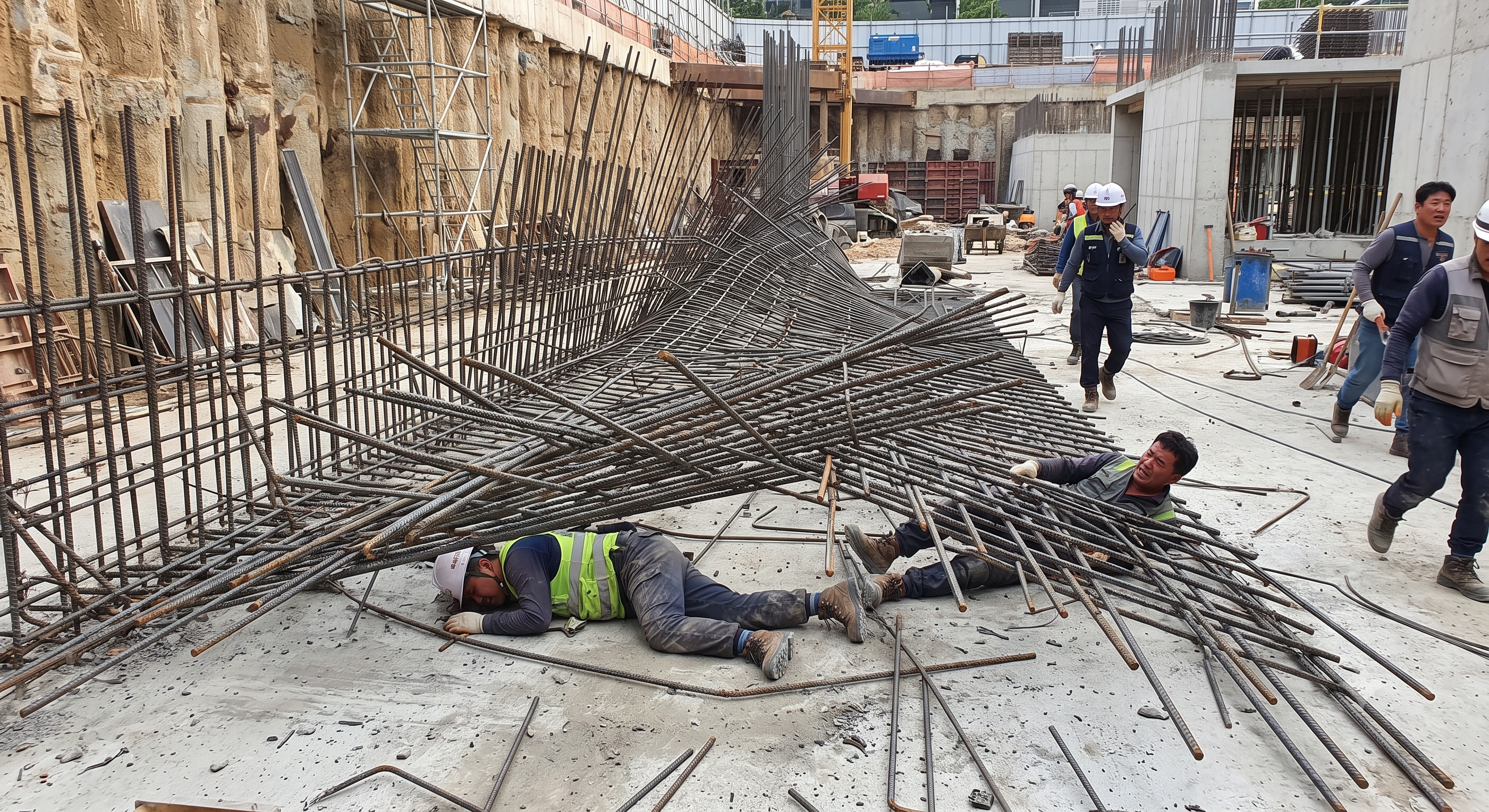
Retained educational illustration; not evidence of an actual incident.
The scenario and record comparisons are fictional teaching examples, not records of real incidents, measurements, inspections, signatures or approvals.
| Item | Fictional scenario |
|---|---|
| Initial situation | Fictional exercise: a reinforcement cage has been landed and tied while the crane remains connected. |
| Changed condition | A route change leads someone to propose removing a temporary brace before the next trade arrives. |
| Failure path | The crew treats tie-wire completion as evidence of temporary stability and asks to release the hook. |
| Possible outcome | The cage could move or collapse when crane restraint is removed; no actual incident, injury or successful rescue is asserted. |
| Prevention barrier | Hold the release, exclude the collapse zone and have the competent designer or designated checker verify the support arrangement and any change. |
Failure mechanisms
Tie wire normally maintains reinforcement position; it is not automatically a designed brace or lifting attachment. Temporary stability depends on the complete load path, base, anchors, bracing, connections and construction stage. Wind on attached screens or formwork can change loading substantially. A single idealised column formula or a blanket height threshold does not validate a cage.
A bender can sweep a long free bar end even when the operator is beside the controls. Guard the tools and control the full sweep and feed areas. A stop button is not energy isolation; some machines return a roller after an emergency stop. Before clearing a jam or changing tools, follow the actual manual, isolate all relevant energy and verify safe state.
A highly visible end cap may reduce contact injury without resisting a fall onto a bar. Select a cap, trough or secured cover for the actual projection, fall path and required impact protection. Material colour, plastic construction or a metal insert alone does not prove suitability. Protect exposed ends wherever contact or impalement is foreseeable, including nonvertical projections.
Bundle flexibility, sling angles and centre of gravity affect lifting forces and stability. Packaging straps and tying wire are not certified lifting points. Keep people out of the suspended-load and collapse zones, and verify the designed support before unhooking. Do not remove braces merely because tying or inspection is finished.
Decision sequence
| Decision stage | What to verify |
|---|---|
| Known facts | Identify cage geometry, construction stage, supports, lifting method and actual machine. |
| Unresolved matters | Check design revision, equipment limits, access and protection evidence. |
| Reason to hold | Hold if a brace, anchor, guard or lifting point is unverified, or if conditions change. |
| Required evidence | Keep the area excluded and obtain the relevant competent design or equipment review. |
| Restart decision | Release only the checked stage; record outstanding restrictions and the separate authority for later support removal. |
5. Conditional decisions and common errors
| Condition | Action | Evidence | Proceed when |
|---|---|---|---|
| Brace removed | Hold crane release | Updated support check | Stability verified |
| Machine jam | Stop, isolate, verify | Isolation procedure | Safe access to jam |
| Cap uncertain | Prevent access or replace | Impact suitability | Protection verified |
| Wind/load change | Stop and review | Current design limits | Conditions accepted |
Similar situations, different decisions
The scenario and record comparisons are fictional teaching examples, not records of real incidents, measurements, inspections, signatures or approvals.
| Comparison | Situation A | Situation B |
|---|---|---|
| Tie / brace | Tie wire holds bar position | Designed support resists stage loads |
| Stop / isolate | Stop may leave stored energy | Isolation prevents hazardous movement |
| Visible / protective | A coloured cap marks an end | Rated protection suits the fall exposure |
6. Roles and responsibilities
| Role | Responsibility |
|---|---|
| Site supervisor | Coordinates delivery, exclusion zones, access, permits and handover restrictions. |
| Temporary works designer/checker | Defines construction-stage stability and reviews the installed support and changes within assigned authority. |
| Machine operator and lifting crew | Follow the actual equipment and lift plans, keep people clear and stop for unsafe conditions. |
| Receiving trade | Acknowledges defects, load limits, retained protection and the authority required for support removal. |
Supervision, records, handover
| Job stage | Technical and procedural controls | Site verification |
|---|---|---|
| Receive and store | 1. Confirm delivery and storage plan2. Record bundle identity and weight3. Assign unloading control | 1. Weight and storage capacity2. Supports and chocks3. Bar identity and defects |
| Cut and bend | 1. Record machine and manual2. Verify isolation competence3. Log defects before use | 1. Guarded operating method2. Bar sweep exclusion3. Isolation for adjustment |
| Lift the bundle | 1. Approve the lifting arrangement2. Record gear and lift points3. Assign signal and exclusion roles | 1. Lift plan and load identity2. Gear and attachment checks3. Landing support ready |
| Protect access and ends | 1. Record projection protection basis2. Check access and rescue plan3. Track displaced covers | 1. Access and fall protection2. Projection protection suitability3. Rescue and route clearance |
| Erect and brace | 1. Review installed bracing evidence2. Hold crane release until checked3. Refer changes to the designer | 1. Current erection sequence2. Braces and anchor evidence3. Wind and construction-stage loads |
| Hand over safely | 1. Record inspection and defects2. Transfer support restrictions3. Name support-removal authority | 1. Condition and drawing check2. Defect and change record3. Handover and open restrictions |
7. Hold points and record comparison
| Hold point | Evidence before release | Confirmation / approval |
|---|---|---|
| Start | Receiving and storing reinforcement, preparing cutting and bending equipment, processing bars, lifting bundles or cages, protecting access and projections, erecting and bracing, tying and handing over the assembly. | |
| HP-1 Cut and bend | Guarded operating method · Bar sweep exclusion · Offcut containment · Isolation for adjustment | |
| HP-2 Lift the bundle | Lift plan and load identity · Gear and attachment checks · Signals and weather limits · Landing support ready | |
| HP-3 Erect and brace | Current erection sequence · Braces and anchor evidence · Release authority at hold point · Wind and construction-stage loads | |
| HP-4 Hand over safely | Condition and drawing check · Defect and change record · Support-transfer authority · Handover and open restrictions |
Complete after actual checks. Recheck after changes, defects or shift handover.
Record comparison examples
The scenario and record comparisons are fictional teaching examples, not records of real incidents, measurements, inspections, signatures or approvals.
The boxes are static record prompts, not interactive or saved approvals. A tick does not establish suitability or permission to restart. Record the evidence, person, time and unresolved issues; retain the change history.
| Record type | Insufficient record | Record checklist |
|---|---|---|
| Cut and bend | Only “OK” | □ Guarded operating method□ Bar sweep exclusion□ Offcut containment□ Isolation for adjustment |
| Lift the bundle | Only “OK” | □ Lift plan and load identity□ Gear and attachment checks□ Signals and weather limits□ Landing support ready |
| Erect and brace | Only “OK” | □ Current erection sequence□ Braces and anchor evidence□ Release authority at hold point□ Wind and construction-stage loads |
| Hand over safely | Only “OK” | □ Condition and drawing check□ Defect and change record□ Support-transfer authority□ Handover and open restrictions |
8. Site checklist and emergency response
| Check item | Result | Person / action |
|---|---|---|
| □ Receive and store: Weight and storage capacity | ||
| □ Prepare the machine: Machine manual and capacity | ||
| □ Cut and bend: Guarded operating method | ||
| □ Lift the bundle: Lift plan and load identity | ||
| □ Protect access and ends: Access and fall protection | ||
| □ Erect and brace: Current erection sequence | ||
| □ Tie and inspect: Tie layout and cover | ||
| □ Hand over safely: Condition and drawing check | ||
| □ Release / handover authority |
Stop work
Stop for a missing guard, uncontrolled bar sweep, uncertain isolation, damaged lifting gear, people under a load, unstable storage, missing projection protection or any cage movement. Do not unhook while braces, anchors or release authority remain unverified. Stop and reassess changed wind, load or access conditions.
Emergency response
Move clear of the sweep, suspended-load or collapse zone and prevent entry. Use an accessible safe stop, then have authorised personnel isolate equipment. Do not enter beneath an unstable cage or improvise a stabilising lift. Call the site emergency response; rescue from height or impalement requires the planned trained response, with the structure made safe.
9. Sources and review limits
2026-10-11
| Source | Scope and limitations |
|---|---|
| WorkSafe Victoria: reinforcement collapse | Alert read: construction-stage support design, installed-condition checking and controlled changes. Victoria-specific context. |
| Safe Work Australia: plant model code | Official publication page identified; model-code status only, not a claim that the entire code or local adoption was checked. |
| BG BAU: Bewehrungsschutz | 2026 article read for projection protection options; foreign technical context, not a Canadian or Australian product certification. |
| Multiquip MB25A | Manufacturer product page for this electric bender only; not proof of the actual site machine. |
| Multiquip MB25A manual, Rev. 3 | Indexed page 8 excerpt on controls and roller return read. Direct PDF retrieval failed; complete manual not reviewed. |
This is reference content written and revised with AI. It has not been verified or approved by a professional. Review by a suitably qualified professional and site authorisation are required before use.
10. PDF guidance and FAQ
PDF A covers basic task controls; B focuses on technical failures; C covers supervision, records and handover. The article has eight stages with four items per main cell; each PDF has six key stages with three items per main cell. P/S/R/A, measurements, confirmations and signatures remain blank for actual site assessment.
Content group ID
jsa-rebar-work
Does completed tying prove stability?
No. Confirm the designed construction-stage support and connections before releasing the crane or allowing access.
Are all plastic caps unsuitable?
No. Suitability depends on the documented protection and exposure. A visibility cap alone is not proof of fall-impact protection.
Is emergency stop enough for a jam?
No. Follow the actual machine isolation procedure and verify stored energy and movement are controlled before intervention.
Can braces be removed before concrete work?
Only under the authorised support-transfer sequence. Pour readiness or a completed rebar inspection alone is insufficient.
Has a professional verified or approved this document?
No. Public sources and editorial, layout and consistency checks were reviewed using AI. No site inspection or professional technical approval has been performed. Obtain appropriate professional review before use.
11. Revision history and authorship
This is reference content written and revised with AI. It has not been verified or approved by a professional. Review by a suitably qualified professional and site authorisation are required before use.
| Date | Version | Change | Review status |
|---|---|---|---|
| 2026-07-22 | Original version unmarked | Original preserved | No professional approval |
| 2026-10-11 | 1.1 | Decisions, records, JSA and PDFs revised | No professional approval |
Retained unloading, stock restraint, guards, lifting exclusion, access, end protection, ties and housekeeping. Replaced the unsupported local incident narrative with a clearly fictional decision exercise. Removed universal height, platform-width, lighting, stack-height, anchor-force and cap drop-test numbers that were not verified for the jurisdiction and actual equipment. Added construction-stage design, isolation verification, full bar sweep, ergonomic tying and explicit support-transfer authority.