A mobile tower is released for one identified configuration and location. A green tag, engaged brakes or a familiar height ratio alone does not prove stability. This revision retains component inspection, bracing, edge protection and empty relocation, while separating the controls for erection, use, movement and dismantling.
Verify configuration and support before access
This is reference content written and revised with AI. It has not been verified or approved by a professional. Review by a suitably qualified professional and site authorisation are required before use.
Stop work
Stop for missing or damaged parts, failed brakes, unsettled base, incomplete edge protection, unknown configuration, excessive wind, unintended movement or unassessed side loading. Do not compensate by climbing outside, adding a ladder or hanging improvised ballast. Correct and reinspect before reuse.
1. Legal and technical scope
| Basis | Application limits |
|---|---|
| Safe Work Australia - Tower and mobile scaffolds | Official guidance: model configuration and licensing based on potential fall distance; use local regulator requirements. |
| Safe Work Australia - Scaffolding | Official overview of licensing and high-risk construction work; not approval for this site. |
Check the state or territory implementation and site work classification. Safe Work Australia publishes guidance; it is not the local enforcement authority. Required competence, licensing and any SWMS must be determined for the actual work.
The SWA tower/mobile information sheet and scaffolding topic were read. The licensing example uses a possible fall exceeding 4 m from the platform or structure, so a lower tower next to an excavation can still trigger it. Original wording based only on tower height and a typical indoor 3:1 ratio is not retained as universal permission. Paid AS/NZS text and actual model instructions were not reviewed.
2. Scope and required inputs
Included scope
Prefabricated manually moved access towers assembled from compatible parts, used within their documented height and load limits, relocated without occupants or materials, and dismantled by a protected sequence. Determine whether a tower is the right access method for the task.
Separate review
Powered movement, occupied movement, bridging towers, crane-lifting an assembled tower, sheeting, cantilevers, missing components and nonstandard structural alterations require separate assessment; this guide does not release them.
| Required input | What to verify |
|---|---|
| Select tower | Model identifier · Parts inventory · Configuration drawing · Load and height limits |
| Check site | Floor assessment · Opening protection · Service clearance · Route survey |
| Set base | Level check · Brake function · Stabiliser layout · Jack and stem check |
| Fit platform | Deck seating · Edge protection · Internal ladder · Hatch function |
| Inspect and use | Inspection record · People and load plan · Task side forces · Weather and sheeting |
| Relocate empty | Empty-platform check · Movement configuration · Travel route · New-position inspection |
Use the actual model manual and applicable local rules for stabilisers, ballast, ties, load, maximum height, wind and moving configuration. A generic 3:1 or 4:1 ratio cannot replace the complete permitted configuration. Never assume the tower is a suitable fall-arrest anchor.
Select head protection, slip-resistant footwear and handling gloves for the assessed task. PPE does not replace a protected platform or safe erection sequence. Any personal fall protection must have a suitable assessed anchorage and rescue arrangement; never assume a guardrail can arrest a fall.
3. Eight-stage JSA
| Job stage | Hazards and effects | Failure factors | Technical and procedural controls | Site verification | P | S | R | A |
|---|---|---|---|---|---|---|---|---|
| 1. Select tower | 1. Wrong system2. Excess height3. Side loading4. Missing parts | 1. Mixed components2. Unknown model3. Wrong configuration4. Generic ratio | 1. Identify tower model2. Use matching parts3. Confirm load and height4. Obtain assembly manual | 1. Model identifier2. Parts inventory3. Configuration drawing4. Load and height limits | ||||
| 2. Check site | 1. Settlement2. Wheel drop3. Power contact4. Traffic impact | 1. Weak floor2. Uncovered opening3. Overhead services4. Unsegregated route | 1. Assess floor capacity2. Protect floor openings3. Check service clearance4. Separate work and traffic | 1. Floor assessment2. Opening protection3. Service clearance4. Route survey | ||||
| 3. Set base | 1. Unintended rolling2. Overturning3. Base slip4. Uneven loading | 1. Brake failure2. Missing stabiliser3. Loose wheel stem4. Excess jack extension | 1. Level approved base2. Lock wheel mechanisms3. Fit specified stabilisers4. Secure wheel stems | 1. Level check2. Brake function3. Stabiliser layout4. Jack and stem check | ||||
| 4. Erect frames | 1. Erector fall2. Frame collapse3. Dropped brace4. Pinched hand | 1. Unguarded erection2. Missing diagonal3. Loose joint lock4. Premature access | 1. Follow protected sequence2. Fit all required braces3. Engage joint locks4. Control component transfer | 1. Erection method2. Brace layout3. Joint lock check4. Exclusion zone | ||||
| 5. Fit platform | 1. Edge fall2. Hatch fall3. Dropped tool4. Access fall | 1. Unseated deck2. Missing guardrail3. Unsecured hatch4. Outside climbing | 1. Secure deck units2. Fit rails and toe boards3. Use internal access4. Manage hatch closure | 1. Deck seating2. Edge protection3. Internal ladder4. Hatch function | ||||
| 6. Inspect and use | 1. Overturning2. Overload3. Tool reaction4. Wind loading | 1. Excess reach2. Stockpiled material3. Unassessed side force4. Added sheeting | 1. Inspect before use2. Keep within load limit3. Avoid overreaching4. Stop outside wind limits | 1. Inspection record2. People and load plan3. Task side forces4. Weather and sheeting | ||||
| 7. Relocate empty | 1. Occupant fall2. Tower overturning3. Collision4. Wheel impact | 1. Person still aloft2. Obstructed route3. Excess moving height4. Pushing high on frame | 1. Empty platform first2. Prepare permitted height3. Move from low position4. Relevel and relock | 1. Empty-platform check2. Movement configuration3. Travel route4. New-position inspection | ||||
| 8. Dismantle | 1. Dismantler fall2. Frame instability3. Falling parts4. Defective reuse | 1. Early rail removal2. Wrong brace sequence3. Thrown components4. Damage unrecorded | 1. Follow protected sequence2. Retain needed stability3. Lower parts controllably4. Segregate damaged parts | 1. Dismantling plan2. Remaining supports3. Lowering arrangement4. Damage and storage log |
PDF A covers basic task controls; B focuses on technical failures; C covers supervision, records and handover. The article has eight stages with four items per main cell; each PDF has six key stages with three items per main cell. P/S/R/A, measurements, confirmations and signatures remain blank for actual site assessment.
4. Fictional scenario and failure mechanisms
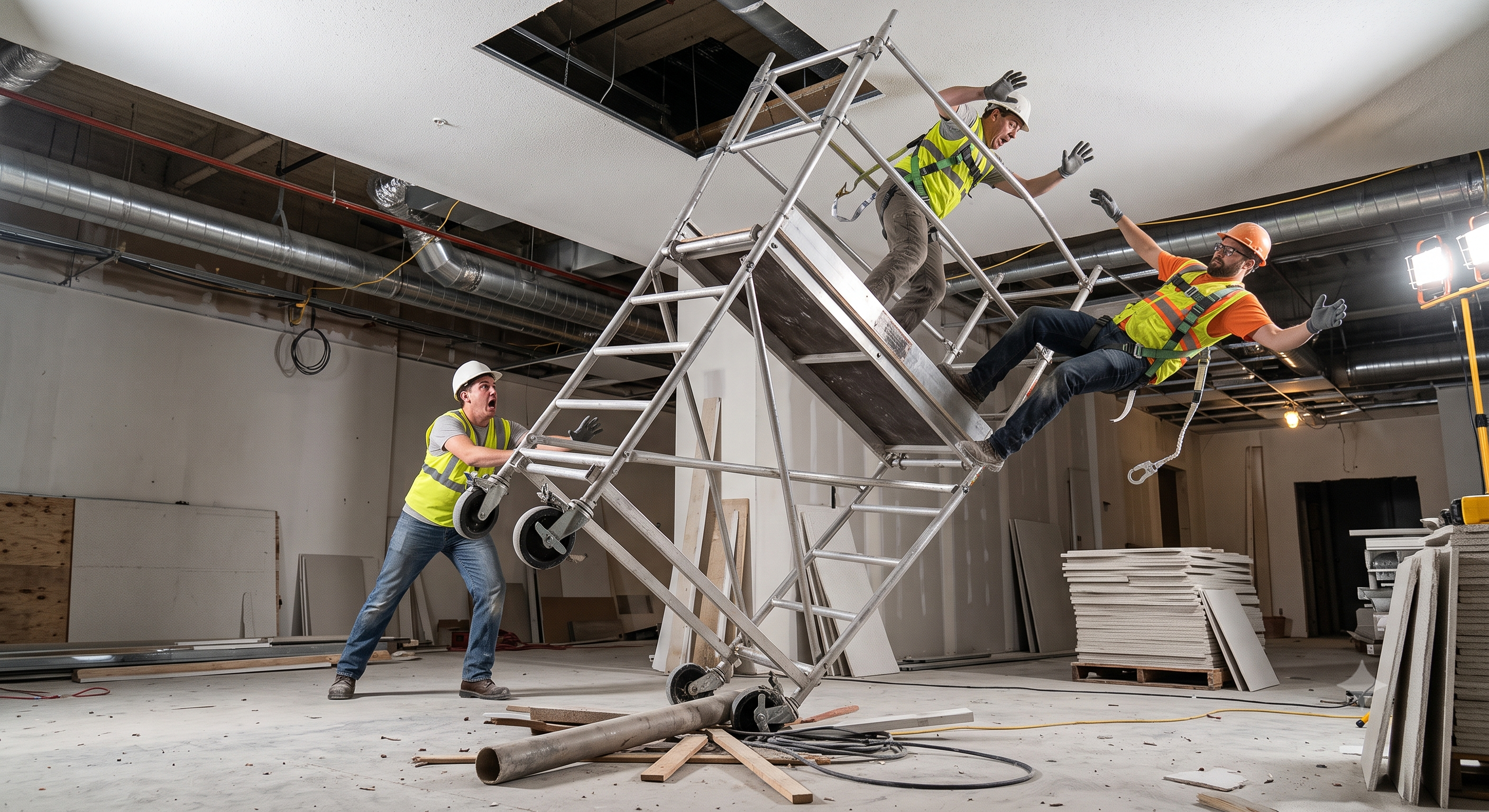
Retained AI-generated educational illustration; not an actual incident photograph.
The scenario and record comparisons are fictional teaching examples, not records of real incidents, measurements, inspections, signatures or approvals.
| Item | Fictional scenario |
|---|---|
| Initial situation | A crew proposes pushing a tower to the next ceiling bay while tools remain above. |
| Changed condition | The route looks level but a wheel path crosses a floor opening and debris. |
| Failure path | The stabiliser layout and permitted moving height have not been checked against the model manual. |
| Possible outcome | The move is held: unload, inspect the whole route and establish the permitted moving configuration. |
| Prevention barrier | After movement, level, lock, restore specified stabilisers and inspect before anyone climbs. No actual movement, injury or approval is asserted. |
Failure mechanisms
Brakes resist rolling but do not widen the support base or prevent every overturning mode. Bracing and stabilisers perform different functions.
A wheel striking a small obstacle produces an abrupt change of motion; an elevated load and a high pushing point increase the overturning tendency.
A guardrail fitted after a worker stands on an open platform does not protect the preceding erection step. Use a protected assembly and dismantling method for the model.
Sheeting, pushing tools and stored materials can change wind area, lateral force or load distribution. Reassess the configuration when the task or location changes.
Decision sequence
| Decision stage | What to verify |
|---|---|
| Known facts | Identify model, parts, platform height and total intended load before choosing the layout. |
| Unresolved matters | Confirm floor support, openings, traffic and overhead services at both the working position and travel route. |
| Reason to hold | Check the protected erection sequence, all braces, joint locks, internal access and edge protection. |
| Required evidence | Release use only with the completed configuration and a real inspection; stop if wind, load or condition changes. |
| Restart decision | Treat relocation as a separate hold point: empty, configure, move, relevel, relock and reinspect. |
5. Conditional decisions and common errors
| Condition | Action | Evidence | Proceed when |
|---|---|---|---|
| Model or height unknown | Obtain the matching manual and configuration | Model label, parts list and height limits | Configuration confirmed |
| Brake locked; stabiliser unclear | Check the complete base arrangement | Brake test and stabiliser layout | Base arrangement verified |
| Move requested while occupied | Clear people and materials; inspect route | Empty-platform check and route record | Tower empty; route ready |
| Wind or side load changed | Stop and reassess use limits | Weather, task forces and model limits | Conditions within verified limits |
Similar situations, different decisions
The scenario and record comparisons are fictional teaching examples, not records of real incidents, measurements, inspections, signatures or approvals.
| Comparison | Situation A | Situation B |
|---|---|---|
| Stability | Brakes engaged only | Base, braces and stabilisers checked |
| Erection | Rails planned for later | Protection maintained during assembly |
| Relocation | Same tag retained | New position and configuration checked |
6. Roles and responsibilities
| Role | Responsibility |
|---|---|
| Work supervisor | Provide the correct tower and manual; authorise the actual configuration and task interfaces. |
| Technical reviewer | Supervise protected erection and dismantling; control exclusion, component transfer and the empty-move hold point. |
| Work crew | Assemble compatible parts in order, engage locks, use internal access and report defects. |
| Inspector / assessor | Inspect the installed arrangement and assess wind, load, side forces and any proposed change. |
| Release / handover authority | Accept the actual inspection and handover records; ensure damaged parts are segregated before reuse. |
Supervision, records, handover
| Job stage | Technical and procedural controls | Site verification |
|---|---|---|
| Select tower | 1. Approve model configuration2. Record load limits3. Resolve missing parts | 1. Model identifier2. Parts inventory3. Configuration drawing |
| Check site | 1. Confirm floor capacity2. Assign route control3. Resolve overhead services | 1. Floor assessment2. Opening protection3. Service clearance |
| Erect frames | 1. Assign competent erection2. Witness joint locks3. Keep erection exclusion | 1. Erection method2. Brace layout3. Joint lock check |
| Fit platform | 1. Verify protected access2. Record edge completion3. Release the platform | 1. Deck seating2. Edge protection3. Internal ladder |
| Relocate empty | 1. Authorise empty move2. Record moving configuration3. Inspect new position | 1. Empty-platform check2. Movement configuration3. Travel route |
| Dismantle | 1. Approve dismantling order2. Control component lowering3. Record rejected parts | 1. Dismantling plan2. Remaining supports3. Lowering arrangement |
7. Hold points and record comparison
| Hold point | Evidence before release | Confirmation / approval |
|---|---|---|
| Start | Prefabricated manually moved access towers assembled from compatible parts, used within their documented height and load limits, relocated without occupants or materials, and dismantled by a protected sequence. Determine whether a tower is the right access method for the task. | |
| HP-1 Set base | Level check · Brake function · Stabiliser layout · Jack and stem check | |
| HP-2 Fit platform | Deck seating · Edge protection · Internal ladder · Hatch function | |
| HP-3 Relocate empty | Empty-platform check · Movement configuration · Travel route · New-position inspection | |
| HP-4 Dismantle | Dismantling plan · Remaining supports · Lowering arrangement · Damage and storage log |
Complete after actual checks. Recheck after changes, defects or shift handover.
Record comparison examples
The scenario and record comparisons are fictional teaching examples, not records of real incidents, measurements, inspections, signatures or approvals.
The boxes are static record prompts, not interactive or saved approvals. A tick does not establish suitability or permission to restart. Record the evidence, person, time and unresolved issues; retain the change history.
| Record type | Insufficient record | Record checklist |
|---|---|---|
| Model | Only marked OK | □ Model identifier□ Parts inventory□ Configuration drawing□ Load and height limits |
| Base | Only marked OK | □ Level check□ Brake function□ Stabiliser layout□ Jack and stem check |
| Move | Only marked OK | □ Empty-platform check□ Movement configuration□ Travel route□ New-position inspection |
| Handover | Only marked OK | □ Dismantling plan□ Remaining supports□ Lowering arrangement□ Damage and storage log |
8. Site checklist and emergency response
| Check item | Result | Person / action |
|---|---|---|
| □ Select tower: Model identifier | ||
| □ Check site: Floor assessment | ||
| □ Set base: Level check | ||
| □ Erect frames: Erection method | ||
| □ Fit platform: Deck seating | ||
| □ Inspect and use: Inspection record | ||
| □ Relocate empty: Empty-platform check | ||
| □ Dismantle: Dismantling plan | ||
| □ Release / handover authority |
Stop work
Stop for missing or damaged parts, failed brakes, unsettled base, incomplete edge protection, unknown configuration, excessive wind, unintended movement or unassessed side loading. Do not compensate by climbing outside, adding a ladder or hanging improvised ballast. Correct and reinspect before reuse.
Emergency response
Keep clear of an unstable tower and isolate the area. Raise the alarm and arrange rescue from height under the site plan; do not climb or pull a leaning structure to reach a casualty. For electrical contact, keep people away and have the electrical supply made safe before rescue.
9. Sources and review limits
2026-10-11
| Source | Scope and limitations |
|---|---|
| Safe Work Australia - Tower and mobile scaffolds | Official guidance: model configuration and licensing based on potential fall distance; use local regulator requirements. |
| Safe Work Australia - Scaffolding | Official overview of licensing and high-risk construction work; not approval for this site. |
This is reference content written and revised with AI. It has not been verified or approved by a professional. Review by a suitably qualified professional and site authorisation are required before use.
10. PDF guidance and FAQ
PDF A covers basic task controls; B focuses on technical failures; C covers supervision, records and handover. The article has eight stages with four items per main cell; each PDF has six key stages with three items per main cell. P/S/R/A, measurements, confirmations and signatures remain blank for actual site assessment.
Content group ID
jsa-prefab-scaffold
Is a locked brake enough?
No. Check ground, level, bracing, stabilisers and permitted configuration as separate conditions.
Does a green tag prove the current setup?
No. It is a record indicator; changes, defects and the new location require the applicable checks.
Can a harness be clipped to any tower rail?
No. Anchorage suitability, fall clearance, rescue and the model restrictions need separate competent assessment.
Can we move it with someone on board?
This task is limited to empty relocation. Any legal exception is outside this generic procedure and is not authorised here.
Has a professional verified or approved this document?
No. Public sources and editorial, layout and consistency checks were reviewed using AI. No site inspection or professional technical approval has been performed. Obtain appropriate professional review before use.
11. Revision history and authorship
This is reference content written and revised with AI. It has not been verified or approved by a professional. Review by a suitably qualified professional and site authorisation are required before use.
| Date | Version | Change | Review status |
|---|---|---|---|
| 2026-09-06 | Original version unmarked | Original preserved | No professional approval |
| 2026-10-11 | 1.1 | Decisions, records, JSA and PDFs revised | No professional approval |
The useful component, access, bracing, edge and empty-movement controls are retained. Unsupported compliance guarantees, invented investigation outcomes, universal ratios, fixed component counts and automatic residual-risk acceptance are corrected; actual records remain blank.