Record the state or territory and review the SWMS with the crew before work involving mobile plant. Queensland guidance is identified separately below. Land-based driven piles and bored/CFA piles, with separate method branches. Confirm rig configuration, services and the platform before assembly; verify each method's controls before starting its cycle.
Release platform / Drill and clear spoil / Park and hand over
This is reference content written and revised with AI. It has not been verified or approved by a professional. Review by a suitably qualified professional and site authorisation are required before use.
Stop work
Stop for settlement, unexpected tilt, lost signals, unknown services, guard failure, unstable pile, damaged pressure lines, uncontained spoil or a person in the danger zone. Do not attempt to regain stability by an improvised slew or reverse movement.
1. Legal and technical scope
| Basis | Application limits |
|---|---|
| WHS Queensland: Mobile piling rig alert | Primary regulator guidance on stability, travel and competence. Its real 2018 incident is not the unverified incident in the original article. |
| Safe Work Australia: Construction work model code, Nov 2024 | Model guidance on HRCW and SWMS; verify adoption and local law. |
| FPS: Working platform FAQ | UK industry reference on actual rig pressures and designed platforms; technical reference, not Australian law. |
Apply the actual state or territory WHS law. Safe Work Australia model codes are not automatically the enacted law everywhere. Work involving moving powered mobile plant can trigger HRCW/SWMS duties; the method and jurisdiction must be recorded. Queensland's piling alert addresses ground, travel and crane-mode competence. A WPC is useful project evidence, not a universal statutory certificate proving every condition. BYDA enquiry does not itself prove service location; local notice periods and owner requirements apply. AS 4991/2759 full texts were not reviewed.
2. Scope and required inputs
Included scope
Land-based driven piles and bored/CFA piles, with separate method branches. Confirm rig configuration, services and the platform before assembly; verify each method's controls before starting its cycle.
Separate review
Does not authorize marine piling, explosives, entry into a bore, work on live services or an engineered platform design. Reinforcement cage lifting and any special extraction operation require a separate detailed lift/method plan.
| Required input | What to verify |
|---|---|
| Plan and locate | Owner responses · Method and rig limits · Exclusion layout · Service and overhead-line restrictions |
| Release platform | Rig load cases · Platform condition · Drainage and boundaries · Repair record and release |
| Assemble and test | Pins and retainers · Brake and limit checks · Energy isolation · Fall protection and rescue |
| Drill and clear spoil | Guard function · Spoil discharge zone · Bore protection · Residual motion controlled |
| Pump concrete or grout | Couplings and restraints · Pressure limits · Wash and spill provisions · Leak isolation procedure |
| Pitch and drive piles | Rigging and pile support · Hammer blocks and stops · Alignment and vibration · Signals and exclusion maintained |
| Crop and handle heads | Lift and cut sequence · Drive stop confirmation · Cutter condition · Rebar and fragment controls |
| Park and hand over | Parking configuration · Openings and stored tools · Next-shift restrictions · Route handed to next operator |
Actual rig load cases, ground investigation, platform dimensions, lifting attachments and pressure-line specifications must be supplied for the selected method. Assess noise, vibration and flying fragments; use engineering controls and exclusion first, with suitable eye and hearing protection for remaining exposure. This reference contains no measured site values or completed approvals.
3. Eight-stage JSA
| Job stage | Hazards and effects | Failure factors | Technical and procedural controls | Site verification | P | S | R | A |
|---|---|---|---|---|---|---|---|---|
| 1. Plan and locate | 1. Utility strike2. Overhead contact3. Public intrusion4. Striking buried services (gas mains, electric cables) with auger drill bit due to outdated utility plans | 1. Unproved service route2. Wrong rig configuration3. Shared access uncontrolled4. Unresolved asset-owner conditions | 1. Verify services before penetration2. Select the actual piling method3. Separate plant and pedestrian routes4. Confirm overhead-line arrangements | 1. Owner responses2. Method and rig limits3. Exclusion layout4. Service and overhead-line restrictions | ||||
| 2. Release platform | 1. Rig overturn2. Track punch-through3. Edge collapse4. Equipment tip-over or rollover during assembly due to soft ground or inadequate mat support | 1. Design omits operating loads2. Soft patch beneath mats3. Drainage or edge altered4. Mat layout changed without review | 1. Use site-specific platform design2. Inspect travel and setup areas3. Reassess after ground changes4. Control platform repairs and edges | 1. Rig load cases2. Platform condition3. Drainage and boundaries4. Repair record and release | ||||
| 3. Assemble and test | 1. Falling mast2. Hammer descent3. Stored-energy release4. Rigging hardware failure or dropped components during crane-assisted leader assembly | 1. Temporary pins missing2. Hoist or brake defect3. Unsupported raised parts4. Unsafe access for connection work | 1. Follow erection sequence2. Test guards and safety functions3. Block and isolate for access4. Provide protected mast access | 1. Pins and retainers2. Brake and limit checks3. Energy isolation4. Fall protection and rescue | ||||
| 4. Drill and clear spoil | 1. Auger entanglement2. Flying spoil3. Fall into bore4. Worker entanglement in rotating auger flights, kelly bars, or winch drums during drilling | 1. Reach into rotating flights2. Unsafe spin-off method3. Open bore left unguarded4. Emergency stop mistaken for isolation | 1. Prevent access to rotation2. Use specified spoil removal3. Guard unattended bores4. Isolate before tool changes | 1. Guard function2. Spoil discharge zone3. Bore protection4. Residual motion controlled | ||||
| 5. Pump concrete or grout | 1. Hose whip2. Pressure injection3. Cement burns4. High-pressure concrete delivery hose whip or coupling failure causing severe impact injuries | 1. Mismatched line components2. Coupling opened under pressure3. Blockage cleared unsafely4. Hands used to find pressure leak | 1. Use rated compatible lines2. Isolate and verify zero pressure3. Follow pump clearing procedure4. Keep hands away from suspected leaks | 1. Couplings and restraints2. Pressure limits3. Wash and spill provisions4. Leak isolation procedure | ||||
| 6. Pitch and drive piles | 1. Dropped pile2. Crushing at leader3. Flying fragments and noise4. Dropped pile hazard caused by rigging slip, shackle failure, or wire rope snapping during hoisting | 1. Wrong lifting attachment2. Pile unstable before release3. Damaged cap or cushion4. Hands used to guide the pile butt | 1. Use planned pile lifting points2. Secure pile before unhooking3. Monitor driving and isolate zone4. Keep hands clear of pile guides | 1. Rigging and pile support2. Hammer blocks and stops3. Alignment and vibration4. Signals and exclusion maintained | ||||
| 7. Crop and handle heads | 1. Falling cut-off2. Silica and fragments3. Crushing by cutter4. Struck-by or crush injuries during mechanical pile head trimming and handling of concrete debris | 1. Section not supported2. Driving continues nearby3. People enter cropper envelope4. Unsupported debris removal | 1. Support section before severing2. Suspend conflicting driving3. Control dust and debris4. Plan reinforcement and sharp-end protection | 1. Lift and cut sequence2. Drive stop confirmation3. Cutter condition4. Rebar and fragment controls | ||||
| 8. Park and hand over | 1. Unsecured bore2. Unexpected movement3. Unsafe next setup4. Struck-by or crush injuries during mechanical pile head trimming and handling of concrete debris | 1. Hammer left unsupported2. Platform damage unreported3. Stored tools can roll4. Move started without route release | 1. Secure hammer and attachments2. Protect bores and travel route3. Record defects before handover4. Reassess the next travel route | 1. Parking configuration2. Openings and stored tools3. Next-shift restrictions4. Route handed to next operator |
PDF A covers basic task controls; B focuses on technical failures; C covers supervision, records and handover. The article has eight stages with four items per main cell; each PDF has six key stages with three items per main cell. P/S/R/A, measurements, confirmations and signatures remain blank for actual site assessment.
4. Fictional scenario and failure mechanisms
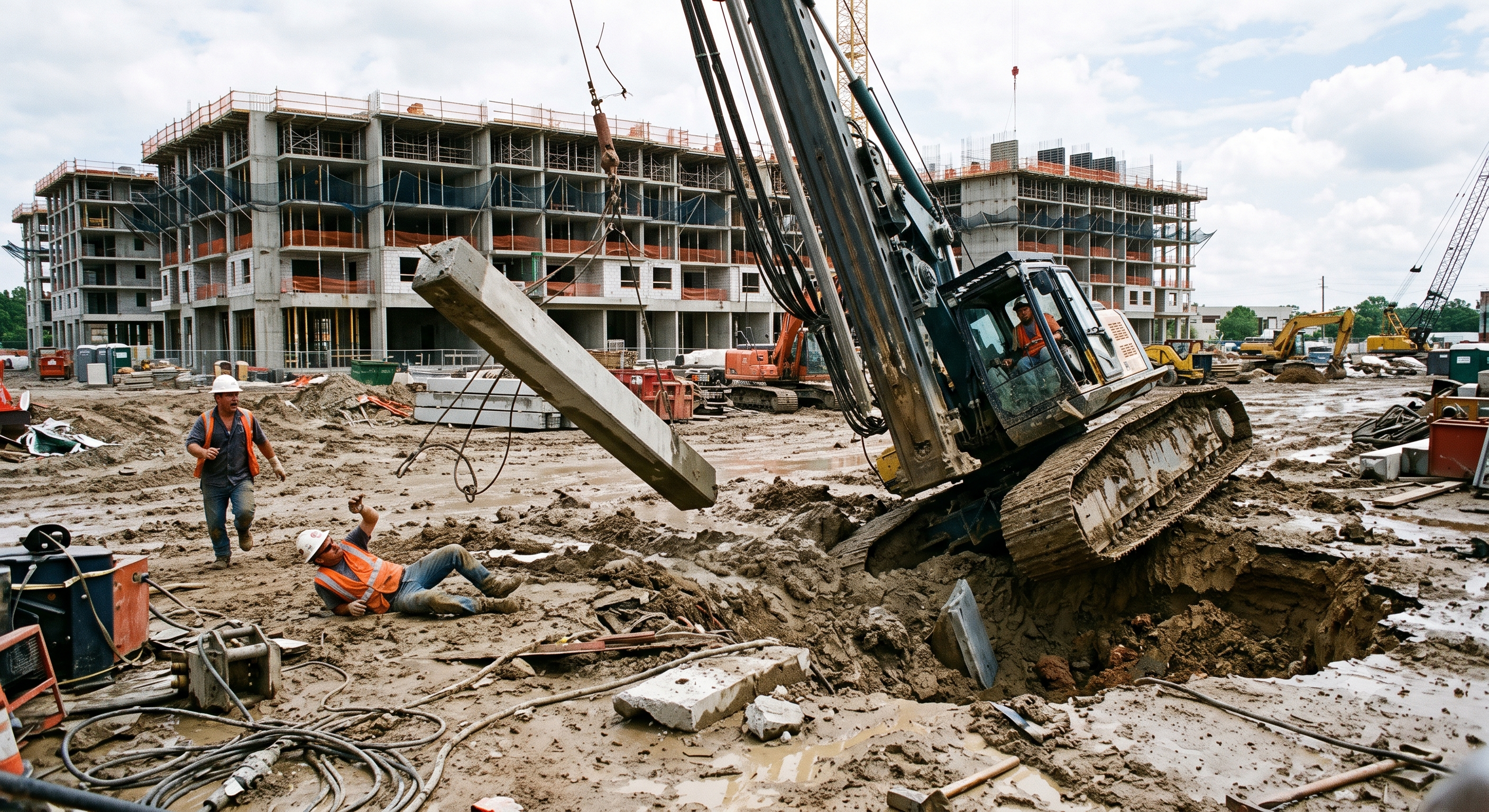
The original educational image is retained. It is not evidence of an actual incident or site suitability. The production method, including possible AI generation, and any real-incident origin have not been verified.
The scenario and record comparisons are fictional teaching examples, not records of real incidents, measurements, inspections, signatures or approvals.
| Item | Fictional scenario |
|---|---|
| Initial situation | A crew is ready to start a new pile after rain. |
| Changed condition | The original platform certificate exists, but a service trench has since crossed the travel route. |
| Failure path | The foreman treats the certificate and a level mast display as permission to proceed. |
| Possible outcome | An unassessed patch could yield during travel or lifting, changing the load distribution and destabilising the rig. No actual accident or investigation is claimed. |
| Prevention barrier | Hold the move; have the changed platform assessed, restore the designed arrangement, record inspection and release the specific rig route and configuration. |
Failure mechanisms
Platform pressure changes with mast position, suspended load, slew and travel. Total weight divided by track area is only an average; it does not prove resistance to edge failure, weak layers or punching. A plate test and an inclinometer alone do not validate every operating load case.
A rotating auger can draw in clothing before a person can react. A trip wire is a stopping device, not automatically a substitute for access prevention. Tool changing and manual cleaning require isolation and control of residual movement; use the rig-specific guarding and operating modes.
A blocked delivery line can retain pressure after the pump stops. Restraints limit hose movement but do not repair a worn coupling or make opening it safe. Isolate, release and verify pressure by the manufacturer's method before disconnection. Driving and CFA pumping are different branches, not compulsory sequential steps for one pile.
Decision sequence
| Decision stage | What to verify |
|---|---|
| Known facts | Select driven or bored/CFA work and identify all buried and overhead services, traffic interfaces and neighbouring assets. |
| Unresolved matters | Match platform evidence to the actual rig load cases and travel route. A certificate predating repairs does not release the altered area. |
| Reason to hold | Verify erection, brakes, guards, lifting attachments and the method branch. Reject defective parts before the first cycle. |
| Required evidence | For CFA, control rotation, spoil and pressure. For driving, secure the pile, check hammer protection and monitor ground response. Stop if people enter the danger zone. |
| Restart decision | At completion protect bores, secure hammer and tools, separate cropping from driving, and hand over restrictions and unresolved defects to the next shift. |
5. Conditional decisions and common errors
| Condition | Action | Evidence | Proceed when |
|---|---|---|---|
| Design omits operating loads | Use site-specific platform design | Rig load cases / Platform condition | Current platform matches rig load cases |
| Reach into rotating flights | Prevent access to rotation | Guard function / Spoil discharge zone | Rotation guarded and bore protected |
| Mismatched line components | Use rated compatible lines | Couplings and restraints / Pressure limits | Compatible line; zero pressure before opening |
| Wrong lifting attachment | Use planned pile lifting points | Rigging and pile support / Hammer blocks and stops | Pile secured before rigging release |
| Hammer left unsupported | Secure hammer and attachments | Parking configuration / Openings and stored tools | Hammer secured; bores protected |
Similar situations, different decisions
The scenario and record comparisons are fictional teaching examples, not records of real incidents, measurements, inspections, signatures or approvals.
| Comparison | Situation A | Situation B |
|---|---|---|
| Release platform | Design omits operating loads | Use site-specific platform design |
| Drill and clear spoil | Reach into rotating flights | Prevent access to rotation |
| Pump concrete or grout | Mismatched line components | Use rated compatible lines |
| Pitch and drive piles | Wrong lifting attachment | Use planned pile lifting points |
6. Roles and responsibilities
| Role | Responsibility |
|---|---|
| Work supervisor | Select driven or bored/CFA work and identify all buried and overhead services, traffic interfaces and neighbouring assets. At completion protect bores, secure hammer and tools, separate cropping from driving, and hand over restrictions and unresolved defects to the next shift. |
| Technical reviewer | Verify erection, brakes, guards, lifting attachments and the method branch. Reject defective parts before the first cycle. |
| Work crew | Match platform evidence to the actual rig load cases and travel route. A certificate predating repairs does not release the altered area. |
| Inspector / assessor | For CFA, control rotation, spoil and pressure. For driving, secure the pile, check hammer protection and monitor ground response. Stop if people enter the danger zone. |
Supervision, records, handover
| Job stage | Technical and procedural controls | Site verification |
|---|---|---|
| Plan and locate | 1. Assign service liaison2. Record method selection3. Brief exclusion and stop signals | 1. Owner responses2. Method and rig limits3. Exclusion layout |
| Release platform | 1. Accept rig load data2. Log platform alterations3. Release only inspected areas | 1. Rig load cases2. Platform condition3. Drainage and boundaries |
| Assemble and test | 1. Record erection inspection2. Quarantine defective rigging3. Assign isolation authority | 1. Pins and retainers2. Brake and limit checks3. Energy isolation |
| Drill and clear spoil | 1. Witness guard checks2. Control access requests3. Record bore protection | 1. Guard function2. Spoil discharge zone3. Bore protection |
| Pump concrete or grout | 1. Verify line compatibility2. Approve blockage procedure3. Record pressure-line defects | 1. Couplings and restraints2. Pressure limits3. Wash and spill provisions |
| Park and hand over | 1. Confirm hammer secured2. Record open bore locations3. Hand over next-shift limits | 1. Parking configuration2. Openings and stored tools3. Next-shift restrictions |
7. Hold points and record comparison
| Hold point | Evidence before release | Confirmation / approval |
|---|---|---|
| Start | Land-based driven piles and bored/CFA piles, with separate method branches. Confirm rig configuration, services and the platform before assembly; verify each method's controls before starting its cycle. | |
| HP-1 Release platform | Rig load cases · Platform condition · Drainage and boundaries · Repair record and release | |
| HP-2 Assemble and test | Pins and retainers · Brake and limit checks · Energy isolation · Fall protection and rescue | |
| HP-3 Pump concrete or grout | Couplings and restraints · Pressure limits · Wash and spill provisions · Leak isolation procedure | |
| HP-4 Park and hand over | Parking configuration · Openings and stored tools · Next-shift restrictions · Route handed to next operator |
Complete after actual checks. Recheck after changes, defects or shift handover.
Record comparison examples
The scenario and record comparisons are fictional teaching examples, not records of real incidents, measurements, inspections, signatures or approvals.
The boxes are static record prompts, not interactive or saved approvals. A tick does not establish suitability or permission to restart. Record the evidence, person, time and unresolved issues; retain the change history.
| Record type | Insufficient record | Record checklist |
|---|---|---|
| Release platform | Recorded only: checked and safe | □ Rig load cases□ Platform condition□ Drainage and boundaries□ Repair record and release |
| Drill and clear spoil | Recorded only: checked and safe | □ Guard function□ Spoil discharge zone□ Bore protection□ Residual motion controlled |
| Pump concrete or grout | Recorded only: checked and safe | □ Couplings and restraints□ Pressure limits□ Wash and spill provisions□ Leak isolation procedure |
| Pitch and drive piles | Recorded only: checked and safe | □ Rigging and pile support□ Hammer blocks and stops□ Alignment and vibration□ Signals and exclusion maintained |
8. Site checklist and emergency response
| Check item | Result | Person / action |
|---|---|---|
| □ Plan and locate: Owner responses | ||
| □ Release platform: Rig load cases | ||
| □ Assemble and test: Pins and retainers | ||
| □ Drill and clear spoil: Guard function | ||
| □ Pump concrete or grout: Couplings and restraints | ||
| □ Pitch and drive piles: Rigging and pile support | ||
| □ Crop and handle heads: Lift and cut sequence | ||
| □ Park and hand over: Parking configuration | ||
| □ Release / handover authority |
Stop work
Stop for settlement, unexpected tilt, lost signals, unknown services, guard failure, unstable pile, damaged pressure lines, uncontained spoil or a person in the danger zone. Do not attempt to regain stability by an improvised slew or reverse movement.
Emergency response
Raise the alarm, keep people outside the collapse or pressure-release area and call the site rescue team. Do not approach a tilted rig, suspended pile or pressurised coupling. Emergency stopping does not establish isolation; specialist stabilisation and a recorded release are needed before recovery.
9. Sources and review limits
2026-10-08
| Source | Scope and limitations |
|---|---|
| WHS Queensland: Mobile piling rig alert | Primary regulator guidance on stability, travel and competence. Its real 2018 incident is not the unverified incident in the original article. |
| Safe Work Australia: Construction work model code, Nov 2024 | Model guidance on HRCW and SWMS; verify adoption and local law. |
| FPS: Working platform FAQ | UK industry reference on actual rig pressures and designed platforms; technical reference, not Australian law. |
This is reference content written and revised with AI. It has not been verified or approved by a professional. Review by a suitably qualified professional and site authorisation are required before use.
10. PDF guidance and FAQ
PDF A covers basic task controls; B focuses on technical failures; C covers supervision, records and handover. The article has eight stages with four items per main cell; each PDF has six key stages with three items per main cell. P/S/R/A, measurements, confirmations and signatures remain blank for actual site assessment.
Content group ID
jsa-pile-driving
Does a platform certificate permit every rig move?
No. Confirm configuration, route and condition against the design, especially after rain, repairs or excavation.
Can a trip wire replace guarding?
Not automatically. Prevent access to dangerous rotation with the rig-specific protective system; isolate for manual intervention.
Is a stopped pump safe to disconnect?
No. Stored pressure can remain. Follow isolation, pressure-release and verification procedures before opening the line.
Are driving and CFA steps one sequence?
No. Select the method branch. Their hazards, plant setup and completion evidence differ; document interfaces separately.
Has a professional verified or approved this document?
No. Public sources and editorial, layout and consistency checks were reviewed using AI. No site inspection or professional technical approval has been performed. Obtain appropriate professional review before use.
11. Revision history and authorship
This is reference content written and revised with AI. It has not been verified or approved by a professional. Review by a suitably qualified professional and site authorisation are required before use.
| Date | Version | Change | Review status |
|---|---|---|---|
| 2026-07-22 | Original version unmarked | Original preserved | No professional approval |
| 2026-10-08 | 1.1 | Decisions, records, JSA and PDFs revised | No professional approval |
Retained the original themes of ground support, service locating, auger guarding, pressure lines, pile handling, driving and head removal. Corrected unsupported universal matting, rigging, distance and notice-period rules; removed fabricated incident findings and automatic compliance claims. All original text and citations remain in recovery. No previous article revision or PDF was present; this dated editorial revision is 1.1.