A BYDA response is the start of locating services, not permission to excavate mechanically. Establish the asset, method, ground protection and access arrangements for each section before work advances.
Excavation near underground assets
This is reference content written and revised with AI. It has not been verified or approved by a professional. Review by a suitably qualified professional and site authorisation are required before use.
Stop work
Stop for an unidentified service, unusual odour, arcing, cracking, deformation, water ingress or loss of signals. Keep people away and do not touch a damaged service or send someone into an unprotected area to investigate.
1. Legal and technical scope
| Basis | Application limits |
|---|---|
| Safe Work Australia — Excavation work | Official model Code landing page: local adoption must be established. |
| Safe Work Australia — Excavation Code PDF | Selected sections reviewed for surcharge, zone of influence and regulation 306; not a site-specific design. |
| Safe Work Australia — Construction work, November 2024 | Regulation 291 high risk construction examples reviewed; distinguish the greater-than-1.5 m trigger. |
| HSE — HSG47 | UK overview of planning, locating and safe excavation; technical reference, not Australian law. |
Australia: Safe Work Australia publishes model guidance; legal effect depends on the state or territory. Model regulation 291 identifies work in or near a shaft or trench deeper than 1.5 m as high risk construction work. The model excavation Code separately describes regulation 306 for trenches at least 1.5 m deep. These are different thresholds and purposes. Other high risk triggers can apply at shallower depths; assess SWMS requirements and local law.
2. Scope and required inputs
Included scope
Open trench and shaft excavation using an excavator, appropriate service exposure, progressive protection, controlled access, water management and backfilling. Protection progresses with excavation; the numbered stages never permit entry before the affected section is protected.
Separate review
Blasting, tunnelling, contaminated ground, work directly on live assets and special lifting operations need additional procedures. A trench is not automatically a confined space solely because of depth; assess the applicable definition and actual conditions.
| Required input | What to verify |
|---|---|
| Plan the work | Record revision · Owner responses · Ground and water · Protection design |
| Check plant | Plant condition · Coupler test · Agreed signals · Ground capacity |
| Prove services | Asset identity · Position and depth · Method limits · Released work area |
| Excavate in stages | Excavation geometry · Loads and setbacks · Ground changes · Asset alignment |
The current state or territory implementation, a specific asset owner procedure, AS 4744, AS 4991 and plant manuals have not been fully reviewed. No national two-day BYDA rule, one-metre exclusion distance, 9 m ladder spacing, 1,800 mm fence, vacuum pressure or universal coupler pin arrangement is asserted. Owner responses and field evidence must establish method-specific limits.
3. Eight-stage JSA
| Job stage | Hazards and effects | Failure factors | Technical and procedural controls | Site verification | P | S | R | A |
|---|---|---|---|---|---|---|---|---|
| 1. Plan the work | 1. Utility strike2. Wall collapse3. Building movement4. Traffic collision | 1. Incomplete records2. Unknown ground3. Unreviewed loads4. Unclear sequence | 1. Contact asset owners2. Assess ground3. Plan protection4. Separate traffic | 1. Record revision2. Owner responses3. Ground and water4. Protection design | ||||
| 2. Check plant | 1. Person struck2. Attachment falls3. Slew impact4. Plant overturns | 1. Blind spot2. Coupler fault3. Person in work zone4. Weak standing area | 1. Inspect excavator2. Test attachment lock3. Exclude people4. Check standing area | 1. Plant condition2. Coupler test3. Agreed signals4. Ground capacity | ||||
| 3. Prove services | 1. Electric shock2. Gas release3. Water release4. Asset damage | 1. Position differs2. Unclear detection3. Unsuitable method4. Wrong asset identity | 1. Reconcile records2. Trace asset route3. Expose appropriately4. Confirm with owner | 1. Asset identity2. Position and depth3. Method limits4. Released work area | ||||
| 4. Excavate in stages | 1. Wall collapse2. Edge failure3. Falling material4. Utility contact | 1. Edge surcharge2. Water in ground3. Loose wall material4. Work limit crossed | 1. Excavate in stages2. Control edge loads3. Manage loose material4. Respect asset limits | 1. Excavation geometry2. Loads and setbacks3. Ground changes4. Asset alignment | ||||
| 5. Install protection | 1. Worker buried2. Support failure3. Shield displacement4. Crushing during lift | 1. Unprotected entry2. Incorrect installation3. Unsuitable system4. Person under load | 1. Prevent unsafe entry2. Advance protection3. Use suitable system4. Clear lifting zone | 1. Protection plan2. Installed condition3. Protected area4. Installation sequence | ||||
| 6. Control entry | 1. Fall into trench2. Worker buried3. Hazardous air4. Delayed rescue | 1. Unsafe access2. Outside protection3. Air risk unassessed4. No escape route | 1. Provide safe access2. Stay in protected zone3. Assess atmosphere4. Prepare emergency plan | 1. Protected access2. Effective protection3. Air risk assessment4. Escape arrangements | ||||
| 7. Review changes | 1. Soil erosion2. Wall collapse3. Flooding4. Support distortion | 1. Rainfall2. New edge loading3. Water ingress4. Missed inspection | 1. Evacuate affected area2. Control water3. Reassess protection4. Record changes | 1. Water conditions2. Cracks and movement3. Support condition4. New release decision | ||||
| 8. Backfill and hand over | 1. Wall collapse2. Asset damage3. Public fall4. Residual hazard | 1. Support removed early2. Unsupported service3. Open excavation4. Unclear handover | 1. Follow removal plan2. Protect services3. Secure openings4. Hand over condition | 1. Backfill sequence2. Asset protection3. Remaining barriers4. Handover scope |
PDF A covers basic task controls; B focuses on technical failures; C covers supervision, records and handover. The article has eight stages with four items per main cell; each PDF has six key stages with three items per main cell. P/S/R/A, measurements, confirmations and signatures remain blank for actual site assessment.
4. Fictional scenario and failure mechanisms
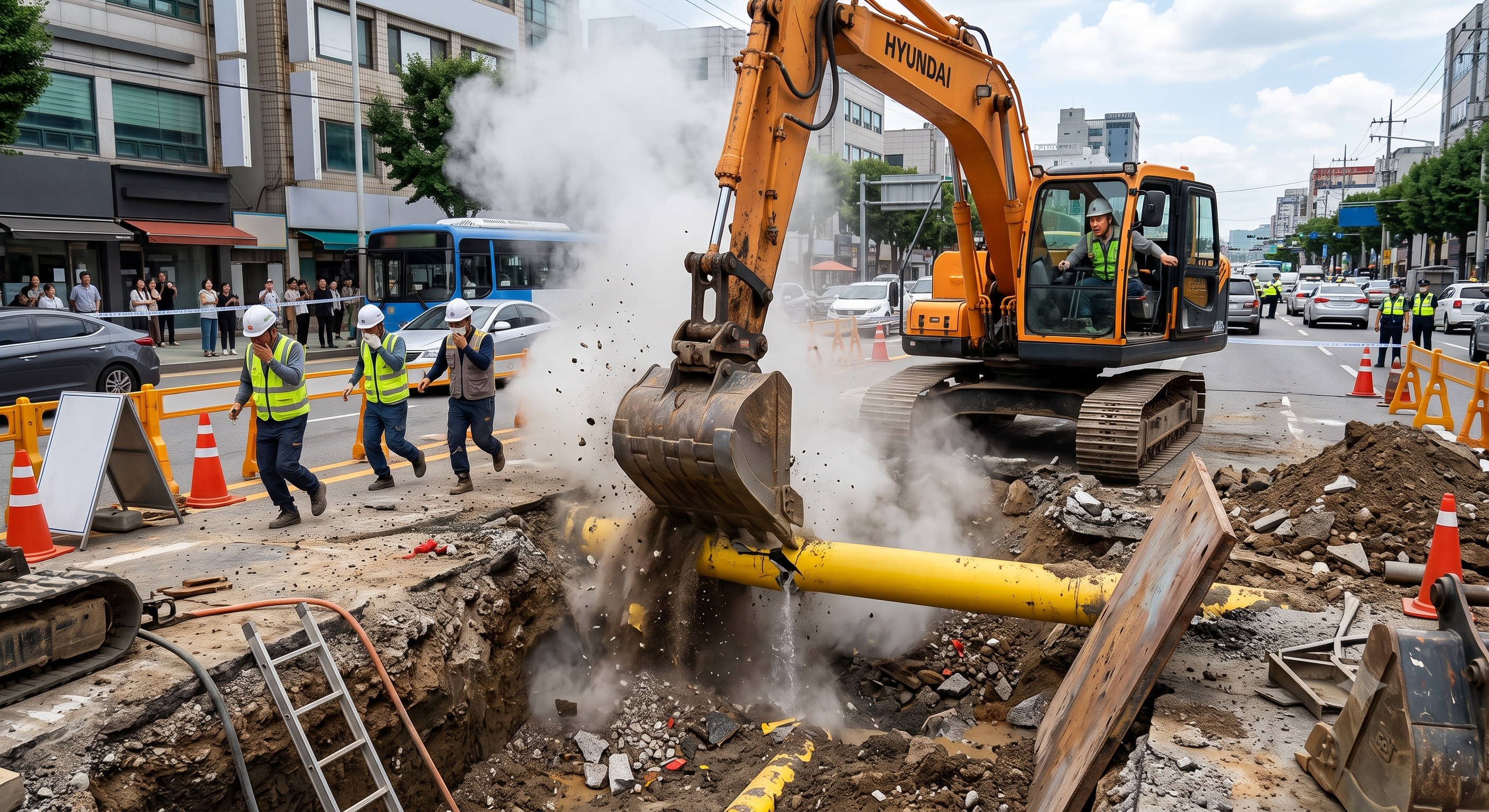
The original educational image is retained. It is not evidence of an actual incident or site suitability.
The scenario and record comparisons are fictional teaching examples, not records of real incidents, measurements, inspections, signatures or approvals.
| Item | Fictional scenario |
|---|---|
| Initial situation | An asset record shows a service beside the proposed trench. |
| Changed condition | The locator response differs from the record and another service may be present. |
| Failure path | The team proposes digging up to a fixed offset from the painted line. |
| Possible outcome | The bucket could contact an unproven asset; edge loading could also destabilise the wall. |
| Prevention barrier | Stop the affected section, reconcile information with the owner and prove the asset by an agreed method. |
Failure mechanisms
Water may increase pore pressure, reduce effective stress or erode soil particles. It does not make every soil lose all cohesion. Ground type, layering, groundwater and changes over time determine the response and the protection required.
Plant, spoil and nearby structures impose surcharge loads. Their influence depends on weight, position, ground and the support system. A clear edge strip is not proof that plant is outside the zone of influence; neither a fixed 45-degree wedge nor a universal load-doubling factor is a design method.
Shoring restrains ground movement; a shield protects workers within its designed envelope and does not necessarily prevent movement outside it. Install, advance and remove protection without exposing people to an unsupported face. Hand digging or vacuum excavation can still damage services; the owner must define suitable methods and limits. A gas reading does not demonstrate wall stability.
Decision sequence
| Decision stage | What to verify |
|---|---|
| Known facts | Records and locator response disagree. |
| Unresolved matters | Asset identity, alignment and depth remain unproven. |
| Reason to hold | A painted mark, insulated tool or earlier permit does not establish clearance for the excavator. |
| Required evidence | Reconcile owner records and detection, expose appropriately, confirm identity and route, and record the permitted area and method. |
| Restart decision | The responsible person releases only the section with verified protection and work limits; new assets, water, cracking or changed loads require reassessment. |
5. Conditional decisions and common errors
| Condition | Action | Evidence | Proceed when |
|---|---|---|---|
| Unknown asset | Stop plant | Identity and route proven | Section defined |
| Edge cracking | Evacuate area | Stability reassessed | Protection effective |
| Water ingress | Prevent entry | Ground and water reviewed | Conditions controlled |
| Support removal | Hold sequence | Backfill and removal plan | Protection maintained |
Similar situations, different decisions
The scenario and record comparisons are fictional teaching examples, not records of real incidents, measurements, inspections, signatures or approvals.
| Comparison | Situation A | Situation B |
|---|---|---|
| Location | A line on an asset plan. | Identity and position established for the working area. |
| Edge | A nominal clear strip. | Clear strip plus assessed plant loading and stability. |
| Entry | A ladder is available. | A protected route leads into an effectively protected area. |
6. Roles and responsibilities
| Role | Responsibility |
|---|---|
| Work supervisor | Coordinate asset owners, work sequence and traffic separation. |
| Technical reviewer | Arrange competent assessment of ground and protective systems. |
| Work crew | Operator and spotter agree signals and keep people outside plant movement zones. |
| Inspector / assessor | Record actual location evidence, inspections and changed conditions. |
| Release / handover authority | Accept only the checked scope and secure remaining excavations with clear restrictions. |
Supervision, records, handover
| Job stage | Technical and procedural controls | Site verification |
|---|---|---|
| Plan the work | 1. Assign responsibilities2. Coordinate owners3. Review protection plan | 1. Record revision2. Owner responses3. Ground and water |
| Prove services | 1. Record asset evidence2. Define work limits3. Release the section | 1. Asset identity2. Position and depth3. Method limits |
| Excavate in stages | 1. Coordinate edge loads2. Review geometry3. Record changes | 1. Excavation geometry2. Loads and setbacks3. Ground changes |
| Install protection | 1. Review system design2. Verify installation3. Decide on access | 1. Protection plan2. Installed condition3. Protected area |
| Review changes | 1. Assign reinspection2. Close defects3. Record new decision | 1. Water conditions2. Cracks and movement3. Support condition |
| Backfill and hand over | 1. Coordinate removal2. Secure residual risks3. Record handover | 1. Backfill sequence2. Asset protection3. Remaining barriers |
7. Hold points and record comparison
| Hold point | Evidence before release | Confirmation / approval |
|---|---|---|
| Start | Open trench and shaft excavation using an excavator, appropriate service exposure, progressive protection, controlled access, water management and backfilling. Protection progresses with excavation; the numbered stages never permit entry before the affected section is protected. | |
| HP-1 Prove services | Asset identity · Position and depth · Method limits · Released work area | |
| HP-2 Install protection | Protection plan · Installed condition · Protected area · Installation sequence | |
| HP-3 Control entry | Protected access · Effective protection · Air risk assessment · Escape arrangements | |
| HP-4 Backfill and hand over | Backfill sequence · Asset protection · Remaining barriers · Handover scope |
Complete after actual checks. Recheck after changes, defects or shift handover.
Record comparison examples
The scenario and record comparisons are fictional teaching examples, not records of real incidents, measurements, inspections, signatures or approvals.
The boxes are static record prompts, not interactive or saved approvals. A tick does not establish suitability or permission to restart. Record the evidence, person, time and unresolved issues; retain the change history.
| Record type | Insufficient record | Record checklist |
|---|---|---|
| Services | Plans received | □ Asset owner□ Record revision□ Detection and exposure□ Working limits |
| Ground | Walls standing | □ Soil and water□ Depth and geometry□ Edge loading□ Protection arrangement |
| Entry | Box installed | □ Protected envelope□ Installation condition□ Access route□ Atmospheric risk review |
| Handover | Filled in | □ Asset protection□ Backfill sequence□ Remaining safeguards□ Person and decision |
8. Site checklist and emergency response
| Check item | Result | Person / action |
|---|---|---|
| □ Plan the work: Record revision | ||
| □ Check plant: Plant condition | ||
| □ Prove services: Asset identity | ||
| □ Excavate in stages: Excavation geometry | ||
| □ Install protection: Protection plan | ||
| □ Control entry: Protected access | ||
| □ Review changes: Water conditions | ||
| □ Backfill and hand over: Backfill sequence | ||
| □ Release / handover authority |
Stop work
Stop for an unidentified service, unusual odour, arcing, cracking, deformation, water ingress or loss of signals. Keep people away and do not touch a damaged service or send someone into an unprotected area to investigate.
Emergency response
Stop movement, keep clear of the affected service and unstable ground, and contact the asset owner and emergency services under the site plan. Do not enter a collapse for improvised rescue. For possible electrical contact, follow the asset owner emergency procedure and keep others away from the plant and surrounding ground.
9. Sources and review limits
2026-10-08
| Source | Scope and limitations |
|---|---|
| Safe Work Australia — Excavation work | Official model Code landing page: local adoption must be established. |
| Safe Work Australia — Excavation Code PDF | Selected sections reviewed for surcharge, zone of influence and regulation 306; not a site-specific design. |
| Safe Work Australia — Construction work, November 2024 | Regulation 291 high risk construction examples reviewed; distinguish the greater-than-1.5 m trigger. |
| HSE — HSG47 | UK overview of planning, locating and safe excavation; technical reference, not Australian law. |
This is reference content written and revised with AI. It has not been verified or approved by a professional. Review by a suitably qualified professional and site authorisation are required before use.
10. PDF guidance and FAQ
PDF A covers basic task controls; B focuses on technical failures; C covers supervision, records and handover. The article has eight stages with four items per main cell; each PDF has six key stages with three items per main cell. P/S/R/A, measurements, confirmations and signatures remain blank for actual site assessment.
Content group ID
jsa-excavation-works
Decision sequence?
Reconcile owner records and detection, expose appropriately, confirm identity and route, and record the permitted area and method.
Proceed when?
The responsible person releases only the section with verified protection and work limits; new assets, water, cracking or changed loads require reassessment.
Separate review?
Blasting, tunnelling, contaminated ground, work directly on live assets and special lifting operations need additional procedures. A trench is not automatically a confined space solely because of depth; assess the applicable definition and actual conditions.
Scope and limitations?
The current state or territory implementation, a specific asset owner procedure, AS 4744, AS 4991 and plant manuals have not been fully reviewed. No national two-day BYDA rule, one-metre exclusion distance, 9 m ladder spacing, 1,800 mm fence, vacuum pressure or universal coupler pin arrangement is asserted. Owner responses and field evidence must establish method-specific limits.
Has a professional verified or approved this document?
No. Public sources and editorial, layout and consistency checks were reviewed using AI. No site inspection or professional technical approval has been performed. Obtain appropriate professional review before use.
11. Revision history and authorship
This is reference content written and revised with AI. It has not been verified or approved by a professional. Review by a suitably qualified professional and site authorisation are required before use.
| Date | Version | Change | Review status |
|---|---|---|---|
| 2026-07-21 | Original version unmarked | Original preserved | No professional approval |
| 2026-10-08 | 1.1 | Decisions, records, JSA and PDFs revised | No professional approval |
Useful service planning, plant inspection, exposure, shoring and handover content is retained. Corrected confusion between model regulations 291 and 306, fixed plant setbacks and hydraulic pressure claims. Removed the unsupported Sydney accident narrative, fine and release radius, claims of automatic compliance, and the suggestion that insulated tools alone make live electrical assets safe.