A clear reversing camera does not prove that the loading zone is empty. A covered body does not prove that the vehicle is within its gross and axle limits. This revision connects each loading cycle to waste identity, safe positioning, load evidence and the receiving facility, while retaining the original dust, sharp-edge, swing-zone, tarping and wheel-wash controls.
Confirm the waste, separate people, control the load, close the transfer record
This is reference content written and revised with AI. It has not been verified or approved by a professional. Review by a suitably qualified professional and site authorisation are required before use.
Stop work
Stop for an entrant in the movement zone, lost signal, unclear waste identity, unstable pile or pad, defective brakes, unknown mass, failed tailgate or cover, or blocked gate visibility. Isolate the affected cycle and record the reason; queue pressure is not a release condition.
1. Legal and technical scope
| Basis | Application limits |
|---|---|
| WorkSafe Victoria - SWMS | Victorian regulator guidance: high-risk construction work includes workplaces with powered mobile plant; official search text reviewed. |
| SWA - Managing risks of plant | Model guidance: verify legal effect with the state or territory regulator; official publication page reviewed. |
| SWA - Construction work, November 2024 | Official indexed SWMS extract reviewed for mobile-plant category, not a full PDF review. |
Australia: identify the state or territory first. Safe Work Australia publishes model guidance and is not the enforcing regulator. Victoria uses its OHS framework; the original Melbourne example must not be described as direct application of national model WHS law. This JSA does not replace a site-specific SWMS.
Confirm the local WHS/OHS, road authority and EPA requirements, waste acceptance and applicable heavy-vehicle regime. No universal P2 rule, 10 km/h wash speed or 20 km/h site speed is asserted.
2. Scope and required inputs
Included scope
Segregated non-hazardous construction waste: stockpiling, truck positioning, excavator loading, mass checks, covering, wheel washing, exit and receipt reconciliation. Tipping is included only as a receiver-interface check; use the receiving facility’s separate unloading plan.
Separate review
Suspected asbestos, contaminated soil, unknown drums, hot loads, demolition stability, crushing, lifting with a suspended load and repairs under a raised body require separate competent planning. Do not continue an ordinary rubble cycle when suspicious material appears.
| Required input | What to verify |
|---|---|
| Waste identity | Waste description · Survey reference · Carrier authority · Receiver permit |
| Stockpile and routes | Pile condition · Barrier layout · Dust controls · Pad inspection |
| Truck positioning | Clear travel path · Guide refuge · Brake check · Visibility check |
| Mass and tailgate | Weighing evidence · Vehicle limits · Latch condition · No protruding debris |
| Load covering | Cover condition · Safe access method · Isolation boundary · Closure inspection |
| Receipt and closeout | Receiver instructions · Overhead clearance · Receipt and quantity · Restart authority |
No universal stockpile slope, speed, dust pressure, respirator class or fill percentage is established here. Check ground capacity, actual waste properties, exposure assessment and the specific truck, excavator, attachment and tarp manuals. Paid standards and model-specific manuals were not inspected. Overseas guidance is technical reference only, not local law.
Keep cut-resistant hand protection and puncture-resistant footwear for sharp debris, high-visibility clothing for traffic interfaces, and eye/face and slip protection for washing, selected for the actual task. Respiratory protection needs exposure-based selection, fit and training. Keep manual picking separate from live plant; isolate attachments before clearing a snag. Identify overhead services before positioning booms or raising a body.
3. Eight-stage JSA
| Job stage | Hazards and effects | Failure factors | Technical and procedural controls | Site verification | P | S | R | A |
|---|---|---|---|---|---|---|---|---|
| 1. Waste identity | 1. Dust inhalation2. Sharp rebar3. Hidden asbestos4. Wrong destination | 1. Mixed waste stream2. Missing survey3. Unknown contaminants4. Unaccepted waste code | 1. Classify before handling2. Quarantine suspect waste3. Confirm receiver acceptance4. Plan separate specialist work | 1. Waste description2. Survey reference3. Carrier authority4. Receiver permit | ||||
| 2. Stockpile and routes | 1. Pile collapse2. Pedestrian collision3. Dust escape4. Ground failure | 1. Undercut pile toe2. Shared access3. Dry disturbance4. Water-softened pad | 1. Keep people off piles2. Separate walking routes3. Control dust at source4. Check ground and drainage | 1. Pile condition2. Barrier layout3. Dust controls4. Pad inspection | ||||
| 3. Truck positioning | 1. Run-over2. Crushing at rear3. Roll-away4. Overturn | 1. Dirty camera2. Lost signal3. Weak shoulder4. Brake defect | 1. Avoid reversing first2. Use agreed safe guidance3. Stop if contact is lost4. Secure stationary truck | 1. Clear travel path2. Guide refuge3. Brake check4. Visibility check | ||||
| 4. Excavator loading | 1. Swing impact2. Falling rubble3. Cab strike4. Rebar snag | 1. Person in swing zone2. Overfilled bucket3. Swing over cab4. Interlocked debris | 1. Exclude people from swing2. Keep bucket clear of cab3. Load low and evenly4. Stop for tangled material | 1. Exclusion maintained2. Driver safe position3. Attachment condition4. Load distribution | ||||
| 5. Mass and tailgate | 1. Overload2. Load shift3. Road spillage4. Tailgate impact | 1. Volume used as mass2. Unequal axle load3. Defective latch4. Debris on edges | 1. Check gross and axle mass2. Redistribute safely3. Secure tailgate closure4. Remove loose edge debris | 1. Weighing evidence2. Vehicle limits3. Latch condition4. No protruding debris | ||||
| 6. Load covering | 1. Fall from body2. Tarp entanglement3. Windborne debris4. Pinch injury | 1. Climbing tyres2. Damaged tarp3. Unexpected actuation4. Unsupported access | 1. Operate cover from ground2. Provide protected access3. Isolate before adjustment4. Check effective containment | 1. Cover condition2. Safe access method3. Isolation boundary4. Closure inspection | ||||
| 7. Wash and exit | 1. Slips on mud2. Hose injection3. Road collision4. Dirty runoff | 1. Blocked drainage2. Damaged coupling3. Blocked sightline4. Uncontrolled discharge | 1. Isolate before hose repair2. Contain wash runoff3. Use site-assessed speed4. Separate gate crossings | 1. Hose inspection2. Drain condition3. Exit visibility4. Approved haul route | ||||
| 8. Receipt and closeout | 1. Tipping rollover2. Overhead contact3. Untracked waste4. Unsafe next shift | 1. Soft tipping ground2. Raised body travel3. Missing receipt4. Unresolved defect | 1. Follow receiver tipping plan2. Lower body before travel3. Reconcile waste receipt4. Hand over open defects | 1. Receiver instructions2. Overhead clearance3. Receipt and quantity4. Restart authority |
PDF A covers basic task controls; B focuses on technical failures; C covers supervision, records and handover. The article has eight stages with four items per main cell; each PDF has six key stages with three items per main cell. P/S/R/A, measurements, confirmations and signatures remain blank for actual site assessment.
4. Fictional scenario and failure mechanisms
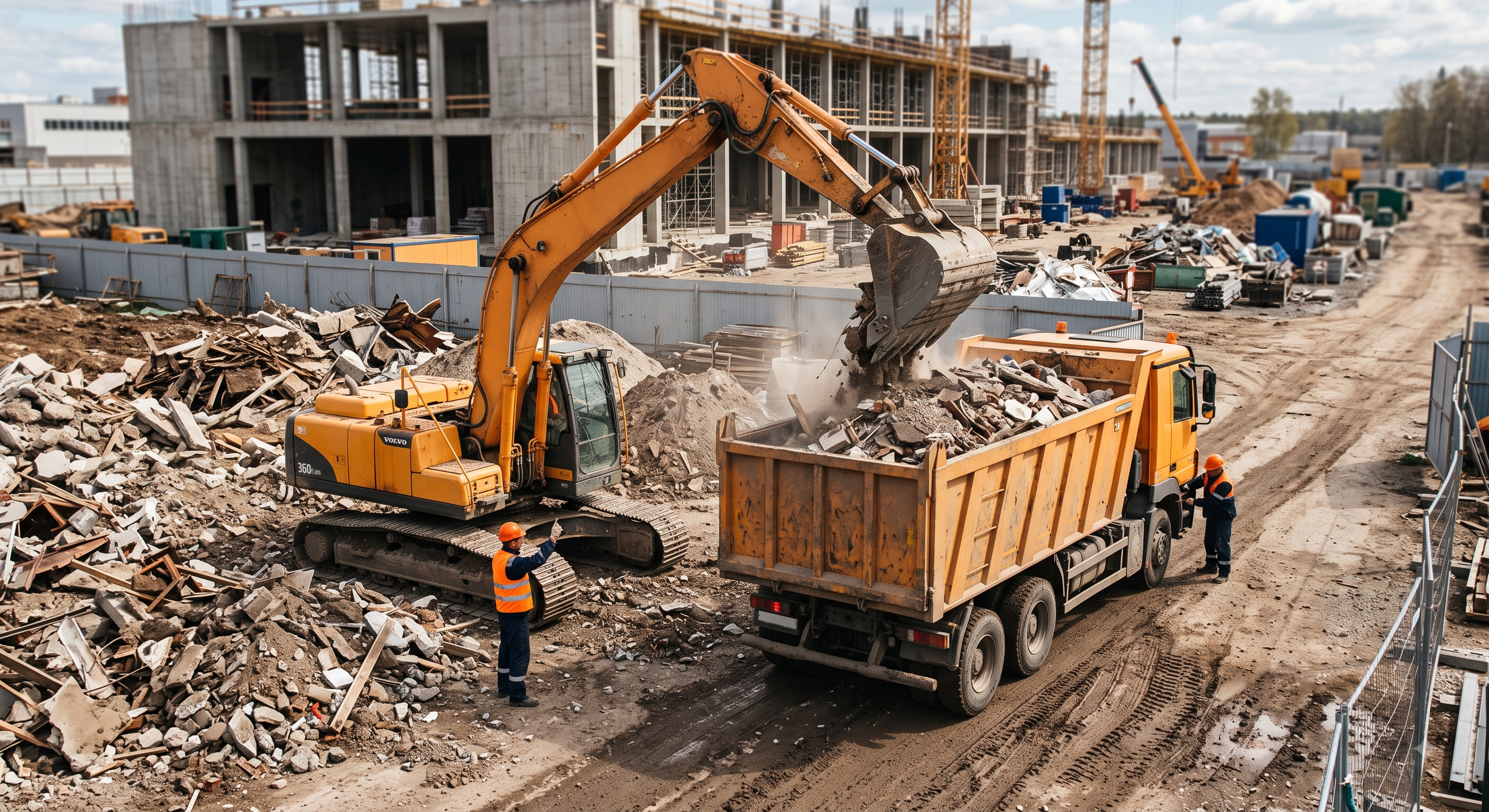
Retained AI-generated educational illustration; not an actual incident photograph.
The scenario and record comparisons are fictional teaching examples, not records of real incidents, measurements, inspections, signatures or approvals.
| Item | Fictional scenario |
|---|---|
| Initial situation | A truck is waiting at a rubble bay while a worker picks loose metal near the boundary. |
| Changed condition | Rain has dirtied the camera; the pedestrian gate is open and the guide’s safe standing point is obstructed. |
| Failure path | A reverse alarm sounds, but the driver cannot establish whether the path and excavator swing zone are clear. |
| Possible outcome | Continuing could trap the worker between the tailgate and the excavator or stockpile. This is a fictional possibility, not an accident record. |
| Prevention barrier | Stop both movements, clear and segregate the zone, restore visibility and agree guidance from a protected position. |
Failure mechanisms
An alarm communicates a warning; it does not detect every person or create stopping clearance. Noise, attention and hearing protection affect perception. A simple sound-distance equation cannot establish audibility throughout a reflecting, moving work zone. Verify the actual arrangement without exposing a person as a test target.
The excavator counterweight and bucket sweep different areas. A barrier line must account for both, the parked truck and a guide’s escape route. A driver should use the designated protected cab or refuge under the assessed loading plan; requiring every driver to step out can itself put people in the swing zone.
Wet concrete rubble may reach mass or axle limits while the body still looks partly empty. The tarp contains suitable loose material; it neither corrects overweight nor secures an unstable large piece. Recheck mass and distribution after any adjustment.
Water can reduce airborne dust but can also soften the pad and create slip or runoff hazards. Select suppression and respiratory protection from the exposure assessment. No visible dust is not a measurement of respirable silica.
Decision sequence
| Decision stage | What to verify |
|---|---|
| Known facts | Known: the camera is obscured and the guide’s refuge is blocked. |
| Unresolved matters | Unknown: whether anyone remains behind the truck; whether the revised guide position is visible and clear of swing. |
| Reason to hold | Hold: movement cannot be released merely because the alarm works. |
| Required evidence | Evidence: cleared route, closed pedestrian access, restored visibility, agreed signal and verified guide refuge. |
| Restart decision | Restart: the designated controller confirms the loading configuration; repeat the check after entry, relocation or loss of contact. |
5. Conditional decisions and common errors
| Condition | Action | Evidence | Proceed when |
|---|---|---|---|
| Unknown waste | Isolate the load; obtain classification | Survey, waste code and receiver acceptance | Waste identified |
| Lost guide contact | Stop travel and loading | Safe guide position and communication | Contact restored |
| Mass not established | Hold exit; weigh or substantiate mass | Gross and axle evidence | Limits met |
| Damaged cover | Repair using safe access and isolation | Cover and closure inspection | Containment restored |
Similar situations, different decisions
The scenario and record comparisons are fictional teaching examples, not records of real incidents, measurements, inspections, signatures or approvals.
| Comparison | Situation A | Situation B |
|---|---|---|
| Camera | Clean image: visibility aid available | Zone still needs to be cleared and access controlled |
| Load | Tarp closed: windblown debris controlled | Mass and axle limits still require separate evidence |
| Transfer | Transport form issued: movement described | Receiver acceptance and quantity reconciliation close the record |
6. Roles and responsibilities
| Role | Responsibility |
|---|---|
| Work supervisor | Confirm waste class, receiver acceptance and the sequence of truck movements. |
| Technical reviewer | Verify pad, equipment limits, attachment and safe access for the actual fleet. |
| Work crew | Operators and guide agree signals; stop on lost contact; keep people out of movement zones. |
| Inspector / assessor | Verify mass, closure, wash and exit conditions; record the actual scope checked. |
| Release / handover authority | Reconcile receipt and quantity; hand over defects and authorize restart only within delegated authority. |
Supervision, records, handover
| Job stage | Technical and procedural controls | Site verification |
|---|---|---|
| Release scope | 1. Confirm waste identity2. Check receiver acceptance3. Assign hold authority | 1. Waste description2. Survey reference3. Receiver permit |
| Brief drivers | 1. Explain one-way route2. Agree guide and signals3. Confirm safe refuge | 1. Clear travel path2. Guide refuge3. Visibility check |
| Release loading | 1. Keep people segregated2. Confirm driver position3. Stop changed conditions | 1. Exclusion maintained2. Driver safe position3. Load distribution |
| Release covering | 1. Review mass evidence2. Assign safe access3. Control energy isolation | 1. Cover condition2. Safe access method3. Closure inspection |
| Release exit | 1. Check cover and gate2. Confirm wash drainage3. Link load to documents | 1. Hose inspection2. Drain condition3. Approved haul route |
| Close handover | 1. Match receipt to load2. Resolve rejected waste3. Assign open defects | 1. Receiver instructions2. Overhead clearance3. Restart authority |
7. Hold points and record comparison
| Hold point | Evidence before release | Confirmation / approval |
|---|---|---|
| Start | Segregated non-hazardous construction waste: stockpiling, truck positioning, excavator loading, mass checks, covering, wheel washing, exit and receipt reconciliation. Tipping is included only as a receiver-interface check; use the receiving facility’s separate unloading plan. | |
| HP-1 Waste identity | Waste description · Survey reference · Carrier authority · Receiver permit | |
| HP-2 Truck positioning | Clear travel path · Guide refuge · Brake check · Visibility check | |
| HP-3 Mass and tailgate | Weighing evidence · Vehicle limits · Latch condition · No protruding debris | |
| HP-4 Wash and exit | Hose inspection · Drain condition · Exit visibility · Approved haul route |
Complete after actual checks. Recheck after changes, defects or shift handover.
Record comparison examples
The scenario and record comparisons are fictional teaching examples, not records of real incidents, measurements, inspections, signatures or approvals.
The boxes are static record prompts, not interactive or saved approvals. A tick does not establish suitability or permission to restart. Record the evidence, person, time and unresolved issues; retain the change history.
| Record type | Insufficient record | Record checklist |
|---|---|---|
| Reversing | “Camera OK” | □ Vehicle and bay ID□ Clear path and refuge□ Signal method and guide□ Person, time and remaining restriction |
| Loading | “Not full” | □ Gross and axle limits□ Mass evidence and method□ Distribution and tailgate□ Adjustment and recheck |
| Cover | “Tarp fitted” | □ Access and isolation method□ Cover damage and anchorage□ Edge debris and closure□ Checker, time and defect |
| Transfer | “Truck left” | □ Waste code and quantity□ Carrier and receiver details□ Receipt reference and discrepancy□ Owner and closure of pending items |
8. Site checklist and emergency response
| Check item | Result | Person / action |
|---|---|---|
| □ Waste identity: Waste description | ||
| □ Stockpile and routes: Pile condition | ||
| □ Truck positioning: Clear travel path | ||
| □ Excavator loading: Exclusion maintained | ||
| □ Mass and tailgate: Weighing evidence | ||
| □ Load covering: Cover condition | ||
| □ Wash and exit: Hose inspection | ||
| □ Receipt and closeout: Receiver instructions | ||
| □ Release / handover authority |
Stop work
Stop for an entrant in the movement zone, lost signal, unclear waste identity, unstable pile or pad, defective brakes, unknown mass, failed tailgate or cover, or blocked gate visibility. Isolate the affected cycle and record the reason; queue pressure is not a release condition.
Emergency response
Stop and secure equipment without entering the crush zone. Keep others away, contact the site emergency response and provide the exact location and material hazards. Do not attempt an unplanned extraction with the excavator. Suspected high-pressure injection needs urgent medical assessment even if the wound looks small.
9. Sources and review limits
2026-10-08
| Source | Scope and limitations |
|---|---|
| WorkSafe Victoria - SWMS | Victorian regulator guidance: high-risk construction work includes workplaces with powered mobile plant; official search text reviewed. |
| SWA - Managing risks of plant | Model guidance: verify legal effect with the state or territory regulator; official publication page reviewed. |
| SWA - Construction work, November 2024 | Official indexed SWMS extract reviewed for mobile-plant category, not a full PDF review. |
This is reference content written and revised with AI. It has not been verified or approved by a professional. Review by a suitably qualified professional and site authorisation are required before use.
10. PDF guidance and FAQ
PDF A covers basic task controls; B focuses on technical failures; C covers supervision, records and handover. The article has eight stages with four items per main cell; each PDF has six key stages with three items per main cell. P/S/R/A, measurements, confirmations and signatures remain blank for actual site assessment.
Content group ID
jsa-construction-waste
Does a tarp prove the truck can leave?
No. Waste acceptance, mass and axle limits, load stability, closure, route and documents must also be checked.
Must the driver always leave the cab?
Use the assessed protected position specified for the actual loading arrangement. Do not create pedestrian exposure by applying a universal rule.
Can the original speed and slope values be reused?
Only when separately justified for the site and equipment. The original generic values are not certified limits.
Does a transport document complete the job?
No. Connect dispatch to the receiving record, resolve rejected loads or quantity differences, and hand over open defects.
Has a professional verified or approved this document?
No. Public sources and editorial, layout and consistency checks were reviewed using AI. No site inspection or professional technical approval has been performed. Obtain appropriate professional review before use.
11. Revision history and authorship
This is reference content written and revised with AI. It has not been verified or approved by a professional. Review by a suitably qualified professional and site authorisation are required before use.
| Date | Version | Change | Review status |
|---|---|---|---|
| 2026-08-11 | Original version unmarked | Original preserved | No professional approval |
| 2026-10-08 | 1.1 | Decisions, records, JSA and PDFs revised | No professional approval |
Preserved: dust and cut protection, pedestrian separation, reversing guidance, swing exclusion, stable loading, covering, wheel washing and exit planning. Corrected: invented authority findings in a fictional narrative, preset risk scores, universal speed/slope/fill values, automatic-compliance claims and universal driver exit. No measurement, incident finding or professional approval has been created.