A winch nameplate does not rate the whole lifting system. Drum layer changes the effective radius and may change available line pull. Brake holding, rope, attachments, duty cycle and anchor capacity must all suit the actual lifting configuration.
This is reference content written and revised with AI. It has not been verified or approved by a professional. Review by a suitably qualified professional and site authorization are required before use.
Stop before starting
Stop for rope overlap/damage, anchor movement, brake slip, abnormal resistance, lost signals or entry into rope/load zones. Do not repair under an unsupported load or increase force to free a stuck object.
1. Legal and technical scope
| Basis | Scope and limits |
|---|---|
| OSHA 1926.553 | Base-mounted drum hoists within scope, including explicit derrick exclusion. |
| OSHA 1926.251 | Construction rigging selection, identification and inspection. |
For construction base-mounted drum hoists within scope, 1926.553 addresses safeguards, power-failure controls and manufacturer requirements. Its derrick-associated exclusion requires the applicable derrick provisions instead. Apply 1926.251 to covered rigging and determine any other actual equipment classification; do not label every winch a crane. General-industry installations need their applicable rules. Check State Plan requirements and the lifting-approved manufacturer instructions.
2. Scope and required inputs
Included work
Lifting material with a winch specifically permitted for that lifting duty and an engineered arrangement of anchors, sheaves, rope and rigging, followed by stable landing, tension release and dismantling.
Separate assessment
Converting a vehicle-recovery-only winch to a lifting device, personnel lifting, forced extraction of stuck loads and unreviewed load-path changes are excluded.
| Required input | Evidence to obtain |
|---|---|
| Review lifting duty and load | Model and lifting duty; Load weight and center; Layer capacity; Speed and duty limits |
| Review anchors and route | Sheave location and angle; Anchor reaction basis; Revised layout; Recoil and fall boundary |
| Inspect rope and controls | Rope and attachment; Brake inspection; Stop and restart response; Supply and protection |
| Rig and trial lift | Rigging and center; Trial position; Brake holding; Anchor sheave movement |
No actual equipment model, SDS, site measurements, design calculations or authorization record was supplied. Product-specific limits and methods must be verified before use. Federal OSHA is a baseline within its scope; determine the applicable State Plan and local requirements. Manufacturer guidance is not government approval; an incorporated standard differs from voluntary guidance. No nationwide-compliance or expert-approval claim is made.
3. Eight-stage JSA
| Job stage | Hazards and effects | Failure factors | Technical and procedural controls | Site verification | P | S | R | A |
|---|---|---|---|---|---|---|---|---|
| 1. Review lifting duty and load | 1. Dropped load2. Winch failure3. Insufficient line pull4. Brake loss | 1. Recovery-only tool used2. Weight unknown3. Layer capacity ignored4. Duty misunderstood | 1. Verify lifting-permitted model2. Confirm actual load3. Review layer chart4. Match duty and brake limits | 1. Model and lifting duty2. Load weight and center3. Layer capacity4. Speed and duty limits | ||||
| 2. Review anchors and route | 1. Anchor pullout2. Sheave drop3. Side-load failure4. Rope recoil | 1. Redirect reaction omitted2. Support unreviewed3. Sheave moved4. People in bight | 1. Review complete force path2. Match support directions3. Reassess layout changes4. Exclude rope and load zones | 1. Sheave location and angle2. Anchor reaction basis3. Revised layout4. Recoil and fall boundary | ||||
| 3. Inspect rope and controls | 1. Brake failure2. Entanglement3. End slip4. Unexpected restart | 1. Rope damaged2. Guard missing3. Termination wrong4. Power-loss control defective | 1. Inspect rope and drum2. Check guards and stops3. Verify approved termination4. Test required control features | 1. Rope and attachment2. Brake inspection3. Stop and restart response4. Supply and protection | ||||
| 4. Rig and trial lift | 1. Eccentric rotation2. Rigging release3. Support deformation4. Load collision | 1. Center unreviewed2. Hook connection incomplete3. Movement ignored4. Path obstructed | 1. Use approved lift points2. Inspect complete rigging3. Trial low by accepted method4. Watch support and balance | 1. Rigging and center2. Trial position3. Brake holding4. Anchor sheave movement | ||||
| 5. Lift and watch spooling | 1. Overlap damage2. Sudden load drop3. Flange interference4. Crushed rope | 1. Layer unchecked2. Signals lost3. Fleet angle excessive4. Rope hand-guided | 1. Maintain permitted spooling2. Stop on lost contact3. Observe actual lead angle4. Keep hands off moving rope | 1. Layers and wrap conditions2. Signals and sightline3. Rope lead angle4. Drum and rope condition | ||||
| 6. Land and transfer load | 1. Support collapse2. Sudden movement3. Hand crush4. Stack overturn | 1. Rope slackened early2. Contact mistaken for support3. Hands adjust gap4. Restraint absent | 1. Land on accepted supports2. Verify full load transfer3. Keep pinch zones clear4. Restrain before tension release | 1. Support and contact2. Movement restraint3. Hand-clearance check4. Tension-release sequence | ||||
| 7. Hold fault or outage | 1. Brake-release drop2. Residual-energy recoil3. Unexpected motion4. Temporary-support failure | 1. Repair under load2. Stuck load overpulled3. Power alone isolated4. Residual load unknown | 1. Stop and exclude area2. Use reviewed load support3. Control power and tension4. Follow separate recovery plan | 1. Load and tension state2. Support plan3. Isolation verification4. Repair and restart authority | ||||
| 8. Dismantle and transfer | 1. Tensioned-rope strike2. Damaged gear reused3. Falling anchor parts4. Lost defect history | 1. Anchor released loaded2. Defect untagged3. Order confused4. Gear ID absent | 1. Verify unloaded condition2. Follow removal sequence3. Segregate damaged gear4. Transfer inspection history | 1. Load transfer and no tension2. Dismantling order3. Rope and equipment defects4. Recipient and use limits |
P = likelihood; S = severity; R = risk under the site method; A = site-defined acceptance/authorization. These actual assessment cells are blank. A low score never overrides a missing safeguard or a legal or manufacturer restriction.
4. Fictional scenario and failure mechanisms
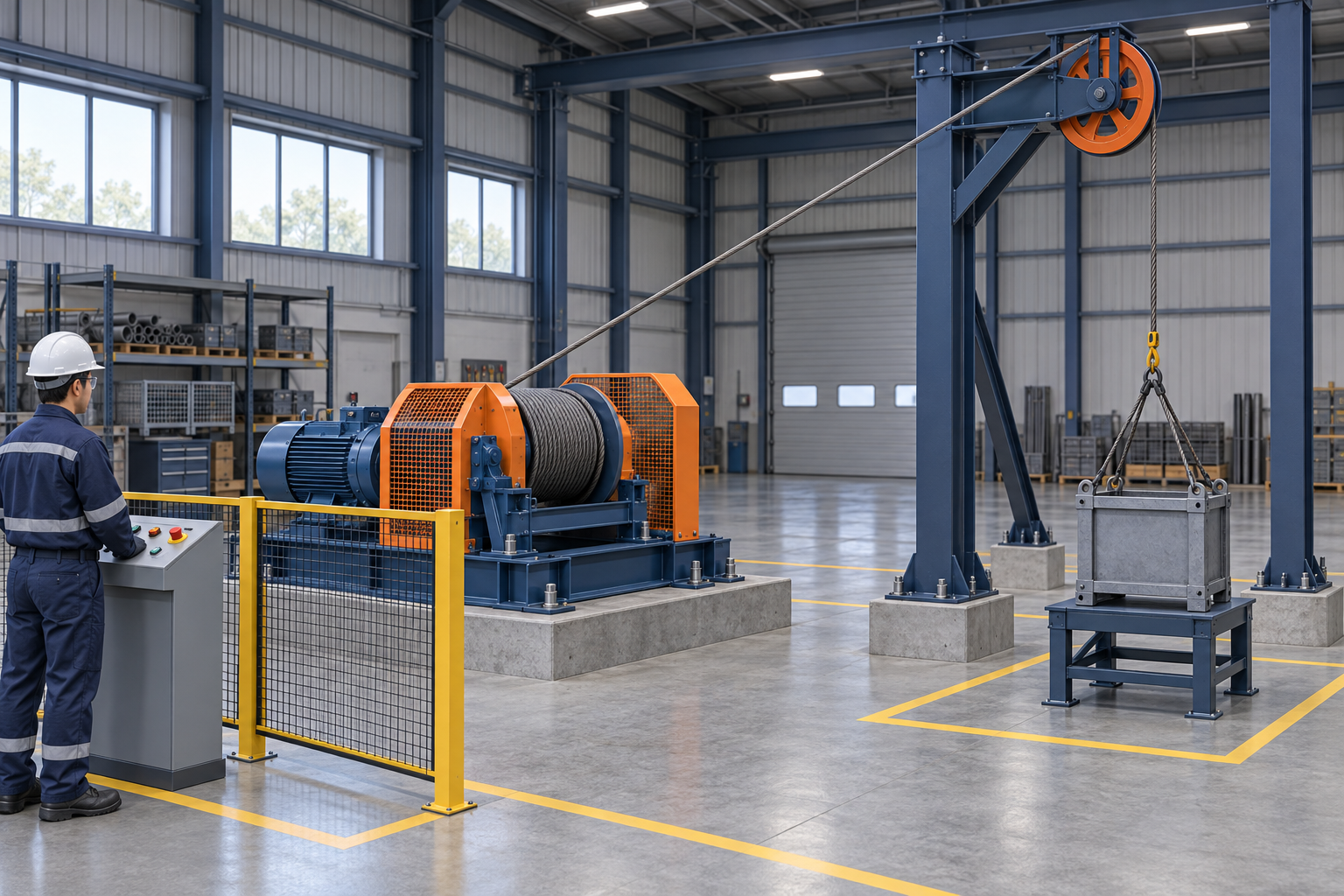
This illustration provides educational context. It is not an actual incident photograph or evidence of equipment suitability; any AI-generated depiction is illustrative only.
The scenario and record comparisons are fictional teaching examples, not records of real incidents, measurements, inspections, signatures or approvals.
| Stage | Fictional situation |
|---|---|
| Initial situation | A fictional winch lift uses a redirecting sheave. |
| Changed condition | The sheave is moved to clear a walkway. |
| Failure path | The crew relies on unchanged load weight and winch rating and omits a new anchor review. |
| Possible outcome | The changed reaction could deform the support, release the rope and drop the load. |
| Prevention barrier | Hold the lift, record actual angles and positions, verify the revised support and rope arrangement and complete the accepted trial before release. |
Failure mechanisms
A winch nameplate does not rate the whole lifting system. Drum layer changes the effective radius and may change available line pull. Brake holding, rope, attachments, duty cycle and anchor capacity must all suit the actual lifting configuration.
A redirecting sheave support carries the vector sum of the rope forces acting on it, with the actual geometry and relevant friction/dynamic effects considered. Moving the sheave can change the force direction and reaction even when material weight and winch are unchanged.
Touching a landing support is not complete load transfer. Verify the intended contact and restraint against movement before releasing rope tension. Power isolation also does not support a suspended load or remove stored rope energy.
Work sequence: Review lifting duty and load → Review anchors and route → Inspect rope and controls → Rig and trial lift → Lift and watch spooling → Land and transfer load → Hold fault or outage → Dismantle and transfer. This is a teaching flow, not a device drawing or a complete operating procedure.
5. Conditional decisions and common errors
| Situation | Required action | Evidence | Proceed when |
|---|---|---|---|
| Sheave relocated | Review whole force path | Angles, anchor and reaction review | Layout accepted |
| Rope overlaps or crushes | Stop safely | Layer, rope condition and recovery | Spooling restored |
| Brake slips | Use planned safe load support | Brake repair and test evidence | Equipment accepted |
| Dismantling requested | Verify unloaded state | Landing, restraint and tension | Load fully transferred |
Similar observations, different decisions
The scenario and record comparisons are fictional teaching examples, not records of real incidents, measurements, inspections, signatures or approvals.
| Observation | Insufficient conclusion | Required distinction |
|---|---|---|
| Same load weight | Mass unchanged | Sheave reaction may differ |
| Load touches support | Contact observed | Complete transfer unproved |
| Power switched off | Drive isolated | Suspended load remains |
6. Roles and responsibilities
| Role | Responsibility |
|---|---|
| Work supervisor | Confirm model and lifting duty and the task scope, resources, interfaces and stop authority. |
| Qualified technical reviewer | Review sheave location and angle, model limits, compatibility and unresolved technical conditions within assigned competence. |
| Work crew | Apply the listed controls, report changes and stop when evidence or safeguards are missing. |
| Inspector / assessor | Record actual layers and wrap conditions and other relevant checks; do not mark unverified conditions as accepted. |
| Handover authority | Reconcile load transfer and no tension, restrictions and outstanding actions before the next task. Role labels do not establish a legal credential. |
Supervision and handover focus
| Stage | Management action | Evidence |
|---|---|---|
| Review lifting duty and load | 1. Record model and lifting duty2. Record load weight and center3. Record layer capacity | 1. Model and lifting duty2. Load weight and center3. Layer capacity |
| Review anchors and route | 1. Record sheave location and angle2. Record anchor reaction basis3. Record revised layout | 1. Sheave location and angle2. Anchor reaction basis3. Revised layout |
| Rig and trial lift | 1. Record rigging and center2. Record trial position3. Record brake holding | 1. Rigging and center2. Trial position3. Brake holding |
| Lift and watch spooling | 1. Record layers and wrap conditions2. Record signals and sightline3. Record rope lead angle | 1. Layers and wrap conditions2. Signals and sightline3. Rope lead angle |
| Hold fault or outage | 1. Record load and tension state2. Record support plan3. Record isolation verification | 1. Load and tension state2. Support plan3. Isolation verification |
| Dismantle and transfer | 1. Record load transfer and no tension2. Record dismantling order3. Record rope and equipment defects | 1. Load transfer and no tension2. Dismantling order3. Rope and equipment defects |
7. Hold points and record comparison
| Hold point | Evidence before release | Actual approval |
|---|---|---|
| HP-0 Scope | Lifting material with a winch specifically permitted for that lifting duty and an engineered arrangement of anchors, sheaves, rope and rigging, followed by stable landing, tension release and dismantling. | |
| HP-1 Review anchors and route | Sheave location and angle; Anchor reaction basis; Revised layout; Recoil and fall boundary | |
| HP-2 Rig and trial lift | Rigging and center; Trial position; Brake holding; Anchor sheave movement | |
| HP-3 Hold fault or outage | Load and tension state; Support plan; Isolation verification; Repair and restart authority | |
| HP-4 Dismantle and transfer | Load transfer and no tension; Dismantling order; Rope and equipment defects; Recipient and use limits |
Hold points are internal project checks. They are not universal statutory permits and do not grant work permission. Reassess after defects, changed conditions and shift changes.
Record comparison
The scenario and record comparisons are fictional teaching examples, not records of real incidents, measurements, inspections, signatures or approvals.
The boxes are static record prompts, not interactive or saved approvals. A tick does not establish suitability or permission to restart. Record the evidence, person, time and unresolved issues; retain the change history.
| Record | Insufficient record | Record checklist |
|---|---|---|
| Review lifting duty and load | Only marked “OK” | □ Model and lifting duty□ Load weight and center□ Layer capacity□ Speed and duty limits |
| Rig and trial lift | Only marked “OK” | □ Rigging and center□ Trial position□ Brake holding□ Anchor sheave movement |
| Hold fault or outage | Only marked “OK” | □ Load and tension state□ Support plan□ Isolation verification□ Repair and restart authority |
| Dismantle and transfer | Only marked “OK” | □ Load transfer and no tension□ Dismantling order□ Rope and equipment defects□ Recipient and use limits |
8. Site checklist and emergency response
| Site check | Actual result | Person / action |
|---|---|---|
| Review lifting duty and load: Model and lifting duty; Load weight and center; Layer capacity; Speed and duty limits | ||
| Review anchors and route: Sheave location and angle; Anchor reaction basis; Revised layout; Recoil and fall boundary | ||
| Inspect rope and controls: Rope and attachment; Brake inspection; Stop and restart response; Supply and protection | ||
| Rig and trial lift: Rigging and center; Trial position; Brake holding; Anchor sheave movement | ||
| Lift and watch spooling: Layers and wrap conditions; Signals and sightline; Rope lead angle; Drum and rope condition | ||
| Land and transfer load: Support and contact; Movement restraint; Hand-clearance check; Tension-release sequence | ||
| Hold fault or outage: Load and tension state; Support plan; Isolation verification; Repair and restart authority | ||
| Dismantle and transfer: Load transfer and no tension; Dismantling order; Rope and equipment defects; Recipient and use limits |
Stop work
Stop for rope overlap/damage, anchor movement, brake slip, abnormal resistance, lost signals or entry into rope/load zones. Do not repair under an unsupported load or increase force to free a stuck object.
Emergency response
Maintain exclusion from the suspended load, rope bights and recoil paths. Use the planned competent load-stabilization and emergency response arrangements. Do not release anchors, brakes or rope connections until the actual load and residual energy are controlled.
9. Sources and review limits
Public-source access/review: 2026-10-14.
| Official source | Reviewed scope and limits |
|---|---|
| OSHA 1926.553 | Base-mounted drum hoists within scope, including explicit derrick exclusion. |
| OSHA 1926.251 | Construction rigging selection, identification and inspection. |
No actual equipment model, SDS, site measurements, design calculations or authorization record was supplied. Product-specific limits and methods must be verified before use. Federal OSHA is a baseline within its scope; determine the applicable State Plan and local requirements. Manufacturer guidance is not government approval; an incorporated standard differs from voluntary guidance. No nationwide-compliance or expert-approval claim is made.
10. PDF guidance and FAQ
PDF A covers basic task controls; B focuses on technical failures; C covers supervision, records and handover. The article has eight stages with four items per main cell; each PDF has six key stages with three items per main cell. P/S/R/A, measurements, confirmations and signatures remain blank for actual site assessment.
PDFs are complementary six-stage extracts. Apply all eight body stages and the actual equipment/site procedure.
Can a recovery-winch rating authorize lifting?
No. Verify that the actual model and installation are permitted for this lifting duty.
How many rope wraps must remain?
Meet the applicable equipment requirements and the exact manufacturer minimum-wrap, attachment and layer conditions; do not use a generic number.
Can the anchor be removed when the load touches down?
Only after complete stable support, movement restraint and verified tension removal under the approved sequence.
Has a professional verified or approved this document?
No. Public sources and editorial, layout and consistency checks were reviewed using AI. No site inspection or professional technical approval has been performed. Obtain appropriate professional review before use.
11. Revision history and authorship
This is reference content written and revised with AI. It has not been verified or approved by a professional. Review by a suitably qualified professional and site authorization are required before use.
| Date | Version | Change | Review status |
|---|---|---|---|
| 2026-10-14 | US 1.0 | New US edition from assigned Korean source; task decisions, records and PDFs localized. | AI editorial review; no professional technical approval |
Korean edition revision history: 2026-09-19 (v1.0): earlier published draft/version retained in the source history; 2026-10-02 (v1.1): task decisions, record checklist, JSA and three PDF variants revised. These are editorial records, not professional technical approval. US v1.0 adapts the earlier edition to United States requirements and terminology.
Site reviewers must add their actual qualifications, scope, date and approval only after the review occurs.