A warning sign does not separate pedestrians from a moving machine or wet strip. Define a protected route and crossings, then verify floor condition before reopening each segment.
This reference material was written and revised with AI. It has not been verified or approved by a professional. Review by a suitably qualified professional and required site approval are necessary before field use.
Stop before proceeding
Stop for uncontrolled pedestrian entry, poor braking, leakage, abnormal brush motion, uncertain floor or slope compatibility, or failed recovery. Protect the wet area and do not reopen until the floor is safe.
1. Legal and technical scope
Routine general-industry cleaning uses applicable 1910.22 walking-surface and 1910.1200 hazard-communication requirements. Covered servicing requires applicable 1910.147 energy control. Construction cleaning must be assessed under the applicable Part 1926 provisions. The Tennant T360 manual is a specific technical example; use the actual model instructions for floor, chemical, slope, pad and isolation limits.
Confirm whether federal OSHA or an OSHA-approved State Plan covers this employer and worksite; state requirements and public-sector coverage can differ. Apply the task-specific provisions and limitations identified above.
| Basis | Application |
|---|---|
| OSHA 29 CFR 1910.22 | Keep walking surfaces safe; guard unsafe areas until corrected. |
| OSHA 29 CFR 1910.1200 | Chemical labels, safety data sheets and worker information. |
| OSHA 29 CFR 1910.147 | Covered general-industry servicing and stored energy. |
| Tennant T360 operator manual TN7100065 Rev 00 | June 2025 safety and operation scope reviewed: indoor hard floors, approved supplies, no flammable/reactive pickup, battery disconnection for maintenance. Model-specific slope values are not universal limits. |
| OSHA State Plans | Official overview of federal and State Plan jurisdiction and differing public-sector coverage, checked 2026-10-13. Individual state rules require a site-specific check. |
2. Scope and required inputs
Included scope
Clean ordinary dirt from approved indoor hard flooring with a battery walk-behind scrubber, segregating pedestrians and collecting wastewater for a designated disposal route.
Separate assessment
Ride-on or autonomous machines, stairs, hazardous-spill recovery, flammable atmospheres, charging, battery replacement and electrical repairs require separate assessments.
| Input | Evidence needed |
|---|---|
| Plan route | Floor and route; Traffic timing; Slope and surface; Exit access. |
| Fill approved solution | Product identity; Dilution and PPE; Fill level; Floor and pad match. |
| Clean controlled route | People and doors; Travel clearance; Recovered floor; Speed and handling. |
| Store and reopen | Parking and power; Floor release; Fault and receiver; Key custody. |
No site measurements, equipment manuals for the actual installation, inspection records or signed technical approvals were supplied. Confirm the applicable requirements and actual product instructions before use; record each criterion with its units, source and equipment or work-area ID.
3. Eight-stage JSA
| Job stage | Hazards and effects | Failure factors | Technical and procedural controls | Site verification | P | S | R | A |
|---|---|---|---|---|---|---|---|---|
| 1. Plan route | 1. Pedestrian struck2. Slip3. Machine slides4. Exit blocked | 1. Shared path2. Wet area open3. Slope unknown4. Barrier misplaced | 1. Segregate work area2. Control crossings3. Check model slope limits4. Keep exits usable | 1. Floor and route2. Traffic timing3. Slope and surface4. Exit access | ||||
| 2. Inspect machine | 1. Unexpected drive2. Electric fault3. Leak slip4. Guard contact | 1. Brake fault2. Charger connected3. Hose damaged4. Safety device bypassed | 1. Test drive and stop2. Disconnect charger for use3. Check tanks and hoses4. Verify safety devices | 1. Drive and stop2. Battery and charger3. Leak and hose check4. Guards and controls | ||||
| 3. Fill approved solution | 1. Chemical splash2. Harmful mixture3. Overflow slip4. Floor damage | 1. Unlabeled cleaner2. Products mixed3. Tank overfilled4. Incompatible supply | 1. Read label and SDS2. Use approved dilution3. Stop at fill limit4. Check floor compatibility | 1. Product identity2. Dilution and PPE3. Fill level4. Floor and pad match | ||||
| 4. Test recovery | 1. Slippery strip2. Surface damage3. Pad contact4. Dirty-water overflow | 1. Vacuum fault2. Wrong pad3. Hands near brush4. Tank full | 1. Test segregated patch2. Check pad reaction3. Keep clear of movement4. Verify pickup and level | 1. Test location2. Pad and floor result3. Squeegee and vacuum4. Residual water | ||||
| 5. Clean controlled route | 1. Foot crushed2. Door collision3. Slip4. Loss of control | 1. Blind reverse2. Crossing unprotected3. Water ignored4. Fast turn | 1. Keep clear sightline2. Control doors and crossings3. Watch recovery trail4. Turn and travel slowly | 1. People and doors2. Travel clearance3. Recovered floor4. Speed and handling | ||||
| 6. Recover fault | 1. Brush entanglement2. Unexpected start3. Slip4. Repeated damage | 1. Clearing energized2. Key-off trusted3. Area left open4. Fault bypassed | 1. Stop and isolate2. Control relevant energy3. Protect wet area4. Repair and retest | 1. Isolation state2. Brush and hose fault3. Residual water control4. Retest acceptance | ||||
| 7. Drain wastewater | 1. Splash exposure2. Spill slip3. Wrong discharge4. Hose whip | 1. Contents unknown2. Outlet uncontrolled3. Nearest drain chosen4. Hose not held | 1. Identify waste contents2. Use designated route3. Control drain hose4. Clean spills promptly | 1. Waste and cleaner2. Approved outlet3. Hose and PPE4. Spill result | ||||
| 8. Store and reopen | 1. Rolling machine2. Slip remains3. Fault reused4. Unauthorized use | 1. Parking unstable2. Floor unchecked3. Defect untagged4. Key left available | 1. Park per instructions2. Verify safe floor3. Transfer fault restrictions4. Secure controls and key | 1. Parking and power2. Floor release3. Fault and receiver4. Key custody |
P = likelihood; S = severity; R = risk under the site method; A = the site-defined acceptance/authorization decision. Complete only after actual assessment. Blank cells and checklist prompts are not completed inspections.
4. Fictional scenario and failure mechanisms
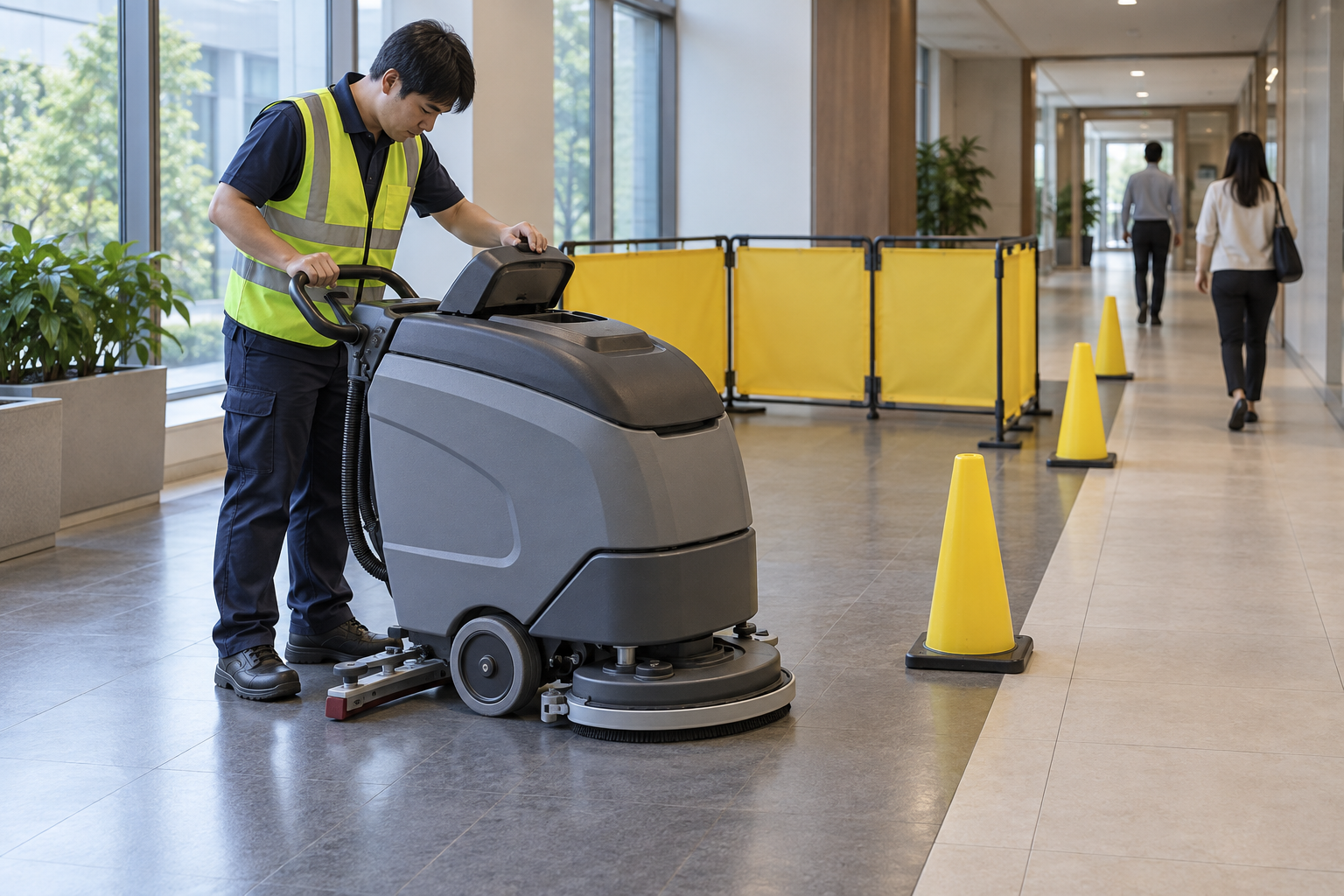
Retained AI-generated educational illustration from the source edition; not a real incident photograph, approved installation drawing or evidence of equipment suitability.
The scenario and record comparisons are fictional teaching examples, not records of real incidents, measurements, inspections, signatures or approvals.
| Item | Fictional scenario |
|---|---|
| Initial | A lobby is being scrubbed before a busy arrival period. |
| Change | A stripe of water remains behind the machine. |
| Failure | The operator repeats the pass while pedestrians enter. |
| Outcome | The recovery fault leaves a slip hazard despite visible warning signs. |
| Barrier | Close the affected route, recover the water, correct the fault and verify a safe floor before reopening. |
Why the controls matter
A warning sign does not separate pedestrians from a moving machine or wet strip. Define a protected route and crossings, then verify floor condition before reopening each segment.
Repeated passes cannot fix failed liquid recovery. Stop and protect a residual-water area, identify squeegee, vacuum, tank or hose faults and retest in a segregated area before continuing.
Key-off does not establish safe brush access. Isolate battery, charger and other relevant energy by the actual servicing procedure before clearing or maintenance. Wastewater goes to the approved route for its contents, not the nearest drain.
Decision sequence
| Step | Decision |
|---|---|
| Known | A stripe of water remains behind the machine. |
| Unknown | Actual condition, extent of damage and suitability of people and doors, travel clearance remain to be established. |
| Hold | The operator repeats the pass while pedestrians enter. |
| Evidence | Link people and doors, travel clearance, recovered floor, speed and handling, waste and cleaner, approved outlet to the affected equipment or work area. |
| Next | Close the affected route, recover the water, correct the fault and verify a safe floor before reopening. |
5. Conditional decisions and common errors
| Condition | Action | Evidence | Proceed when |
|---|---|---|---|
| Pedestrians enter | Stop and separate | Route and crossings | Area controlled |
| Water remains | Hold cleaning and access | Recovery-system check | Safe floor verified |
| Brush obstructed | Isolate before access | Battery and stored energy | Safe clearing method |
| Waste route unclear | Retain wastewater | Contents and disposal route | Route authorized |
Similar appearance, different evidence
The scenario and record comparisons are fictional teaching examples, not records of real incidents, measurements, inspections, signatures or approvals.
| Comparison | Supported decision | Insufficient basis |
|---|---|---|
| Condition | Route and crossings | Pedestrians enter has not been resolved. |
| Evidence | Battery and stored energy | A photograph or a completed-looking task without the relevant inspection record. |
| Release | Route authorized | Completion of one step does not release the excluded tasks in section 2. |
6. Roles and responsibilities
| Role | Responsibility |
|---|---|
| Work supervisor | Assign the task boundary, stop authority, interfaces and emergency communication for battery walk-behind floor scrubber. |
| Technical lead | Confirm Floor and route; Traffic timing; Slope and surface; Exit access. Resolve design and manufacturer limits before work. |
| Authorized crew | Apply Product identity; Dilution and PPE; Fill level; Floor and pad match. Stop when the working arrangement changes. |
| Inspector / receiving lead | Review People and doors; Travel clearance; Recovered floor; Speed and handling. Transfer Parking and power; Floor release; Fault and receiver; Key custody. |
Role labels allocate responsibilities; they do not confer a legal qualification. Verify the competence, training and authority required for the actual task.
Record and handoff perspective
| Stage | Record controls | Verification |
|---|---|---|
| Plan route | 1. Record floor and route2. Record traffic timing3. Record slope and surface | 1. Traffic timing2. Slope and surface3. Exit access |
| Fill approved solution | 1. Record product identity2. Record dilution and ppe3. Record fill level | 1. Dilution and PPE2. Fill level3. Floor and pad match |
| Test recovery | 1. Record test location2. Record pad and floor result3. Record squeegee and vacuum | 1. Pad and floor result2. Squeegee and vacuum3. Residual water |
| Clean controlled route | 1. Record people and doors2. Record travel clearance3. Record recovered floor | 1. Travel clearance2. Recovered floor3. Speed and handling |
| Drain wastewater | 1. Record waste and cleaner2. Record approved outlet3. Record hose and ppe | 1. Approved outlet2. Hose and PPE3. Spill result |
| Store and reopen | 1. Record parking and power2. Record floor release3. Record fault and receiver | 1. Floor release2. Fault and receiver3. Key custody |
7. Hold points and record comparison
| Hold point | Evidence before release | Actual record |
|---|---|---|
| HP-0 Start | Clean ordinary dirt from approved indoor hard flooring with a battery walk-behind scrubber, segregating pedestrians and collecting wastewater for a designated disposal route. | |
| HP-1 Plan route | Floor and route; Traffic timing; Slope and surface; Exit access | |
| HP-2 Test recovery | Test location; Pad and floor result; Squeegee and vacuum; Residual water | |
| HP-3 Recover fault | Isolation state; Brush and hose fault; Residual water control; Retest acceptance | |
| HP-4 Store and reopen | Parking and power; Floor release; Fault and receiver; Key custody |
These are internal hold points, not issued permits. Recheck affected points after a change, fault or shift handoff; link the actual approval record.
Record comparison
The scenario and record comparisons are fictional teaching examples, not records of real incidents, measurements, inspections, signatures or approvals.
The boxes are static record prompts, not interactive or saved approvals. A tick does not establish suitability or permission to restart. Record the evidence, person, time and unresolved issues; retain the change history.
| Record | Insufficient | Record checklist |
|---|---|---|
| Plan route | "Checked" without target, criteria or result | □ Floor and route□ Traffic timing□ Slope and surface□ Exit access |
| Fill approved solution | "Checked" without target, criteria or result | □ Product identity□ Dilution and PPE□ Fill level□ Floor and pad match |
| Clean controlled route | "Checked" without target, criteria or result | □ People and doors□ Travel clearance□ Recovered floor□ Speed and handling |
| Store and reopen | "Checked" without target, criteria or result | □ Parking and power□ Floor release□ Fault and receiver□ Key custody |
8. Site checklist and emergency response
| Check | Result | Person / action |
|---|---|---|
| □ Plan route: Floor and route | ||
| □ Inspect machine: Drive and stop | ||
| □ Fill approved solution: Product identity | ||
| □ Test recovery: Test location | ||
| □ Clean controlled route: People and doors | ||
| □ Recover fault: Isolation state | ||
| □ Drain wastewater: Waste and cleaner | ||
| □ Store and reopen: Parking and power | ||
| □ Emergency access and handoff restrictions |
Stop work
Stop for uncontrolled pedestrian entry, poor braking, leakage, abnormal brush motion, uncertain floor or slope compatibility, or failed recovery. Protect the wet area and do not reopen until the floor is safe.
Emergency response
Stop the machine safely and protect people from traffic and wet flooring. For serious injury call 911 and follow site first aid. Isolate the affected area after a chemical spill; use the SDS and trained response procedure rather than collecting an unknown spill with the scrubber.
9. Sources and review limits
Public-source review: 2026-10-13. Official regulation pages and specific technical references are distinguished below; no agency or manufacturer has approved this content.
| Source | Reviewed scope and limitation |
|---|---|
| OSHA 29 CFR 1910.22 | Keep walking surfaces safe; guard unsafe areas until corrected. |
| OSHA 29 CFR 1910.1200 | Chemical labels, safety data sheets and worker information. |
| OSHA 29 CFR 1910.147 | Covered general-industry servicing and stored energy. |
| Tennant T360 operator manual TN7100065 Rev 00 | June 2025 safety and operation scope reviewed: indoor hard floors, approved supplies, no flammable/reactive pickup, battery disconnection for maintenance. Model-specific slope values are not universal limits. |
| OSHA State Plans | Official overview of federal and State Plan jurisdiction and differing public-sector coverage, checked 2026-10-13. Individual state rules require a site-specific check. |
No site measurements, equipment manuals for the actual installation, inspection records or signed technical approvals were supplied. Confirm the applicable requirements and actual product instructions before use; record each criterion with its units, source and equipment or work-area ID.
10. PDF guidance and FAQ
PDF A covers basic task controls; B focuses on technical failures; C covers supervision, records and handover. The article has eight stages with four items per main cell; each PDF has six key stages with three items per main cell. P/S/R/A, measurements, confirmations and signatures remain blank for actual site assessment.
Content group
jsa-walkbehind-floor-scrubber
Does a sign allow pedestrians through?
No. Establish effective separation and controlled crossings.
Can another pass solve residual water?
First stop and diagnose the recovery problem; protect and restore the floor.
Is switching off enough for brush access?
No. Follow the actual model and applicable servicing isolation procedure.
Can wastewater go to any drain?
No. Identify its contents and the approved disposal route.
Has a professional approved this JSA?
This reference material was written and revised with AI. It has not been verified or approved by a professional. Review by a suitably qualified professional and required site approval are necessary before field use.
11. Revision history and authorship
This reference material was written and revised with AI. It has not been verified or approved by a professional. Review by a suitably qualified professional and required site approval are necessary before field use.
Korean source created 2026-09-25. This US edition adapts the Korean source; earlier editorial revisions do not constitute professional approval of this edition.
| Date | Edition | Change | Review status |
|---|---|---|---|
| 2026-09-25 | Korean source v1.0 | Source editorial publication or revision; retained as provenance of the Korean edition. | Editorial record only; no professional approval of this US edition. |
| 2026-10-13 | 1.0 | US localization: preserve task judgments; replace Korean legal applicability with scoped US references. | AI editorial and output checks; no professional technical approval. |