This is reference content written and revised with AI. It has not been verified or approved by a professional. Review by a suitably qualified professional and site authorisation are required before use.
Revision: the master JSA is organised into eight stages with four prompts in each main cell. Short conditional release criteria and sixteen record prompts separate evidence from approval. Three six-stage PDFs use task, technical-failure and supervision viewpoints; actual evaluation fields remain blank. Valid prior explanations, sources and history are retained. This is an editorial revision, not professional technical verification.
1. Legal and technical scope
Review update, 12 October 2026: the entries below identify the official material rechecked for this revision and its specific scope. Earlier source notes and dates are retained as revision history; they do not mean that every cited provision was reverified today. Full paid standards, actual equipment manuals, site calculations and approvals were not supplied or verified. Resolve their current applicability with a qualified reviewer before use.
| Source | Scope and limitations |
|---|---|
| OSHA — 1926.800 | Underground construction scope, access/accounting, communication and atmospheric assessment were consulted. Apply the underground oxygen criteria in this provision; do not silently substitute a general confined-space range. |
| OSHA — 1926.911 | Misfire restrictions support continued exclusion and authorised specialist control. No misfire treatment or dismantling instruction is reproduced. |
A. US underground-construction framework
This guide addresses US civil tunnel construction using drilling and blasting. It combines task-level hazard assessment with proposed internal permit-to-work controls. It is not a blast design, explosives-handling manual, or instruction for charging, connecting, initiating, or treating a misfire.
| Reference | Application to this guide |
|---|---|
| OSHA 29 CFR 1926.800, Subpart S | Underground construction, including access, shift information, atmospheric protection, ground conditions, drilling equipment, and emergency arrangements |
| OSHA 29 CFR 1926 Subpart U | Blasting and explosives controls, including qualifications, transportation, storage, restricted activities, warning, inspection, and misfire management |
| §1926.905(e), (f), and (k) | Examination of previous hole remnants and specific drilling restrictions |
| §1926.910 and §1926.911 | Post-blast inspection and management of misfire hazards |
| §1926.1153 | Respirable crystalline silica exposure controls |
| §1926.103 and applicable §1910.134 requirements | Respiratory protection |
| §1926.32(f) | Competent-person definition, including authority to take prompt corrective action |
B. Jurisdiction and qualifications
Determine whether federal OSHA or an OSHA-approved State Plan governs the work. Separately identify applicable federal explosives requirements, state blaster and explosives requirements, local permits, transportation rules, and project conditions. Do not treat this federal-baseline guide as a complete permit register for every state.
The Colorado location in the hypothetical case is illustrative. An actual Colorado project requires a current state and local applicability review before work begins.
A blaster's competence under §1926.901, an applicable state credential, an explosives license or permit, and employer authorization are separate matters. “Licensed Blaster-in-Charge” is not a single nationwide OSHA credential.
C. JSA and permit-to-work status
Does a tunnel drilling and blasting JSA replace regulatory permits or blaster qualifications?
No. A JSA supports identification and control of task hazards. The PTW described here is an internal authorization system, not a universal federal blasting-permit form. Neither document replaces applicable legal requirements, required qualifications, manufacturer restrictions, or technical approvals.
D. Underground construction versus confined spaces
Does OSHA's construction confined-space standard automatically apply to tunnel excavation?
No. Section 1926.1201(b)(2) excludes construction work regulated by Subpart S from Subpart AA. Evaluate separate spaces and activities according to their actual scope rather than automatically assigning every underground task a Subpart AA entry permit.
This distinction does not reduce the need to control dangerous atmospheres, restricted access, equipment movement, or rescue hazards.
2. Scope and required inputs
This revision is a safety analysis for authorised tunnel work. It covers the specialist plan, competence, custody, ignition-source restrictions, exclusion and evacuation, ventilation, atmospheric testing, ground stability and documented re-entry. Explosive formulations, charge calculations, detonator wiring, initiation-system construction, detailed blast patterns and misfire dismantling are outside this content. A suspected misfire means continued exclusion and referral to the authorised specialist, not a general-worker recovery task. Elapsed time alone never releases entry.
A. Work covered
The assessment covers shift handover, previous-round status review, face access, surveying, jumbo drill movement and drilling, transfer to specialist blasting personnel, evacuation verification, post-blast assessment, and controlled return to work.
Specialist explosives operations remain subject to separate lawful procedures and qualified supervision. No hole pattern, explosive quantity, firing arrangement, or misfire-treatment method is specified here.
B. Documentation register
| Document or record | Minimum review focus | Status |
|---|---|---|
| Jurisdiction and permit register | Applicable authorities, authorizations, conditions, locations, and validity | Verify project-specific legal requirements |
| Project method statement and JSA | Work boundaries, interfaces, hazards, controls, and change triggers | Project control supporting compliance |
| Approved technical documents | Ground support, equipment configuration, ventilation, and specialist blasting documents | Verify author, applicability, and approval |
| Previous-round handover | Unresolved findings, restricted locations, responsible persons, and release status | Essential input to the next cycle |
| Qualifications and appointments | Blaster competence, applicable credentials, competent-person duties, and employer authority | Verify each role separately |
| Equipment records | Model-specific instructions, inspections, maintenance, and defect closure | Confirm applicable regulatory requirements |
| Exposure-control documents | Silica controls, respiratory protection, noise management, and monitoring | Apply relevant standards |
| Atmospheric assessment plan | Contaminants, instruments, locations, criteria, frequency, and abnormal-condition response | Site-specific implementation |
| Evacuation and emergency plan | Personnel accounting, communications, access guards, rescue resources, and interfaces | Site-specific implementation |
| Internal PTW and hold-point records | Authorized scope, evidence, approvers, validity, suspension, and restart | Proposed project authorization system |
C. Boundaries and changes
Compressed-air work, mining operations, underwater blasting, and separate confined-space tasks require additional or different assessments. Do not extend this document to those activities without reviewing applicability.
Reassess when geology, water inflow, equipment, ventilation, personnel, adjacent operations, or the specialist blasting system changes.
3. Eight-stage JSA
| Job stage | Hazards and effects | Failure factors | Technical and procedural controls | Site verification | P | S | R | A |
|---|---|---|---|---|---|---|---|---|
| 1. Plan and handover | 1. Unreleased heading2. Unfound misfire3. Water inflow4. Lost emergency access | 1. Previous status omitted2. Specialist authority unclear3. Changed ground ignored4. No personnel count | 1. Review previous-round status2. Verify competent roles3. Review ground and water4. Plan escape and accounting | 1. Handover and restrictions2. Competence and permits3. Ground and water review4. Emergency and count plan | ||||
| 2. Inspect protected | 1. Rockfall at face2. Oxygen or gas hazard3. Falling support4. Unknown old hole | 1. Unprotected approach2. No valid air assessment3. Support defect ignored4. Face status unconfirmed | 1. Inspect from protected place2. Assess air before access3. Secure ground by design4. Refer suspect holes to blaster | 1. Ground inspection record2. Air results and instrument3. Support acceptance4. Specialist face clearance | ||||
| 3. Set drill jumbo | 1. Crushed by boom2. Vehicle collision3. Electrical contact4. Hose or cable damage | 1. Shared travel route2. Weak standing area3. Unprotected services4. Controls not checked | 1. Separate plant and people2. Check footing and stabilisers3. Protect feeds and services4. Test controls per manual | 1. Route and exclusion2. Plant standing check3. Service and cable condition4. Communication and stop test | ||||
| 4. Drill and stop | 1. Rotating rod entanglement2. Dust and noise exposure3. Ground change4. Stored energy injury | 1. Entry near moving rods2. Dust control ineffective3. Unexpected void or water4. Maintenance without isolation | 1. Exclude rotating equipment2. Control dust and exposure3. Stop for ground anomalies4. Isolate before intervention | 1. Drill-zone inspection2. Exposure-control records3. Ground-change report4. Isolation and restart check | ||||
| 5. Specialist handover | 1. Unauthorised explosive work2. Uncontrolled ignition source3. Lost material custody4. Conflicting nearby work | 1. Qualifications not checked2. Unapproved work interface3. Custody record incomplete4. Other trades remain | 1. Hand over to licensed team2. Control ignition sources3. Maintain specialist custody4. Suspend conflicting work | 1. Specialist authorisation2. Ignition-control check3. Custody and area record4. Interface release | ||||
| 6. Clear and secure | 1. Person in danger area2. Public enters zone3. Missed warning4. Premature return | 1. Count not reconciled2. Access unguarded3. Failed communication4. Authority unclear | 1. Verify evacuation and count2. Guard defined boundaries3. Check warning communication4. Keep control with specialist | 1. Evacuation record2. Boundary and guard check3. Communication confirmation4. Specialist decision record | ||||
| 7. Ventilate and assess | 1. Toxic post-event fumes2. Oxygen hazard3. Gas in blind heading4. Tester enters danger | 1. Time used as clearance2. Damaged ventilation duct3. Unrepresentative sampling4. Unprotected testing route | 1. Keep general access closed2. Restore planned ventilation3. Use competent air assessment4. Plan protected restricted checks | 1. Ventilation status2. Air results and location3. Instrument verification4. Restricted-entry authority | ||||
| 8. Inspect and release | 1. Loose rock or support2. Suspected misfire3. Loader strikes worker4. Hazard passed to next shift | 1. Visual check only2. Unresolved suspect material3. Shared mucking route4. Release not recorded | 1. Obtain specialist clearance2. Keep suspect area isolated3. Inspect ground and traffic4. Record next-task release | 1. Ground and support record2. Misfire-status handover3. Traffic and air checks4. Release and restrictions |
PDF A covers basic task controls; B focuses on technical failures; C covers supervision, records and handover. The article has eight stages with four items per main cell; each PDF has six key stages with three items per main cell. P/S/R/A, measurements, confirmations and signatures remain blank for actual site assessment.
4. Fictional scenario and failure mechanisms
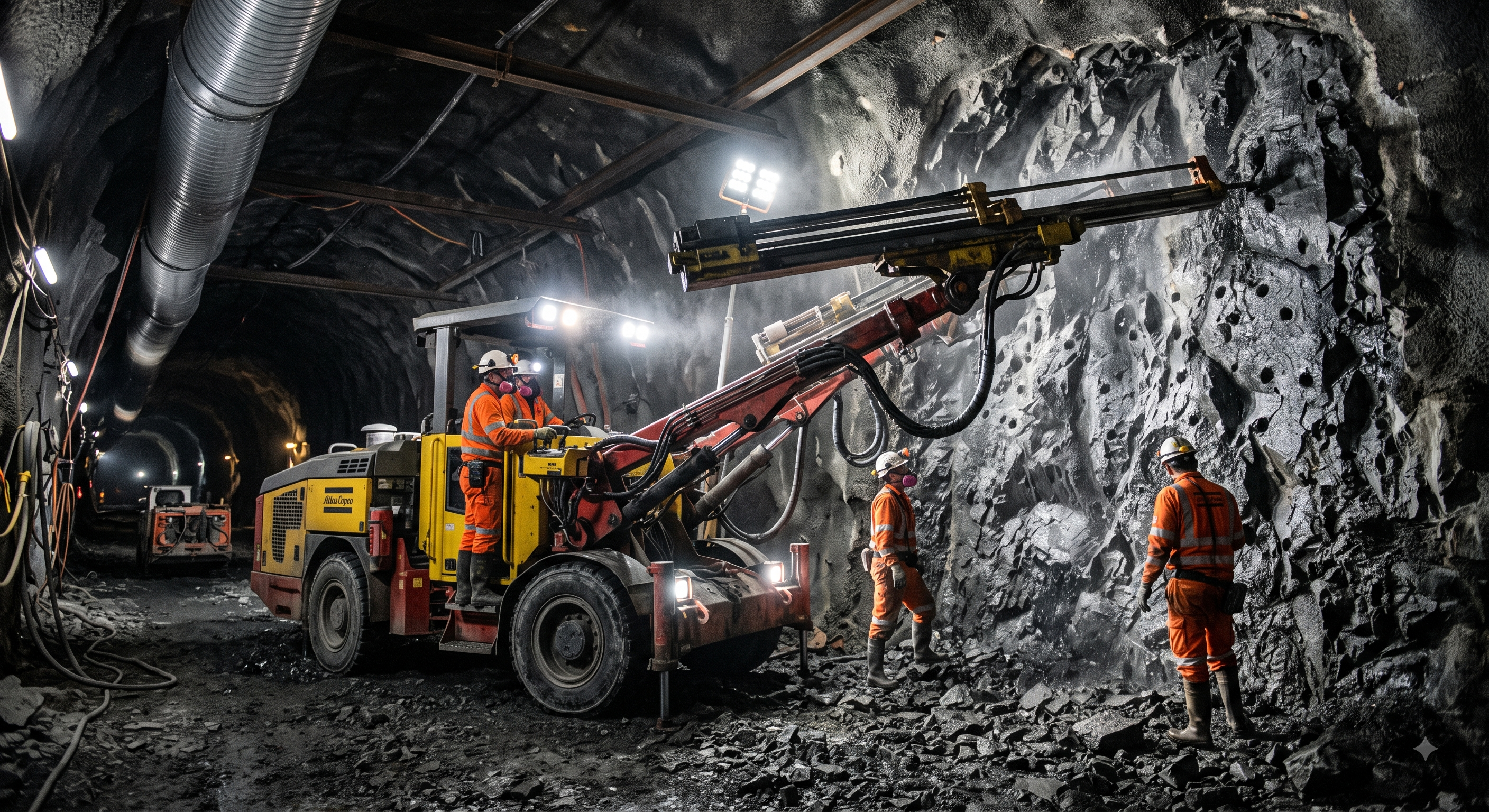
The following case is a hypothetical simulation for training and risk assessment. It does not represent an actual accident, an OSHA investigation, or an event involving an identified company. The image is illustrative and does not establish equipment performance or incident severity.
A. Initial conditions
A night-shift crew is preparing the next round in a deep mountain rail tunnel in Colorado. The previous blast has left hole remnants at the face. One location is assumed, for this scenario, to contain unexploded commercial explosives and an initiation component.
Information about an uncertain previous-round result has not been reliably transferred to the incoming crew.
B. Changing work conditions
Schedule pressure, fatigue, restricted visibility, and competing tasks weaken the handover process. The crew proceeds without the necessary specialist examination and drilling-area release.
The source scenario also assumes that planned face cleaning and visual checks were skipped. These omissions must not be presented as proof that high-pressure washing alone would have prevented the event. Routine cleaning is not misfire clearance.
C. Authorization and separation failures
The operator receives a marked drilling layout but no reliable confirmation that the work area has been released. A survey assistant remains close to the operating jumbo.
The drilling-start hold point fails to stop work, and the crew treats an incomplete previous-round record as acceptable.
D. Assumed mechanical progression and consequences
The drill intersects the suspect location. Mechanical disturbance initiates the remaining explosive material in this hypothetical sequence.
Blast loading and rock fragments severely damage the boom and breach the cab glazing. The operator and nearby survey assistant suffer fatal injuries. Secondary hazards include unstable rock, damaged services, and contaminated air.
These outcomes are scenario assumptions, not reconstructed forensic findings.
E. Engineering interpretation
• The continuing source of danger is unreacted explosive material, not pressure simply left inside an old hole.
• A sudden explosion imposes dynamic loading and fragment impact. Tunnel geometry can affect pressure propagation and reflection.
• Exact structural damage depends on conditions not established here. No blast calculation or equipment survivability assessment has been performed.
• Ordinary cab glazing and falling-object protection must not be assumed to provide blast protection.
• Even after the initial event, damaged ground support, toxic fumes, and unresolved explosives can endanger rescuers.
F. Failed protective barriers
| Barrier | Assumed failure | Improvement and verification evidence |
|---|---|---|
| Previous-round handover | Uncertain blast result not transferred | Location-linked findings and signed handover |
| Examination and area release | Drilling starts without verified clearance | Specialist findings and a recorded drilling hold-point release |
| Suspect-area exclusion | Uncertain location remains accessible | Physical boundary matched to the restriction record |
| Equipment-person separation | Survey assistant remains in the operating zone | Verified work-zone arrangement and access control |
| Stop-work authority | Schedule pressure overrides unresolved concerns | Clear escalation route and prohibition on informal release |
| Emergency access control | Potential for unprotected rescue entry | Incident command, specialist assessment, and prepared rescue resources |
G. Key lesson
A clean-looking face, an experienced operator, or a marked drilling pattern is not evidence that a previous-round hazard has been resolved. The protective system must connect inspection findings, exclusion boundaries, handover, and authorization.
5. Conditional decisions and common errors
| Condition | Action | Evidence | Proceed when |
|---|---|---|---|
| Air or ground not released | Restrict entry; arrange protected assessment of ventilation, atmosphere and support. | Representative gas readings, instrument checks and ground inspection. | Atmosphere and ground accepted for entry. |
| Drill jam or damaged hose | Stop and isolate; use the competent maintenance procedure. | Energy-isolation check, defect disposition and equipment inspection. | Defect resolved; guards and isolation checks complete. |
| Unreconciled person count | Maintain exclusion and locate everyone through the control system. | Entry/exit count, guard reports and clear escape routes. | Everyone accounted for; exclusion secured. |
| Suspected misfire or abnormal result | Keep the area closed; refer to the authorised specialist and preserve handover. | Specialist disposition, atmosphere and ground checks, release record. | Specialist release and all re-entry conditions satisfied. |
A. Bootlegs and suspected misfires
Is every bootleg a misfire containing unexploded explosives?
No. A bootleg is a remnant of a previously blasted hole. Its appearance does not establish whether explosive material remains.
Apply the examination and drilling restrictions in §1926.905 and the misfire controls in §1926.911 together. An internal approval cannot waive an express regulatory restriction.
• Stop and isolate when previous-round information or field findings are uncertain.
• Do not probe, drill, pick, or wash a suspect location as an improvised investigation.
• Refer suspected explosives to the authorized blaster; ordinary equipment operators must not attempt clearance.
• Do not confuse regulated post-blast wetting requirements with a blanket instruction to pressure-wash suspected unexploded explosives.
B. Ground control and mobile equipment
• Select scaling, support, and inspection arrangements for the actual ground condition and authorized access state.
• Keep survey personnel outside active equipment envelopes. Provide suitable platforms where elevated access is necessary; do not mandate an aerial lift for every marking task.
• Confirm the actual jumbo's support arrangement. Do not assume every model uses identical outriggers, interlocks, or hydraulic load paths.
• Inspect installed cameras and alarms, but do not treat them as substitutes for separation and effective signaling.
• Use the equipment-specific isolation procedure before maintenance or entry into movement zones.
C. Specialist explosives-work controls
Section 1926.900(k) contains controls addressing extraneous electrical energy and electric blasting caps, including transmitter precautions and electrical-storm suspension. Section 1926.904 concerns storage; it is not a blanket mobile-phone prohibition.
The project must implement the applicable regulatory provisions and system-specific instructions. Manufacturer guidance does not authorize the project to disregard federal requirements or substitute an informal exception.
• Verify personnel authority, applicable credentials, and the specialist procedure.
• Separate unrelated work from the controlled explosives operation.
• Establish compliant communication restrictions while maintaining an approved emergency communication method.
• Do not treat antistatic clothing or a material label such as “plastic” as proof that a tool or operation is safe.
• Do not assume one test instrument or test procedure applies to every initiation system.
D. Evacuation and clearance
Use project-specific danger-zone and protective-location decisions supported by competent technical review. Do not turn an equipment-separation distance or a radio-control distance into a personnel blast-clearance radius.
Under §1926.909, warnings and access protection must be coordinated with actual clearance of the affected area. A sounded siren is not evidence that everyone has left.
Include connected workings, potential breakthrough locations, contractors, visitors, and relevant surface interfaces in the clearance arrangements.
E. Post-blast atmosphere and re-entry
Can workers re-enter a tunnel once the post-blast waiting period has elapsed?
No. Comply with the applicable minimum waiting requirements in §1926.910 and any additional misfire restrictions. Elapsed time alone does not authorize return. Atmospheric conditions, the blaster's inspection, and ground hazards require separate confirmation.
Does a standard four-gas monitor detect all post-blast gases?
No. A configuration measuring oxygen, combustible gas, CO, and H₂S does not establish NO₂ concentrations. Check the actual instrument and sensor configuration.
Assessment essentials
• Identify contaminants and monitoring needs from the geology, work, previous findings, and ventilation conditions.
• Apply the underground-construction requirements in §1926.800(j), (k), and (p), including additional provisions where potentially gassy or gassy classifications apply.
• Confirm instrument suitability, calibration, functional checks, sampling limitations, and interpretation of results.
• Record representative locations and conditions; one favorable reading does not establish safety throughout connected areas.
• Do not use visible haze, odor, or fan run time as a substitute for evaluation.
• Do not send an unprotected worker into an unverified atmosphere to obtain a reading.
• Distinguish controlled specialist assessment from authorization for the general workforce to resume operations.
F. Silica, respiratory protection, and noise
Use a site-specific silica exposure-control approach under §1926.1153. Do not assume an underground jumbo operation satisfies a Table 1 entry unless the actual task and all relevant conditions match.
Where respirators are required, implement the applicable respiratory protection program, including suitable selection, medical evaluation, training, and fit testing for tight-fitting respirators. NIOSH approval alone does not establish task suitability.
A particulate respirator does not protect against oxygen deficiency or establish protection against blast gases. Engineering controls and suitable noise protection must also be assessed.
6. Roles and responsibilities
A. Distinct duties
| Role | Core responsibility | Important boundary |
|---|---|---|
| Employer and project management | Provide resources, coordinate employers, implement required controls, and maintain accountability | A PTW does not transfer away employer duties |
| Tunnel superintendent or work supervisor | Coordinate sequencing, work boundaries, briefings, and suspension | Must not override specialist restrictions |
| Blaster-in-charge | Direct the assigned specialist blasting work and required blasting inspections | Verify competence, applicable credentials, and employer authority |
| Atmospheric-monitoring competent person | Perform assigned monitoring and evaluate atmospheric hazards | Requires relevant capability and corrective authority, not just a training card |
| Ground-control responsible person | Assess ground and support conditions within the assigned scope | Ground clearance does not establish explosives clearance |
| Jumbo operator and spotter | Control equipment movement, verify signals, and report defects | Equipment experience is not blaster authorization |
| Safety and industrial-hygiene personnel | Support assessment, exposure control, verification, and escalation | Do not assume universal approval authority across disciplines |
| Access guards and accountability personnel | Maintain boundaries, report incursions, and reconcile personnel | Must not confirm clearance when information is incomplete |
| Workers and subcontractors | Follow controls, participate in briefings, and stop/report uncertain conditions | Informal instructions do not release a hold point |
B. Competent-person appointments
OSHA's competent-person concept includes the ability to recognize relevant hazards and authority to take corrective action. Record the assigned scope, experience, and authority. One appointment must not be treated as competence in every tunnel, explosives, respiratory, or geotechnical subject.
Supervision, records, handover
| Job stage | Technical and procedural controls | Site verification |
|---|---|---|
| Plan ownership | 1. Verify assigned authority2. Review previous-round status3. Plan escape and accounting | 1. Handover and restrictions2. Competence and permits3. Ground and water review |
| Team and equipment | 1. Record equipment evidence2. Separate plant and people3. Test controls per manual | 1. Route and exclusion2. Plant standing check3. Service and cable condition |
| Stage release | 1. Hold stage release2. Hand over to licensed team3. Suspend conflicting work | 1. Specialist authorisation2. Ignition-control check3. Custody and area record |
| Energy control | 1. Record energy controls2. Exclude rotating equipment3. Isolate before intervention | 1. Drill-zone inspection2. Exposure-control records3. Ground-change report |
| Inspection closure | 1. Close inspection defects2. Keep general access closed3. Plan protected restricted checks | 1. Ventilation status2. Air results and location3. Instrument verification |
| Shift handover | 1. Transmit limits and issues2. Obtain specialist clearance3. Record next-task release | 1. Ground and support record2. Misfire-status handover3. Traffic and air checks |
7. Hold points and record comparison
A. Proposed project authorization gates
These hold points are an internal management arrangement. They are not presented as an OSHA-prescribed universal permit format.
| Hold Point | Evidence required before release | Responsible verification | Stop condition |
|---|---|---|---|
| HP-1: Shift start | Current scope, authorizations, handover, and crew briefing | Supervisor and designated permit issuer | Missing documents or unresolved previous-round information |
| HP-2: Face access | Previous release status, access boundaries, and relevant atmospheric and ground findings | Assigned competent and specialist personnel | Unverified atmosphere, suspect explosives, or unstable ground |
| HP-3: Drilling start | Required examination, applicable drilling restrictions, and equipment readiness | Blaster-related verification, equipment inspection, and supervisor | Unexamined remnants, unresolved restrictions, or safety defects |
| HP-4: Specialist-work handover | Drilling anomalies, area transfer, authorized personnel, and segregation | Outgoing supervisor and blasting team | Incomplete handover or conflicting activities |
| HP-5: Pre-blast clearance | Personnel reconciliation, guards, communications, and required warnings | Blaster-in-charge and designated control personnel | Missing person, unguarded entry, communication failure, or storm restriction |
| HP-6: Controlled post-blast assessment | Applicable waiting restrictions, safe assessment arrangements, and permitted scope | Blaster and relevant competent persons | Unsafe or uncertain access conditions |
| HP-7: General return to work | Required inspection, atmospheric evaluation, ground findings, and closure of restrictions | Relevant specialists and designated work-release authority | Unresolved explosives concern or incomplete release evidence |
B. Permit fields
• Project, tunnel, heading, and affected area identification
• Work scope, crew, interfaces, and authorized activities
• Linked document numbers and revisions
• Verification evidence, names, signatures, and times
• Permit validity, suspension triggers, and revalidation conditions
• Separate status for specialist assessment and general work resumption
C. Revalidation
Suspend the affected authorization after an unexpected finding, ventilation failure, access breach, communication loss, equipment defect, or material change in conditions. Reassess before restart.
A risk score, uploaded attachment, timer, or single instrument reading must not automatically release a hold point.
Record comparison examples
The scenario and record comparisons are fictional teaching examples, not records of real incidents, measurements, inspections, signatures or approvals.
The boxes are static record prompts, not interactive or saved approvals. A tick does not establish suitability or permission to restart. Record the evidence, person, time and unresolved issues; retain the change history.
| Record type | Insufficient record | Record checklist |
|---|---|---|
| Plan and handover | “OK” | □ Handover and restrictions□ Competence and permits□ Ground and water review□ Emergency and count plan |
| Drill and stop | “OK” | □ Drill-zone inspection□ Exposure-control records□ Ground-change report□ Isolation and restart check |
| Clear and secure | “OK” | □ Evacuation record□ Boundary and guard check□ Communication confirmation□ Specialist decision record |
| Inspect and release | “OK” | □ Ground and support record□ Misfire-status handover□ Traffic and air checks□ Release and restrictions |
8. Site checklist and emergency response
A. Use at the relevant stage
Complete common items before the shift and repeat stage-specific checks immediately before the relevant authorization. Record the reason for any “Not applicable” decision.
| Check | Yes | No | N/A | Evidence or action |
|---|---|---|---|---|
| Are the jurisdiction, permits, and project conditions identified? | □ | □ | □ | |
| Has the incoming crew received previous-round findings and restrictions? | □ | □ | □ | |
| Are qualifications, appointments, and employer authorizations verified separately? | □ | □ | □ | |
| Are uncertain locations isolated and assigned to the appropriate specialist? | □ | □ | □ | |
| Have ground conditions, support, water, lighting, and access been reviewed? | □ | □ | □ | |
| Are surveyors and pedestrians separated from equipment movements? | □ | □ | □ | |
| Is the jumbo's pre-use inspection complete with safety defects corrected? | □ | □ | □ | |
| Are model-specific support and cable arrangements acceptable? | □ | □ | □ | |
| Are dust, silica, noise, and respiratory controls suitable for the task? | □ | □ | □ | |
| Are maintenance isolation and restart responsibilities clear? | □ | □ | □ | |
| Is specialist-work custody and area handover documented? | □ | □ | □ | |
| Are storm, electrical, transmitter, and communication controls coordinated? | □ | □ | □ | |
| Are all relevant entrances and connected workings included in evacuation control? | □ | □ | □ | |
| Does the verified headcount agree with personnel-accountability records? | □ | □ | □ | |
| Are ventilation condition and safe atmospheric-assessment arrangements confirmed? | □ | □ | □ | |
| Can the instruments actually measure the required contaminants, including NO₂ where applicable? | □ | □ | □ | |
| Are instrument checks, results, and acceptance criteria documented? | □ | □ | □ | |
| Are blaster inspection and ground findings available before general release? | □ | □ | □ | |
| Are rescue resources and prevention of unplanned rescue entry addressed? | □ | □ | □ | |
| Are remaining restrictions included in the next handover? | □ | □ | □ |
B. Failed checks
A failed or unverified critical check prevents release of the affected stage. Assign corrective action, retain completion evidence, and obtain reauthorization from the responsible person.
9. Sources and review limits
Review update, 12 October 2026: the entries below identify the official material rechecked for this revision and its specific scope. Earlier source notes and dates are retained as revision history; they do not mean that every cited provision was reverified today. Full paid standards, actual equipment manuals, site calculations and approvals were not supplied or verified. Resolve their current applicability with a qualified reviewer before use.
| Source | Scope and limitations |
|---|---|
| OSHA — 1926.800 | Underground construction scope, access/accounting, communication and atmospheric assessment were consulted. Apply the underground oxygen criteria in this provision; do not silently substitute a general confined-space range. |
| OSHA — 1926.911 | Misfire restrictions support continued exclusion and authorised specialist control. No misfire treatment or dismantling instruction is reproduced. |
A. Primary references
| Official source | Purpose |
|---|---|
| OSHA §1926.800 — Underground Construction | Underground-construction scope and safeguards |
| OSHA §1926.900 — General Provisions | General explosives controls, including electrical and transmitter hazards |
| OSHA §1926.901 — Blaster Qualifications | Blaster competence requirements |
| OSHA §1926.905 — Loading of Explosives or Blasting Agents | Previous-hole examination and applicable work restrictions |
| OSHA §1926.909 — Firing the Blast | Warning and area-clearance responsibilities |
| OSHA §1926.910 — Inspection After Blasting | Post-blast access restrictions and inspection |
| OSHA §1926.911 — Misfires | Misfire exclusion and specialist control |
| OSHA §1926.1201 — Scope | Subpart AA exceptions, including Subpart S work |
| OSHA §1926.1153 — Respirable Crystalline Silica | Silica exposure-control requirements |
| OSHA §1926.103 — Respiratory Protection | Construction respiratory-protection requirements |
| OSHA §1926.32 — Definitions | Competent and authorized person distinctions |
| ATF — Explosives | Federal explosives regulatory and licensing information |
B. Additional project-specific verification
Obtain current state and local explosives requirements, actual permit conditions, and equipment and system manuals. The references above do not certify compliance with a particular state's licensing scheme or a specific project.
For an actual Colorado project, verify current requirements with the responsible state explosives authority and relevant local authorities. No site-specific Colorado authorization has been verified for this guide.
C. Application priority
• Satisfy applicable law and enforceable permit conditions.
• Follow applicable manufacturer restrictions and approved technical documents together; project approval does not automatically override manufacturer limits.
• Apply additional site controls where the assessment requires them.
• Distinguish enforceable provisions, incorporated references, contractual standards, and advisory guidance.
• Where requirements conflict or applicability is uncertain, hold the work for competent resolution rather than selecting the least restrictive provision.
10. PDF guidance and FAQ
PDF A covers basic task controls; B focuses on technical failures; C covers supervision, records and handover. The article has eight stages with four items per main cell; each PDF has six key stages with three items per main cell. P/S/R/A, measurements, confirmations and signatures remain blank for actual site assessment.
The three PDF sheets are complementary extracts, not a complete work sequence. Apply all eight body stages and the applicable site procedure. PDF HP-0 to HP-4 are worksheet labels: match each to its event, evidence and responsible authority, not to the same number in a different permit or table. An omitted PDF stage is not permission to omit its controls.
A. Recommended record structure
The following fields are proposed for document organization and traceability. They do not confirm that every function is implemented or validated in the live service.
| Record group | Recommended fields | Intended use |
|---|---|---|
| Work identity | en-US, jurisdiction, project, heading, shift, and activity | Link the assessment to the actual work |
| Applicable requirements | Authority, permit, clause, document revision, and review date | Track applicability and validity |
| Previous-round status | Findings, uncertain locations, restrictions, and action owners | Prevent unresolved hazards passing into the next cycle |
| JSA controls | Step, hazard, failure mode, control, and verification evidence | Distinguish planned controls from verified implementation |
| Personnel and equipment | Appointments, credentials, model, and inspection status | Support role- and model-specific review |
| Atmosphere | Instrument, sensors, check status, readings, locations, and ventilation conditions | Preserve the basis of evaluation |
| Clearance | Personnel reconciliation, access guards, and communication checks | Track area-control evidence |
| Authorization | Hold-point status, verifier, approver, time, and suspension reason | Maintain an auditable approval history |
B. Automation boundaries
• Keep P, S, R, and A unassigned until the site's assessment and verification are complete.
• Do not automatically certify the absence of unexploded explosives or the safety of re-entry.
• Do not present generated clearance distances, transmitter controls, or ventilation durations as verified engineering outputs.
• Do not represent a completed form as an OSHA approval, blaster credential, or statutory permit.
• Require human review of unresolved conditions and changes before authorization.
Does a tunnel drilling and blasting JSA replace regulatory permits or blaster qualifications?
No. A JSA supports task-level hazard assessment, and an internal permit-to-work controls project authorization. Neither replaces applicable explosives licenses or permits, OSHA requirements, blaster qualifications, manufacturer instructions, or project-specific technical approvals.
Is every bootleg a misfire containing unexploded explosives?
No. A bootleg is a remnant of a previously blasted hole; it is not proof that unexploded explosives are present or absent. Required examination and drilling restrictions apply. Suspected unexploded explosives require work stoppage, exclusion, and referral to the authorized blaster. Washing or a casual visual check does not establish clearance.
Can workers re-enter a tunnel once the post-blast waiting period has elapsed?
No. Applicable waiting requirements are minimum restrictions, not automatic clearance. Ventilation, required atmospheric testing, the blaster's inspection, ground conditions, and unresolved misfire hazards must be addressed before the relevant entry or work-resumption authorization.
Does a standard four-gas monitor detect all post-blast gases?
No. Detection depends on the installed sensors. A monitor configured for oxygen, combustible gas, carbon monoxide, and hydrogen sulfide does not establish nitrogen dioxide concentrations. Select and verify instruments for the actual hazards, including sensor suitability, calibration, functional checks, and sampling limitations.
Does OSHA's construction confined-space standard automatically apply to tunnel excavation?
No. Section 1926.1201(b)(2) excludes construction work regulated by Subpart S from Subpart AA. Determine the applicable standard for the actual activity and space. This exclusion does not remove underground-construction requirements for atmospheric protection, access control, communications, or emergency response.
Has a professional verified or approved this document?
No. Public sources and editorial, layout and consistency checks were reviewed using AI. No site inspection or professional technical approval has been performed. Obtain appropriate professional review before use.
11. Revision history and authorship
A. Document status
This is an AI-assisted reference draft for qualified review before use. It does not establish a site inspection, professional approval or work authorization.
B. No unverified professional endorsement
Unless supported by a separate verifiable review record, this document must not be represented as prepared, reviewed, or approved by an actual engineer, blaster, safety professional, manufacturer, OSHA, or another government authority.
C. No physical inspection
The system has not physically inspected the tunnel, ground support, jumbo drill, explosives, ventilation installation, monitoring equipment, or actual working conditions. An image or completed input form cannot establish their condition.
D. Documents and decisions not replaced
This draft is not legal advice, a blast design, an explosives execution procedure, a manufacturer manual, a structural calculation, an inspection certificate, a qualification record, a finalized site JSA, or a work authorization.
It must not be used as an instruction for loading, connecting, initiating, or treating explosives.
E. Review before use
Personnel with the appropriate competence, qualifications, and authority must review the actual jurisdiction, permits, geology, equipment, work interfaces, exposure conditions, and emergency arrangements. Resolve outstanding issues and obtain project authorization before use.
F. Actual professional review record
Record any professional review actually performed with the following information.
• Reviewer's name and organization
• Qualifications and formal delegation of authority
• Scope reviewed
• Equipment and documents reviewed
• Review date and signature
• Limitations and exclusions
• Required corrections
• Conditions of approval and continuing validity
Legal and source review date: September 19, 2026. Recheck current regulations, applicable state and local requirements, permit conditions, and manufacturer documentation before actual use.
2026-10-12 · v2026.10.12
Revision: the master JSA is organised into eight stages with four prompts in each main cell. Short conditional release criteria and sixteen record prompts separate evidence from approval. Three six-stage PDFs use task, technical-failure and supervision viewpoints; actual evaluation fields remain blank. Valid prior explanations, sources and history are retained. This is an editorial revision, not professional technical verification.
This is reference content written and revised with AI. It has not been verified or approved by a professional. Review by a suitably qualified professional and site authorisation are required before use.
This revision is a safety analysis for authorised tunnel work. It covers the specialist plan, competence, custody, ignition-source restrictions, exclusion and evacuation, ventilation, atmospheric testing, ground stability and documented re-entry. Explosive formulations, charge calculations, detonator wiring, initiation-system construction, detailed blast patterns and misfire dismantling are outside this content. A suspected misfire means continued exclusion and referral to the authorised specialist, not a general-worker recovery task. Elapsed time alone never releases entry.