Planning, commissioning, launch, controlled EPB shield advance, muck removal, segment erection, backfill grouting and shift handover in a reviewed underground construction operation.
Apply the approved safe-stop and evacuation response for abrupt pressure or muck changes, unexpected water or soil inflow, ground or structure monitoring alarms, fire or gas alarms, failed ventilation, communications or escape arrangements.
Reference content written and revised with AI. It has not been verified or approved by a professional. Review by a suitably qualified professional and site approval are required before use.
1. Legal and technical scope
Apply OSHA 1926.800 to covered underground construction, including its access, personnel accounting, instruction, shift notification, communications, emergency, atmospheric and ventilation requirements as applicable. Compressed-air work has separate requirements under 1926.803 and is excluded from this routine production JSA. Project operating envelopes and specialist entry procedures must be established by the responsible qualified parties.
Determine Federal OSHA or the applicable OSHA-approved State Plan, including public/private employer coverage. State Plans must be at least as effective and can impose different or additional requirements. The actual activity determines construction versus general-industry scope. Manufacturer instructions, consensus standards, project design and site approvals have distinct roles; this page is not a finding of nationwide compliance.
| Basis | Application and limits |
|---|---|
| OSHA 1926.800 | Selected scope, access, accounting, instruction, notification, communications, emergency and atmospheric-control provisions. This JSA does not reproduce the complete underground-construction program. |
| OSHA 1926.803 | Separate compressed-air framework, including specialist medical and entry controls. No pressure-entry or decompression procedure is supplied here. |
| Herrenknecht EPB shield technical overview | Manufacturer concept description of conditioned muck support and screw discharge. It supplies neither project settings nor a chamber-entry procedure. |
2. Scope and required inputs
Included: Planning, commissioning, launch, controlled EPB shield advance, muck removal, segment erection, backfill grouting and shift handover in a reviewed underground construction operation.
Separate review: Slurry and hard-rock TBM operating methods, pressurized cutter-chamber entry, compression or decompression, specialist rescue and recovery design for uncontrolled inflow require separate qualified procedures.
| Input | Required evidence |
|---|---|
| Review ground and launch | Geology and groundwater basis; Structures and monitoring map; Launch and reaction acceptance; Operating and response envelope |
| Connect and commission | Guard and stop-function tests; Electrical and hydraulic checks; Communication and escape test; Monitoring ventilation and drainage |
| Control advance and muck | Ring position and time; Pressure thrust and discharge; Surface and structure monitoring; Escape ventilation and drainage |
| Transfer and approve restart | Trend alarm and action history; Open ring and monitoring issues; Current settings and limitations; Restart owner and surveillance |
Obtain the actual ground and groundwater model, adjacent-structure assessment, TBM configuration, launch and reaction design, synchronized instrumentation, operating envelope and alarm-response plan. Face pressure, thrust, screw operation and grout limits are project-specific. Maintain necessary ground-support and life-safety functions during a planned stop; this JSA provides no operating setpoints or chamber-entry authorization.
3. Eight-stage JSA
P = likelihood; S = severity; R = risk under the site method; A = acceptance or authorization as defined by the site. Leave these blank until actual assessment and control verification. A low score does not override a legal requirement, product limit or unreleased hold point.
| Job stage | Hazards and effects | Failure factors | Required controls | Site verification | P | S | R | A |
|---|---|---|---|---|---|---|---|---|
| 1. Review ground and launch | 1. Face instability2. Ground settlement3. Launch inflow4. Adjacent-structure damage | 1. Groundwater model incomplete2. Monitoring response absent3. Launch seals unreviewed4. Reaction design uncertain | 1. Review ground and water data2. Approve monitoring response3. Accept launch support and seals4. Confirm machine-specific plan | 1. Geology and groundwater basis2. Structures and monitoring map3. Launch and reaction acceptance4. Operating and response envelope | ||||
| 2. Assemble and control zone | 1. Falling heavy component2. Assembly crush3. Pressure release4. Unexpected rotation | 1. Component mass unknown2. Temporary support incomplete3. Energy boundary unclear4. Concurrent operation allowed | 1. Use component lift plans2. Provide accepted assembly support3. Identify energy sources4. Separate assembly from operation | 1. Mass center and lifting gear2. Temporary support and sequence3. Power pressure and gravity4. People and zone control | ||||
| 3. Connect and commission | 1. Erector strike2. Electrical or hydraulic injury3. Failed emergency response4. Loss of safe atmosphere | 1. Interlocks bypassed2. Connections untested3. Communications fail4. Ventilation not accepted | 1. Inspect system connections2. Test protective functions safely3. Test communications and escape4. Verify air and drainage readiness | 1. Guard and stop-function tests2. Electrical and hydraulic checks3. Communication and escape test4. Monitoring ventilation and drainage | ||||
| 4. Launch and begin advance | 1. Loss of face support2. Launch-seal damage3. Uncontrolled inflow4. Early ground movement | 1. Advance and discharge imbalance2. Launch support unaccepted3. Leakage ignored4. Monitoring baseline uncertain | 1. Use approved launch envelope2. Coordinate advance and discharge3. Observe seals and leakage4. Record synchronized early trends | 1. Launch support and sealing2. Pressure advance and muck trends3. Time and location alignment4. Ground response and alarms | ||||
| 5. Control advance and muck | 1. Ground loss or overpressure2. Conveyor entanglement3. Gas or fire exposure4. Unexpected soil inflow | 1. Single gauge trusted2. Muck system accessed running3. Air monitoring interrupted4. Blockage left unresolved | 1. Correlate operating trends2. Exclude access to moving systems3. Maintain air and fire controls4. Apply approved abnormal response | 1. Ring position and time2. Pressure thrust and discharge3. Surface and structure monitoring4. Escape ventilation and drainage | ||||
| 6. Erect ring and grout | 1. Segment fall2. Erector crush3. Lining deformation4. Tail leakage | 1. Support released too early2. People in rotation envelope3. Joint or seal defect4. Grout record missing | 1. Follow erection support sequence2. Clear erector envelope3. Inspect joints and seals4. Link grouting to ring records | 1. Segment and ring IDs2. Support and joint checks3. Seal damage and leakage4. Backfill quantity and condition | ||||
| 7. Stop and isolate for work | 1. Unexpected cutter motion2. Loss of support pressure3. Stored-energy release4. Unsafe chamber entry | 1. Stop confused with isolation2. Support functions shut blindly3. Pressure or gravity retained4. Entry scope not reviewed | 1. Apply engineered safe-stop plan2. Maintain required support functions3. Isolate task-specific energies4. Hold entry for separate procedure | 1. Support and life-safety state2. Cutter screw thrust isolation3. Pressure gravity and access limits4. Personnel and guard restoration | ||||
| 8. Transfer and approve restart | 1. Unexplained trend repeats2. Unresolved ring defect3. Ground effects worsen4. Lost operating restriction | 1. Alarm history omitted2. Defect location not linked3. Settings changed unrecorded4. Incoming shift unbriefed | 1. Transfer synchronized records2. Identify open ring and plant holds3. Review setting-change basis4. Authorize bounded restart | 1. Trend alarm and action history2. Open ring and monitoring issues3. Current settings and limitations4. Restart owner and surveillance |
4. Hypothetical scenario and failure mechanisms
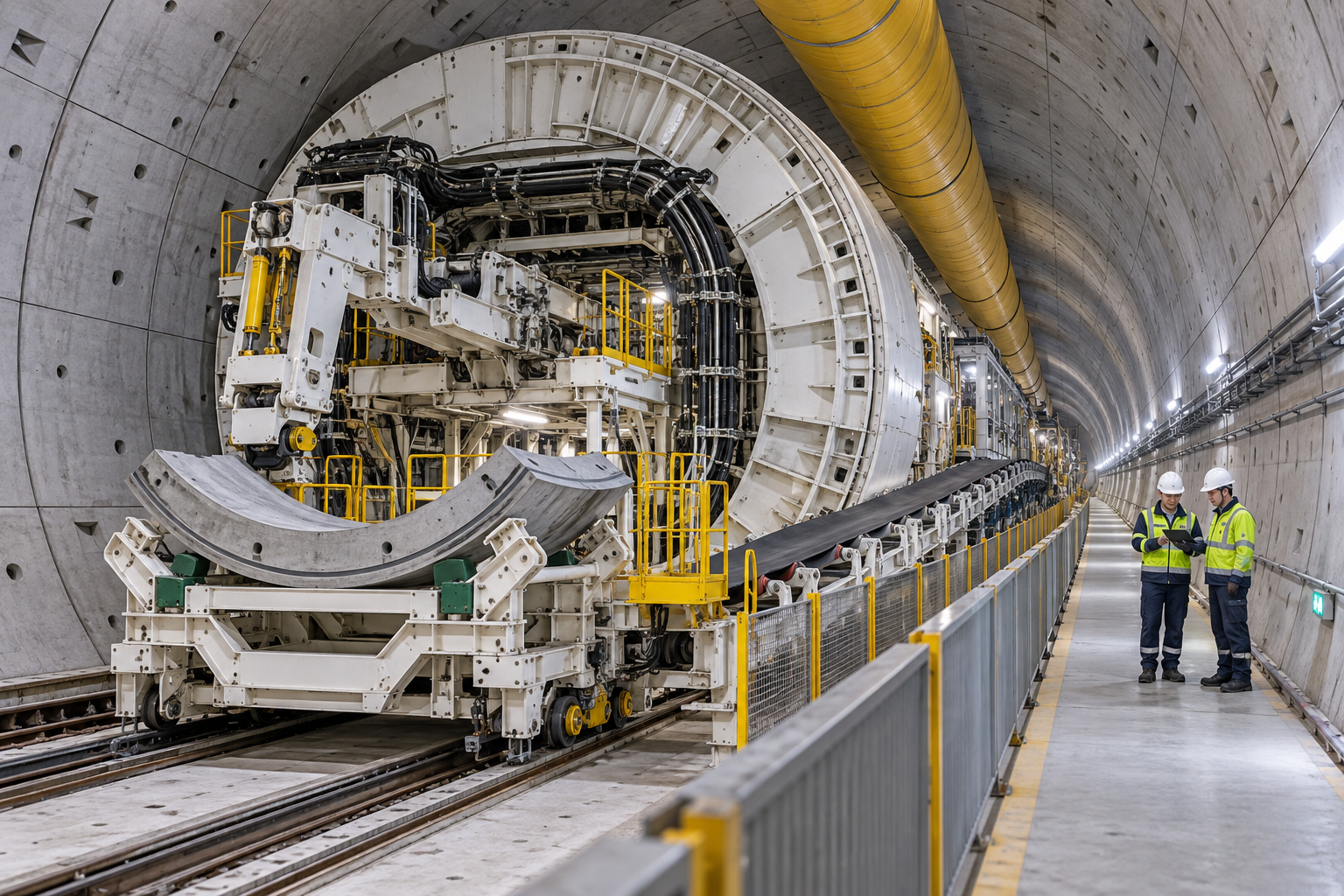 Retained source illustration: an AI-generated educational concept, not a real incident photograph or evidence of equipment suitability.
The following scenario, comparisons and example records are hypothetical teaching material. They do not reproduce actual incidents, measurements, signatures or approvals.
| Item | Hypothetical situation |
|---|---|
| Initial state | An EPB shield approaches a reviewed geological transition. |
| Change | Face-pressure trend and muck behavior change while advance continues. |
| Failure path | The operator proposes changing screw settings solely to return one gauge to its usual value. |
| Possible harm | Unexplained setting changes can aggravate face imbalance, ground loss or excessive ground loading. |
| Barrier | Apply the approved safe-stop response, correlate ring, position and time records, investigate ground, instrument and plant causes and obtain a documented restart decision. |
An EPB shield uses conditioned excavated material and controlled discharge to support the face. A single restored pressure indication does not establish overall face stability. Correlate advance, discharge, pressures and surface response under the actual approved operating plan.
A mismatch between advance and muck observations can arise from geological change, blockage, measurement uncertainty or other causes. Preserve the timing and location of changes; do not infer ground loss from one isolated quantity or correct an unexplained trend by trial settings.
Segment erection and backfill affect the support and water-control conditions behind the shield. Keep people outside the erector envelope, follow the specified support-release sequence and connect segment condition, joints, seals and grout records to the ring ID.
A safe production stop is distinct from maintenance isolation. Determine which systems must maintain ground support, drainage and ventilation while separately isolating hazardous cutter, screw, thrust and erector energies. Chamber entry, especially under pressure, requires its own specialist assessment and procedure.
| Decision | Reason and evidence |
|---|---|
| Known facts | Face-pressure trend and muck behavior change while advance continues. |
| Unresolved | The operator proposes changing screw settings solely to return one gauge to its usual value. |
| Hold reason | Apply the approved safe-stop and evacuation response for abrupt pressure or muck changes, unexpected water or soil inflow, ground or structure monitoring alarms, fire or gas alarms, failed ventilation, communications or escape arrangements. |
| Evidence needed | Support and life-safety state; Cutter screw thrust isolation; Pressure gravity and access limits; Personnel and guard restoration. |
| Next decision | Apply the approved safe-stop response, correlate ring, position and time records, investigate ground, instrument and plant causes and obtain a documented restart decision. |
5. Conditional decisions and common errors
| Condition | Action | Evidence | Proceed when |
|---|---|---|---|
| Pressure and muck change | Apply approved safe-stop response. | Synchronized operating and ground trends. | Cause and support state reviewed. |
| Ground alarm | Apply planned affected-area actions. | Ground and structure monitoring. | Response conditions satisfied. |
| Ring leakage or damage | Hold affected release and inspect. | Ring, joint, seal and grout records. | Disposition accepted. |
| Maintenance entry requested | Separate energy and entry review. | Pressure, isolation and access boundary. | Specific procedure authorized. |
| Comparison | Situation A | Situation B |
|---|---|---|
| Pressure display restored | Time-linked advance, muck and ground trends support the diagnosis. | Only the present pressure value is checked. |
| TBM stopped | Maintenance energies and entry boundaries are separately controlled. | Stopped production is treated as chamber-entry permission. |
6. Roles and responsibilities
| Role | Responsibility |
|---|---|
| Work supervisor | Confirm scope, task sequence, exclusion and stop authority. Coordinate review ground and launch with affected operations. |
| Technical reviewer | Resolve the actual design and equipment limits: Geology and groundwater basis; Structures and monitoring map; Launch and reaction acceptance; Operating and response envelope. |
| Work crew | Perform connect and commission using the approved procedure; report any mismatch before proceeding. |
| Inspector / assessor | Verify Segment and ring IDs; Support and joint checks; Seal damage and leakage; Backfill quantity and condition. Record what was actually checked and what remains unresolved. |
| Release / receiving authority | Confirm Trend alarm and action history; Open ring and monitoring issues; Current settings and limitations; Restart owner and surveillance. Transfer restrictions and the next permitted stage. |
These are responsibility examples, not invented statutory credentials. Meet the actual training, competent-person, qualified-person and licensing requirements for the assigned work. Anyone may raise a hazard and request a stop; only the designated authority may release the affected stage after evidence is reviewed.
7. Hold points and record comparison
| Hold point | Evidence before release | Confirmation / approval |
|---|---|---|
| HP-0 Start | Scope, jurisdiction, equipment identity, responsible people and emergency arrangements. | |
| HP-1 Connect and commission | Guard and stop-function tests; Electrical and hydraulic checks; Communication and escape test; Monitoring ventilation and drainage | |
| HP-2 Launch and begin advance | Launch support and sealing; Pressure advance and muck trends; Time and location alignment; Ground response and alarms | |
| HP-3 Erect ring and grout | Segment and ring IDs; Support and joint checks; Seal damage and leakage; Backfill quantity and condition | |
| HP-4 Transfer and approve restart | Trend alarm and action history; Open ring and monitoring issues; Current settings and limitations; Restart owner and surveillance |
Hold points are internal evidence gates. They do not replace statutory permits or actual signatures. Recheck affected gates after a change, abnormal event or shift transfer. The blank record must identify the evidence, person, time, limits and release scope.
| Record | Insufficient record | Record checklist |
|---|---|---|
| Advance | Normal pressure | □ Ring position and time□ Pressure thrust and discharge□ Surface and structure monitoring□ Escape ventilation and drainage |
| Ring | Looks complete | □ Segment and ring IDs□ Support and joint checks□ Seal damage and leakage□ Backfill quantity and condition |
| Maintenance | Machine stopped | □ Support and life-safety state□ Cutter screw thrust isolation□ Pressure gravity and access limits□ Personnel and guard restoration |
| Shift | No problems | □ Trend alarm and action history□ Open ring and monitoring issues□ Current settings and limitations□ Restart owner and surveillance |
The □ boxes are static prompts, not saved or interactive approvals. Each checks one record element. A tick alone does not establish suitability or permission to restart. Link equipment IDs and supporting records; retain unresolved matters and the earlier record when conditions change.
8. Site checklist and emergency response
| Check item | Result | Person / action |
|---|---|---|
| Geology and groundwater basis | ||
| Mass center and lifting gear | ||
| Guard and stop-function tests | ||
| Launch support and sealing | ||
| Ring position and time | ||
| Segment and ring IDs | ||
| Support and life-safety state | ||
| Trend alarm and action history | ||
| Emergency arrangements and unresolved restrictions communicated |
Stop work: Apply the approved safe-stop and evacuation response for abrupt pressure or muck changes, unexpected water or soil inflow, ground or structure monitoring alarms, fire or gas alarms, failed ventilation, communications or escape arrangements.
Emergency response: For inflow, fire or gas alarms, apply the approved underground emergency response, communications and evacuation plan while preserving designated life-safety functions. Account for personnel and contact the planned rescue service and 911 as appropriate. Do not enter a hazardous chamber or inflow area for an improvised rescue.
9. Sources and review limits
Official-source review date: October 14, 2026. The following review is limited to the public provisions or selected manufacturer material identified below. It does not establish that any authority approved this article or the actual installation.
- OSHA 1926.800: Selected scope, access, accounting, instruction, notification, communications, emergency and atmospheric-control provisions. This JSA does not reproduce the complete underground-construction program.
- OSHA 1926.803: Separate compressed-air framework, including specialist medical and entry controls. No pressure-entry or decompression procedure is supplied here.
- Herrenknecht EPB shield technical overview: Manufacturer concept description of conditioned muck support and screw discharge. It supplies neither project settings nor a chamber-entry procedure.
- OSHA State Plans: jurisdiction and coverage overview; identify the actual state program before use.
Paid consensus standards and site-specific calculations, manuals, inspection records and product certificates were not independently obtained or verified unless specifically identified. Korean legal citations remain in the preserved Korean source as source history; they are not represented as US legal duties.
10. PDF guidance and FAQ
PDF A covers basic task controls; B examines technical failures; C focuses on supervision, evidence and handover. Each has six rows and three items per main cell. They are complementary extracts: apply all eight body stages and the applicable site procedure. An omitted stage is not permission to omit its controls. PDF HP-0 through HP-4 are worksheet labels; match the event, evidence and authority rather than assuming they match another permit by number.
P/S/R/A, actual measurements, confirmations and signatures remain blank. The PDFs are uncompleted reference worksheets, not issued work permits.
Content group ID: jsa-tbm-excavation
Is a normal face-pressure value enough to restart?
No. Review the cause together with advance, muck, ground monitoring and the approved response plan.
Can the same settings be used for every TBM?
No. Machine type, geology, water pressure and project design govern the operating envelope.
Does stopping the TBM permit cutter-chamber entry?
No. Energy, pressure, atmosphere and entry controls require a separate procedure; pressurized entry is specialist work.
Can sound-looking segments replace grout records?
No. Link segment, joint, seal and backfill evidence to the actual ring.
Has a professional verified or approved this document?
No. This is AI-assisted reference material. Editorial and layout checks are not a physical inspection or professional technical approval. Obtain qualified professional review and required site approval before use.
11. Revision history and authorship
Reference content written and revised with AI. It has not been verified or approved by a professional. Review by a suitably qualified professional and site approval are required before use.
This system has not physically inspected the equipment, structures, ground, atmosphere or worksite. The document does not replace legal advice, manufacturer procedures, engineering design, inspection certificates, qualification evidence, the site risk assessment or an actual work permit.
Before use, a suitably qualified and authorized person must review the actual equipment, loads, methods, protection, inspection and emergency arrangements and resolve open issues. Record the real reviewer, organization, qualifications, delegated authority, reviewed documents, date, signature, exclusions and conditions of approval separately.
| Date | Version | Change | Review status |
|---|---|---|---|
| 2026-09-19 | 1.0 | Korean source revision retained in the source snapshot. | Historical editorial status; not US professional approval. |
| 2026-09-30 | 1.1 | Korean source revision retained in the source snapshot. | Historical editorial status; not US professional approval. |
| 2026-10-14 | US 1.0 | US localization of the assigned Korean source; task reasoning, educational image and history retained; US scope and sources reviewed. | AI-assisted editorial work; professional approval not performed. |