Heat and cooling create uneven expansion and contraction in a broad bottom plate. Foundation contact and restraint affect how the plate responds. A plate can lift or buckle even when the bead looks continuous; pressing it flat does not resolve the cause.
This is reference content written and revised with AI. It has not been verified or approved by a professional. Review by a suitably qualified professional and site authorization are required before use.
Stop before starting
Stop plate movement for unstable support, rigging problems, loss of signals or entry into pinch zones. Hold welding and covering for changed sequence, unexpected plate lift, cracking, unknown backside combustibles, lost ventilation or unreviewed enclosure conditions.
1. Legal and technical scope
| Basis | Scope and limits |
|---|---|
| OSHA 1926.352 | Fire prevention, backside exposure and continuing fire-watch conditions. |
| OSHA 1926.353 | Welding ventilation and protection. |
| OSHA 1926.1203 | Construction confined-space identification and evaluation. |
| TWI distortion control | General fabrication sequence and restraint principles; not tank-specific acceptance. |
This construction task requires applicable arc-welding, fire-prevention and ventilation controls under 1926.351, 1926.352 and 1926.353. Determine confined-space conditions under 1926.1203 as assembly changes. TWI explains distortion mechanisms; it does not establish tank-code, WPS or leak-test acceptance. Use the actual governing tank design/code and inspection plan, and check State Plan requirements.
2. Scope and required inputs
Included work
Surveying an accepted foundation, receiving and arranging bottom plates for a new tank, fitting and welding in the approved sequence, observing distortion, completing specified inspections and transferring restrictions to subsequent assembly.
Separate assessment
Used-tank repair, hot work with unknown residues, confined-space entry or test execution and improvised heat straightening require separate plans. Reassess access and atmosphere as tank construction encloses the space.
| Required input | Evidence to obtain |
|---|---|
| Review foundation and plate plan | Foundation elevations; Plate grade size weight; Layout and WPS; New-tank scope |
| Receive and secure plates | Rigging rating direction; Edges and hand protection; Signals and route; Wind and storage |
| Prepare electrical hot work | Fire protection and watch; Insulation and return; Fume-control method; Space assessment |
| Lift arrange and fit | Lift balance and exclusion; Hands and feet clear; Support and contact; Fit-up and walk route |
No actual equipment model, SDS, site measurements, design calculations or authorization record was supplied. Product-specific limits and methods must be verified before use. Federal OSHA is a baseline within its scope; determine the applicable State Plan and local requirements. Manufacturer guidance is not government approval; an incorporated standard differs from voluntary guidance. No nationwide-compliance or expert-approval claim is made.
3. Eight-stage JSA
| Job stage | Hazards and effects | Failure factors | Technical and procedural controls | Site verification | P | S | R | A |
|---|---|---|---|---|---|---|---|---|
| 1. Review foundation and plate plan | 1. Foundation settlement2. Plate overturn3. Weld distortion4. Residue fire | 1. Survey absent2. Weight unknown3. Sequence unplanned4. New used status confused | 1. Survey support and drainage2. Match plate identity3. Approve layout and welding4. Confirm tank history | 1. Foundation elevations2. Plate grade size weight3. Layout and WPS4. New-tank scope | ||||
| 2. Receive and secure plates | 1. Plate drop2. Sharp-edge cut3. Vehicle strike4. Wind displacement | 1. Lifting device unsuitable2. Edges unprotected3. Routes mixed4. Stack unrestrained | 1. Verify plate lifting method2. Select edge protection3. Separate delivery traffic4. Secure stored plates | 1. Rigging rating direction2. Edges and hand protection3. Signals and route4. Wind and storage | ||||
| 3. Prepare electrical hot work | 1. Backside fire2. Electric shock3. Fume buildup4. Unsafe atmosphere | 1. Combustibles unreviewed2. Return insulation poor3. Capture absent4. Space change ignored | 1. Review hot-work controls2. Inspect supply and return3. Provide effective ventilation4. Evaluate current enclosure | 1. Fire protection and watch2. Insulation and return3. Fume-control method4. Space assessment | ||||
| 4. Lift arrange and fit | 1. Plate swing2. Pinch injury3. Support collapse4. Trip at seam | 1. Balance unchecked2. Hands in gap3. Blocks unsuitable4. Levels unmarked | 1. Check balance safely2. Use alignment tools3. Use stable supports4. Mark walk routes and steps | 1. Lift balance and exclusion2. Hands and feet clear3. Support and contact4. Fit-up and walk route | ||||
| 5. Weld and observe | 1. Arc exposure2. Plate uplift3. Fume accumulation4. Fire spread | 1. Screens absent2. Sequence changed3. Hood displaced4. Backside watch missed | 1. Maintain arc protection2. Follow approved sequence3. Keep capture effective4. Watch hidden spark paths | 1. Eye protection and screens2. Sequence and distortion3. Ventilation condition4. Backside fire condition | ||||
| 6. Inspect and disposition | 1. Concealed leak path2. Test exposure3. Plate thinning4. Repair distortion | 1. Scope incomplete2. Test unapproved3. Excess grinding4. Repair criteria unclear | 1. Apply inspection plan2. Use separate test controls3. Respect removal limits4. Record repair and retest | 1. Method and seam map2. Test boundary and medium3. Thickness and repair limit4. Repair reinspection | ||||
| 7. Stop and secure area | 1. Smoldering fire2. Reenergization3. Loose-plate movement4. Unsafe access | 1. Watch stopped early2. Supply unattended3. Scrap unsecured4. Barriers removed | 1. Complete required fire watch2. Secure welding power3. Restrain remaining plates4. Maintain access protection | 1. Fire-watch closeout2. Supply safe state3. Stored plate restraints4. Steps and boundaries | ||||
| 8. Transfer next-stage limits | 1. Hidden seam defect2. Load distortion3. Opening fall4. Unauthorized use | 1. Records not located2. Later load unreviewed3. Protection missing4. Completion overclaimed | 1. Link plate seam records2. Set next-stage load limits3. Protect openings4. Release only accepted scope | 1. Layout weld inspection map2. Loading and support limits3. Opening and access state4. Recipient and holds |
P = likelihood; S = severity; R = risk under the site method; A = site-defined acceptance/authorization. These actual assessment cells are blank. A low score never overrides a missing safeguard or a legal or manufacturer restriction.
4. Fictional scenario and failure mechanisms
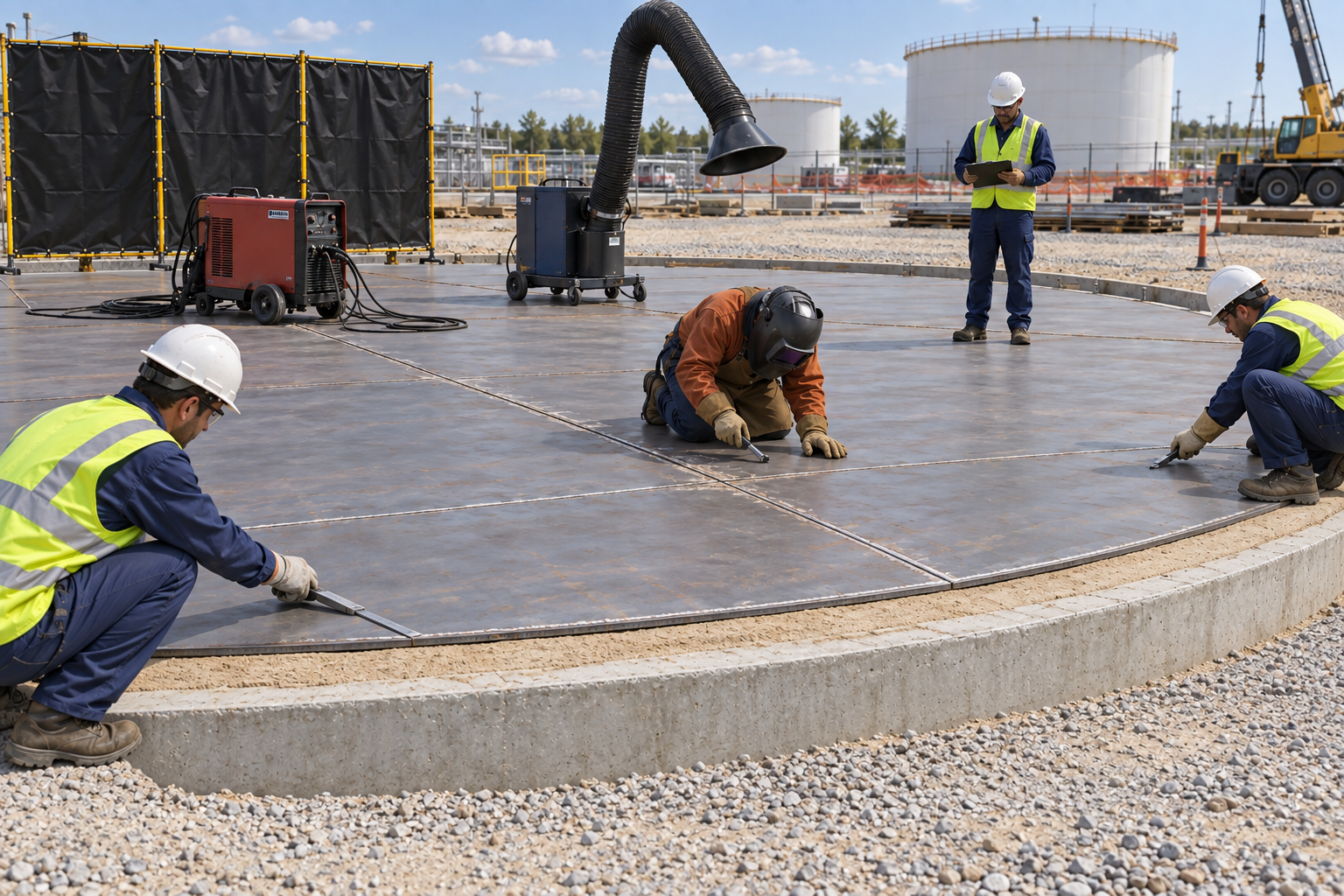
This illustration provides educational context. It is not an actual incident photograph or evidence of equipment suitability; any AI-generated depiction is illustrative only.
The scenario and record comparisons are fictional teaching examples, not records of real incidents, measurements, inspections, signatures or approvals.
| Stage | Fictional situation |
|---|---|
| Initial situation | A fictional crew welds bottom plates in a new tank. |
| Changed condition | To recover schedule, it proposes a long continuous weld in a changed sequence and postpones intermediate checks. |
| Failure path | Only the continuous bead appearance is used to judge completion. |
| Possible outcome | Unreviewed shrinkage and restraint could cause plate lift, buckling or concealed inspection gaps. |
| Prevention barrier | Hold the changed sequence and covering; record seam locations, support, restraint and observations, then obtain the technical disposition and required reinspection. |
Failure mechanisms
Heat and cooling create uneven expansion and contraction in a broad bottom plate. Foundation contact and restraint affect how the plate responds. A plate can lift or buckle even when the bead looks continuous; pressing it flat does not resolve the cause.
Tack locations, restraints and their removal sequence influence both fit-up and later movement. Follow the approved arrangement and WPS. Do not add tacks, cut restraints or stack heavy material to force a correction without review.
Bead appearance, flatness measurement and specified nondestructive or leak inspection check different features. Link plate and seam locations to inspection and repair records before they become concealed. Inspection completion does not authorize unrestricted equipment or material loads.
A new tank can develop confined-space hazards as walls and roof are added. Reassess the actual stage, access, ventilation and rescue conditions; a front-side fire watch alone cannot see combustible material behind or beneath the weld.
Work sequence: Review foundation and plate plan → Receive and secure plates → Prepare electrical hot work → Lift arrange and fit → Weld and observe → Inspect and disposition → Stop and secure area → Transfer next-stage limits. This is a teaching flow, not a device drawing or a complete operating procedure.
5. Conditional decisions and common errors
| Situation | Required action | Evidence | Proceed when |
|---|---|---|---|
| Foundation contact unstable | Hold fitting | Survey, supports and fit-up record | Support accepted |
| Sequence change proposed | Review thermal and restraint effects | WPS and sequence drawing | Change approved |
| Plate lifts or cracks | Mark and hold area | Location, distortion and inspection | Repair inspected |
| Next trade requests loading | Review inspection and loads | Seam map and permitted route | Handover authorized |
Similar observations, different decisions
The scenario and record comparisons are fictional teaching examples, not records of real incidents, measurements, inspections, signatures or approvals.
| Observation | Insufficient conclusion | Required distinction |
|---|---|---|
| Continuous weld bead | Visible weld deposited | Inspection completeness separate |
| Plate pressed flat | Shape restrained | Residual condition unproved |
| New tank | No previous service assumed | Current space hazards remain |
6. Roles and responsibilities
| Role | Responsibility |
|---|---|
| Work supervisor | Confirm foundation elevations and the task scope, resources, interfaces and stop authority. |
| Qualified technical reviewer | Review rigging rating direction, model limits, compatibility and unresolved technical conditions within assigned competence. |
| Work crew | Apply the listed controls, report changes and stop when evidence or safeguards are missing. |
| Inspector / assessor | Record actual eye protection and screens and other relevant checks; do not mark unverified conditions as accepted. |
| Handover authority | Reconcile layout weld inspection map, restrictions and outstanding actions before the next task. Role labels do not establish a legal credential. |
Supervision and handover focus
| Stage | Management action | Evidence |
|---|---|---|
| Review foundation and plate plan | 1. Record foundation elevations2. Record plate grade size weight3. Record layout and wps | 1. Foundation elevations2. Plate grade size weight3. Layout and WPS |
| Prepare electrical hot work | 1. Record fire protection and watch2. Record insulation and return3. Record fume-control method | 1. Fire protection and watch2. Insulation and return3. Fume-control method |
| Lift arrange and fit | 1. Record lift balance and exclusion2. Record hands and feet clear3. Record support and contact | 1. Lift balance and exclusion2. Hands and feet clear3. Support and contact |
| Weld and observe | 1. Record eye protection and screens2. Record sequence and distortion3. Record ventilation condition | 1. Eye protection and screens2. Sequence and distortion3. Ventilation condition |
| Stop and secure area | 1. Record fire-watch closeout2. Record supply safe state3. Record stored plate restraints | 1. Fire-watch closeout2. Supply safe state3. Stored plate restraints |
| Transfer next-stage limits | 1. Record layout weld inspection map2. Record loading and support limits3. Record opening and access state | 1. Layout weld inspection map2. Loading and support limits3. Opening and access state |
7. Hold points and record comparison
| Hold point | Evidence before release | Actual approval |
|---|---|---|
| HP-0 Scope | Surveying an accepted foundation, receiving and arranging bottom plates for a new tank, fitting and welding in the approved sequence, observing distortion, completing specified inspections and transferring restrictions to subsequent assembly. | |
| HP-1 Prepare electrical hot work | Fire protection and watch; Insulation and return; Fume-control method; Space assessment | |
| HP-2 Lift arrange and fit | Lift balance and exclusion; Hands and feet clear; Support and contact; Fit-up and walk route | |
| HP-3 Stop and secure area | Fire-watch closeout; Supply safe state; Stored plate restraints; Steps and boundaries | |
| HP-4 Transfer next-stage limits | Layout weld inspection map; Loading and support limits; Opening and access state; Recipient and holds |
Hold points are internal project checks. They are not universal statutory permits and do not grant work permission. Reassess after defects, changed conditions and shift changes.
Record comparison
The scenario and record comparisons are fictional teaching examples, not records of real incidents, measurements, inspections, signatures or approvals.
The boxes are static record prompts, not interactive or saved approvals. A tick does not establish suitability or permission to restart. Record the evidence, person, time and unresolved issues; retain the change history.
| Record | Insufficient record | Record checklist |
|---|---|---|
| Review foundation and plate plan | Only marked “OK” | □ Foundation elevations□ Plate grade size weight□ Layout and WPS□ New-tank scope |
| Lift arrange and fit | Only marked “OK” | □ Lift balance and exclusion□ Hands and feet clear□ Support and contact□ Fit-up and walk route |
| Stop and secure area | Only marked “OK” | □ Fire-watch closeout□ Supply safe state□ Stored plate restraints□ Steps and boundaries |
| Transfer next-stage limits | Only marked “OK” | □ Layout weld inspection map□ Loading and support limits□ Opening and access state□ Recipient and holds |
8. Site checklist and emergency response
| Site check | Actual result | Person / action |
|---|---|---|
| Review foundation and plate plan: Foundation elevations; Plate grade size weight; Layout and WPS; New-tank scope | ||
| Receive and secure plates: Rigging rating direction; Edges and hand protection; Signals and route; Wind and storage | ||
| Prepare electrical hot work: Fire protection and watch; Insulation and return; Fume-control method; Space assessment | ||
| Lift arrange and fit: Lift balance and exclusion; Hands and feet clear; Support and contact; Fit-up and walk route | ||
| Weld and observe: Eye protection and screens; Sequence and distortion; Ventilation condition; Backside fire condition | ||
| Inspect and disposition: Method and seam map; Test boundary and medium; Thickness and repair limit; Repair reinspection | ||
| Stop and secure area: Fire-watch closeout; Supply safe state; Stored plate restraints; Steps and boundaries | ||
| Transfer next-stage limits: Layout weld inspection map; Loading and support limits; Opening and access state; Recipient and holds |
Stop work
Stop plate movement for unstable support, rigging problems, loss of signals or entry into pinch zones. Hold welding and covering for changed sequence, unexpected plate lift, cracking, unknown backside combustibles, lost ventilation or unreviewed enclosure conditions.
Emergency response
Stop the heat source safely, clear unstable plate and fire zones and activate the site emergency response. Do not enter an unevaluated enclosed tank for rescue. Maintain support and access restrictions until competent responders establish safe conditions.
9. Sources and review limits
Public-source access/review: 2026-10-14.
| Official source | Reviewed scope and limits |
|---|---|
| OSHA 1926.352 | Fire prevention, backside exposure and continuing fire-watch conditions. |
| OSHA 1926.353 | Welding ventilation and protection. |
| OSHA 1926.1203 | Construction confined-space identification and evaluation. |
| TWI distortion control | General fabrication sequence and restraint principles; not tank-specific acceptance. |
No actual equipment model, SDS, site measurements, design calculations or authorization record was supplied. Product-specific limits and methods must be verified before use. Federal OSHA is a baseline within its scope; determine the applicable State Plan and local requirements. Manufacturer guidance is not government approval; an incorporated standard differs from voluntary guidance. No nationwide-compliance or expert-approval claim is made.
10. PDF guidance and FAQ
PDF A covers basic task controls; B focuses on technical failures; C covers supervision, records and handover. The article has eight stages with four items per main cell; each PDF has six key stages with three items per main cell. P/S/R/A, measurements, confirmations and signatures remain blank for actual site assessment.
PDFs are complementary six-stage extracts. Apply all eight body stages and the actual equipment/site procedure.
Can a lifted plate be flattened with stored material?
Do not improvise extra loading. Review foundation contact, restraint and distortion and use an accepted correction method.
Does a good-looking bead replace leak testing?
No. Complete the inspection methods and scope required by the governing design and inspection plan.
Does bottom-plate acceptance permit all later loads?
No. Transfer specific stacking, route, support and subsequent-work restrictions.
Has a professional verified or approved this document?
No. Public sources and editorial, layout and consistency checks were reviewed using AI. No site inspection or professional technical approval has been performed. Obtain appropriate professional review before use.
11. Revision history and authorship
This is reference content written and revised with AI. It has not been verified or approved by a professional. Review by a suitably qualified professional and site authorization are required before use.
| Date | Version | Change | Review status |
|---|---|---|---|
| 2026-10-14 | US 1.0 | New US edition from assigned Korean source; task decisions, records and PDFs localized. | AI editorial review; no professional technical approval |
Korean edition revision history: 2026-09-19 (v1.1): earlier published draft/version retained in the source history; 2026-09-26 (v1.2): task decisions, record checklist, JSA and three PDF variants revised. These are editorial records, not professional technical approval. US v1.0 adapts the earlier edition to United States requirements and terminology.
Site reviewers must add their actual qualifications, scope, date and approval only after the review occurs.