A tack weld may hold fit-up without being an accepted load-carrying connection for the next construction stage. Removing a support changes the load path. Its release needs the specified joint condition, remaining support and inspection evidence.
This is reference content written and revised with AI. It has not been verified or approved by a professional. Review by a suitably qualified professional and site authorization are required before use.
Stop before starting
Stop for member or support movement, unverified support-release conditions, cracked tacks, damaged electrical insulation, loss of ventilation or fire protection, or departure from the approved WPS. Do not continue a defective joint merely to finish the run.
1. Legal and technical scope
| Basis | Scope and limits |
|---|---|
| OSHA 1926.351 | Construction arc-welding holders, cables, current return and machine grounding. |
| OSHA 1926.352 | Construction fire prevention and fire-watch conditions. |
| OSHA 1926.353 | Ventilation and protection for actual welding conditions. |
For construction arc welding, apply 1926.351 equipment and electrical provisions, 1926.352 fire prevention and 1926.353 ventilation/protection. Steel-erection stability rules apply where the work is within Subpart R. General-industry fabrication requires the relevant Part 1910 welding provisions instead. Resolve State Plan requirements. The governing design/code, welder qualification, WPS and consumable instructions determine acceptance; no universal current, drying or support-release value is assigned.
2. Scope and required inputs
Included work
Identifying and supporting steel members, preparing SMAW equipment and electrodes, welding to the applicable WPS, removing slag, completing specified inspection and handing over joint and support status.
Separate assessment
Structural erection design, lifting plans, changes to temporary support, confined-space or elevated access plans and internal electrical repairs require separate competent review.
| Required input | Evidence to obtain |
|---|---|
| Review member and joint | Support and release plan; Member and joint IDs; WPS and electrode lot; Inspection and release scope |
| Prepare work zone | Access and lower zone; Combustibles and watch; Fume and eye protection; Supply insulation and moisture |
| Support and fit up | Supports and restraints; Temporary-joint approval; Fire controls and watch; Coating removal basis |
| Prepare welder | Insulation and connections; Machine grounding; Return path and clamp; Ventilation position |
No actual equipment model, SDS, site measurements, design calculations or authorization record was supplied. Product-specific limits and methods must be verified before use. Federal OSHA is a baseline within its scope; determine the applicable State Plan and local requirements. Manufacturer guidance is not government approval; an incorporated standard differs from voluntary guidance. No nationwide-compliance or expert-approval claim is made.
3. Eight-stage JSA
| Job stage | Hazards and effects | Failure factors | Technical and procedural controls | Site verification | P | S | R | A |
|---|---|---|---|---|---|---|---|---|
| 1. Review member and joint | 1. Member instability2. Wrong joint3. Unsuitable electrode4. Missed inspection | 1. Support change unreviewed2. Drawing confused3. WPS mismatched4. Release owner absent | 1. Verify staged load path2. Match joint IDs3. Confirm WPS and consumables4. Define inspection authority | 1. Support and release plan2. Member and joint IDs3. WPS and electrode lot4. Inspection and release scope | ||||
| 2. Prepare work zone | 1. Fall2. Spark ignition3. Fume exposure4. Electric shock | 1. Access unaccepted2. Openings unprotected3. Capture absent4. Wet damaged insulation | 1. Check platform and access2. Protect spark destinations3. Prepare ventilation screens4. Review electrical conditions | 1. Access and lower zone2. Combustibles and watch3. Fume and eye protection4. Supply insulation and moisture | ||||
| 3. Support and fit up | 1. Steel overturn2. Gap crush3. Hidden fire4. Coating fume | 1. Support capacity unknown2. Tacks treated as final3. Backside unprotected4. Coating unidentified | 1. Secure stable support2. Follow fit-up sequence3. Protect openings and backside4. Identify base and coating | 1. Supports and restraints2. Temporary-joint approval3. Fire controls and watch4. Coating removal basis | ||||
| 4. Prepare welder | 1. Shock2. Cable overheating3. Stray current4. Fume buildup | 1. Holder damaged2. Cable underrated3. Return path poor4. Hood misplaced | 1. Inspect holder and leads2. Verify electrical protection3. Connect accepted return4. Establish effective capture | 1. Insulation and connections2. Machine grounding3. Return path and clamp4. Ventilation position | ||||
| 5. Weld to WPS | 1. Arc-eye injury2. Spatter burn3. Weld defect4. Loss of balance | 1. Screen absent2. Clothing wet3. Electrode settings wrong4. Posture unsupported | 1. Use selected arc protection2. Keep insulation dry3. Follow qualified procedure4. Maintain stable access | 1. Filter and screens2. Dry gloves and clothing3. Electrode and settings4. Interpass and joint checks | ||||
| 6. Clean and inspect | 1. Slag eye injury2. Residual-heat burn3. Smoldering fire4. Defect transfer | 1. Face unprotected2. Heat tested by hand3. Watch ended early4. Support released early | 1. Protect eyes and face2. Mark hot surfaces3. Continue required fire watch4. Separate inspection and release | 1. Slag removal2. Cooling and hot markings3. Fire-watch closeout4. Inspection and support basis | ||||
| 7. Hold defects or movement | 1. Member crush2. Missed affected joint3. Repeated shock4. Recurring defect | 1. Tack alone trusted2. Stop time unrecorded3. Damaged lead reused4. Repair cause unknown | 1. Hold support changes2. Mark affected joints3. Isolate defective equipment4. Review repair and restart | 1. Displacement and support2. Joint and stop time3. Electrical correction4. Repair and reinspection | ||||
| 8. Close and hand over | 1. Uninspected joint used2. Premature support release3. Hidden fire4. Lost traceability | 1. Appearance equals acceptance2. Release evidence absent3. Residual heat ignored4. Lot linkage missing | 1. Transfer inspection scope2. Confirm support decision3. Close fire-watch duties4. Link joint records | 1. Accepted and held joints2. Support-release authority3. Heat and watch record4. WPS lot and restrictions |
P = likelihood; S = severity; R = risk under the site method; A = site-defined acceptance/authorization. These actual assessment cells are blank. A low score never overrides a missing safeguard or a legal or manufacturer restriction.
4. Fictional scenario and failure mechanisms
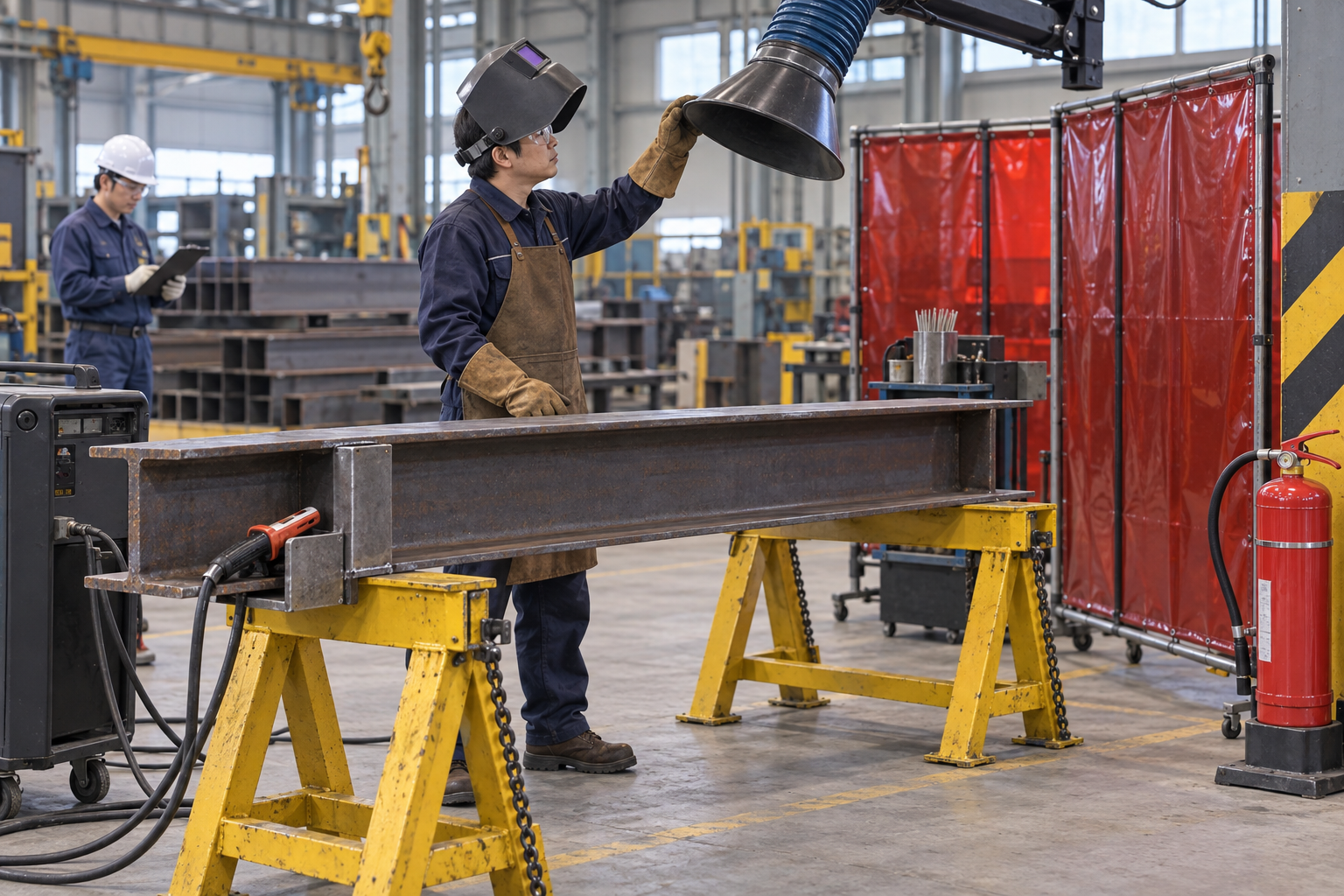
This illustration provides educational context. It is not an actual incident photograph or evidence of equipment suitability; any AI-generated depiction is illustrative only.
The scenario and record comparisons are fictional teaching examples, not records of real incidents, measurements, inspections, signatures or approvals.
| Stage | Fictional situation |
|---|---|
| Initial situation | A fictional crew tack-welds members held by temporary supports. |
| Changed condition | A worker proposes removing a support because the joint appears attached. |
| Failure path | The post-removal load path and tack capacity have not been reviewed. |
| Possible outcome | The member could move or overturn and damage the joint. |
| Prevention barrier | Hold support release, control access if movement occurs and verify the approved support transition and required inspection before proceeding. |
Failure mechanisms
A tack weld may hold fit-up without being an accepted load-carrying connection for the next construction stage. Removing a support changes the load path. Its release needs the specified joint condition, remaining support and inspection evidence.
Repairing a tack, completing the weld, passing an inspection and releasing temporary support are different decisions. Link each to the member and joint ID; mark uninspected or unresolved sections instead of treating the whole member as accepted.
The welding-current return and protective machine grounding have different purposes. Verify both, together with holder insulation, cable capacity, dry working conditions and ventilation. Electrode appearance does not prove storage or required conditioning history.
Work sequence: Review member and joint → Prepare work zone → Support and fit up → Prepare welder → Weld to WPS → Clean and inspect → Hold defects or movement → Close and hand over. This is a teaching flow, not a device drawing or a complete operating procedure.
5. Conditional decisions and common errors
| Situation | Required action | Evidence | Proceed when |
|---|---|---|---|
| Tack cracks or member moves | Hold welding and support changes | Member, tack and load-path review | Stability accepted |
| Cable insulation damaged | Remove equipment from use | Repair and electrical verification | Equipment accepted |
| Electrode history absent | Segregate consumables | Lot, storage and WPS requirements | Consumables accepted |
| Weld inspection passes | Check release scope | Joint results and support plan | Stage authorized |
Similar observations, different decisions
The scenario and record comparisons are fictional teaching examples, not records of real incidents, measurements, inspections, signatures or approvals.
| Observation | Insufficient conclusion | Required distinction |
|---|---|---|
| Tack present | Fit-up attachment | Load capacity unproved |
| Return lead attached | Current path started | Machine grounding separate |
| Weld accepted | Inspected joint scope | Whole-stage release separate |
6. Roles and responsibilities
| Role | Responsibility |
|---|---|
| Work supervisor | Confirm support and release plan and the task scope, resources, interfaces and stop authority. |
| Qualified technical reviewer | Review access and lower zone, model limits, compatibility and unresolved technical conditions within assigned competence. |
| Work crew | Apply the listed controls, report changes and stop when evidence or safeguards are missing. |
| Inspector / assessor | Record actual filter and screens and other relevant checks; do not mark unverified conditions as accepted. |
| Handover authority | Reconcile accepted and held joints, restrictions and outstanding actions before the next task. Role labels do not establish a legal credential. |
Supervision and handover focus
| Stage | Management action | Evidence |
|---|---|---|
| Review member and joint | 1. Record support and release plan2. Record member and joint ids3. Record wps and electrode lot | 1. Support and release plan2. Member and joint IDs3. WPS and electrode lot |
| Prepare work zone | 1. Record access and lower zone2. Record combustibles and watch3. Record fume and eye protection | 1. Access and lower zone2. Combustibles and watch3. Fume and eye protection |
| Prepare welder | 1. Record insulation and connections2. Record machine grounding3. Record return path and clamp | 1. Insulation and connections2. Machine grounding3. Return path and clamp |
| Weld to WPS | 1. Record filter and screens2. Record dry gloves and clothing3. Record electrode and settings | 1. Filter and screens2. Dry gloves and clothing3. Electrode and settings |
| Hold defects or movement | 1. Record displacement and support2. Record joint and stop time3. Record electrical correction | 1. Displacement and support2. Joint and stop time3. Electrical correction |
| Close and hand over | 1. Record accepted and held joints2. Record support-release authority3. Record heat and watch record | 1. Accepted and held joints2. Support-release authority3. Heat and watch record |
7. Hold points and record comparison
| Hold point | Evidence before release | Actual approval |
|---|---|---|
| HP-0 Scope | Identifying and supporting steel members, preparing SMAW equipment and electrodes, welding to the applicable WPS, removing slag, completing specified inspection and handing over joint and support status. | |
| HP-1 Prepare work zone | Access and lower zone; Combustibles and watch; Fume and eye protection; Supply insulation and moisture | |
| HP-2 Prepare welder | Insulation and connections; Machine grounding; Return path and clamp; Ventilation position | |
| HP-3 Hold defects or movement | Displacement and support; Joint and stop time; Electrical correction; Repair and reinspection | |
| HP-4 Close and hand over | Accepted and held joints; Support-release authority; Heat and watch record; WPS lot and restrictions |
Hold points are internal project checks. They are not universal statutory permits and do not grant work permission. Reassess after defects, changed conditions and shift changes.
Record comparison
The scenario and record comparisons are fictional teaching examples, not records of real incidents, measurements, inspections, signatures or approvals.
The boxes are static record prompts, not interactive or saved approvals. A tick does not establish suitability or permission to restart. Record the evidence, person, time and unresolved issues; retain the change history.
| Record | Insufficient record | Record checklist |
|---|---|---|
| Review member and joint | Only marked “OK” | □ Support and release plan□ Member and joint IDs□ WPS and electrode lot□ Inspection and release scope |
| Prepare welder | Only marked “OK” | □ Insulation and connections□ Machine grounding□ Return path and clamp□ Ventilation position |
| Hold defects or movement | Only marked “OK” | □ Displacement and support□ Joint and stop time□ Electrical correction□ Repair and reinspection |
| Close and hand over | Only marked “OK” | □ Accepted and held joints□ Support-release authority□ Heat and watch record□ WPS lot and restrictions |
8. Site checklist and emergency response
| Site check | Actual result | Person / action |
|---|---|---|
| Review member and joint: Support and release plan; Member and joint IDs; WPS and electrode lot; Inspection and release scope | ||
| Prepare work zone: Access and lower zone; Combustibles and watch; Fume and eye protection; Supply insulation and moisture | ||
| Support and fit up: Supports and restraints; Temporary-joint approval; Fire controls and watch; Coating removal basis | ||
| Prepare welder: Insulation and connections; Machine grounding; Return path and clamp; Ventilation position | ||
| Weld to WPS: Filter and screens; Dry gloves and clothing; Electrode and settings; Interpass and joint checks | ||
| Clean and inspect: Slag removal; Cooling and hot markings; Fire-watch closeout; Inspection and support basis | ||
| Hold defects or movement: Displacement and support; Joint and stop time; Electrical correction; Repair and reinspection | ||
| Close and hand over: Accepted and held joints; Support-release authority; Heat and watch record; WPS lot and restrictions |
Stop work
Stop for member or support movement, unverified support-release conditions, cracked tacks, damaged electrical insulation, loss of ventilation or fire protection, or departure from the approved WPS. Do not continue a defective joint merely to finish the run.
Emergency response
Secure the welding supply if safe, maintain support and clear the member movement zone. Activate fire or medical response under the site plan. Do not touch an electrically exposed person or enter an unstable steel area to recover tools.
9. Sources and review limits
Public-source access/review: 2026-10-14.
| Official source | Reviewed scope and limits |
|---|---|
| OSHA 1926.351 | Construction arc-welding holders, cables, current return and machine grounding. |
| OSHA 1926.352 | Construction fire prevention and fire-watch conditions. |
| OSHA 1926.353 | Ventilation and protection for actual welding conditions. |
No actual equipment model, SDS, site measurements, design calculations or authorization record was supplied. Product-specific limits and methods must be verified before use. Federal OSHA is a baseline within its scope; determine the applicable State Plan and local requirements. Manufacturer guidance is not government approval; an incorporated standard differs from voluntary guidance. No nationwide-compliance or expert-approval claim is made.
10. PDF guidance and FAQ
PDF A covers basic task controls; B focuses on technical failures; C covers supervision, records and handover. The article has eight stages with four items per main cell; each PDF has six key stages with three items per main cell. P/S/R/A, measurements, confirmations and signatures remain blank for actual site assessment.
PDFs are complementary six-stage extracts. Apply all eight body stages and the actual equipment/site procedure.
Can temporary supports be removed after tacking?
Only after the actual staged load path, connection condition and release criteria are accepted.
Can any structural contact be used as the return path?
No. Verify an appropriate electrically adequate return path and connection; protective grounding is a separate check.
Can dry-looking electrodes be used without records?
Match the actual product and lot to its storage/conditioning requirements and the WPS; hold uncertain material.
Has a professional verified or approved this document?
No. Public sources and editorial, layout and consistency checks were reviewed using AI. No site inspection or professional technical approval has been performed. Obtain appropriate professional review before use.
11. Revision history and authorship
This is reference content written and revised with AI. It has not been verified or approved by a professional. Review by a suitably qualified professional and site authorization are required before use.
| Date | Version | Change | Review status |
|---|---|---|---|
| 2026-10-14 | US 1.0 | New US edition from assigned Korean source; task decisions, records and PDFs localized. | AI editorial review; no professional technical approval |
Korean edition revision history: 2026-09-20 (v1.0): initial article, sources, fictional analysis and PDF editorial checks; 2026-09-23 (v1.1): task decisions, record checklist, JSA and three PDF variants revised. These are editorial records, not professional technical approval. US v1.0 adapts the earlier edition to United States requirements and terminology.
Site reviewers must add their actual qualifications, scope, date and approval only after the review occurs.