Geometry alone does not describe the result of heat forming. Link each heated zone and cycle to material identity, temperature, restraint, cooling and the specified inspection.
This is reference content written and revised with AI. It has not been verified or approved by a professional. Review by a suitably qualified professional and required site authorization are necessary before use.
Stop conditions first
Do not heat unknown steel or an unreviewed support arrangement. Stop for loss of valid temperature measurement, unplanned displacement, support movement or gas leakage; hold the affected member until disposition is established.
1. US legal and technical basis
General-industry fabrication using an engineered oxygen/fuel-gas heating plan. Applicable OSHA 1910.253 gas-equipment controls and the site hot-work/exposure program apply. Construction work requires its 1926 assessment. FHWA bridge guidance is technical reference, not a universal process specification.
| Reference | Use and limit |
|---|---|
| OSHA 29 CFR 1910.253 | Selected oxygen/fuel-gas equipment, cylinder, regulator, hose and contamination controls. Match the actual apparatus and applicable hot-work requirements. |
| FHWA-HIF-23-003, March 2023 | Current official catalog checked; selected sections 2.2.7, 2.2.8.3 and 2.4.2 read from the retained public document copy. Temperature/color and heat-curving principles only; no universal steel temperature, force or radius adopted. |
| OSHA State Plans | Federal baseline and State Plan coverage reviewed. Confirm the applicable state program and employer coverage; this edition does not establish nationwide compliance. |
Determine whether Federal OSHA or an applicable State Plan governs the employer and work. Standards incorporated into a regulation must be read in their legally applicable edition. Other NFPA/ANSI guidance and manufacturer instructions have distinct roles; they are not automatically federal law.
2. Scope and required inputs
Included
Support, heat, monitor deformation, cool and inspect an identified unloaded steel member within a reviewed material-specific forming plan.
Separate assessment
Heating an in-service loaded beam, designing unapproved temperature/force limits, improvised quenching and unreviewed reheating are excluded.
| Input | Evidence needed |
|---|---|
| Identify member and boundary | Member/certificate ID; Load/support review; Combustibles/adjacent work; Roles and communication |
| Prepare work area | Support/restraint layout; Coating/exposure controls; Hose/connections; Cylinder/escape state |
| Set supports and gas | Ratings/reaction points; Stability/exclusion; Gas/leak/protection checks; Regulator/hose cleanliness |
| Close and transfer | Supply/temp/watch end; Inspection/use restrictions; Support/moving release; Member/cycle/receiver |
Selected public official provisions were checked on October 13, 2026. This is not a complete legal audit. No actual equipment manual, site measurements, engineering calculations, product certification or professional technical approval was supplied. Full paid NFPA/ANSI standards and state/local amendments were not reviewed. Check actual equipment, jurisdiction and project requirements before use.
Select task-appropriate eye, hand, foot, skin and hearing protection from the exposure assessment. Where respiratory protection is necessary, use the applicable respiratory-protection program; PPE does not replace isolation, guarding, support or ventilation.
3. Eight-stage JSA
| Job stage | Hazards and effects | Failure factors | Controls | Site verification | P | S | R | A |
|---|---|---|---|---|---|---|---|---|
| 1. Identify member and boundary | 1. Wrong steel heated2. Loaded member destabilized3. Nearby fire4. Delayed stop | 1. Certificate not linked2. Service load unknown3. Hot-work reach missed4. Monitoring role absent | 1. Link member/material record2. Confirm permitted load state3. Plan heat-work boundary4. Assign monitor/stop signals | 1. Member/certificate ID2. Load/support review3. Combustibles/adjacent work4. Roles and communication | ||||
| 2. Prepare work area | 1. Beam overturns2. Coating fume exposure3. Hose leaks4. Escape blocked | 1. Storage support weak2. Coating unidentified3. Hose near heat/traffic4. Cylinders block route | 1. Verify stable supports2. Assess/remove coating safely3. Protect gas hose route4. Separate cylinders/escape | 1. Support/restraint layout2. Coating/exposure controls3. Hose/connections4. Cylinder/escape state | ||||
| 3. Review forming plan | 1. Material properties change2. Curve exceeds target3. Local buckle/twist4. Repeat-heat damage | 1. Grade/history unknown2. Temperature improvised3. Restraint force unreviewed4. Cycles not tracked | 1. Verify steel/heat history2. Use reviewed heating zones3. Check force/displacement limits4. Define cooling/reheat/tests | 1. Grade/treatment/history2. Plan/temp/time basis3. Support/reaction limits4. Cooling/cycle/inspection | ||||
| 4. Set supports and gas | 1. Restraint fragments2. Support moves3. Fuel-gas fire4. Oxygen contamination fire | 1. Capacity mismatched2. Reaction point changed3. Hose/equipment damaged4. Oil on oxygen parts | 1. Match approved rated setup2. Exclude movement/reaction zone3. Check gas equipment properly4. Keep oxygen system clean | 1. Ratings/reaction points2. Stability/exclusion3. Gas/leak/protection checks4. Regulator/hose cleanliness | ||||
| 5. Heat and monitor | 1. Overheat damage2. Sudden beam movement3. Contact burn4. Fume/fire exposure | 1. Color used as thermometer2. Extra force added3. Hot zone entered4. Ventilation/fire controls lost | 1. Use valid temperature method2. Monitor heat and displacement3. Keep hot/reaction zone clear4. Maintain exposure/fire controls | 1. Instrument/point/readings2. Cycle/movement/support3. People/hot marking4. Coating/ventilation/watch | ||||
| 6. Cool and inspect | 1. Cooling-induced damage2. Release movement3. Residual-heat burn4. Uninspected member used | 1. Quench/reheat improvised2. Release order unknown3. Cool state judged by appearance4. Curve alone accepted | 1. Follow specified cooling2. Transfer support by plan3. Verify safe handling temperature4. Complete geometry/material checks | 1. Cooling/reheat history2. Transfer/stability3. Temperature/hot marking4. Curve/twist/tests | ||||
| 7. Hold anomaly and reassess | 1. Repeat heat on unknown zone2. Restraint failure grows3. Leak reignites4. Unreviewed restart | 1. Gap not identified2. Movement ignored3. Leak cause unresolved4. Shift change loses hold | 1. Stop heat and secure area2. Identify affected zone/cycle3. Review gas/support/material4. Require corrected restart basis | 1. Last valid/time/zone2. Support/gas state3. Impact review/plan change4. Disposition/restart authority | ||||
| 8. Close and transfer | 1. Smoldering fire2. Unreleased member installed3. Support-transfer overturn4. Heat history lost | 1. Closeout incomplete2. Appearance called approval3. Move sequence unplanned4. Record detached from member | 1. Secure gas/heat/fire state2. Check inspections/holds3. Follow approved moving plan4. Link full member history | 1. Supply/temp/watch end2. Inspection/use restrictions3. Support/moving release4. Member/cycle/receiver |
Actual risk assessments, measurements, checks, approvals and signatures have not been performed. Keep unverified fields blank and link the actual site records. P/S/R/A mean likelihood, severity, site-method risk and site-defined acceptance/authorization; a score cannot waive a required control.
4. Failure mechanisms and hypothetical case
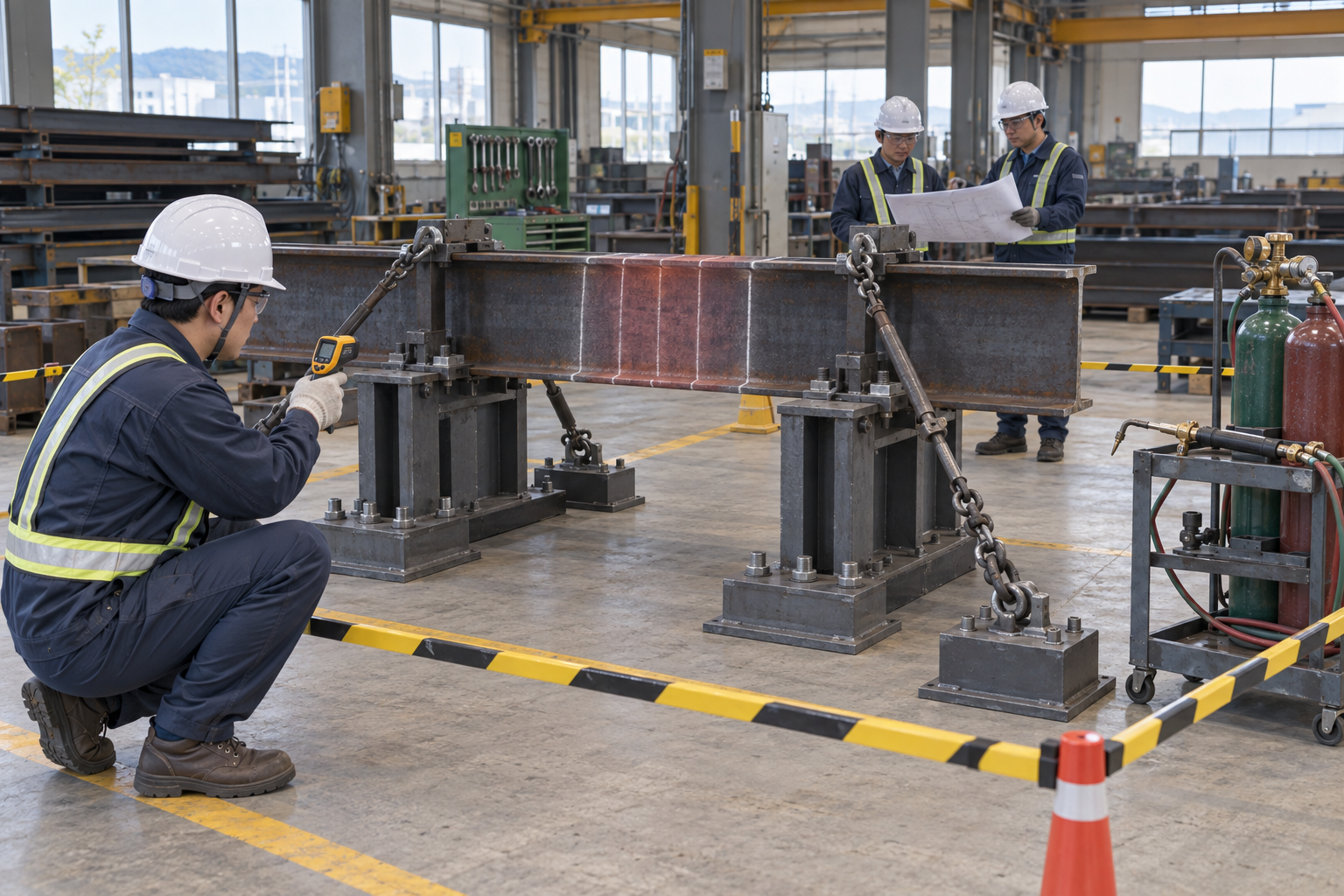
The retained illustration is an AI-generated educational image from the Korean source. It is not an actual incident photograph, approved drawing, equipment certification or proof that the depicted arrangement is safe.
Thermal expansion and contraction interact with colder steel and external restraint. Heat curving primarily uses this thermal response; force-dominated hot bending is a different process and cannot inherit a heat-curving recipe.
Steel color changes with viewing and lighting conditions and cannot replace the specified temperature method. Restoring the instrument gives a current reading; it does not reconstruct an unmeasured earlier peak or duration.
An unexplained displacement or shifting reaction point is a separate stop condition. Do not add jack force because the desired curve has not appeared; the hot member and restraint system need engineering review.
Final curvature, twist, material condition and authorization for use are separate. Preserve original cycle records and append rework decisions without filling gaps with guessed temperatures.
Hypothetical decision example
Hypothetical example: temperature readings become invalid during a planned heating cycle, but the operator continues because the steel color looks familiar. The affected zone is held, the last valid record and gap are identified, and both instrument validity and the earlier material exposure are reviewed before restart.
The example is fictional; no incident, measurement, inspection or approval is asserted.
Task flow: Identify member and boundary → Prepare work area → Review forming plan → Set supports and gas → Heat and monitor → Cool and inspect → Hold anomaly and reassess → Close and transfer
5. Hold and proceed decisions
| Condition | Action | Evidence | Proceed when |
|---|---|---|---|
| Temperature record lost | Stop heat; preserve gap | Last valid point, zone and cycle | Gap disposition accepted |
| Curve still short | No unplanned force/reheat | Temperature/shape/restraint record | Revised plan approved |
| Support shifts | Stop; exclude reaction zone | Support/load/movement assessment | Stability restored |
| Shape passes only | Hold material release | Heat history and required tests | Inspection complete |
Similar observation, different conclusion
| Observation | Supported conclusion | What remains unresolved |
|---|---|---|
| Thermometer works again | Current measurement available | Earlier unmeasured exposure unknown |
| Curvature meets target | Specified geometry observed | Material/inspection release unproved |
6. Roles and supervision
| Role | Responsibility |
|---|---|
| Work supervisor | Coordinate identify member and boundary, affected operations, stop signals and stage transitions. |
| Technical/equipment reviewer | Verify Member/certificate ID, Load/support review, actual instructions and unresolved technical limits. |
| Task crew | Apply the stated controls, report changes and keep actual checks and signatures factual. |
| Inspector/test lead | Connect Cooling/reheat history, Transfer/stability to the required acceptance criteria. |
| Receiving authority | Accept the recorded restrictions, Support/moving release, Member/cycle/receiver, and follow-up ownership. |
These are responsibility examples, not invented statutory credentials. Verify actual competence, training and authority for the assigned work.
Supervision and handover controls
| Stage | Management controls | Evidence |
|---|---|---|
| Plan review | 1. Assign technical owner2. Close task-specific questions3. Link member/material record | 1. Member/certificate ID2. Load/support review3. Roles and communication |
| Competence | 1. Verify required competence2. Assign stop authority3. Verify stable supports | 1. Support/restraint layout2. Training and task briefing3. Cylinder/escape state |
| Prestart evidence | 1. Inspect actual equipment2. Link evidence to this stage3. Match approved rated setup | 1. Ratings/reaction points2. Stability/exclusion3. Regulator/hose cleanliness |
| Change control | 1. Stop and secure the area2. Review affected controls3. Stop heat and secure area | 1. Last valid/time/zone2. Support/gas state3. Disposition/restart authority |
| Shift handover | 1. Identify remaining restrictions2. Confirm receiving responsibility3. Secure gas/heat/fire state | 1. Supply/temp/watch end2. Inspection/use restrictions3. Member/cycle/receiver |
| Closeout | 1. Record defect disposition2. Archive factual evidence3. Secure gas/heat/fire state | 1. Supply/temp/watch end2. Inspection/use restrictions3. Member/cycle/receiver |
7. Hold points and record quality
| Hold point | Evidence before release | Actual record |
|---|---|---|
| HP-0 Start | Support, heat, monitor deformation, cool and inspect an identified unloaded steel member within a reviewed material-specific forming plan. | |
| HP-1 Prepare work area | Support/restraint layout; Coating/exposure controls; Hose/connections; Cylinder/escape state | |
| HP-2 Set supports and gas | Ratings/reaction points; Stability/exclusion; Gas/leak/protection checks; Regulator/hose cleanliness | |
| HP-3 Hold anomaly and reassess | Last valid/time/zone; Support/gas state; Impact review/plan change; Disposition/restart authority | |
| HP-4 Close and transfer | Supply/temp/watch end; Inspection/use restrictions; Support/moving release; Member/cycle/receiver |
Hold points are internal evidence gates. They do not establish that a statutory permit exists or has been approved. Recheck affected gates after changes, faults and shift handover.
Record comparison - hypothetical templates
The 16 boxes below identify record elements, not completed checks or approvals. They are static symbols. Link equipment/location, date, actual findings and the separate record reference; preserve unresolved items.
| Record | Insufficient entry | Required record elements |
|---|---|---|
| Identify member and boundary | "Checked" without supporting facts | □ Member/certificate ID□ Load/support review□ Combustibles/adjacent work□ Roles and communication |
| Review forming plan | "Checked" without supporting facts | □ Grade/treatment/history□ Plan/temp/time basis□ Support/reaction limits□ Cooling/cycle/inspection |
| Heat and monitor | "Checked" without supporting facts | □ Instrument/point/readings□ Cycle/movement/support□ People/hot marking□ Coating/ventilation/watch |
| Hold anomaly and reassess | "Checked" without supporting facts | □ Last valid/time/zone□ Support/gas state□ Impact review/plan change□ Disposition/restart authority |
8. Pre-work checks and emergency response
| Check required | Result | Checker/action |
|---|---|---|
| Identify member and boundary: Member/certificate ID | ||
| Prepare work area: Support/restraint layout | ||
| Review forming plan: Grade/treatment/history | ||
| Set supports and gas: Ratings/reaction points | ||
| Heat and monitor: Instrument/point/readings | ||
| Cool and inspect: Cooling/reheat history | ||
| Hold anomaly and reassess: Last valid/time/zone | ||
| Close and transfer: Supply/temp/watch end |
Stop work
Do not heat unknown steel or an unreviewed support arrangement. Stop for loss of valid temperature measurement, unplanned displacement, support movement or gas leakage; hold the affected member until disposition is established.
Emergency response
Stop heating and isolate gas by the planned procedure only when safe. Clear the hot-member, reaction and possible fragment paths; do not stabilize a moving beam with the body or approach a leaking/fire-exposed cylinder. Activate fire response, evacuate for uncontrolled gas/fire and call 911 for serious burns, crush injury or fire. Give responders the gas type, hot zones and support/restraint state.
9. Official sources and review limits
Official public-source check: October 13, 2026. The review concerns the selected passages described below, not endorsement of this article.
| Official source | Checked scope and limit |
|---|---|
| OSHA 29 CFR 1910.253 | Selected oxygen/fuel-gas equipment, cylinder, regulator, hose and contamination controls. Match the actual apparatus and applicable hot-work requirements. |
| FHWA-HIF-23-003, March 2023 | Current official catalog checked; selected sections 2.2.7, 2.2.8.3 and 2.4.2 read from the retained public document copy. Temperature/color and heat-curving principles only; no universal steel temperature, force or radius adopted. |
| OSHA State Plans | Federal baseline and State Plan coverage reviewed. Confirm the applicable state program and employer coverage; this edition does not establish nationwide compliance. |
Selected public official provisions were checked on October 13, 2026. This is not a complete legal audit. No actual equipment manual, site measurements, engineering calculations, product certification or professional technical approval was supplied. Full paid NFPA/ANSI standards and state/local amendments were not reviewed. Check actual equipment, jurisdiction and project requirements before use.
This is reference content written and revised with AI. It has not been verified or approved by a professional. Review by a suitably qualified professional and required site authorization are necessary before use.
10. PDF use and frequently asked questions
PDF A summarizes core controls; B emphasizes technical failures; C covers supervision, records and handover. Each uses six stages from or aligned with the eight-stage body. All actual risk, measurement, check and signature fields are blank. Use a separate linked record where more space is needed.
Can color replace a failed thermometer?
No. Stop and resolve both measurement validity and the affected historical gap.
Can extra jack force finish the bend?
Only within the reviewed material/process plan; do not add force by judgment alone.
May water speed up cooling?
Use the specified cooling method. Any unplanned quench needs an identified hold and technical disposition.
Does correct shape authorize shipment?
Complete the required material/geometry inspections, restriction review and use authorization first.
Has a professional approved this JSA?
This is reference content written and revised with AI. It has not been verified or approved by a professional. Review by a suitably qualified professional and required site authorization are necessary before use.
11. Authorship and revision history
This is reference content written and revised with AI. It has not been verified or approved by a professional. Review by a suitably qualified professional and required site authorization are necessary before use.
| Date/version | Editorial history | Technical approval |
|---|---|---|
| September 20, 2026 / Korean v1.0 | Korean source: initial article, evidence, hypothetical decisions and body/PDF editorial checks. | Professional technical approval not performed |
| September 22, 2026 / Korean v1.1 | Korean source: separated measurement failure from support instability; expanded JSA, decisions, FAQ and PDFs through editorial and source checks. | Professional technical approval not performed |
| September 22, 2026 / Korean body v1.2 | Added hypothetical decision sequence, comparison and record examples; retained PDF v1.1. | Professional technical approval not performed |
| September 22, 2026 / Korean body v1.3 | Reformatted record examples as checklists and adjusted comparison widths; retained PDF v1.1. | Professional technical approval not performed |
| October 14, 2026 / US v1.0 | US localization: Preserves thermometer-gap case and distinction between missing evidence and proven damage. Retains heat-curving versus force-dominated hot-bending limits and separates instrument repair from material release; no temperature, jack force or cooling recipe is invented. | Not performed |
Source topic: https://smartjsabridge.com/ko/case-study/jsa-steel-heatbending
Content group: jsa-steel-heatbending