A zero gauge reading does not prove an empty, cool line. Identify steam, condensate, bypass and connected feeds; verify isolation, drainage, safe temperature and continued absence of pressure at the intended work boundary.
This reference material was written and revised with AI. It has not been verified or approved by a professional. Review by a suitably qualified professional and required site approval are necessary before field use.
Stop before proceeding
Do not cut or open if feeds, drainage, temperature or supports are uncertain. Stop for release, unexpected odor or smoke, missing fire watch, weld defects or incomplete examination. Hold steam admission until separately authorized.
1. Legal and technical scope
Classify the activity before choosing rules: general-industry maintenance uses applicable 1910.147 energy control and 1910.252 welding provisions; construction uses applicable Part 1926 welding requirements including 1926.352 fire prevention. Piping design, welding qualifications, examination and testing depend on the actual service/code and jurisdiction. Spirax Sarco drainage guidance is technical reference, not a universal test pressure, trap spacing or startup approval.
Confirm whether federal OSHA or an OSHA-approved State Plan covers this employer and worksite; state requirements and public-sector coverage can differ. Apply the task-specific provisions and limitations identified above.
| Basis | Application |
|---|---|
| OSHA 29 CFR 1910.147 | General-industry covered servicing: pressure, thermal and other hazardous-energy control and reaccumulation. |
| OSHA 29 CFR 1910.252 | General-industry welding fire precautions and protection; use applicable activity scope. |
| OSHA 29 CFR 1926.352 | Construction fire prevention and fire-watch requirements. |
| Spirax Sarco steam mains and drainage | Low-point condensate after shutdown and waterhammer mechanisms; example dimensions and warmup values not adopted. |
| OSHA State Plans | Official overview of federal and State Plan jurisdiction and differing public-sector coverage, checked 2026-10-13. Individual state rules require a site-specific check. |
2. Scope and required inputs
Included scope
Drain and cool an isolated steam line, support both sides, cut/fit/weld, complete specified inspection and restore insulation before a separate operations handoff.
Separate assessment
Live or hot opening, unapproved hot tapping, concealing unaccepted welds and unauthorized steam admission are excluded. Suspect hazardous insulation requires separate identification and handling.
| Input | Evidence needed |
|---|---|
| Map line and isolation | Line and drawing IDs; Isolation boundary; Drain cooling method; Support and expansion. |
| Prepare hot work | Fire watch and fuel; Welder return path; Ventilation and PPE; Platform and exclusion. |
| Weld and inspect | Procedure and personnel; Spark reach area; Joint and weld record; Support and alignment. |
| Restore and handoff | Inspection and insulation; Guides and supports; Traps and valve plan; Warmup release. |
No site measurements, equipment manuals for the actual installation, inspection records or signed technical approvals were supplied. Confirm the applicable requirements and actual product instructions before use; record each criterion with its units, source and equipment or work-area ID.
3. Eight-stage JSA
| Job stage | Hazards and effects | Failure factors | Technical and procedural controls | Site verification | P | S | R | A |
|---|---|---|---|---|---|---|---|---|
| 1. Map line and isolation | 1. Steam release2. Hot-water burn3. Wrong fluid4. Pipe movement | 1. Line misidentified2. Bypass omitted3. History unknown4. Expansion ignored | 1. Identify every connection2. Plan drain and cooling3. Coordinate operations4. Review supports | 1. Line and drawing IDs2. Isolation boundary3. Drain cooling method4. Support and expansion | ||||
| 2. Isolate drain and cool | 1. Trapped steam2. Condensate burn3. Repressurization4. Hot drain exposure | 1. Valve closure trusted2. Low point missed3. Leakage untested4. Outlet uncontrolled | 1. Secure all sources2. Drain trapped pockets3. Verify cool no-pressure state4. Contain safe discharge | 1. Isolation locks2. Low points and pockets3. Temperature pressure state4. Discharge route | ||||
| 3. Prepare hot work | 1. Fire2. Electric shock3. Fume exposure4. Access fall | 1. Hidden fuel missed2. Return path poor3. No extraction4. Platform unsuitable | 1. Arrange hot-work controls2. Check welding circuit3. Capture fume4. Provide stable access | 1. Fire watch and fuel2. Welder return path3. Ventilation and PPE4. Platform and exclusion | ||||
| 4. Cut fit and support | 1. Pipe springs2. Cut section falls3. Finger crush4. Tool contact | 1. Residual load unknown2. One side unsupported3. Hands align ends4. Guard defective | 1. Review cut movement2. Support both sides3. Use alignment tools4. Inspect tool guarding | 1. Cut and load plan2. Support points3. Pinch exclusion4. Tool and blade rating | ||||
| 5. Weld and inspect | 1. Fume exposure2. Spark spread3. Weld defect4. Pipe distortion | 1. Procedure wrong2. Watch absent3. Changes unrecorded4. Sequence wrong | 1. Follow approved welding plan2. Maintain spark controls3. Record weld checks4. Monitor alignment | 1. Procedure and personnel2. Spark reach area3. Joint and weld record4. Support and alignment | ||||
| 6. Release insulation | 1. Defect concealed2. Fiber exposure3. Sheet-metal cut4. Hot surface burn | 1. Weld unaccepted2. Material unknown3. Sharp edges4. Cooling unchecked | 1. Accept inspection first2. Check material SDS3. Control sharp edges4. Verify surface condition | 1. Examination and test2. Insulation and PPE3. Jacket edge finish4. Temperature and access | ||||
| 7. Hold repair and fire | 1. Smoldering fire2. Pressure returns3. Pipe falls4. Fume accumulates | 1. Watch ends early2. Isolation lost3. Support removed4. Ventilation stops | 1. Complete post-work watch2. Recheck isolation3. Retain repair supports4. Maintain safe atmosphere | 1. Hidden-area fire check2. Pressure reaccumulation3. Repair support4. Ventilation status | ||||
| 8. Restore and handoff | 1. Steam leak2. Expansion restrained3. Waterhammer4. Unauthorized startup | 1. Defect not conveyed2. Guide locked3. Drain not restored4. No operator release | 1. Transfer inspection holds2. Verify expansion guides3. Restore drain plan4. Separate steam authorization | 1. Inspection and insulation2. Guides and supports3. Traps and valve plan4. Warmup release |
P = likelihood; S = severity; R = risk under the site method; A = the site-defined acceptance/authorization decision. Complete only after actual assessment. Blank cells and checklist prompts are not completed inspections.
4. Fictional scenario and failure mechanisms
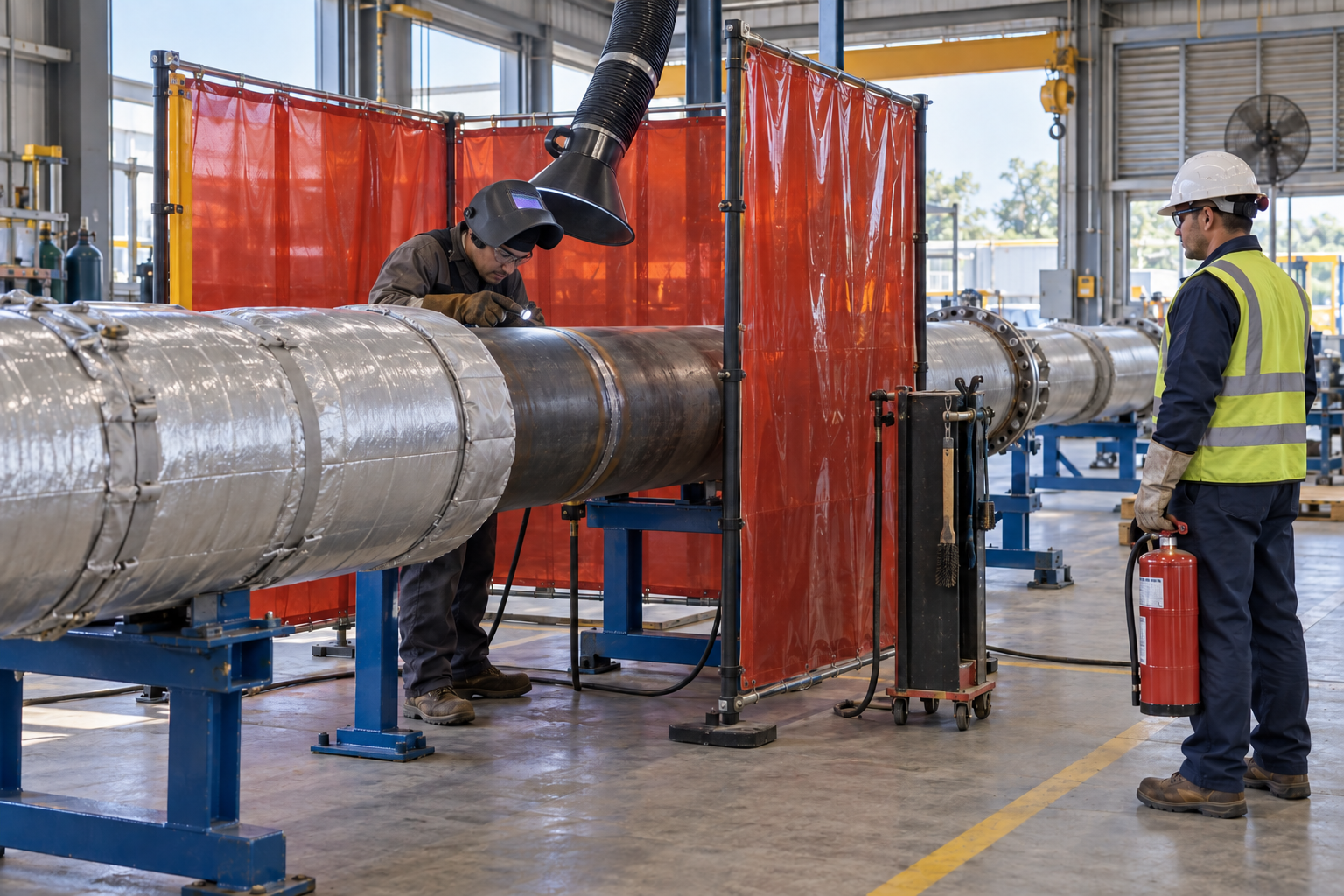
Retained AI-generated educational illustration from the source edition; not a real incident photograph, approved installation drawing or evidence of equipment suitability.
The scenario and record comparisons are fictional teaching examples, not records of real incidents, measurements, inspections, signatures or approvals.
| Item | Fictional scenario |
|---|---|
| Initial | An isolated line shows zero gauge pressure. |
| Change | Hot condensate remains in a low pocket before the first cut. |
| Failure | No-pressure indication is treated as no fluid and safe temperature. |
| Outcome | Opening can release hot water and cause a burn or a startled fall. |
| Barrier | Hold opening until all feeds, low-point drainage, temperature and both-side supports are verified. |
Why the controls matter
A zero gauge reading does not prove an empty, cool line. Identify steam, condensate, bypass and connected feeds; verify isolation, drainage, safe temperature and continued absence of pressure at the intended work boundary.
Cutting changes both the fluid boundary and structural support. Plan pipe weight, thermal residual forces and cut-piece movement and support both sides before opening; do not force the ends together by releasing supports.
Sparks travel behind, below and through openings into hidden insulation. Maintain the required fire watch and post-work checks. Keep welds visible until examination, repairs and any retest are accepted.
Insulation completion does not authorize steam. Transfer drain/trap condition, expansion guides, valve state, unresolved defects and the separate test/warmup plan to the authorized operations receiver.
Decision sequence
| Step | Decision |
|---|---|
| Known | Hot condensate remains in a low pocket before the first cut. |
| Unknown | Actual condition, extent of damage and suitability of procedure and personnel, spark reach area remain to be established. |
| Hold | No-pressure indication is treated as no fluid and safe temperature. |
| Evidence | Link procedure and personnel, spark reach area, joint and weld record, support and alignment, hidden-area fire check, pressure reaccumulation to the affected equipment or work area. |
| Next | Hold opening until all feeds, low-point drainage, temperature and both-side supports are verified. |
5. Conditional decisions and common errors
| Condition | Action | Evidence | Proceed when |
|---|---|---|---|
| Gauge reads zero | Hold until complete verification | Drain temperature and feeds | Opening criteria met |
| Support uncertain | Hold cutting | Weight force and supports | Both sides secured |
| Weld ready to cover | Complete examination | Repair and retest record | Concealment released |
| Steam requested | Transfer to operations | Drains guides and warmup plan | Startup separately authorized |
Similar appearance, different evidence
The scenario and record comparisons are fictional teaching examples, not records of real incidents, measurements, inspections, signatures or approvals.
| Comparison | Supported decision | Insufficient basis |
|---|---|---|
| Condition | Drain temperature and feeds | Gauge reads zero has not been resolved. |
| Evidence | Repair and retest record | A photograph or a completed-looking task without the relevant inspection record. |
| Release | Startup separately authorized | Completion of one step does not release the excluded tasks in section 2. |
6. Roles and responsibilities
| Role | Responsibility |
|---|---|
| Work supervisor | Assign the task boundary, stop authority, interfaces and emergency communication for isolated steam pipe welding and insulation restoration. |
| Technical lead | Confirm Line and drawing IDs; Isolation boundary; Drain cooling method; Support and expansion. Resolve design and manufacturer limits before work. |
| Authorized crew | Apply Fire watch and fuel; Welder return path; Ventilation and PPE; Platform and exclusion. Stop when the working arrangement changes. |
| Inspector / receiving lead | Review Procedure and personnel; Spark reach area; Joint and weld record; Support and alignment. Transfer Inspection and insulation; Guides and supports; Traps and valve plan; Warmup release. |
Role labels allocate responsibilities; they do not confer a legal qualification. Verify the competence, training and authority required for the actual task.
Record and handoff perspective
| Stage | Record controls | Verification |
|---|---|---|
| Map line and isolation | 1. Record line and drawing ids2. Record isolation boundary3. Record drain cooling method | 1. Isolation boundary2. Drain cooling method3. Support and expansion |
| Prepare hot work | 1. Record fire watch and fuel2. Record welder return path3. Record ventilation and ppe | 1. Welder return path2. Ventilation and PPE3. Platform and exclusion |
| Cut fit and support | 1. Record cut and load plan2. Record support points3. Record pinch exclusion | 1. Support points2. Pinch exclusion3. Tool and blade rating |
| Weld and inspect | 1. Record procedure and personnel2. Record spark reach area3. Record joint and weld record | 1. Spark reach area2. Joint and weld record3. Support and alignment |
| Hold repair and fire | 1. Record hidden-area fire check2. Record pressure reaccumulation3. Record repair support | 1. Pressure reaccumulation2. Repair support3. Ventilation status |
| Restore and handoff | 1. Record inspection and insulation2. Record guides and supports3. Record traps and valve plan | 1. Guides and supports2. Traps and valve plan3. Warmup release |
7. Hold points and record comparison
| Hold point | Evidence before release | Actual record |
|---|---|---|
| HP-0 Start | Drain and cool an isolated steam line, support both sides, cut/fit/weld, complete specified inspection and restore insulation before a separate operations handoff. | |
| HP-1 Isolate drain and cool | Isolation locks; Low points and pockets; Temperature pressure state; Discharge route | |
| HP-2 Cut fit and support | Cut and load plan; Support points; Pinch exclusion; Tool and blade rating | |
| HP-3 Release insulation | Examination and test; Insulation and PPE; Jacket edge finish; Temperature and access | |
| HP-4 Restore and handoff | Inspection and insulation; Guides and supports; Traps and valve plan; Warmup release |
These are internal hold points, not issued permits. Recheck affected points after a change, fault or shift handoff; link the actual approval record.
Record comparison
The scenario and record comparisons are fictional teaching examples, not records of real incidents, measurements, inspections, signatures or approvals.
The boxes are static record prompts, not interactive or saved approvals. A tick does not establish suitability or permission to restart. Record the evidence, person, time and unresolved issues; retain the change history.
| Record | Insufficient | Record checklist |
|---|---|---|
| Map line and isolation | "Checked" without target, criteria or result | □ Line and drawing IDs□ Isolation boundary□ Drain cooling method□ Support and expansion |
| Prepare hot work | "Checked" without target, criteria or result | □ Fire watch and fuel□ Welder return path□ Ventilation and PPE□ Platform and exclusion |
| Weld and inspect | "Checked" without target, criteria or result | □ Procedure and personnel□ Spark reach area□ Joint and weld record□ Support and alignment |
| Restore and handoff | "Checked" without target, criteria or result | □ Inspection and insulation□ Guides and supports□ Traps and valve plan□ Warmup release |
8. Site checklist and emergency response
| Check | Result | Person / action |
|---|---|---|
| □ Map line and isolation: Line and drawing IDs | ||
| □ Isolate drain and cool: Isolation locks | ||
| □ Prepare hot work: Fire watch and fuel | ||
| □ Cut fit and support: Cut and load plan | ||
| □ Weld and inspect: Procedure and personnel | ||
| □ Release insulation: Examination and test | ||
| □ Hold repair and fire: Hidden-area fire check | ||
| □ Restore and handoff: Inspection and insulation | ||
| □ Emergency access and handoff restrictions |
Stop work
Do not cut or open if feeds, drainage, temperature or supports are uncertain. Stop for release, unexpected odor or smoke, missing fire watch, weld defects or incomplete examination. Hold steam admission until separately authorized.
Emergency response
Move away from hot-fluid discharge and prevent approach. Control supply only from a safe position; do not tighten leaking joints during release. Call 911/site response for fire or burns and verify isolation, cooling and support before reentry.
9. Sources and review limits
Public-source review: 2026-10-13. Official regulation pages and specific technical references are distinguished below; no agency or manufacturer has approved this content.
| Source | Reviewed scope and limitation |
|---|---|
| OSHA 29 CFR 1910.147 | General-industry covered servicing: pressure, thermal and other hazardous-energy control and reaccumulation. |
| OSHA 29 CFR 1910.252 | General-industry welding fire precautions and protection; use applicable activity scope. |
| OSHA 29 CFR 1926.352 | Construction fire prevention and fire-watch requirements. |
| Spirax Sarco steam mains and drainage | Low-point condensate after shutdown and waterhammer mechanisms; example dimensions and warmup values not adopted. |
| OSHA State Plans | Official overview of federal and State Plan jurisdiction and differing public-sector coverage, checked 2026-10-13. Individual state rules require a site-specific check. |
No site measurements, equipment manuals for the actual installation, inspection records or signed technical approvals were supplied. Confirm the applicable requirements and actual product instructions before use; record each criterion with its units, source and equipment or work-area ID.
10. PDF guidance and FAQ
PDF A covers basic task controls; B focuses on technical failures; C covers supervision, records and handover. The article has eight stages with four items per main cell; each PDF has six key stages with three items per main cell. P/S/R/A, measurements, confirmations and signatures remain blank for actual site assessment.
Content group
jsa-steampipe-welding
Is zero pressure enough to cut?
No. Verify trapped liquid, temperature, feeds and supports as well.
May insulation cover a completed weld?
Only after required examination, repairs and acceptance for concealment.
Can supports be loosened to align the pipe?
Only under the approved load and alignment plan; no improvised release or forced pull.
Does completed insulation permit steam startup?
No. Restore drains, supports and valves and obtain the separate operations release.
Has a professional approved this JSA?
This reference material was written and revised with AI. It has not been verified or approved by a professional. Review by a suitably qualified professional and required site approval are necessary before field use.
11. Revision history and authorship
This reference material was written and revised with AI. It has not been verified or approved by a professional. Review by a suitably qualified professional and required site approval are necessary before field use.
Korean source created 2026-09-19. This US edition adapts the Korean source; earlier editorial revisions do not constitute professional approval of this edition.
| Date | Edition | Change | Review status |
|---|---|---|---|
| 2026-09-19 | Korean source v1.1 | Source editorial publication or revision; retained as provenance of the Korean edition. | Editorial record only; no professional approval of this US edition. |
| 2026-09-26 | Korean source v1.2 | Source editorial publication or revision; retained as provenance of the Korean edition. | Editorial record only; no professional approval of this US edition. |
| 2026-10-13 | 1.0 | US localization: preserve task judgments; replace Korean legal applicability with scoped US references. | AI editorial and output checks; no professional technical approval. |