For US construction, identify the applicable OSHA or state-plan requirements. Every dismantling step changes the structure supporting people, materials and environmental loads. Verify the remaining ties, braces, access and protection for the next state; the old handover of the complete scaffold is not sufficient.
Release components only within a verified stable sequence
This is reference content written and revised with AI. It has not been verified or approved by a professional. Review by a suitably qualified professional and site authorisation are required before use.
Stop work
Stop for missing or altered ties, unexplained movement, damaged bases or decks, lost access protection, work above or below, unverified lifting support, weather outside the plan or any unplanned sequence change. Keep people away from a potentially unstable scaffold; do not send them back simply to replace a tie.
1. Legal and technical scope
| Basis | Application limits |
|---|---|
| OSHA · 1926.451 | Relevant scaffold provisions including (f)(7), (g)(2), (g)(3) read; not a site compliance determination. |
United States: Federal OSHA construction scaffold provisions were reviewed; verify applicable state-plan and project requirements. Paid ANSI/ASSP standards and actual equipment manuals were not read.
1926.451(g)(2) specifically addresses feasible, safe fall protection during supported-scaffold erection/dismantling. It must not be replaced by a universal 100% PFAS slogan. Paragraph (g)(3) does not prohibit every scaffold-member attachment; the actual system and remaining member must be suitable, and a loosening member is not an acceptable assumption.
2. Scope and required inputs
Included scope
Survey and planning for tube and coupler scaffold dismantling; exclusion, protected access, progressive removal, tie control, member handling, lowering and securing the remaining structure at interruptions and completion.
Separate review
Structural design, complex or damaged scaffold recovery, temporary roofs, suspended scaffolds, demolition of the host building, electrical isolation and lifting operations need appropriate separate plans and expertise. Do not apply this sequence to a different scaffold system without its instructions.
| Required input | What to verify |
|---|---|
| Survey and plan | Condition survey · Stage drawings · Tie and brace schedule · Supervisor and rescue plan |
| Isolate and clear | Access barriers · Trade release · Electrical controls · Deck load and debris |
| Protected access | Access route · Anchor compatibility · Clearance and rescue · Protection for next stage |
| Strip top lift | Current lift boundary · Platform protection · Board support and retention · Lowering bay load |
| Release ties | Tie release instruction · Remaining tie pattern · Brace continuity · Design review of change |
| Secure remainder | Remaining-state record · Access status · Quarantine record · Handover and closure |
Paid standards and model-specific scaffold, anchor and lowering-equipment manuals have not been read. Obtain the actual design, manufacturer instructions and governing local requirements. Tie capacity and spacing, unsupported height, platform arrangement, anchor strength, lifting support and weather limits require verification for each stage. A fixed 0.2H exclusion radius or 40 km/h wind limit does not establish safety for every site.
Prefer collective fall prevention and protected platforms and access. If personal fall protection is required, verify anchor location, permitted users, system compatibility, free space, swing-fall exposure and rescue. Never attach to a member being loosened or rely on an unverified remaining scaffold as an anchor. A slogan of 100% tie-off does not establish a safe system. Select retained head protection, eye protection, suitable gloves and footwear for the exposure. Assess member weight, length and handling route; use sufficient workers or suitable mechanical assistance and keep racks secured within their limits. Coordinate isolation or the applicable utility-approved electrical controls before approaching overhead services; visual markers are not electrical insulation.
3. Eight-stage JSA
| Job stage | Hazards and effects | Failure factors | Technical and procedural controls | Site verification | P | S | R | A |
|---|---|---|---|---|---|---|---|---|
| 1. Survey and plan | 1. Collapse of remaining bays2. Fall through weak deck3. Failure of altered ties4. Loss of rescue access | 1. Unknown scaffold changes2. Missing tie records3. No staged dismantling plan4. No competent supervision | 1. Survey as found condition2. Confirm each stable stage3. Plan tie release points4. Assign competent supervision | 1. Condition survey2. Stage drawings3. Tie and brace schedule4. Supervisor and rescue plan | ||||
| 2. Isolate and clear | 1. Objects strike people2. Concurrent work above3. Contact with power lines4. Overloaded work platform | 1. Other trades still using it2. Open public walkway3. Services not coordinated4. Debris left on decks | 1. Close affected work areas2. Stop work above and below3. Coordinate electrical risks4. Clear decks by safe method | 1. Access barriers2. Trade release3. Electrical controls4. Deck load and debris | ||||
| 3. Protected access | 1. Fall during transfer2. Anchor removed with tube3. Swing fall onto scaffold4. Suspended worker stranded | 1. Climbing outer braces2. Unverified anchor point3. No clearance calculation4. Rescue route blocked | 1. Retain protected access2. Prioritise collective means3. Verify fall protection system4. Keep rescue access usable | 1. Access route2. Anchor compatibility3. Clearance and rescue4. Protection for next stage | ||||
| 4. Strip top lift | 1. Fall through open deck2. Guardrail loss at edge3. Drop from loose planks4. Overload at lowering bay | 1. Several lifts stripped at once2. Rails removed too early3. Worker stands on loose board4. Parts piled on deck | 1. Follow planned top down steps2. Keep protection as long as able3. Work from secured platform4. Limit temporary accumulation | 1. Current lift boundary2. Platform protection3. Board support and retention4. Lowering bay load | ||||
| 5. Release ties | 1. Collapse of residual frame2. Sway of unsupported bay3. Overturning at return4. Failure after sheeting change | 1. Lower ties removed early2. Braces removed out of order3. Unplanned tie substitution4. Wind effect not assessed | 1. Keep needed lower ties2. Release only at planned stage3. Verify remaining stability4. Stop for any unplanned change | 1. Tie release instruction2. Remaining tie pattern3. Brace continuity4. Design review of change | ||||
| 6. Free members | 1. Tube falls when unclamped2. Hands trapped at joint3. Tool falls onto people4. Sudden release of stuck part | 1. Last clamp opened unsupported2. Long tube handled alone3. Loose fittings on deck4. Forcing a seized connection | 1. Support before final release2. Use planned handling team3. Bag fittings, retain tools4. Stop and assess seized parts | 1. Positive member control2. Handling method3. Tool and fitting retention4. Next stable configuration | ||||
| 7. Lower materials | 1. Suspended bundle falls2. Hoist support fails3. Load strikes landing crew4. Tube rolls from rack | 1. Unverified lowering support2. Damaged rope or sling3. People under load path4. Unsecured ground stack | 1. Use rated lowering method2. Check support and accessories3. Exclude people under loads4. Land, secure and segregate | 1. Lowering arrangement2. Capacity and inspection3. Clear landing route4. Secured material racks | ||||
| 8. Secure remainder | 1. Collapse during interruption2. Unauthorised re-entry3. Hidden damaged component4. Sharp ties left in building | 1. No remaining-state check2. Old access tag retained3. Damage mixed with sound stock4. Unprotected residual opening | 1. Verify residual stability2. Close access, update status3. Quarantine damaged pieces4. Hand over residual hazards | 1. Remaining-state record2. Access status3. Quarantine record4. Handover and closure |
PDF A covers basic task controls; B focuses on technical failures; C covers supervision, records and handover. The article has eight stages with four items per main cell; each PDF has six key stages with three items per main cell. P/S/R/A, measurements, confirmations and signatures remain blank for actual site assessment.
4. Fictional scenario and failure mechanisms
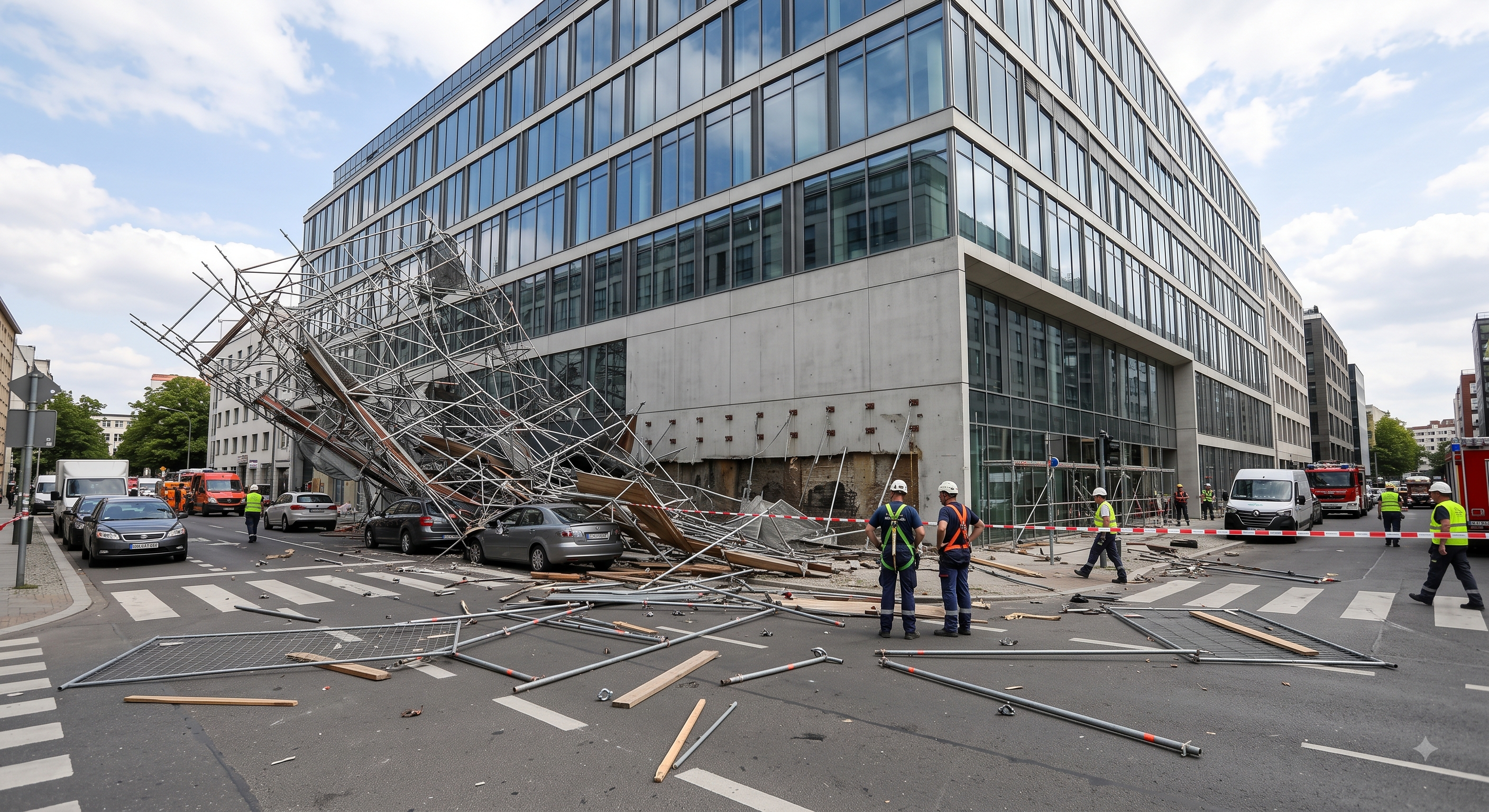
Retained educational illustration; not evidence of an actual incident.
The scenario and record comparisons are fictional teaching examples, not records of real incidents, measurements, inspections, signatures or approvals.
| Item | Fictional scenario |
|---|---|
| Initial situation | A hypothetical crew dismantles the upper lift while a delivery vehicle waits below. |
| Changed condition | Another crew proposes removing lower ties to speed loading. |
| Failure path | The remaining structure would lose restraints outside the agreed sequence. |
| Possible outcome | Sway, collapse and falling objects are possible; no measured load or actual casualty is claimed. |
| Prevention barrier | Stop the conflicting activities, keep access closed and obtain a competent assessment of the remaining scaffold and revised sequence. |
Failure mechanisms
An ideal column's Euler relationship illustrates why restraint matters; it cannot calculate the residual capacity of a scaffold with joints, imperfections, changing bracing and multiple load paths. Do not infer an exact percentage loss or inevitable immediate buckling from tie removal alone.
Ties and braces control displacement and transmit forces. Their removal is permitted only when the design and sequence allow it, with required replacement restraint installed before any substitution.
Sheeting, netting, return bays, loading bays and attached hoists change actions and stability. A reduction in height does not automatically make every intermediate state safe.
Platforms and edge protection also change during dismantling. Keep a secured working position and access, remove protective components at the latest practicable planned stage, and prevent work above or below the active dismantling area.
Decision sequence
| Decision stage | What to verify |
|---|---|
| Known facts | A hypothetical crew dismantles the upper lift while a delivery vehicle waits below. |
| Unresolved matters | Another crew proposes removing lower ties to speed loading. |
| Reason to hold | The remaining structure would lose restraints outside the agreed sequence. |
| Required evidence | Access route · Anchor compatibility · Clearance and rescue · Protection for next stage |
| Restart decision | Stop the conflicting activities, keep access closed and obtain a competent assessment of the remaining scaffold and revised sequence. |
5. Conditional decisions and common errors
| Condition | Action | Evidence | Proceed when |
|---|---|---|---|
| Missing tie | Stop and isolate | Survey and recovery plan | Stability verified |
| Access gap | Provide protected transition | Access and rescue check | Protected route ready |
| Hoist moved | Verify support before use | Load and connection check | Support verified |
| Weather change | Secure and reassess | Stage-specific limits | Within agreed limits |
Similar situations, different decisions
The scenario and record comparisons are fictional teaching examples, not records of real incidents, measurements, inspections, signatures or approvals.
| Comparison | Situation A | Situation B |
|---|---|---|
| Tie release | Lower ties removed to save time | Release only at planned stage |
| Handling | Last clamp opened without support | Positive control before release |
| Interruption | Old use tag remains displayed | Residual check and closed access |
6. Roles and responsibilities
| Role | Responsibility |
|---|---|
| Work management | Coordinate trades, public protection, competent personnel and site approval of the plan. |
| Technical/design review | Verify staged stability, tie substitutions and changes within the assigned design competence. |
| Dismantling supervisor | Direct the dismantling sequence and hold points, and stop unexpected conditions. |
| Dismantling crew | Maintain protected working positions, control members and report defects immediately. |
| Exclusion and rescue coordination | Keep the landing area and exclusion controlled, communicate clearly and maintain rescue readiness. |
Supervision, records, handover
| Job stage | Technical and procedural controls | Site verification |
|---|---|---|
| Survey and plan | 1. Check Condition survey2. Record Stage drawings3. Brief Tie and brace schedule | 1. Stage drawings2. Tie and brace schedule3. Supervisor and rescue plan |
| Isolate and clear | 1. Check Access barriers2. Record Trade release3. Brief Electrical controls | 1. Trade release2. Electrical controls3. Deck load and debris |
| Protected access | 1. Check Access route2. Record Anchor compatibility3. Brief Clearance and rescue | 1. Anchor compatibility2. Clearance and rescue3. Protection for next stage |
| Release ties | 1. Check Tie release instruction2. Record Remaining tie pattern3. Brief Brace continuity | 1. Remaining tie pattern2. Brace continuity3. Design review of change |
| Lower materials | 1. Check Lowering arrangement2. Record Capacity and inspection3. Brief Clear landing route | 1. Capacity and inspection2. Clear landing route3. Secured material racks |
| Secure remainder | 1. Check Remaining-state record2. Record Access status3. Brief Quarantine record | 1. Access status2. Quarantine record3. Handover and closure |
7. Hold points and record comparison
| Hold point | Evidence before release | Confirmation / approval |
|---|---|---|
| Start | Survey and planning for tube and coupler scaffold dismantling; exclusion, protected access, progressive removal, tie control, member handling, lowering and securing the remaining structure at interruptions and completion. | |
| HP-1 Survey and plan | Condition survey · Stage drawings · Tie and brace schedule · Supervisor and rescue plan | |
| HP-2 Protected access | Access route · Anchor compatibility · Clearance and rescue · Protection for next stage | |
| HP-3 Release ties | Tie release instruction · Remaining tie pattern · Brace continuity · Design review of change | |
| HP-4 Secure remainder | Remaining-state record · Access status · Quarantine record · Handover and closure |
Complete after actual checks. Recheck after changes, defects or shift handover.
Record comparison examples
The scenario and record comparisons are fictional teaching examples, not records of real incidents, measurements, inspections, signatures or approvals.
The boxes are static record prompts, not interactive or saved approvals. A tick does not establish suitability or permission to restart. Record the evidence, person, time and unresolved issues; retain the change history.
| Record type | Insufficient record | Record checklist |
|---|---|---|
| Plan | Only OK | □ Condition survey□ Stage drawings□ Tie and brace schedule□ Supervisor and rescue plan |
| Ties | Only OK | □ Tie release instruction□ Remaining tie pattern□ Brace continuity□ Design review of change |
| Lowering | Only OK | □ Lowering arrangement□ Capacity and inspection□ Clear landing route□ Secured material racks |
| Remainder | Only OK | □ Remaining-state record□ Access status□ Quarantine record□ Handover and closure |
8. Site checklist and emergency response
| Check item | Result | Person / action |
|---|---|---|
| □ Survey and plan: Condition survey | ||
| □ Isolate and clear: Access barriers | ||
| □ Protected access: Access route | ||
| □ Strip top lift: Current lift boundary | ||
| □ Release ties: Tie release instruction | ||
| □ Free members: Positive member control | ||
| □ Lower materials: Lowering arrangement | ||
| □ Secure remainder: Remaining-state record | ||
| □ Release / handover authority |
Stop work
Stop for missing or altered ties, unexplained movement, damaged bases or decks, lost access protection, work above or below, unverified lifting support, weather outside the plan or any unplanned sequence change. Keep people away from a potentially unstable scaffold; do not send them back simply to replace a tie.
Emergency response
Stop adjacent activity, extend exclusion as required by the assessed hazard and summon the planned rescue response. Do not climb an unstable scaffold or load a damaged anchor to attempt recovery. Structural assessment and a protected recovery method must precede re-entry; record the event and revise the plan before restart.
9. Sources and review limits
2026-10-12
| Source | Scope and limitations |
|---|---|
| OSHA · 1926.451 | Relevant scaffold provisions including (f)(7), (g)(2), (g)(3) read; not a site compliance determination. |
This is reference content written and revised with AI. It has not been verified or approved by a professional. Review by a suitably qualified professional and site authorisation are required before use.
10. PDF guidance and FAQ
PDF A covers basic task controls; B focuses on technical failures; C covers supervision, records and handover. The article has eight stages with four items per main cell; each PDF has six key stages with three items per main cell. P/S/R/A, measurements, confirmations and signatures remain blank for actual site assessment.
Content group ID
jsa-scaffolding-dismantling
Can lower ties be removed ahead of upper work?
No. Keep restraints needed by the remaining structure; release only at the planned stage under competent control.
Does 100% tie-off make dismantling safe?
No. Collective measures, suitable anchors, clearance, compatibility and rescue still need verification.
Can the old scaffold handover be reused?
It does not validate altered or partly dismantled states. Check and record the actual remaining configuration.
Can tubes be thrown into an empty zone?
No. Use the planned controlled lowering and landing method and retain the exclusion zone.
Has a professional verified or approved this document?
No. Public sources and editorial, layout and consistency checks were reviewed using AI. No site inspection or professional technical approval has been performed. Obtain appropriate professional review before use.
11. Revision history and authorship
This is reference content written and revised with AI. It has not been verified or approved by a professional. Review by a suitably qualified professional and site authorisation are required before use.
| Date | Version | Change | Review status |
|---|---|---|---|
| 2026-08-18 | Original version unmarked | Original preserved | No professional approval |
| 2026-10-12 | 2026.10.12 | Decisions, records, JSA and PDFs revised | No professional approval |
The original identity, image and valid controls on lower ties, supervision, tool retention, supported handling and controlled lowering are retained. Unsupported universal anchor, wind, exclusion, rope, gin-wheel and stacking values are replaced by configuration checks. Fabricated casualties, measured winds, collapse percentages, fines and professional review claims are removed. Risk scores and approval fields remain blank. The original title is preserved as an identifier, not a declaration of compliance or a universal harness rule. The original blanket ban on all scaffold-member PFAS attachments is corrected: selection must satisfy the actual system requirements, including 1926.451(g)(3); no connection to a member being released. Erection/dismantling fall-protection decisions follow (g)(2).