For a US construction site, identify federal or state-plan requirements and document the applicable net test before use. A net can only reduce the consequences of a fall when the complete system catches the person without striking an obstruction. Net identity, support capacity, joining, deformation space and installer protection must be resolved together before reliance on the net.
Verify the complete catch system before use
This is reference content written and revised with AI. It has not been verified or approved by a professional. Review by a suitably qualified professional and site authorisation are required before use.
Stop work
Stop for missing identification or required test evidence, damaged mesh or ropes, unsupported fixings, unprotected installer access, gaps, lost clearance, unassessed overlay, heat exposure, uncontrolled wind, debris loading or a fall/impact event. Isolate the affected work area until reviewed.
1. Legal and technical scope
| Basis | Application limits |
|---|---|
| OSHA 29 CFR 1926.502(c) | Federal construction net criteria, geometry, clearance, testing, inspection and debris removal; personal fall arrest is addressed separately in paragraph (d). |
For federal construction, 1926.502(c) requires nets as close as practicable, never more than 30 ft below the work level; projection depends on vertical distance. Clearance must prevent contact during the specified impact. Jobsite drop tests apply before use after installation, relocation, major repair and six months in place, subject only to the documented exception in (c)(4)(ii). Inspect at least weekly and after events affecting integrity, remove defects and clear fallen material as soon as possible and before the next shift. State-plan provisions must also be checked; this summary is not the complete rule.
2. Scope and required inputs
Included scope
Selecting a personnel net, inspecting components, protected rigging, verifying supports, joining panels, inspection and handover, use after changes, controlled removal and storage.
Separate review
Structural anchor design, unplanned field repairs, unusual net systems, rescue execution, lifting design and hot work require competent task-specific arrangements. A debris screen or work-platform net is not automatically a personnel fall-arrest net.
| Required input | What to verify |
|---|---|
| Select system | Net type and ID · System design · Clearance envelope · Rescue plan |
| Inspect net | Label and history · Mesh inspection · Test evidence · Component compatibility |
| Prepare access | Access method · Installer protection · Electrical controls · Exclusion boundary |
| Fix supports | Support design · Substrate evidence · Fixing inspection · Support load path |
| Rig and join | Joining detail · Sag and clearance · Catch width · Overlay wind assessment |
| De-rig and store | Removal plan · Protection retained · Lowering arrangement · Quarantine and storage |
Obtain the actual net-system manual, identification, test history and support design. Paid standards and model-specific instructions were not read. Net class, fixing spacing, rope properties, overlap or lacing, sag, catching width, fall height, clearance and wind limits must match the selected system and local rules. A personal-fall anchor rating is not a substitute for a net-support design.
Provide head, eye, hand and foot protection suited to handling and access. Where installer fall protection is required, check the entire compatible system, anchor support, clearance and rescue; do not connect to an unfinished or unverified net support. Select access equipment for the actual terrain and reach.
3. Eight-stage JSA
| Job stage | Hazards and effects | Failure factors | Technical and procedural controls | Site verification | P | S | R | A |
|---|---|---|---|---|---|---|---|---|
| 1. Select system | 1. Unprotected fall2. Wrong net type3. Strike below net4. Rescue delay | 1. Debris net substituted2. Unknown geometry3. No clearance design4. No rescue access | 1. Prefer fall prevention2. Specify personnel net3. Plan catch envelope4. Plan rescue access | 1. Net type and ID2. System design3. Clearance envelope4. Rescue plan | ||||
| 2. Inspect net | 1. Mesh rupture2. Rope failure3. Failed fitting4. Handling injury | 1. UV or heat damage2. Missing test evidence3. Mixed components4. Sharp storage edges | 1. Check identification2. Examine mesh and ropes3. Quarantine defects4. Handle without dragging | 1. Label and history2. Mesh inspection3. Test evidence4. Component compatibility | ||||
| 3. Prepare access | 1. Installer fall2. Dropped tools3. Electrical contact4. People struck below | 1. Reliance on unfinished net2. Unsafe anchor choice3. Uncontrolled services4. Open exclusion zone | 1. Rig from ground if feasible2. Provide protected access3. Verify installer protection4. Isolate work below | 1. Access method2. Installer protection3. Electrical controls4. Exclusion boundary | ||||
| 4. Fix supports | 1. Anchor pullout2. Bracket failure3. Edge damage4. Concrete failure | 1. Unknown substrate2. Wrong fastener3. Unverified load path4. Unapproved hole location | 1. Follow engineered detail2. Check substrate condition3. Fit specified fasteners4. Protect ropes at edges | 1. Support design2. Substrate evidence3. Fixing inspection4. Support load path | ||||
| 5. Rig and join | 1. Person passes gap2. Contact below net3. Net overload4. Wind-driven movement | 1. Wrong connection2. Clearance obstructed3. Excessive tension4. Unassessed overlay | 1. Use system connections2. Check catch geometry3. Set specified sag4. Assess debris overlay | 1. Joining detail2. Sag and clearance3. Catch width4. Overlay wind assessment | ||||
| 6. Handover | 1. Reliance on unsafe net2. Unnoticed defect3. False acceptance4. Failed rescue | 1. No system inspection2. Test omitted3. Approval assumed4. Rescue impracticable | 1. Inspect complete system2. Perform required testing3. Record limitations4. Verify rescue readiness | 1. Inspection record2. Applicable test record3. Release decision4. Rescue readiness | ||||
| 7. Use and inspect | 1. Fall onto debris2. Heat damage3. Impact-weakened net4. Loss of clearance | 1. Debris accumulation2. Hot work above3. No post-event check4. New obstruction below | 1. Control debris and hot work2. Inspect to required schedule3. Isolate after impact4. Review changed clearance | 1. Inspection log2. Debris removal record3. Event isolation4. Changed conditions | ||||
| 8. De-rig and store | 1. Installer fall2. Snapback3. Dropped components4. Damage in storage | 1. Protection removed early2. Loaded ropes cut3. Uncontrolled lowering4. Wet or sharp storage | 1. Retain installer protection2. Unload to planned sequence3. Lower in controlled stages4. Store to instructions | 1. Removal plan2. Protection retained3. Lowering arrangement4. Quarantine and storage |
PDF A covers basic task controls; B focuses on technical failures; C covers supervision, records and handover. The article has eight stages with four items per main cell; each PDF has six key stages with three items per main cell. P/S/R/A, measurements, confirmations and signatures remain blank for actual site assessment.
4. Fictional scenario and failure mechanisms
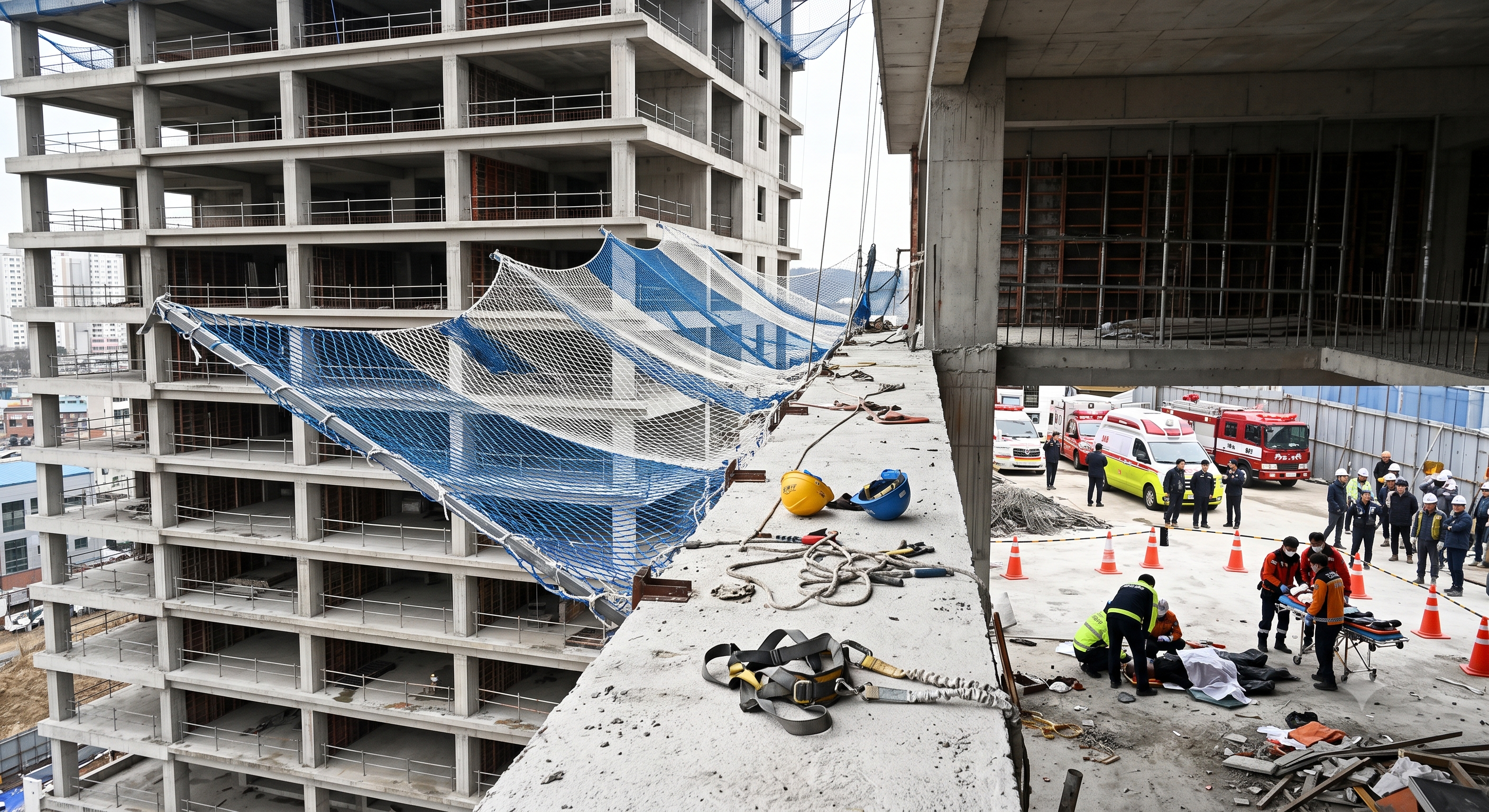
Retained educational illustration; not evidence of an actual incident.
The scenario and record comparisons are fictional teaching examples, not records of real incidents, measurements, inspections, signatures or approvals.
| Item | Fictional scenario |
|---|---|
| Initial situation | A hypothetical US crew relocates a net to the next work bay and wants to reuse the old handover. |
| Changed condition | The new support geometry is not recorded and the required relocation test or valid exception record is missing. |
| Failure path | A previous installation test cannot establish the capacity and clearance of the relocated system. |
| Possible outcome | Reliance on an unverified net can expose workers to an uncontrolled fall; no actual test or event is asserted. |
| Prevention barrier | Hold use until the new installation and the applicable testing or documented regulatory exception are verified. |
Failure mechanisms
An unloaded gap is not the required impact-clearance envelope. Net deformation and the person's position during arrest must be considered against nearby structures throughout the catch area.
Tension and slack are system parameters. Pulling a net drum-tight can alter the intended energy-absorption behavior; leaving excessive slack can consume clearance. Follow the specific configuration rather than a universal percentage.
Loads reach supports through mesh, border ropes, connections, brackets and anchors. A strong rope cannot compensate for weak concrete, an unsuitable beam or a missing connection. Do not infer net anchorage capacity from a personal-fall-arrest number.
A fine debris overlay changes retained weight and wind exposure. Its compatibility and effect on the entire support system need review. A net is not a storage area or normal walking platform; protect it from sharp debris, heat and unassessed loads.
Decision sequence
| Decision stage | What to verify |
|---|---|
| Known facts | Identify the intended personnel-net system and applicable jurisdiction. |
| Unresolved matters | Compare the installed geometry, supports, joining and test evidence with the system plan. |
| Reason to hold | Hold reliance on the net if a gap, defect, obstruction or unresolved test requirement remains. |
| Required evidence | Record the actual inspection, clearance and support evidence, responsible person, time and open items. |
| Restart decision | The authorized site party permits use only within the recorded configuration and reassesses after impact, relocation or change. |
5. Conditional decisions and common errors
| Condition | Action | Evidence | Proceed when |
|---|---|---|---|
| Clear gap looks sufficient | Check loaded catch envelope | Design and site survey | Envelope remains clear |
| Label or test missing | Quarantine pending review | Traceable component history | Suitability established |
| Debris overlay added | Review loads and wind | System compatibility review | Change accepted |
| Impact or heavy debris | Stop reliance and isolate | Competent event assessment | Safe reuse established |
Similar situations, different decisions
The scenario and record comparisons are fictional teaching examples, not records of real incidents, measurements, inspections, signatures or approvals.
| Comparison | Situation A | Situation B |
|---|---|---|
| Visual check | Finds visible cuts and loose fittings | Does not prove residual energy capacity |
| Debris screen | May contain small objects | Not proof of personnel fall arrest |
| Clearance | Looks adequate without load | Must remain adequate during arrest |
6. Roles and responsibilities
| Role | Responsibility |
|---|---|
| Work supervisor | The site manager coordinates work above and below, exclusions, interfaces and the handover boundary. |
| Technical reviewer | The competent designer or supplier resolves support loads, catch geometry, compatibility and changes to the net system. |
| Work crew | The rigging team follows the planned protected installation and records component identity and connections. |
| Inspector / assessor | The inspector checks the complete installed system and applicable tests; a tick alone does not authorize use. |
| Release / handover authority | The receiving team retains inspection schedules, rescue arrangements and restrictions, and isolates the system after relevant events. |
Supervision, records, handover
| Job stage | Technical and procedural controls | Site verification |
|---|---|---|
| Plan system | 1. Confirm system design2. Assign competent roles3. Record boundaries | 1. Net type and ID2. System design3. Clearance envelope |
| Accept components | 1. Review test evidence2. Quarantine defects3. Record component IDs | 1. Label and history2. Mesh inspection3. Test evidence |
| Release supports | 1. Check design evidence2. Record fixing checks3. Hold unsupported changes | 1. Support design2. Substrate evidence3. Fixing inspection |
| Permit use | 1. Review complete inspection2. Confirm required testing3. Record release limits | 1. Inspection record2. Applicable test record3. Release decision |
| Control events | 1. Log impact or change2. Isolate affected work3. Obtain competent review | 1. Inspection log2. Debris removal record3. Event isolation |
| Close and hand over | 1. Record removal sequence2. Retain installer protection3. Transfer storage status | 1. Removal plan2. Protection retained3. Lowering arrangement |
7. Hold points and record comparison
| Hold point | Evidence before release | Confirmation / approval |
|---|---|---|
| Start | Selecting a personnel net, inspecting components, protected rigging, verifying supports, joining panels, inspection and handover, use after changes, controlled removal and storage. | |
| HP-1 Inspect net | Label and history · Mesh inspection · Test evidence · Component compatibility | |
| HP-2 Fix supports | Support design · Substrate evidence · Fixing inspection · Support load path | |
| HP-3 Handover | Inspection record · Applicable test record · Release decision · Rescue readiness | |
| HP-4 De-rig and store | Removal plan · Protection retained · Lowering arrangement · Quarantine and storage |
Complete after actual checks. Recheck after changes, defects or shift handover.
Record comparison examples
The scenario and record comparisons are fictional teaching examples, not records of real incidents, measurements, inspections, signatures or approvals.
The boxes are static record prompts, not interactive or saved approvals. A tick does not establish suitability or permission to restart. Record the evidence, person, time and unresolved issues; retain the change history.
| Record type | Insufficient record | Record checklist |
|---|---|---|
| System | Only OK | □ Net type and ID□ System design□ Clearance envelope□ Rescue plan |
| Supports | Only OK | □ Support design□ Substrate evidence□ Fixing inspection□ Support load path |
| Handover | Only OK | □ Inspection record□ Applicable test record□ Release decision□ Rescue readiness |
| Removal | Only OK | □ Removal plan□ Protection retained□ Lowering arrangement□ Quarantine and storage |
8. Site checklist and emergency response
| Check item | Result | Person / action |
|---|---|---|
| □ Select system: Net type and ID | ||
| □ Inspect net: Label and history | ||
| □ Prepare access: Access method | ||
| □ Fix supports: Support design | ||
| □ Rig and join: Joining detail | ||
| □ Handover: Inspection record | ||
| □ Use and inspect: Inspection log | ||
| □ De-rig and store: Removal plan | ||
| □ Release / handover authority |
Stop work
Stop for missing identification or required test evidence, damaged mesh or ropes, unsupported fixings, unprotected installer access, gaps, lost clearance, unassessed overlay, heat exposure, uncontrolled wind, debris loading or a fall/impact event. Isolate the affected work area until reviewed.
Emergency response
Activate the planned rescue without sending an unprotected person into the net or loading a damaged system. Stop work above and below, prevent additional falls, arrange first aid and competent recovery, then quarantine and assess the net before any decision to reuse it.
9. Sources and review limits
2026-10-11
| Source | Scope and limitations |
|---|---|
| OSHA 29 CFR 1926.502(c) | Federal construction net criteria, geometry, clearance, testing, inspection and debris removal; personal fall arrest is addressed separately in paragraph (d). |
This is reference content written and revised with AI. It has not been verified or approved by a professional. Review by a suitably qualified professional and site authorisation are required before use.
10. PDF guidance and FAQ
PDF A covers basic task controls; B focuses on technical failures; C covers supervision, records and handover. The article has eight stages with four items per main cell; each PDF has six key stages with three items per main cell. P/S/R/A, measurements, confirmations and signatures remain blank for actual site assessment.
Content group ID
jsa-safety-net
Can a debris net catch a person?
Only a system selected and verified for personnel arrest can be relied on for that purpose; appearance is insufficient.
Does a current label prove the installed system is safe?
No. Supports, geometry, joining, clearance, condition and applicable testing must also be verified.
Can a fixed sag or anchor number be copied from another project?
No. Apply the system design, actual instructions and jurisdictional requirements to this installation.
What happens after a fall into the net?
Stop reliance on it, carry out planned rescue and isolate the system for competent assessment before any reuse decision.
Has a professional verified or approved this document?
No. Public sources and editorial, layout and consistency checks were reviewed using AI. No site inspection or professional technical approval has been performed. Obtain appropriate professional review before use.
11. Revision history and authorship
This is reference content written and revised with AI. It has not been verified or approved by a professional. Review by a suitably qualified professional and site authorisation are required before use.
| Date | Version | Change | Review status |
|---|---|---|---|
| 2026-09-16 | Original version unmarked | Original preserved | No professional approval |
| 2026-10-11 | 1.1 | Decisions, records, JSA and PDFs revised | No professional approval |
The original title and source history are preserved. Claims of regulator endorsement, full compliance, professional peer review and real incident findings were unsupported. The revised body separates guidance from legal and product requirements. Universal rope/anchor strengths, support spacing, overlap, sag, clearance and wind values are replaced by system-specific verification; prefilled risk acceptance is removed. The scenario is explicitly hypothetical.