For a US roof project, confirm the competent person’s asbestos classification, applicable OSHA requirements and state/environmental rules before roof access. An asbestos survey does not prove that a roof can carry people. Plan asbestos control and fall prevention together, then release the cleaned area to the roofing crew through a separate hold point. The existing controls for intact removal, protected access, controlled lowering and decontamination are retained.
Asbestos roof removal and replacement
This is reference content written and revised with AI. It has not been verified or approved by a professional. Review by a suitably qualified professional and site authorisation are required before use.
Stop work
Stop for unverified materials or supports, unprotected rooflights or openings, loss of fall protection, unexpected breakage, dust escape, failed RPE/decon arrangements, unsafe weather or a changed lifting/fixing method.
1. Legal and technical scope
| Basis | Application limits |
|---|---|
| OSHA - 1926.1101 Asbestos | Read roofing controls under (g)(8)(ii), including intact removal, wet-method qualifications, lowering and intake isolation. Confirm classification and other applicable provisions on site. |
| OSHA - 1926.501 Fall protection | Read surface capacity and holes/skylights provisions. Protection selection also requires applicable system criteria and rescue planning. |
| HSE - Fragile surfaces | Foreign technical reference for access planning; does not replace OSHA or state requirements. |
United States: OSHA 29 CFR 1926.1101 governs construction asbestos work within its scope; state-plan and environmental requirements may add obligations. A competent person determines material and work classification. Roofing provisions are not interchangeable with siding provisions, nor do built-up roofing exceptions automatically apply to asbestos-cement sheets.
OSHA 1926.501(a)(2) requires adequate strength and structural integrity for walking/working surfaces; its hole provisions include skylights. For this intact-sheet method, use supported lowering without dropping sheets. Do not interpret a restricted roofing exception as permission for an uncontrolled rubble chute.
2. Scope and required inputs
Included scope
Surveyed asbestos-cement sheets and fragile rooflights; supported access; controlled sheet removal, packaging and lowering; cleaning and decontamination; installation of specified asbestos-free metal panels and documented handover.
Separate review
This reference does not authorize untrained removal, sampling, friable insulation removal, mechanical demolition, live electrical work or structural alteration. Such work requires a separate competent assessment. Do not use a small-structure guidance sheet as a plan for an industrial roof.
| Required input | What to verify |
|---|---|
| Survey and plan | Survey and roof map · Removal plan and competence · Structural assessment · Occupant and service plan |
| Protect access | Access and staging design · Rooflight protection · Fall system and clearance · Rescue readiness |
| Set dust controls | RPE selection and fit · Intake isolation plan · Wetting and runoff method · Decon and heat plan |
| Pack and lower | Load and lowering plan · Packaging specification · Exclusion and landing area · Waste tracking |
| Clean and decon | Cleaning and decon record · Waste package condition · Inspection and test scope · Release to roofing crew |
| Install new panels | Panel and lifting manual · Gust and weather limits · Fixing and support checks · Protected work position |
Confirm local work classification, notification, licences, exposure assessment, respiratory programme, waste acceptance and clearance. Use actual structural and product instructions for staging spans, anchors, lifting, fixings and wind. No universal wind speed, board width, respirator, film thickness or three-room decon arrangement is prescribed.
Select RPE for the assessed exposure and legal work class, with required fit testing and wearer checks. Use compatible protective clothing, footwear and handling protection. A respirator does not prevent a fall; a harness does not prevent fibre inhalation. Plan heat, communication and decontamination together.
3. Eight-stage JSA
| Job stage | Hazards and effects | Failure factors | Technical and procedural controls | Site verification | P | S | R | A |
|---|---|---|---|---|---|---|---|---|
| 1. Survey and plan | 1. Unidentified asbestos2. Roof collapse3. Public exposure4. Unplanned live services | 1. No material survey2. Unknown frame capacity3. Occupied space below4. Hidden electrical services | 1. Confirm asbestos scope2. Assess roof and supports3. Agree exclusion and permits4. Plan service isolation | 1. Survey and roof map2. Removal plan and competence3. Structural assessment4. Occupant and service plan | ||||
| 2. Protect access | 1. Fall through rooflight2. Fall from edge3. Access fall4. Failed rescue | 1. Walking on screw lines2. Unsupported staging3. Unproved anchor4. No rescue route | 1. Work from below if feasible2. Provide supported staging3. Protect edges and openings4. Plan fall rescue | 1. Access and staging design2. Rooflight protection3. Fall system and clearance4. Rescue readiness | ||||
| 3. Set dust controls | 1. Fibre inhalation2. Contaminated interior3. Slip on wet roof4. Heat stress | 1. Poor respirator fit2. Open ventilation intake3. Excess water runoff4. Unsuitable work duration | 1. Control area and intakes2. Use fitted selected RPE3. Apply controlled wetting4. Provide decon and breaks | 1. RPE selection and fit2. Intake isolation plan3. Wetting and runoff method4. Decon and heat plan | ||||
| 4. Release sheets | 1. Sheet fracture2. Fall into new opening3. Cut or trapped hand4. Fibre release | 1. Forced removal of fixings2. Premature support removal3. Uncontrolled sheet movement4. Abrasive cutting | 1. Release fixings carefully2. Support each sheet intact3. Protect each new opening4. Stop on unexpected breakage | 1. Removal sequence2. Support and fixing method3. Opening protection4. Breakage response | ||||
| 5. Pack and lower | 1. Falling sheet bundle2. Roof overload3. Airborne debris4. Torn containment | 1. Overstacked sheets2. Unrated lifting attachment3. Throwing or rubble chute4. Sharp edges pierce wrap | 1. Limit temporary roof loads2. Use supported lifting pack3. Lower without throwing4. Seal and label promptly | 1. Load and lowering plan2. Packaging specification3. Exclusion and landing area4. Waste tracking | ||||
| 6. Clean and decon | 1. Residual fiber exposure2. Take-home contamination3. Dirty tool transfer4. Unsafe reopening | 1. Dry sweeping or air blast2. Wrong vacuum or filter3. Dirty and clean routes mix4. Visual check assumed enough | 1. Use asbestos-rated cleaning2. Decon before leaving zone3. Contain PPE and runoff4. Obtain required clearance | 1. Cleaning and decon record2. Waste package condition3. Inspection and test scope4. Release to roofing crew | ||||
| 7. Install new panels | 1. Wind-driven panel2. Fall through open bay3. Panel slide or collapse4. Sharp-edge injury | 1. Unknown lifting limits2. Early removal of protection3. Incomplete fixing pattern4. Unsafe handling position | 1. Use approved panel lift2. Keep fall protection in place3. Secure to fixing sequence4. Stop outside actual limits | 1. Panel and lifting manual2. Gust and weather limits3. Fixing and support checks4. Protected work position | ||||
| 8. Inspect and hand over | 1. Hidden residual asbestos2. Unsecured roof element3. Unprotected rooflight4. Waste lost in transit | 1. Remaining ACM unrecorded2. Fixings not checked3. Protection removed early4. Disposal not reconciled | 1. Inspect completed roof2. Record retained asbestos3. Confirm waste acceptance4. Release access after checks | 1. Roof completion record2. Remaining ACM register3. Waste consignment evidence4. Handover and restrictions |
PDF A covers basic task controls; B focuses on technical failures; C covers supervision, records and handover. The article has eight stages with four items per main cell; each PDF has six key stages with three items per main cell. P/S/R/A, measurements, confirmations and signatures remain blank for actual site assessment.
4. Fictional scenario and failure mechanisms
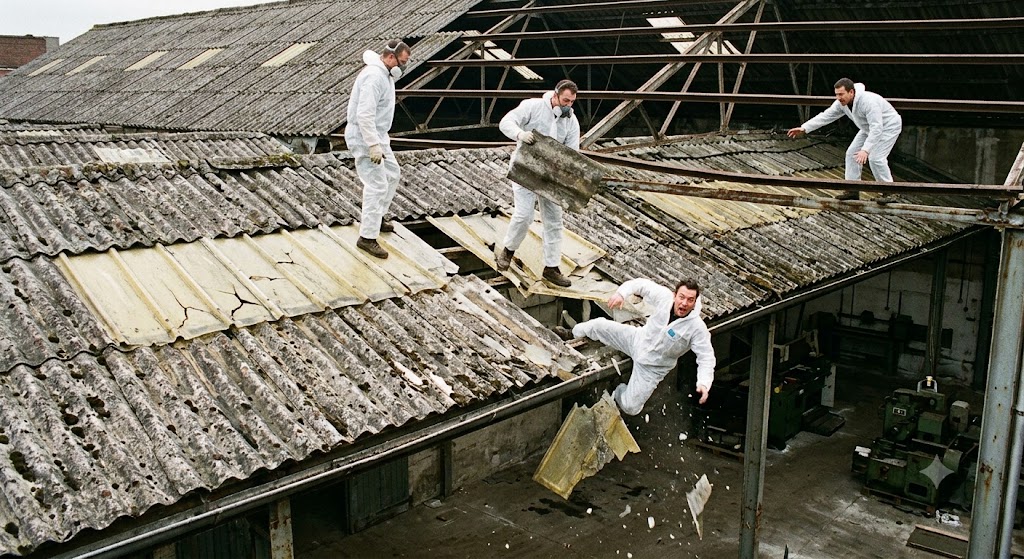
Retained educational illustration; not evidence of an actual incident.
The scenario and record comparisons are fictional teaching examples, not records of real incidents, measurements, inspections, signatures or approvals.
| Item | Fictional scenario |
|---|---|
| Initial situation | Fictional teaching situation: a crew proposes removing sheets from an old warehouse roof while the interior is occupied. |
| Changed condition | A rooflight is hard to distinguish and the access plan assumes that screw lines identify safe walking routes. |
| Failure path | A misstep could break a sheet or rooflight and cause a fall; breaking asbestos cement could also contaminate the occupied area. No injury, fiber reading or regulator investigation is asserted. |
| Possible outcome | Hold work before access. Confirm the survey, structural supports, safe work platform, rooflight protection and isolation of the area below. |
| Prevention barrier | Resume only through the actual project authorization after controls and rescue are checked; release to panel installers separately after the required asbestos completion checks. |
Failure mechanisms
A brittle roof sheet can fail without useful warning. Appearance, screw lines or an assumed residual-strength percentage cannot establish load capacity. A supported walkway transfers loads to verified structural supports; it does not make the adjacent sheet safe to stand on.
Avoid access onto fragile roofing where practicable, for example by a suitable platform from below. Where access remains necessary, design the combination of staging, edge/opening protection and fall protection. Include the exposed openings created as sheets are removed.
Fall restraint prevents reaching a fall position; fall arrest requires suitable anchorage, clearance, compatibility and prompt rescue. Neither a purlin nor a panel fixing becomes an anchor simply because it is steel.
Control fiber release by limiting disturbance, careful fixing removal, suitable wetting and containment. Wetting does not prove zero exposure and can add slip, runoff or electrical hazards. Do not high-pressure wash, dry sweep or use uncontrolled abrasive cutting.
No simple equation converts breakage energy and water content into an airborne fiber concentration. Exposure and clearance decisions need the assessment and measurements required for the process, not invented values.
Removed sheets add temporary roof load. Package at a planned protected location and use supported lifting arrangements without stacking beyond verified capacity. An access platform is not automatically a material crane.
New panels can act as sails and remain fragile or unstable before the specified supports and fixings are complete. Set weather limits for the actual equipment, panel area and handling method; review gusts as well as averages.
Decision sequence
| Decision stage | What to verify |
|---|---|
| Known facts | Known: identify the material, roof sector, occupied areas and intended removal method. |
| Unresolved matters | Unknown: verify support capacity, hidden rooflights, service routes, exposure category and waste route. |
| Reason to hold | Hold: no roof access or sheet disturbance while these controls remain unresolved. |
| Required evidence | Evidence: survey, structural/access plan, removal procedure, competence, rescue and waste acceptance. |
| Restart decision | Next decision: authorize removal, then asbestos completion and roofing handover, then final roof access as separate decisions. |
5. Conditional decisions and common errors
| Condition | Action | Evidence | Proceed when |
|---|---|---|---|
| Material uncertain | Stop disturbance and arrange competent survey. | Survey and laboratory scope | Material scope resolved |
| Board present, support unknown | Hold access and verify the load path. | Staging and support design | Supports accepted |
| Sheet breaks or dust escapes | Stop, exclude and reassess method. | Breakage response and exposure review | Containment restored |
| Wind or fixing changes | Hold panel lift or access. | Manual, gusts and fixing plan | Within verified limits |
Similar situations, different decisions
The scenario and record comparisons are fictional teaching examples, not records of real incidents, measurements, inspections, signatures or approvals.
| Comparison | Situation A | Situation B |
|---|---|---|
| Walkway | A board rests on fragile sheets. | A secured platform spans verified supports and protects the route. |
| Clean appearance | No visible debris is seen. | Required inspection, testing and release criteria are satisfied. |
| New panel | The panel is laid in place. | Required fixings, support and safe access status are checked. |
6. Roles and responsibilities
| Role | Responsibility |
|---|---|
| Work supervisor | Coordinate occupants, utilities, removal and roofing trades; obtain the applicable plan and permissions. |
| Technical reviewer | Check support, staging, lifting, anchorage and panel-fixing design for the actual configuration. |
| Work crew | Use the permitted method, control each new opening and stop for breakage or changed conditions. |
| Inspector / assessor | Assess asbestos process, protection, cleaning and required inspection or measurements without inventing results. |
| Release / handover authority | Accept completion evidence, remaining-asbestos records, waste documentation and restrictions before reopening. |
Supervision, records, handover
| Job stage | Technical and procedural controls | Site verification |
|---|---|---|
| Survey and plan | 1. Record: Survey and roof map2. Review: Removal plan and competence3. Confirm: Structural assessment | 1. Removal plan and competence2. Structural assessment3. Occupant and service plan |
| Protect access | 1. Record: Access and staging design2. Review: Rooflight protection3. Confirm: Fall system and clearance | 1. Rooflight protection2. Fall system and clearance3. Rescue readiness |
| Set dust controls | 1. Record: RPE selection and fit2. Review: Intake isolation plan3. Confirm: Wetting and runoff method | 1. Intake isolation plan2. Wetting and runoff method3. Decon and heat plan |
| Pack and lower | 1. Record: Load and lowering plan2. Review: Packaging specification3. Confirm: Exclusion and landing area | 1. Packaging specification2. Exclusion and landing area3. Waste tracking |
| Clean and decon | 1. Record: Cleaning and decon record2. Review: Waste package condition3. Confirm: Inspection and test scope | 1. Waste package condition2. Inspection and test scope3. Release to roofing crew |
| Inspect and hand over | 1. Record: Roof completion record2. Review: Remaining ACM register3. Confirm: Waste consignment evidence | 1. Remaining ACM register2. Waste consignment evidence3. Handover and restrictions |
7. Hold points and record comparison
| Hold point | Evidence before release | Confirmation / approval |
|---|---|---|
| Start | Surveyed asbestos-cement sheets and fragile rooflights; supported access; controlled sheet removal, packaging and lowering; cleaning and decontamination; installation of specified asbestos-free metal panels and documented handover. | |
| HP-1 Protect access | Access and staging design · Rooflight protection · Fall system and clearance · Rescue readiness | |
| HP-2 Release sheets | Removal sequence · Support and fixing method · Opening protection · Breakage response | |
| HP-3 Clean and decon | Cleaning and decon record · Waste package condition · Inspection and test scope · Release to roofing crew | |
| HP-4 Inspect and hand over | Roof completion record · Remaining ACM register · Waste consignment evidence · Handover and restrictions |
Complete after actual checks. Recheck after changes, defects or shift handover.
Record comparison examples
The scenario and record comparisons are fictional teaching examples, not records of real incidents, measurements, inspections, signatures or approvals.
The boxes are static record prompts, not interactive or saved approvals. A tick does not establish suitability or permission to restart. Record the evidence, person, time and unresolved issues; retain the change history.
| Record type | Insufficient record | Record checklist |
|---|---|---|
| Survey | Only OK | □ Survey and roof map□ Removal plan and competence□ Structural assessment□ Occupant and service plan |
| Access | Only OK | □ Access and staging design□ Rooflight protection□ Fall system and clearance□ Rescue readiness |
| Clearance | Only OK | □ Cleaning and decon record□ Waste package condition□ Inspection and test scope□ Release to roofing crew |
| Handover | Only OK | □ Roof completion record□ Remaining ACM register□ Waste consignment evidence□ Handover and restrictions |
8. Site checklist and emergency response
| Check item | Result | Person / action |
|---|---|---|
| □ Survey and plan: Survey and roof map | ||
| □ Protect access: Access and staging design | ||
| □ Set dust controls: RPE selection and fit | ||
| □ Release sheets: Removal sequence | ||
| □ Pack and lower: Load and lowering plan | ||
| □ Clean and decon: Cleaning and decon record | ||
| □ Install new panels: Panel and lifting manual | ||
| □ Inspect and hand over: Roof completion record | ||
| □ Release / handover authority |
Stop work
Stop for unverified materials or supports, unprotected rooflights or openings, loss of fall protection, unexpected breakage, dust escape, failed RPE/decon arrangements, unsafe weather or a changed lifting/fixing method.
Emergency response
Raise the alarm, exclude people below and preserve a safe access route. Use the planned rescue team and equipment; do not step onto fragile sheets to reach a casualty. For fiber release, contain access and involve the asbestos lead; do not dry sweep or restart merely because the dust is no longer visible.
9. Sources and review limits
2026-10-11
| Source | Scope and limitations |
|---|---|
| OSHA - 1926.1101 Asbestos | Read roofing controls under (g)(8)(ii), including intact removal, wet-method qualifications, lowering and intake isolation. Confirm classification and other applicable provisions on site. |
| OSHA - 1926.501 Fall protection | Read surface capacity and holes/skylights provisions. Protection selection also requires applicable system criteria and rescue planning. |
| HSE - Fragile surfaces | Foreign technical reference for access planning; does not replace OSHA or state requirements. |
This is reference content written and revised with AI. It has not been verified or approved by a professional. Review by a suitably qualified professional and site authorisation are required before use.
10. PDF guidance and FAQ
PDF A covers basic task controls; B focuses on technical failures; C covers supervision, records and handover. The article has eight stages with four items per main cell; each PDF has six key stages with three items per main cell. P/S/R/A, measurements, confirmations and signatures remain blank for actual site assessment.
Content group ID
jsa-roof-slate
Do crawling boards alone make the roof safe?
No. Their supports and security must be verified and adjacent fragile areas, edges and new openings must remain protected.
Does wetting remove the need for RPE?
No. RPE follows the assessed process and applicable rules; wetting is one source-control measure.
Can new panels be installed immediately after removal?
Only after the defined cleaning and asbestos release hold point, with continuing fall protection and an accepted installation method.
Can one wind speed or waste package apply everywhere?
No. Use the actual equipment and panel limits plus the applicable waste rules and receiving facility requirements.
Has a professional verified or approved this document?
No. Public sources and editorial, layout and consistency checks were reviewed using AI. No site inspection or professional technical approval has been performed. Obtain appropriate professional review before use.
11. Revision history and authorship
This is reference content written and revised with AI. It has not been verified or approved by a professional. Review by a suitably qualified professional and site authorisation are required before use.
| Date | Version | Change | Review status |
|---|---|---|---|
| 2026-08-30 | Original version unmarked | Original preserved | No professional approval |
| 2026-10-11 | 1.1 | Decisions, records, JSA and PDFs revised | No professional approval |
Preserves the original image and useful exclusion, intact-removal, access, lowering, decontamination and waste controls. Removes unsupported impact and fiber equations, invented injury/measurement/investigation details and automatic compliance claims. Replaces universal wind, board, PPE and packaging prescriptions with identified local and equipment requirements; adds protected openings, temporary loads, asbestos clearance and final roof acceptance.