Mesh appearance and whole-slope stability are different observations. Anchored mesh transfers force through connections, plates, anchors and rock. New seepage, joints or retained rock can change the demand without an obvious change in the visible mesh shape.
This is reference content written and revised with AI. It has not been verified or approved by a professional. Review by a suitably qualified professional and site authorization are required before use.
Stop before starting
Stop upper and lower work for new cracking, seepage, rock movement, access-rope or anchor defects, communication loss or uncontrolled mesh movement. Keep people outside the runout and recoil zones.
1. Legal and technical scope
| Basis | Scope and limits |
|---|---|
| OSHA 1926.501 | Applicable construction fall and falling-object protection. |
| OSHA 1926.502 | Fall-protection system criteria; actual worker support requires its own assessment. |
| FHWA Rockfall Protection | Anchored and draped mesh function distinctions; technical guidance, not a site design. |
Apply construction fall and falling-object protection appropriate to the access method, including 1926.501 and 1926.502. Apply excavation requirements if that activity is present and silica controls for the actual drilling equipment. FHWA rockfall guidance explains system functions; it is not a project design or worker-anchor certification. Check State Plan requirements and use the engineered system and site geology.
2. Scope and required inputs
Included work
Installing a designed anchored rockfall-mesh system: slope review, accepted access, planned loose-rock treatment, drilling and anchors, controlled mesh deployment, connection and inspection.
Separate assessment
Major slope stabilization, blasting, draped-mesh collection design and specialist rope-access procedures require separate plans. Rockfall mesh or its anchors are not automatically worker fall-protection anchors.
| Required input | Evidence to obtain |
|---|---|
| Review slope and system | Cracks and seepage; Rockfall paths; System design; Weather baseline |
| Prepare access and closure | Worker anchor basis; Access equipment; Rescue route; Upper lower communication |
| Treat loose rock | Rock locations; Treatment sequence; Access-line protection; Changed slope condition |
| Drill and install anchors | Hole ID and geology; Depth and direction; Grout and cure; Specified test record |
No actual equipment model, SDS, site measurements, design calculations or authorization record was supplied. Product-specific limits and methods must be verified before use. Federal OSHA is a baseline within its scope; determine the applicable State Plan and local requirements. Manufacturer guidance is not government approval; an incorporated standard differs from voluntary guidance. No nationwide-compliance or expert-approval claim is made.
3. Eight-stage JSA
| Job stage | Hazards and effects | Failure factors | Technical and procedural controls | Site verification | P | S | R | A |
|---|---|---|---|---|---|---|---|---|
| 1. Review slope and system | 1. Rockfall2. Global slope movement3. Inadequate protection4. Public exposure | 1. Joints unreviewed2. Water ignored3. System confused4. Runout omitted | 1. Survey slope changes2. Review drainage and geology3. Confirm anchored function4. Map influence zone | 1. Cracks and seepage2. Rockfall paths3. System design4. Weather baseline | ||||
| 2. Prepare access and closure | 1. Worker fall2. Person struck below3. Anchor failure4. Rescue fall | 1. Work zones overlap2. Closure incomplete3. Mesh used as lifeline4. Rescue unplanned | 1. Separate upper lower work2. Close drop zone3. Verify worker support4. Prepare rescue and contact | 1. Worker anchor basis2. Access equipment3. Rescue route4. Upper lower communication | ||||
| 3. Treat loose rock | 1. Large rock release2. Tool recoil3. Rope damage4. Secondary rockfall | 1. Removal from below2. Sequence changed3. Rope in fall path4. Slope change ignored | 1. Use specialist sequence2. Keep clear of runout3. Protect access lines4. Reassess after treatment | 1. Rock locations2. Treatment sequence3. Access-line protection4. Changed slope condition | ||||
| 4. Drill and install anchors | 1. Drill entanglement2. Silica exposure3. Anchor pullout4. Fragment strike | 1. Guard missing2. Dust control absent3. Ground differs4. Cure not verified | 1. Guard drilling equipment2. Apply drilling dust controls3. Record each hole condition4. Follow grout cure and testing | 1. Hole ID and geology2. Depth and direction3. Grout and cure4. Specified test record | ||||
| 5. Deploy mesh | 1. Roll recoil2. Wind-driven swing3. Falling rock4. Dropped bundle | 1. Ties released early2. Wind limits ignored3. Lower zone occupied4. Temporary support absent | 1. Plan bundle handling2. Use weather limits3. Maintain lower closure4. Retain staged supports | 1. Mesh weight and rigging2. Wind decision3. Deployment sequence4. Temporary ties and support | ||||
| 6. Connect and tension | 1. Connection release2. Component fracture3. Worker support loss4. Chain failure | 1. Parts mixed2. Overtension3. Supports shared blindly4. Sequence altered | 1. Use designated components2. Follow tensioning method3. Separate worker support4. Inspect before release | 1. Plates and connections2. Tensioning basis3. Worker support4. Temporary-support release | ||||
| 7. Hold weather or damage | 1. Further rockfall2. Tension recoil3. Access failure4. Drainage deterioration | 1. Rain change ignored2. Cable cut casually3. Damaged rope reused4. Rock load unknown | 1. Clear affected paths2. Reassess slope and water3. Control rock and tension4. Use approved repair | 1. Rain and crack changes2. Retained-rock load3. Support condition4. Repair and reinspection | ||||
| 8. Inspect and hand over | 1. Unseen loose connection2. Premature public access3. Later rockfall4. Water pressure change | 1. Hidden joint unchecked2. Opening rushed3. Residual rock concealed4. Inspection owner absent | 1. Inspect complete load path2. Resolve held areas3. Transfer drainage needs4. Authorize public opening | 1. Anchor and connection tests2. Residual rock and drainage3. Opening conditions4. Post-rain inspection owner |
P = likelihood; S = severity; R = risk under the site method; A = site-defined acceptance/authorization. These actual assessment cells are blank. A low score never overrides a missing safeguard or a legal or manufacturer restriction.
4. Fictional scenario and failure mechanisms
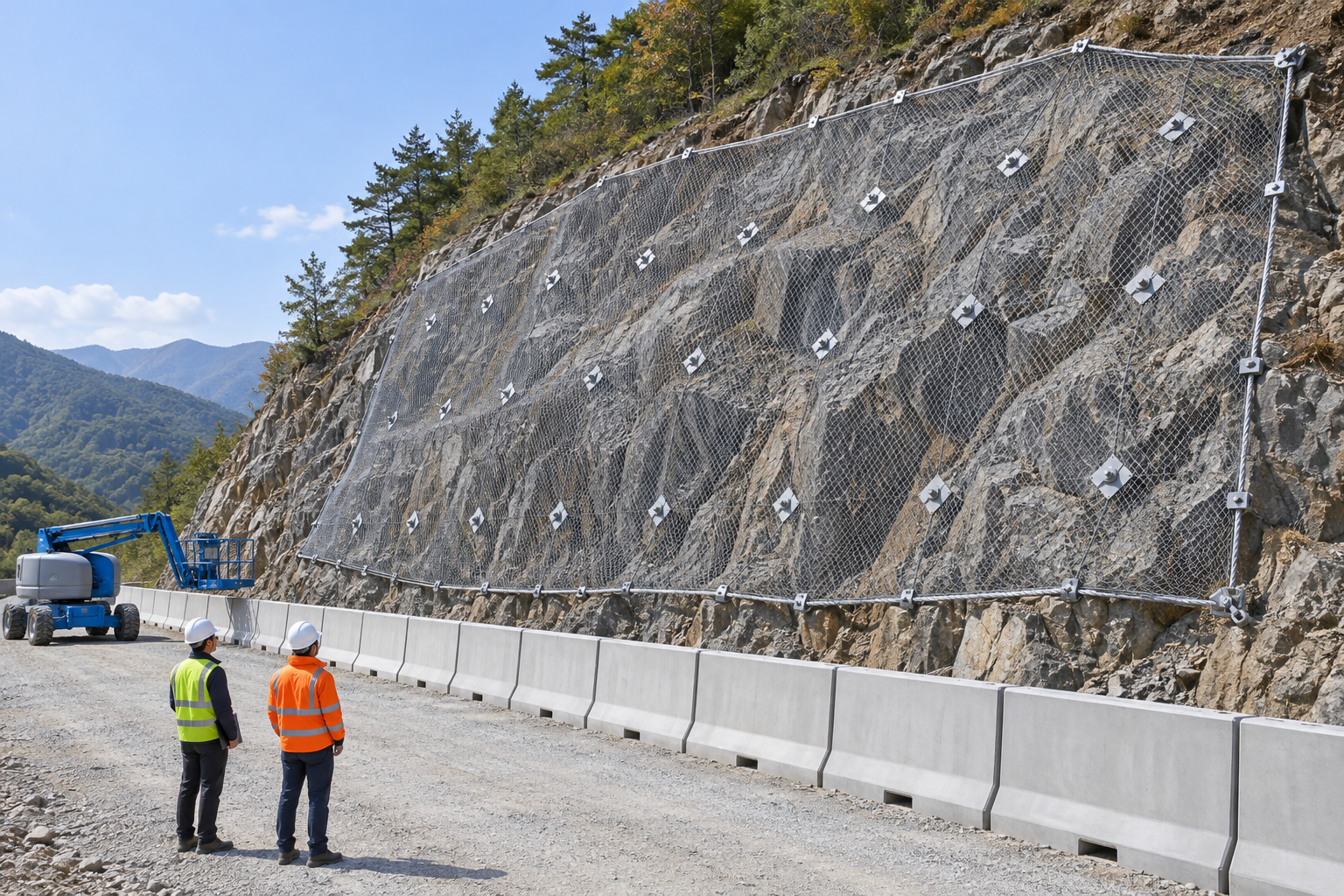
This illustration provides educational context. It is not an actual incident photograph or evidence of equipment suitability; any AI-generated depiction is illustrative only.
The scenario and record comparisons are fictional teaching examples, not records of real incidents, measurements, inspections, signatures or approvals.
| Stage | Fictional situation |
|---|---|
| Initial situation | A fictional anchored-mesh crew returns after rain. |
| Changed condition | New seepage and accumulated rock appear behind mesh that still looks intact. |
| Failure path | A worker proposes opening the road or loosening a connection to clear the rock. |
| Possible outcome | Rock release and cable recoil could reach workers and road users. |
| Prevention barrier | Maintain exclusion, reassess slope, anchors, retained rock and tension, then use the accepted repair and inspection sequence before opening. |
Failure mechanisms
Mesh appearance and whole-slope stability are different observations. Anchored mesh transfers force through connections, plates, anchors and rock. New seepage, joints or retained rock can change the demand without an obvious change in the visible mesh shape.
Draped mesh can guide falling material toward a collection area; anchored mesh has a different restraint function. Do not transfer anchor patterns, clearing methods or road-opening conditions between systems merely because both use wire mesh.
Rolled mesh and tensioned cables retain energy. Releasing ties or opening a connection can combine recoil with rock movement. Keep the designed temporary supports and lower exclusion until the release sequence is accepted.
Worker access, fall protection and rescue support need an independent suitability review. Adding a worker or rescue load to an incomplete mesh anchor changes its loading and is not authorized by the mesh design alone.
Work sequence: Review slope and system → Prepare access and closure → Treat loose rock → Drill and install anchors → Deploy mesh → Connect and tension → Hold weather or damage → Inspect and hand over. This is a teaching flow, not a device drawing or a complete operating procedure.
5. Conditional decisions and common errors
| Situation | Required action | Evidence | Proceed when |
|---|---|---|---|
| New seepage after rain | Reassess slope | Crack, water and drainage map | Slope reviewed |
| Rock behind mesh | Maintain lower closure | Rock and stored-tension plan | Release controlled |
| Mixed components | Hold connection | System parts and drawing | Combination accepted |
| Road opening requested | Inspect residual hazards | Connections, drainage and holds | Opening authorized |
Similar observations, different decisions
The scenario and record comparisons are fictional teaching examples, not records of real incidents, measurements, inspections, signatures or approvals.
| Observation | Insufficient conclusion | Required distinction |
|---|---|---|
| Mesh still attached | Visible shape | Slope stability unproved |
| Anchor supports mesh | System function | Worker anchor suitability separate |
| Installation finished | Components placed | Post-rain opening separate |
6. Roles and responsibilities
| Role | Responsibility |
|---|---|
| Work supervisor | Confirm cracks and seepage and the task scope, resources, interfaces and stop authority. |
| Qualified technical reviewer | Review worker anchor basis, model limits, compatibility and unresolved technical conditions within assigned competence. |
| Work crew | Apply the listed controls, report changes and stop when evidence or safeguards are missing. |
| Inspector / assessor | Record actual mesh weight and rigging and other relevant checks; do not mark unverified conditions as accepted. |
| Handover authority | Reconcile anchor and connection tests, restrictions and outstanding actions before the next task. Role labels do not establish a legal credential. |
Supervision and handover focus
| Stage | Management action | Evidence |
|---|---|---|
| Review slope and system | 1. Record cracks and seepage2. Record rockfall paths3. Record system design | 1. Cracks and seepage2. Rockfall paths3. System design |
| Prepare access and closure | 1. Record worker anchor basis2. Record access equipment3. Record rescue route | 1. Worker anchor basis2. Access equipment3. Rescue route |
| Drill and install anchors | 1. Record hole id and geology2. Record depth and direction3. Record grout and cure | 1. Hole ID and geology2. Depth and direction3. Grout and cure |
| Deploy mesh | 1. Record mesh weight and rigging2. Record wind decision3. Record deployment sequence | 1. Mesh weight and rigging2. Wind decision3. Deployment sequence |
| Hold weather or damage | 1. Record rain and crack changes2. Record retained-rock load3. Record support condition | 1. Rain and crack changes2. Retained-rock load3. Support condition |
| Inspect and hand over | 1. Record anchor and connection tests2. Record residual rock and drainage3. Record opening conditions | 1. Anchor and connection tests2. Residual rock and drainage3. Opening conditions |
7. Hold points and record comparison
| Hold point | Evidence before release | Actual approval |
|---|---|---|
| HP-0 Scope | Installing a designed anchored rockfall-mesh system: slope review, accepted access, planned loose-rock treatment, drilling and anchors, controlled mesh deployment, connection and inspection. | |
| HP-1 Prepare access and closure | Worker anchor basis; Access equipment; Rescue route; Upper lower communication | |
| HP-2 Drill and install anchors | Hole ID and geology; Depth and direction; Grout and cure; Specified test record | |
| HP-3 Hold weather or damage | Rain and crack changes; Retained-rock load; Support condition; Repair and reinspection | |
| HP-4 Inspect and hand over | Anchor and connection tests; Residual rock and drainage; Opening conditions; Post-rain inspection owner |
Hold points are internal project checks. They are not universal statutory permits and do not grant work permission. Reassess after defects, changed conditions and shift changes.
Record comparison
The scenario and record comparisons are fictional teaching examples, not records of real incidents, measurements, inspections, signatures or approvals.
The boxes are static record prompts, not interactive or saved approvals. A tick does not establish suitability or permission to restart. Record the evidence, person, time and unresolved issues; retain the change history.
| Record | Insufficient record | Record checklist |
|---|---|---|
| Review slope and system | Only marked “OK” | □ Cracks and seepage□ Rockfall paths□ System design□ Weather baseline |
| Drill and install anchors | Only marked “OK” | □ Hole ID and geology□ Depth and direction□ Grout and cure□ Specified test record |
| Hold weather or damage | Only marked “OK” | □ Rain and crack changes□ Retained-rock load□ Support condition□ Repair and reinspection |
| Inspect and hand over | Only marked “OK” | □ Anchor and connection tests□ Residual rock and drainage□ Opening conditions□ Post-rain inspection owner |
8. Site checklist and emergency response
| Site check | Actual result | Person / action |
|---|---|---|
| Review slope and system: Cracks and seepage; Rockfall paths; System design; Weather baseline | ||
| Prepare access and closure: Worker anchor basis; Access equipment; Rescue route; Upper lower communication | ||
| Treat loose rock: Rock locations; Treatment sequence; Access-line protection; Changed slope condition | ||
| Drill and install anchors: Hole ID and geology; Depth and direction; Grout and cure; Specified test record | ||
| Deploy mesh: Mesh weight and rigging; Wind decision; Deployment sequence; Temporary ties and support | ||
| Connect and tension: Plates and connections; Tensioning basis; Worker support; Temporary-support release | ||
| Hold weather or damage: Rain and crack changes; Retained-rock load; Support condition; Repair and reinspection | ||
| Inspect and hand over: Anchor and connection tests; Residual rock and drainage; Opening conditions; Post-rain inspection owner |
Stop work
Stop upper and lower work for new cracking, seepage, rock movement, access-rope or anchor defects, communication loss or uncontrolled mesh movement. Keep people outside the runout and recoil zones.
Emergency response
Move to the planned refuge outside the rockfall path and maintain lower exclusion. Use the prepared specialist rescue system; do not add rescue loads to damaged mesh or unverified anchors.
9. Sources and review limits
Public-source access/review: 2026-10-14.
| Official source | Reviewed scope and limits |
|---|---|
| OSHA 1926.501 | Applicable construction fall and falling-object protection. |
| OSHA 1926.502 | Fall-protection system criteria; actual worker support requires its own assessment. |
| FHWA Rockfall Protection | Anchored and draped mesh function distinctions; technical guidance, not a site design. |
No actual equipment model, SDS, site measurements, design calculations or authorization record was supplied. Product-specific limits and methods must be verified before use. Federal OSHA is a baseline within its scope; determine the applicable State Plan and local requirements. Manufacturer guidance is not government approval; an incorporated standard differs from voluntary guidance. No nationwide-compliance or expert-approval claim is made.
10. PDF guidance and FAQ
PDF A covers basic task controls; B focuses on technical failures; C covers supervision, records and handover. The article has eight stages with four items per main cell; each PDF has six key stages with three items per main cell. P/S/R/A, measurements, confirmations and signatures remain blank for actual site assessment.
PDFs are complementary six-stage extracts. Apply all eight body stages and the actual equipment/site procedure.
Can a lifeline attach to the mesh?
Do not assume so. Worker and rescue anchors need separately accepted suitability and loading.
May retained rock be freed by cutting a cable?
Not without a reviewed plan controlling rock loads, residual tension and the release sequence.
Does mesh prevent every slope failure?
No. The actual failure mechanisms, geology and water conditions need the engineered slope assessment.
Has a professional verified or approved this document?
No. Public sources and editorial, layout and consistency checks were reviewed using AI. No site inspection or professional technical approval has been performed. Obtain appropriate professional review before use.
11. Revision history and authorship
This is reference content written and revised with AI. It has not been verified or approved by a professional. Review by a suitably qualified professional and site authorization are required before use.
| Date | Version | Change | Review status |
|---|---|---|---|
| 2026-10-14 | US 1.0 | New US edition from assigned Korean source; task decisions, records and PDFs localized. | AI editorial review; no professional technical approval |
Korean edition revision history: 2026-09-19 (v1.0): earlier published draft/version retained in the source history; 2026-09-30 (v1.1): task decisions, record checklist, JSA and three PDF variants revised. These are editorial records, not professional technical approval. US v1.0 adapts the earlier edition to United States requirements and terminology.
Site reviewers must add their actual qualifications, scope, date and approval only after the review occurs.