Products can mix through residue in a toilet, brush or measuring container. Identifying the bottle is only the first control.
This is reference content written and revised with AI. It has not been verified or approved by a professional. Review by a suitably qualified professional and required site authorization are necessary before use.
Stop conditions first
Stop for an unidentified product, incompatible residue, failed ventilation, eye/throat irritation, coughing, uncontrolled spill or unsafe access. Leave the affected area; do not add another chemical to neutralize the mixture.
1. US legal and technical basis
General-industry routine cleaning: determine OSHA 1910.1200 hazard-communication coverage and applicable PPE/workplace controls. A consumer product label alone does not establish the limited consumer-use exemption.
| Reference | Use and limit |
|---|---|
| OSHA 29 CFR 1910.1200 | Selected scope/consumer-product exception, labels, SDS and employee information/training; no complete transition or product-classification audit. |
| NIOSH, Cleaning Chemicals and Your Health | Selected public worker fact-sheet description: mixing hazards, ventilation, labeling and training. No product-specific exposure limit or dilution inferred. |
| CDC, Cleaning and Disinfecting with Bleach | Selected no-mixing, ventilation and label-direction passages. Household dilution recipes are not transferred to workplace products. |
| OSHA State Plans | Federal baseline and State Plan coverage reviewed. Confirm the applicable state program and employer coverage; this edition does not establish nationwide compliance. |
Determine whether Federal OSHA or an applicable State Plan governs the employer and work. Standards incorporated into a regulation must be read in their legally applicable edition. Other NFPA/ANSI guidance and manufacturer instructions have distinct roles; they are not automatically federal law.
2. Scope and required inputs
Included
Clean ordinary restroom fixtures and nearby surfaces using identified site-approved products, required dilution, controlled application, wiping, collection, drying and storage.
Separate assessment
Sewer/tank or confined-space entry, concentrated industrial acids, blood/sharps cleanup, outbreak disinfection, specialist mold removal and chemical drain opening require separate procedures.
| Input | Evidence needed |
|---|---|
| Identify area and products | Product/label/SDS; Prior use/residue; Surface and purpose; Scope and briefing |
| Control access and air | Airflow and outlet; Access barriers; Floor condition; Escape route |
| Apply and clean | Application method; Skin/eye protection; Air conditions; Residue/product separation |
| Store and hand over | Storage separation; Container/cap state; Inventory and labels; Shift briefing/defects |
Selected public official provisions were checked on October 14, 2026. This is not a complete legal audit. No actual equipment manual, site measurements, engineering calculations, product certification or professional technical approval was supplied. Full paid NFPA/ANSI standards and state/local amendments were not reviewed. Check actual equipment, jurisdiction and project requirements before use.
Select task-appropriate eye, hand, foot, skin and hearing protection from the exposure assessment. Where respiratory protection is necessary, use the applicable respiratory-protection program; PPE does not replace isolation, guarding, support or ventilation.
3. Eight-stage JSA
| Job stage | Hazards and effects | Failure factors | Controls | Site verification | P | S | R | A |
|---|---|---|---|---|---|---|---|---|
| 1. Identify area and products | 1. Incompatible mixing2. Chemical burn3. Wrong surface treatment4. Unexpected biological hazard | 1. Unlabeled bottle2. Prior product unknown3. Purpose mismatched4. Scope not assessed | 1. Match label and contents2. Check previous chemicals3. Use approved product4. Refer excluded contamination | 1. Product/label/SDS2. Prior use/residue3. Surface and purpose4. Scope and briefing | ||||
| 2. Control access and air | 1. Vapor exposure2. Public contact3. Slip injury4. Escape blocked | 1. Ventilation off2. Users enter3. Wet area unmarked4. Tools block exit | 1. Verify ventilation2. Separate cleaning area3. Mark wet boundaries4. Keep exit clear | 1. Airflow and outlet2. Access barriers3. Floor condition4. Escape route | ||||
| 3. Prepare tools and dilution | 1. Splash burn2. Toxic mixing3. Wrong concentration4. Container confusion | 1. Shared measuring tool2. Residue in sprayer3. Recipe improvised4. Drink bottle used | 1. Use dedicated clean tools2. Check compatibility3. Follow exact label dilution4. Use labeled suitable container | 1. Tool/container identity2. Dilution instructions3. Eye/hand protection4. Measured product record | ||||
| 4. Apply and clean | 1. Eye splash2. Skin exposure3. Inhalation4. Product reaction | 1. Spray uncontrolled2. Glove incompatible3. Ventilation inadequate4. Second chemical added | 1. Control application direction2. Use product-matched gloves3. Maintain ventilation4. Keep chemicals separate | 1. Application method2. Skin/eye protection3. Air conditions4. Residue/product separation | ||||
| 5. Wipe and collect | 1. Residual chemical contact2. Splash during disposal3. Cross contamination4. Slip on waste | 1. Cloth saturated2. Waste mixed3. Tools shared4. Runoff left | 1. Follow label removal2. Segregate compatible waste3. Keep tools assigned4. Control wet residue | 1. Surface residue2. Waste route3. Tool segregation4. Floor cleanup | ||||
| 6. Dry and release area | 1. Public slip2. Residual exposure3. Premature entry4. Fixture damage | 1. Floor appearance trusted2. Odor used as test3. Barrier removed early4. Damage ignored | 1. Verify footing and residue2. Apply label completion checks3. Release only safe area4. Report damaged fixtures | 1. Dry/clean condition2. Product completion3. Access release4. Defects/restrictions | ||||
| 7. Hold irritation or spill | 1. Worsening exposure2. Unprotected rescue3. Dangerous neutralization4. Unsafe reentry | 1. Work continues2. Person returns3. Another product added4. Odor decrease trusted | 1. Leave and alert response2. Restrict entry3. Do not improvise chemistry4. Require responder release | 1. Known product information2. People/exposure report3. Response boundary4. Cause/reentry evidence | ||||
| 8. Store and hand over | 1. Later mixing2. Container leak3. Unidentified leftover4. Repeated incident | 1. Incompatibles adjacent2. Cap loose3. Label omitted4. Prior use not shared | 1. Store as product directs2. Secure compatible containers3. Keep contents labeled4. Transfer product/residue status | 1. Storage separation2. Container/cap state3. Inventory and labels4. Shift briefing/defects |
Actual risk assessments, measurements, checks, approvals and signatures have not been performed. Keep unverified fields blank and link the actual site records. P/S/R/A mean likelihood, severity, site-method risk and site-defined acceptance/authorization; a score cannot waive a required control.
4. Failure mechanisms and hypothetical case
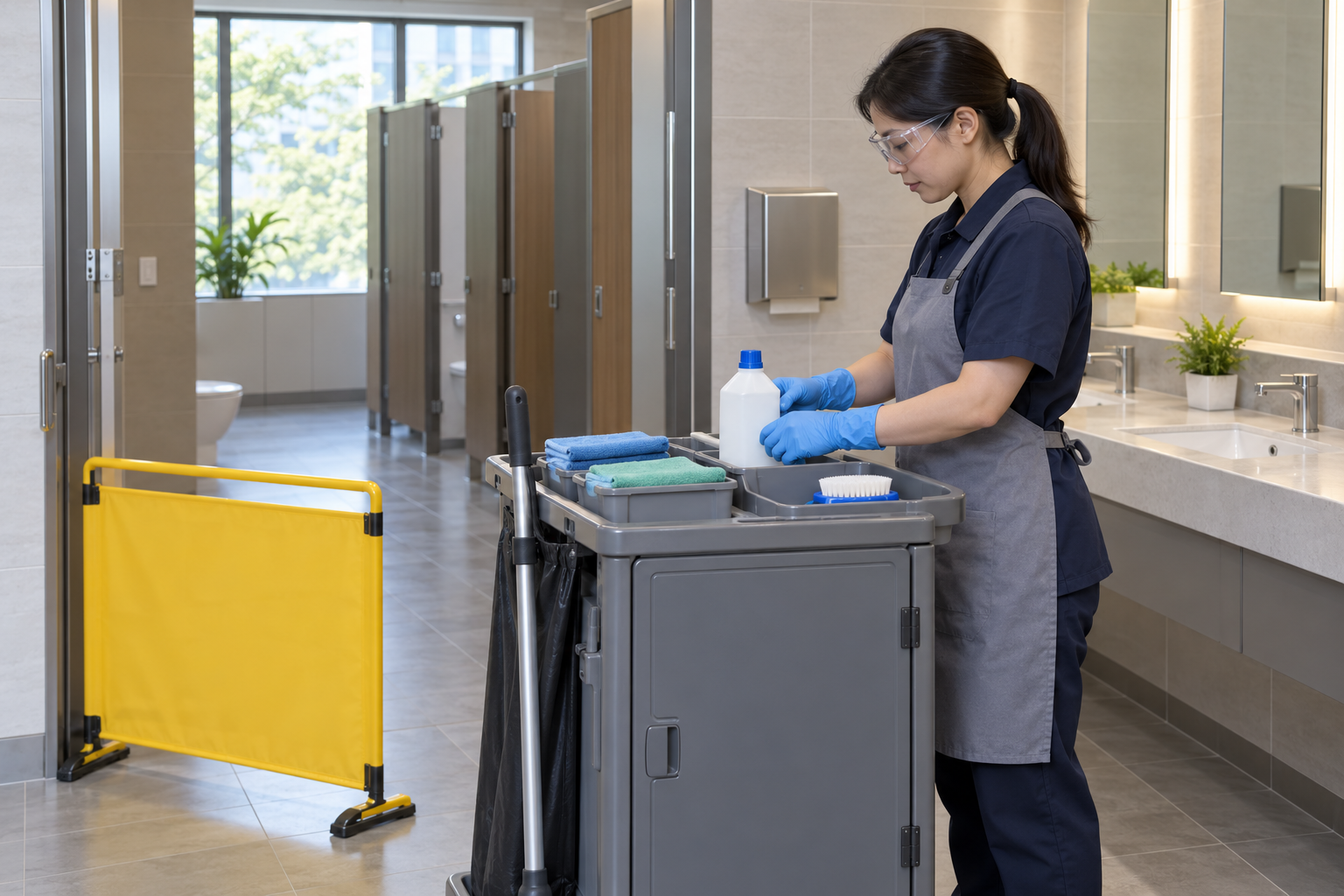
The retained illustration is an AI-generated educational image from the retained source edition. It is not an actual incident photograph, approved drawing, equipment certification or proof that the depicted arrangement is safe.
Never mix bleach with other cleaners, including acids or ammonia-containing products. Separate containers and tools; confirm the prior product and residual liquid before changing chemicals. A different bottle does not prevent contact inside the fixture.
Use the exact product label and SDS for concentration, dilution order, surface suitability, contact conditions and protection. Do not apply an internet household dilution recipe to an unknown workplace concentrate or ready-to-use product.
Where hazard communication applies, provide required labels, accessible SDS and training. The consumer-product exception depends on intended use and comparable exposure duration/frequency; repeated occupational cleaning is not automatically exempt.
Weak odor or a dry floor does not establish safe air or absence of chemical residue. Following an exposure incident, qualified responders determine cleanup, ventilation, assessment and reentry. A particulate dust mask does not supply protection from every gas.
Hypothetical decision example
Hypothetical example: an unlabeled sprayer remains from the previous shift. After acid cleaner is used in a toilet, bleach is added and the worker develops irritation and coughing. Stop, leave, restrict access and relay known product information to responders; do not return to smell-test the area.
The example is fictional; no incident, measurement, inspection or approval is asserted.
Task flow: Identify area and products → Control access and air → Prepare tools and dilution → Apply and clean → Wipe and collect → Dry and release area → Hold irritation or spill → Store and hand over
5. Hold and proceed decisions
| Condition | Action | Evidence | Proceed when |
|---|---|---|---|
| Product unidentified | Hold use; identify container | Label/SDS and contents | Identity confirmed |
| Prior chemical unknown | Do not add product | Previous use/residue review | Compatible method confirmed |
| Irritation or gas suspected | Leave; restrict access | Responder assessment | Reentry authorized |
| Cleaning finished | Check residue and footing | Label completion and area check | Area safe for use |
Similar observation, different conclusion
| Observation | Supported conclusion | What remains unresolved |
|---|---|---|
| Original bottle present | Container has an identity | Actual contents/concentration still matter |
| Odor decreases | Odor seems weaker | Atmosphere/residue safety unproved |
6. Roles and supervision
| Role | Responsibility |
|---|---|
| Work supervisor | Coordinate identify area and products, affected operations, stop signals and stage transitions. |
| Technical/equipment reviewer | Verify Product/label/SDS, Prior use/residue, actual instructions and unresolved technical limits. |
| Task crew | Apply the stated controls, report changes and keep actual checks and signatures factual. |
| Inspector/test lead | Connect Dry/clean condition, Product completion to the required acceptance criteria. |
| Receiving authority | Accept the recorded restrictions, Inventory and labels, Shift briefing/defects, and follow-up ownership. |
These are responsibility examples, not invented statutory credentials. Verify actual competence, training and authority for the assigned work.
Supervision and handover controls
| Stage | Management controls | Evidence |
|---|---|---|
| Plan review | 1. Assign technical owner2. Close task-specific questions3. Match label and contents | 1. Product/label/SDS2. Prior use/residue3. Scope and briefing |
| Competence | 1. Verify required competence2. Assign stop authority3. Verify ventilation | 1. Airflow and outlet2. Training and task briefing3. Escape route |
| Prestart evidence | 1. Inspect actual equipment2. Link evidence to this stage3. Control application direction | 1. Application method2. Skin/eye protection3. Residue/product separation |
| Change control | 1. Stop and secure the area2. Review affected controls3. Leave and alert response | 1. Known product information2. People/exposure report3. Cause/reentry evidence |
| Shift handover | 1. Identify remaining restrictions2. Confirm receiving responsibility3. Store as product directs | 1. Storage separation2. Container/cap state3. Shift briefing/defects |
| Closeout | 1. Record defect disposition2. Archive factual evidence3. Store as product directs | 1. Storage separation2. Container/cap state3. Shift briefing/defects |
7. Hold points and record quality
| Hold point | Evidence before release | Actual record |
|---|---|---|
| HP-0 Start | Clean ordinary restroom fixtures and nearby surfaces using identified site-approved products, required dilution, controlled application, wiping, collection, drying and storage. | |
| HP-1 Control access and air | Airflow and outlet; Access barriers; Floor condition; Escape route | |
| HP-2 Apply and clean | Application method; Skin/eye protection; Air conditions; Residue/product separation | |
| HP-3 Hold irritation or spill | Known product information; People/exposure report; Response boundary; Cause/reentry evidence | |
| HP-4 Store and hand over | Storage separation; Container/cap state; Inventory and labels; Shift briefing/defects |
Hold points are internal evidence gates. They do not establish that a statutory permit exists or has been approved. Recheck affected gates after changes, faults and shift handover.
Record comparison - hypothetical templates
The 16 boxes below identify record elements, not completed checks or approvals. They are static symbols. Link equipment/location, date, actual findings and the separate record reference; preserve unresolved items.
| Record | Insufficient entry | Required record elements |
|---|---|---|
| Identify area and products | "Checked" without supporting facts | □ Product/label/SDS□ Prior use/residue□ Surface and purpose□ Scope and briefing |
| Prepare tools and dilution | "Checked" without supporting facts | □ Tool/container identity□ Dilution instructions□ Eye/hand protection□ Measured product record |
| Wipe and collect | "Checked" without supporting facts | □ Surface residue□ Waste route□ Tool segregation□ Floor cleanup |
| Hold irritation or spill | "Checked" without supporting facts | □ Known product information□ People/exposure report□ Response boundary□ Cause/reentry evidence |
8. Pre-work checks and emergency response
| Check required | Result | Checker/action |
|---|---|---|
| Identify area and products: Product/label/SDS | ||
| Control access and air: Airflow and outlet | ||
| Prepare tools and dilution: Tool/container identity | ||
| Apply and clean: Application method | ||
| Wipe and collect: Surface residue | ||
| Dry and release area: Dry/clean condition | ||
| Hold irritation or spill: Known product information | ||
| Store and hand over: Storage separation |
Stop work
Stop for an unidentified product, incompatible residue, failed ventilation, eye/throat irritation, coughing, uncontrolled spill or unsafe access. Leave the affected area; do not add another chemical to neutralize the mixture.
Emergency response
Stop application, leave the affected area and prevent others from entering. Alert site emergency response and call 911 for breathing difficulty, severe exposure or uncontrolled chemical release. Do not re-enter to identify odor, mix in a neutralizer or attempt an unprotected rescue. Use the product first-aid directions and accessible eyewash from a safe location; give responders known labels/SDS without retrieving them from a hazardous area.
9. Official sources and review limits
Official public-source check: October 14, 2026. The review concerns the selected passages described below, not endorsement of this article.
| Official source | Checked scope and limit |
|---|---|
| OSHA 29 CFR 1910.1200 | Selected scope/consumer-product exception, labels, SDS and employee information/training; no complete transition or product-classification audit. |
| NIOSH, Cleaning Chemicals and Your Health | Selected public worker fact-sheet description: mixing hazards, ventilation, labeling and training. No product-specific exposure limit or dilution inferred. |
| CDC, Cleaning and Disinfecting with Bleach | Selected no-mixing, ventilation and label-direction passages. Household dilution recipes are not transferred to workplace products. |
| OSHA State Plans | Federal baseline and State Plan coverage reviewed. Confirm the applicable state program and employer coverage; this edition does not establish nationwide compliance. |
Selected public official provisions were checked on October 14, 2026. This is not a complete legal audit. No actual equipment manual, site measurements, engineering calculations, product certification or professional technical approval was supplied. Full paid NFPA/ANSI standards and state/local amendments were not reviewed. Check actual equipment, jurisdiction and project requirements before use.
This is reference content written and revised with AI. It has not been verified or approved by a professional. Review by a suitably qualified professional and required site authorization are necessary before use.
10. PDF use and frequently asked questions
PDF A summarizes core controls; B emphasizes technical failures; C covers supervision, records and handover. Each uses six stages from or aligned with the eight-stage body. All actual risk, measurement, check and signature fields are blank. Use a separate linked record where more space is needed.
Can bleach follow acid cleaner immediately?
Do not allow incompatible products or residues to mix. Use an approved product-transition method.
May unused cleaner return to another bottle?
No. Keep contents identified and segregated; do not combine leftovers.
Can a dust mask permit reentry?
No. Leave assessment and any required protection to the trained response team.
Does a household product avoid workplace training?
Determine actual OSHA coverage and exposure pattern; provide the task information and training needed for safe use.
Has a professional approved this JSA?
This is reference content written and revised with AI. It has not been verified or approved by a professional. Review by a suitably qualified professional and required site authorization are necessary before use.
11. Authorship and revision history
This is reference content written and revised with AI. It has not been verified or approved by a professional. Review by a suitably qualified professional and required site authorization are necessary before use.
| Date/version | Editorial history | Technical approval |
|---|---|---|
| October 03, 2026 / Korean v1.0 | Korean source: initial article, evidence, hypothetical decisions and body/PDF editorial checks. | Professional technical approval not performed |
| October 14, 2026 / US v1.0 | US localization: Preserves unlabeled sprayer and acid/bleach exposure scenario. Keeps product-specific dilution and responder-led reentry; clarifies US hazard-communication scope without a blanket household-product exemption. | Not performed |
Source topic: https://smartjsabridge.com/ko/case-study/jsa-restroom-cleaner-use
Content group: jsa-restroom-cleaner-use