Pedestal attachment and traffic release are different decisions. Adhesive fixing may need protected curing under specified substrate conditions. Record the area, product, installation time and required cure conditions before panels conceal the supports.
This is reference content written and revised with AI. It has not been verified or approved by a professional. Review by a suitably qualified professional and site authorization are required before use.
Stop before starting
Hold unverified bases, load limits, layouts or component combinations. Stop traffic for loose pedestals, incomplete cure or height locks, missing panel supports, unprotected openings or an unapproved equipment load.
1. Legal and technical scope
| Basis | Scope and limits |
|---|---|
| OSHA 1926.501 | Construction protection for relevant holes, trips and falls. |
| OSHA 1926.59 | Construction hazard communication, including applicable adhesive SDS and training. |
For construction, apply 1926.501 to actual holes and fall exposures and 1926.59 hazard communication to adhesive use. Floor capacity, component compatibility, curing and concentrated rolling loads require the approved system design and actual product instructions. Check State Plan requirements; a panel layout or this checklist does not certify structural or electrical performance.
2. Scope and required inputs
Included work
Installing an approved raised-floor system in a new indoor area: pedestals, specified stringers, gaskets and prepared panels, including accepted edge and penetration supports and controlled handover.
Separate assessment
Structural slab reinforcement, work around live services beneath existing floors, on-site panel cutting, heavy-equipment moves, load or grounding certification and structural-hole-cover design require separate review.
| Required input | Evidence to obtain |
|---|---|
| Review system and base | Area and system IDs; Substrate condition; Layout and height; Design load limits |
| Deliver and mark grid | Panel mass and aids; Route and cart load; Grid reference; Opening boundaries |
| Fix and protect pedestals | Product and SDS; Base preparation; Fixing time and area; Cure and access limits |
| Assemble and lock height | Stringers and gaskets; Height and level; Lock and fasteners; Component match |
No actual equipment model, SDS, site measurements, design calculations or authorization record was supplied. Product-specific limits and methods must be verified before use. Federal OSHA is a baseline within its scope; determine the applicable State Plan and local requirements. Manufacturer guidance is not government approval; an incorporated standard differs from voluntary guidance. No nationwide-compliance or expert-approval claim is made.
3. Eight-stage JSA
| Job stage | Hazards and effects | Failure factors | Technical and procedural controls | Site verification | P | S | R | A |
|---|---|---|---|---|---|---|---|---|
| 1. Review system and base | 1. Support failure2. Service damage3. Wrong floor height4. Overload | 1. Mixed components2. Base unaccepted3. Layout outdated4. Capacity assumed | 1. Match approved system2. Accept substrate and services3. Confirm grid and height4. Review design loads | 1. Area and system IDs2. Substrate condition3. Layout and height4. Design load limits | ||||
| 2. Deliver and mark grid | 1. Dropped panel2. Handling strain3. Trip into opening4. Unstable cart | 1. Cart overloaded2. Poor grips3. Routes mixed4. Grid improvised | 1. Use suitable handling aids2. Limit transport loads3. Separate open areas4. Mark approved grid | 1. Panel mass and aids2. Route and cart load3. Grid reference4. Opening boundaries | ||||
| 3. Fix and protect pedestals | 1. Adhesive exposure2. Pedestal debonding3. Support movement4. Premature loading | 1. SDS ignored2. Dirty wet base3. Wrong fixing method4. Cure interrupted | 1. Follow adhesive controls2. Prepare specified substrate3. Use approved fixing4. Protect cure zone | 1. Product and SDS2. Base preparation3. Fixing time and area4. Cure and access limits | ||||
| 4. Assemble and lock height | 1. Frame instability2. Finger pinch3. Uneven floor4. Connection failure | 1. Stringer omitted2. Hands in joint3. Lock left loose4. Parts incompatible | 1. Use specified connectors2. Keep hands clear3. Set and lock height4. Inspect system combination | 1. Stringers and gaskets2. Height and level3. Lock and fasteners4. Component match | ||||
| 5. Place supported panels | 1. Hand crush2. Panel drop3. Edge collapse4. Service contact | 1. Hands under edge2. Lifter unsuitable3. Cutout support absent4. Panel direction wrong | 1. Use suitable panel lifter2. Control hand positions3. Verify every support4. Follow edge and cutout detail | 1. Panel orientation2. Lifter and grips3. Support contact4. Perimeter and cutouts | ||||
| 6. Inspect and control traffic | 1. Floor collapse2. Trip at level change3. Wheel overload4. Open-floor fall | 1. Inspection skipped2. Defect hidden3. Cart load unreviewed4. Panels opened freely | 1. Separate accepted areas2. Inspect rocking and levels3. Review rolling loads4. Control panel removal | 1. Assembly inspection2. Steps and openings3. Wheel loads and route4. Area release | ||||
| 7. Hold instability | 1. Progressive damage2. Support failure3. Fall4. Repeated debonding | 1. Rocking stamped down2. Paper shims used3. People enter fault4. Cause unexamined | 1. Close affected zone2. Review cure and locks3. Apply specified repair4. Inspect before reuse | 1. Fault location2. Cure lock support cause3. Repair detail4. Reinspection record | ||||
| 8. Clean and hand over | 1. Unmarked opening2. Unauthorized loading3. Hidden loose items4. Lost restrictions | 1. Reopening unreported2. Completion assumed3. Debris beneath panels4. Recipient unclear | 1. Account for open panels2. Transfer load limits3. Clear permitted debris4. Assign follow-up owner | 1. Accepted and held zones2. Opening procedure3. Transport restrictions4. Recipient and inspection |
P = likelihood; S = severity; R = risk under the site method; A = site-defined acceptance/authorization. These actual assessment cells are blank. A low score never overrides a missing safeguard or a legal or manufacturer restriction.
4. Fictional scenario and failure mechanisms
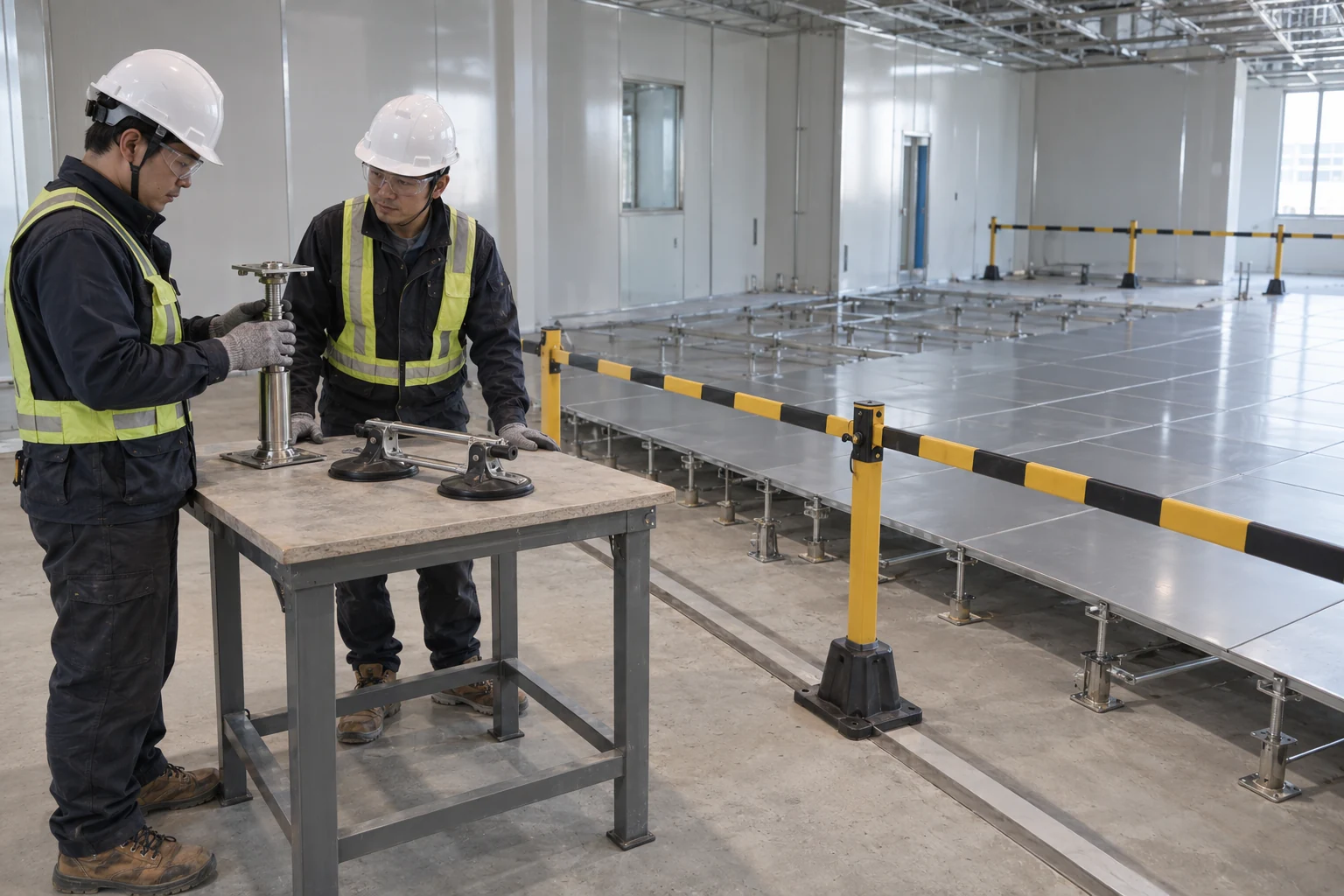
This illustration provides educational context. It is not an actual incident photograph or evidence of equipment suitability; any AI-generated depiction is illustrative only.
The scenario and record comparisons are fictional teaching examples, not records of real incidents, measurements, inspections, signatures or approvals.
| Stage | Fictional situation |
|---|---|
| Initial situation | A fictional floor crew has just placed the last panels. |
| Changed condition | Another trade brings a heavy cart to the area. |
| Failure path | Pedestal cure times and permitted rolling loads were not handed over. |
| Possible outcome | Supports or panels could move or fail under the concentrated wheel load. |
| Prevention barrier | Hold traffic, reconcile curing and assembly inspection with the approved route and load limits, then release only the accepted area. |
Failure mechanisms
Pedestal attachment and traffic release are different decisions. Adhesive fixing may need protected curing under specified substrate conditions. Record the area, product, installation time and required cure conditions before panels conceal the supports.
Perimeter and service-penetration panels need their own approved support details. An intact panel surface does not prove contact at every required support or completion of height locks. Do not mix components or use paper shims to hide rocking.
A person walking without visible deflection does not establish suitability for a loaded cart. Wheel concentration, route, turning and any load-distribution measures require review before equipment moves. Opening panels later also changes the access and system-stability conditions.
Work sequence: Review system and base → Deliver and mark grid → Fix and protect pedestals → Assemble and lock height → Place supported panels → Inspect and control traffic → Hold instability → Clean and hand over. This is a teaching flow, not a device drawing or a complete operating procedure.
5. Conditional decisions and common errors
| Situation | Required action | Evidence | Proceed when |
|---|---|---|---|
| Cure record missing | Restrict traffic | Product, time and substrate record | Cure accepted |
| Panel rocks | Close affected area | Support, lock and edge detail | Repair inspected |
| Heavy cart proposed | Review rolling load | Load, wheels and route | Move authorized |
| Panels reopened | Control openings | System stability and access plan | Opening plan accepted |
Similar observations, different decisions
The scenario and record comparisons are fictional teaching examples, not records of real incidents, measurements, inspections, signatures or approvals.
| Observation | Insufficient conclusion | Required distinction |
|---|---|---|
| Panels all placed | Surface covered | Support acceptance separate |
| Person walked across | One loading event | Cart capacity unproved |
| Standard panel fits | Panel dimensions | Edge support still required |
6. Roles and responsibilities
| Role | Responsibility |
|---|---|
| Work supervisor | Confirm area and system ids and the task scope, resources, interfaces and stop authority. |
| Qualified technical reviewer | Review panel mass and aids, model limits, compatibility and unresolved technical conditions within assigned competence. |
| Work crew | Apply the listed controls, report changes and stop when evidence or safeguards are missing. |
| Inspector / assessor | Record actual panel orientation and other relevant checks; do not mark unverified conditions as accepted. |
| Handover authority | Reconcile accepted and held zones, restrictions and outstanding actions before the next task. Role labels do not establish a legal credential. |
Supervision and handover focus
| Stage | Management action | Evidence |
|---|---|---|
| Review system and base | 1. Record area and system ids2. Record substrate condition3. Record layout and height | 1. Area and system IDs2. Substrate condition3. Layout and height |
| Deliver and mark grid | 1. Record panel mass and aids2. Record route and cart load3. Record grid reference | 1. Panel mass and aids2. Route and cart load3. Grid reference |
| Assemble and lock height | 1. Record stringers and gaskets2. Record height and level3. Record lock and fasteners | 1. Stringers and gaskets2. Height and level3. Lock and fasteners |
| Place supported panels | 1. Record panel orientation2. Record lifter and grips3. Record support contact | 1. Panel orientation2. Lifter and grips3. Support contact |
| Hold instability | 1. Record fault location2. Record cure lock support cause3. Record repair detail | 1. Fault location2. Cure lock support cause3. Repair detail |
| Clean and hand over | 1. Record accepted and held zones2. Record opening procedure3. Record transport restrictions | 1. Accepted and held zones2. Opening procedure3. Transport restrictions |
7. Hold points and record comparison
| Hold point | Evidence before release | Actual approval |
|---|---|---|
| HP-0 Scope | Installing an approved raised-floor system in a new indoor area: pedestals, specified stringers, gaskets and prepared panels, including accepted edge and penetration supports and controlled handover. | |
| HP-1 Deliver and mark grid | Panel mass and aids; Route and cart load; Grid reference; Opening boundaries | |
| HP-2 Assemble and lock height | Stringers and gaskets; Height and level; Lock and fasteners; Component match | |
| HP-3 Hold instability | Fault location; Cure lock support cause; Repair detail; Reinspection record | |
| HP-4 Clean and hand over | Accepted and held zones; Opening procedure; Transport restrictions; Recipient and inspection |
Hold points are internal project checks. They are not universal statutory permits and do not grant work permission. Reassess after defects, changed conditions and shift changes.
Record comparison
The scenario and record comparisons are fictional teaching examples, not records of real incidents, measurements, inspections, signatures or approvals.
The boxes are static record prompts, not interactive or saved approvals. A tick does not establish suitability or permission to restart. Record the evidence, person, time and unresolved issues; retain the change history.
| Record | Insufficient record | Record checklist |
|---|---|---|
| Review system and base | Only marked “OK” | □ Area and system IDs□ Substrate condition□ Layout and height□ Design load limits |
| Assemble and lock height | Only marked “OK” | □ Stringers and gaskets□ Height and level□ Lock and fasteners□ Component match |
| Hold instability | Only marked “OK” | □ Fault location□ Cure lock support cause□ Repair detail□ Reinspection record |
| Clean and hand over | Only marked “OK” | □ Accepted and held zones□ Opening procedure□ Transport restrictions□ Recipient and inspection |
8. Site checklist and emergency response
| Site check | Actual result | Person / action |
|---|---|---|
| Review system and base: Area and system IDs; Substrate condition; Layout and height; Design load limits | ||
| Deliver and mark grid: Panel mass and aids; Route and cart load; Grid reference; Opening boundaries | ||
| Fix and protect pedestals: Product and SDS; Base preparation; Fixing time and area; Cure and access limits | ||
| Assemble and lock height: Stringers and gaskets; Height and level; Lock and fasteners; Component match | ||
| Place supported panels: Panel orientation; Lifter and grips; Support contact; Perimeter and cutouts | ||
| Inspect and control traffic: Assembly inspection; Steps and openings; Wheel loads and route; Area release | ||
| Hold instability: Fault location; Cure lock support cause; Repair detail; Reinspection record | ||
| Clean and hand over: Accepted and held zones; Opening procedure; Transport restrictions; Recipient and inspection |
Stop work
Hold unverified bases, load limits, layouts or component combinations. Stop traffic for loose pedestals, incomplete cure or height locks, missing panel supports, unprotected openings or an unapproved equipment load.
Emergency response
Stop traffic and loading around a dropped panel or distorted floor. Do not walk onto unstable panels to rescue someone. Activate the site emergency plan and arrange a safe access route before recovery.
9. Sources and review limits
Public-source access/review: 2026-10-14.
| Official source | Reviewed scope and limits |
|---|---|
| OSHA 1926.501 | Construction protection for relevant holes, trips and falls. |
| OSHA 1926.59 | Construction hazard communication, including applicable adhesive SDS and training. |
No actual equipment model, SDS, site measurements, design calculations or authorization record was supplied. Product-specific limits and methods must be verified before use. Federal OSHA is a baseline within its scope; determine the applicable State Plan and local requirements. Manufacturer guidance is not government approval; an incorporated standard differs from voluntary guidance. No nationwide-compliance or expert-approval claim is made.
10. PDF guidance and FAQ
PDF A covers basic task controls; B focuses on technical failures; C covers supervision, records and handover. The article has eight stages with four items per main cell; each PDF has six key stages with three items per main cell. P/S/R/A, measurements, confirmations and signatures remain blank for actual site assessment.
PDFs are complementary six-stage extracts. Apply all eight body stages and the actual equipment/site procedure.
Can panels be loaded immediately?
Only after the specified fixing, curing and assembly inspections and actual traffic limits are accepted.
Can a rocking panel be packed with paper?
No. Determine the support or adjustment defect and apply the approved repair.
Does the floor serve as a structural-hole cover?
Only a separately accepted cover design can establish that function; do not assume a raised-floor panel is suitable.
Has a professional verified or approved this document?
No. Public sources and editorial, layout and consistency checks were reviewed using AI. No site inspection or professional technical approval has been performed. Obtain appropriate professional review before use.
11. Revision history and authorship
This is reference content written and revised with AI. It has not been verified or approved by a professional. Review by a suitably qualified professional and site authorization are required before use.
| Date | Version | Change | Review status |
|---|---|---|---|
| 2026-10-14 | US 1.0 | New US edition from assigned Korean source; task decisions, records and PDFs localized. | AI editorial review; no professional technical approval |
Korean edition revision history: 2026-10-08 (v1.0): initial article, sources, fictional analysis and PDF editorial checks. These are editorial records, not professional technical approval. US v1.0 adapts the earlier edition to United States requirements and terminology.
Site reviewers must add their actual qualifications, scope, date and approval only after the review occurs.