Verify the frame, receptacle grounding terminals, protective conductor, neutral configuration and fault protection as a complete system. A ground rod alone cannot establish fault clearing; users must not improvise neutral bonds.
This reference material was written and revised with AI. It has not been verified or approved by a professional. Review by a suitably qualified professional and required site approval are necessary before field use.
Stop before proceeding
Stop if opening or wind changes, electrical setup unknown, trip or overheating. Keep the affected operation on hold until the listed evidence and proceed conditions are satisfied; a low risk score does not release missing safeguards.
1. Legal and technical scope
For construction, review 1926.404 including applicable GFCI or assured equipment-grounding conductor program provisions and portable-generator grounding conditions. General-industry use requires the applicable Part 1910 electrical rules. The frame-grounding exception has specific supply and bonding conditions; neither a ground rod nor an assumed exception proves the complete protective circuit. NIOSH recommends engines outdoors at least 20 feet from building openings; this is guidance, not a guarantee against exhaust entry or a universal OSHA clearance.
Confirm whether federal OSHA or an OSHA-approved State Plan covers this employer and worksite; state requirements and public-sector coverage can differ. Apply the task-specific provisions and limitations identified above.
| Basis | Application |
|---|---|
| OSHA 29 CFR 1926.404 | Construction electrical protection and paragraph (f)(3) portable generator frame-grounding conditions. |
| OSHA portable generator grounding | Supply configuration, bonding and verification; informational factsheet, not new legal requirements. |
| OSHA 3286 generator safety | CO, suitable cords, dry use, no improvised building connection and shutdown/cooling before fueling. |
| NIOSH carbon monoxide at work | Outdoor placement at least 20 feet from openings, exposure assessment and safer power alternatives. |
| OSHA State Plans | Official overview of federal and State Plan jurisdiction and differing public-sector coverage, checked 2026-10-13. Individual state rules require a site-specific check. |
2. Scope and required inputs
Included scope
Use a complete portable gasoline generator in a dry, stable open outdoor location to supply identified cord-connected tools through its designated receptacles after electrical configuration and load review.
Separate assessment
Building backfeed, transfer switching, parallel operation, fixed installation, exhaust modifications, indoor or partly enclosed running and live electrical servicing are excluded.
| Input | Evidence needed |
|---|---|
| Review tools and supply | Model and ratings; Tool load list; Bonding and protection; Connection scope. |
| Inspect fuel and cords | Fuel and container; Cord and connectors; Route protection; Cord rating. |
| Supply tools | Running load; Openings and occupancy; Cord condition; Heat and protection. |
| Store and handoff | Fuel and storage state; Temperature; Fault and receiver; Electrical configuration. |
No site measurements, equipment manuals for the actual installation, inspection records or signed technical approvals were supplied. Confirm the applicable requirements and actual product instructions before use; record each criterion with its units, source and equipment or work-area ID.
3. Eight-stage JSA
| Job stage | Hazards and effects | Failure factors | Technical and procedural controls | Site verification | P | S | R | A |
|---|---|---|---|---|---|---|---|---|
| 1. Review tools and supply | 1. Electric shock2. Overload fire3. Wrong voltage4. Unsafe backfeed | 1. Protection unknown2. Starting load omitted3. Ratings mismatch4. Building connection improvised | 1. Verify electrical configuration2. Assess starting and running loads3. Match tool ratings4. Restrict to approved receptacles | 1. Model and ratings2. Tool load list3. Bonding and protection4. Connection scope | ||||
| 2. Select outdoor site | 1. CO exposure2. Fire3. Generator shifts4. Water contact | 1. Opening nearby2. Fuel near exhaust3. Base unstable4. Rain reaches electrics | 1. Use open outdoor location2. Separate heat and fuel3. Provide stable dry support4. Plan safe weather protection | 1. Openings and intakes2. Wind and barriers3. Dry stable base4. Occupancy and exclusion | ||||
| 3. Inspect fuel and cords | 1. Fuel ignition2. Shock3. Trip4. Cord overheating | 1. Leak present2. Insulation damaged3. Route unprotected4. Cord underrated | 1. Check specified fuel and leaks2. Inspect suitable cords3. Protect traffic crossings4. Match cord load and length | 1. Fuel and container2. Cord and connectors3. Route protection4. Cord rating | ||||
| 4. Start and prepare supply | 1. Unexpected tool start2. CO accumulation3. Shock4. Hot exhaust burn | 1. Tool switched on2. Exhaust path changed3. Protection untested4. People near muffler | 1. Keep tools off for connection2. Recheck exhaust route3. Verify required protection4. Guard hot approach area | 1. Tool switch state2. Engine and exhaust3. Protection check4. People clear | ||||
| 5. Supply tools | 1. Overload2. Indoor exhaust entry3. Cable damage4. Electric fault | 1. Loads added2. Door opened3. Vehicle crosses cable4. Wet connection | 1. Control simultaneous loads2. Monitor surrounding changes3. Protect cable route4. Stop unsafe wet use | 1. Running load2. Openings and occupancy3. Cord condition4. Heat and protection | ||||
| 6. Shutdown and cool | 1. Fuel fire2. Hot surface burn3. Unexpected tool power4. Spill slip | 1. Fuel added running2. Cooling assumed3. Load retained4. Container spills | 1. Disconnect loads safely2. Stop and allow cooling3. Secure supply state4. Use controlled fueling | 1. Load disconnected2. Engine and temperature3. Fueling conditions4. Leak and spill check | ||||
| 7. Respond to alarm | 1. CO poisoning2. Repeated shock3. Fire4. Unsafe re-entry | 1. Symptoms dismissed2. Trip bypassed3. Smoke ignored4. Door opening trusted | 1. Evacuate suspected CO area2. Isolate faulty supply safely3. Call emergency assistance4. Require safe re-entry assessment | 1. Alarm or symptoms2. Affected occupancy3. Fault and isolation4. Authorized restart | ||||
| 8. Store and handoff | 1. Fuel spill2. Hot transport3. Defect reused4. Wrong future connection | 1. Valve unverified2. Engine still hot3. Tag absent4. Configuration lost | 1. Secure fuel per manual2. Cool before handling3. Tag restrictions4. Transfer supply details | 1. Fuel and storage state2. Temperature3. Fault and receiver4. Electrical configuration |
P = likelihood; S = severity; R = risk under the site method; A = the site-defined acceptance/authorization decision. Complete only after actual assessment. Blank cells and checklist prompts are not completed inspections.
4. Fictional scenario and failure mechanisms
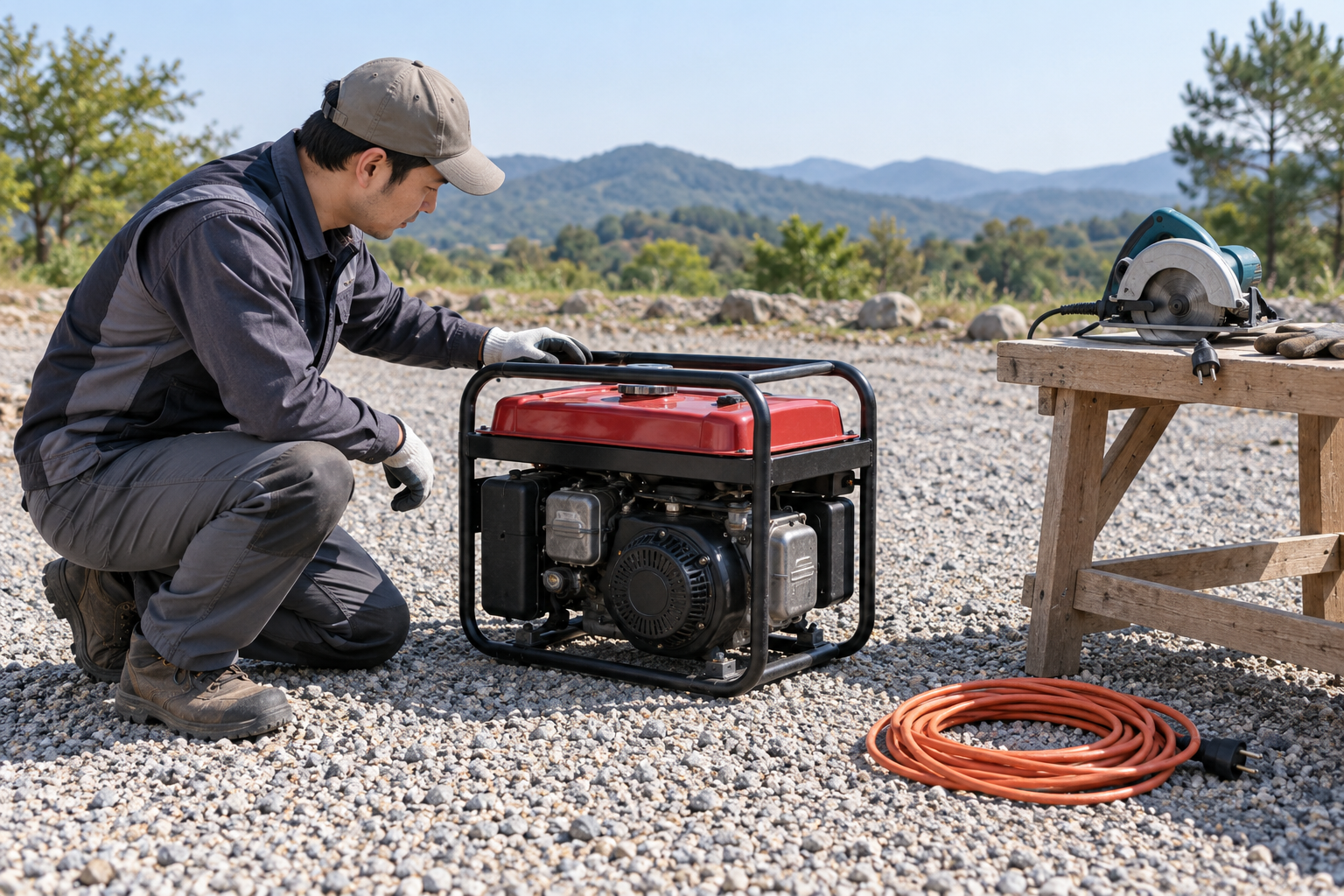
Retained AI-generated educational illustration from the source edition; not a real incident photograph, approved installation drawing or evidence of equipment suitability.
The scenario and record comparisons are fictional teaching examples, not records of real incidents, measurements, inspections, signatures or approvals.
| Item | Fictional scenario |
|---|---|
| Initial | A generator was placed outside a building. |
| Change | Rain prompts relocation under a canopy beside a doorway and an indoor worker reports headache. |
| Failure | The crew proposes opening the door wider and continuing. |
| Outcome | Exhaust may enter occupied spaces despite the outdoor label. |
| Barrier | Evacuate affected people, call 911 for suspected poisoning and have trained personnel establish safe conditions before re-entry or restart. |
Why the controls matter
Verify the frame, receptacle grounding terminals, protective conductor, neutral configuration and fault protection as a complete system. A ground rod alone cannot establish fault clearing; users must not improvise neutral bonds.
Outdoor placement can still send exhaust indoors. Review openings, air intakes, wind and nearby barriers at startup and after changes. Protection must include people in adjacent occupied spaces.
Opening doors does not resolve suspected CO exposure. Stop supply only if safe, evacuate to fresh air and obtain emergency assistance; improved symptoms do not authorize re-entry. Shut down and allow cooling before refueling.
Decision sequence
| Step | Decision |
|---|---|
| Known | Rain prompts relocation under a canopy beside a doorway and an indoor worker reports headache. |
| Unknown | Actual condition, extent of damage and suitability of running load, openings and occupancy remain to be established. |
| Hold | The crew proposes opening the door wider and continuing. |
| Evidence | Link running load, openings and occupancy, cord condition, heat and protection, alarm or symptoms, affected occupancy to the affected equipment or work area. |
| Next | Evacuate affected people, call 911 for suspected poisoning and have trained personnel establish safe conditions before re-entry or restart. |
5. Conditional decisions and common errors
| Condition | Action | Evidence | Proceed when |
|---|---|---|---|
| Opening or wind changes | Reassess placement | Exhaust path and occupancy | Exposure controlled |
| Electrical setup unknown | Hold connection | Bonding and protection review | Configuration verified |
| Trip or overheating | Disconnect safely | Load cord and fault checks | Cause corrected |
| Fuel needed | Shut down and cool | Engine and spill condition | Safe fueling ready |
Similar appearance, different evidence
The scenario and record comparisons are fictional teaching examples, not records of real incidents, measurements, inspections, signatures or approvals.
| Comparison | Supported decision | Insufficient basis |
|---|---|---|
| Condition | Exhaust path and occupancy | Opening or wind changes has not been resolved. |
| Evidence | Load cord and fault checks | A photograph or a completed-looking task without the relevant inspection record. |
| Release | Safe fueling ready | Completion of one step does not release the excluded tasks in section 2. |
6. Roles and responsibilities
| Role | Responsibility |
|---|---|
| Work supervisor | Assign the task boundary, stop authority, interfaces and emergency communication for portable gasoline generator supply to power tools. |
| Technical lead | Confirm Model and ratings; Tool load list; Bonding and protection; Connection scope. Resolve design and manufacturer limits before work. |
| Authorized crew | Apply Fuel and container; Cord and connectors; Route protection; Cord rating. Stop when the working arrangement changes. |
| Inspector / receiving lead | Review Running load; Openings and occupancy; Cord condition; Heat and protection. Transfer Fuel and storage state; Temperature; Fault and receiver; Electrical configuration. |
Role labels allocate responsibilities; they do not confer a legal qualification. Verify the competence, training and authority required for the actual task.
Record and handoff perspective
| Stage | Record controls | Verification |
|---|---|---|
| Review tools and supply | 1. Record model and ratings2. Record tool load list3. Record bonding and protection | 1. Tool load list2. Bonding and protection3. Connection scope |
| Inspect fuel and cords | 1. Record fuel and container2. Record cord and connectors3. Record route protection | 1. Cord and connectors2. Route protection3. Cord rating |
| Start and prepare supply | 1. Record tool switch state2. Record engine and exhaust3. Record protection check | 1. Engine and exhaust2. Protection check3. People clear |
| Supply tools | 1. Record running load2. Record openings and occupancy3. Record cord condition | 1. Openings and occupancy2. Cord condition3. Heat and protection |
| Respond to alarm | 1. Record alarm or symptoms2. Record affected occupancy3. Record fault and isolation | 1. Affected occupancy2. Fault and isolation3. Authorized restart |
| Store and handoff | 1. Record fuel and storage state2. Record temperature3. Record fault and receiver | 1. Temperature2. Fault and receiver3. Electrical configuration |
7. Hold points and record comparison
| Hold point | Evidence before release | Actual record |
|---|---|---|
| HP-0 Start | Use a complete portable gasoline generator in a dry, stable open outdoor location to supply identified cord-connected tools through its designated receptacles after electrical configuration and load review. | |
| HP-1 Review tools and supply | Model and ratings; Tool load list; Bonding and protection; Connection scope | |
| HP-2 Select outdoor site | Openings and intakes; Wind and barriers; Dry stable base; Occupancy and exclusion | |
| HP-3 Start and prepare supply | Tool switch state; Engine and exhaust; Protection check; People clear | |
| HP-4 Respond to alarm | Alarm or symptoms; Affected occupancy; Fault and isolation; Authorized restart |
These are internal hold points, not issued permits. Recheck affected points after a change, fault or shift handoff; link the actual approval record.
Record comparison
The scenario and record comparisons are fictional teaching examples, not records of real incidents, measurements, inspections, signatures or approvals.
The boxes are static record prompts, not interactive or saved approvals. A tick does not establish suitability or permission to restart. Record the evidence, person, time and unresolved issues; retain the change history.
| Record | Insufficient | Record checklist |
|---|---|---|
| Review tools and supply | "Checked" without target, criteria or result | □ Model and ratings□ Tool load list□ Bonding and protection□ Connection scope |
| Inspect fuel and cords | "Checked" without target, criteria or result | □ Fuel and container□ Cord and connectors□ Route protection□ Cord rating |
| Supply tools | "Checked" without target, criteria or result | □ Running load□ Openings and occupancy□ Cord condition□ Heat and protection |
| Store and handoff | "Checked" without target, criteria or result | □ Fuel and storage state□ Temperature□ Fault and receiver□ Electrical configuration |
8. Site checklist and emergency response
| Check | Result | Person / action |
|---|---|---|
| □ Review tools and supply: Model and ratings | ||
| □ Select outdoor site: Openings and intakes | ||
| □ Inspect fuel and cords: Fuel and container | ||
| □ Start and prepare supply: Tool switch state | ||
| □ Supply tools: Running load | ||
| □ Shutdown and cool: Load disconnected | ||
| □ Respond to alarm: Alarm or symptoms | ||
| □ Store and handoff: Fuel and storage state | ||
| □ Emergency access and handoff restrictions |
Stop work
Stop if opening or wind changes, electrical setup unknown, trip or overheating. Keep the affected operation on hold until the listed evidence and proceed conditions are satisfied; a low risk score does not release missing safeguards.
Emergency response
For suspected CO poisoning, move immediately to fresh air and call 911. Keep others out and stop the engine only if this can be done safely. Do not re-enter until trained, properly equipped personnel determine conditions safe. For shock or fire isolate from a safe location and follow the site emergency plan.
9. Sources and review limits
Public-source review: 2026-10-14. Official regulation pages and specific technical references are distinguished below; no agency or manufacturer has approved this content.
| Source | Reviewed scope and limitation |
|---|---|
| OSHA 29 CFR 1926.404 | Construction electrical protection and paragraph (f)(3) portable generator frame-grounding conditions. |
| OSHA portable generator grounding | Supply configuration, bonding and verification; informational factsheet, not new legal requirements. |
| OSHA 3286 generator safety | CO, suitable cords, dry use, no improvised building connection and shutdown/cooling before fueling. |
| NIOSH carbon monoxide at work | Outdoor placement at least 20 feet from openings, exposure assessment and safer power alternatives. |
| OSHA State Plans | Official overview of federal and State Plan jurisdiction and differing public-sector coverage, checked 2026-10-13. Individual state rules require a site-specific check. |
No site measurements, equipment manuals for the actual installation, inspection records or signed technical approvals were supplied. Confirm the applicable requirements and actual product instructions before use; record each criterion with its units, source and equipment or work-area ID.
10. PDF guidance and FAQ
PDF A covers basic task controls; B focuses on technical failures; C covers supervision, records and handover. The article has eight stages with four items per main cell; each PDF has six key stages with three items per main cell. P/S/R/A, measurements, confirmations and signatures remain blank for actual site assessment.
Content group
jsa-portable-generator-tools
Does every portable generator need a ground rod?
No. Determine the actual regulatory and manufacturer conditions; an exception does not remove bonding and protective-circuit requirements.
Is outdoors automatically safe?
No. Keep exhaust away from openings and intakes and reassess changing conditions.
Can a tripped breaker simply be reset?
Identify and correct the load, cord or equipment fault first.
Can fuel be added while running?
No. Shut down and allow cooling before fueling.
Has a professional approved this JSA?
This reference material was written and revised with AI. It has not been verified or approved by a professional. Review by a suitably qualified professional and required site approval are necessary before field use.
11. Revision history and authorship
This reference material was written and revised with AI. It has not been verified or approved by a professional. Review by a suitably qualified professional and required site approval are necessary before field use.
Korean source created 2026-09-26. This US edition adapts the Korean source; earlier editorial revisions do not constitute professional approval of this edition.
| Date | Edition | Change | Review status |
|---|---|---|---|
| 2026-09-26 | Korean source v1.0 | Source editorial publication or revision; retained as provenance of the Korean edition. | Editorial record only; no professional approval of this US edition. |
| 2026-10-14 | 1.0 | US localization: preserve task judgments; replace Korean legal applicability with scoped US references. | AI editorial and output checks; no professional technical approval. |