Full sequential actuation reduces unintended firing risk but does not remove the line of fire. The support hand and other people must remain away from the nail path, opposite face and possible deflection route; use suitable clamps instead of a hand behind the board.
This is reference content written and revised with AI. It has not been verified or approved by a professional. Review by a suitably qualified professional and site authorization are required before use.
Stop before starting
Stop for an altered trigger/contact safety, uncertain pressure, damaged hose, hands or people in the firing path, hidden metal, split wood, jams or a repair beyond the approved criteria. Hold an unverified finished pallet.
1. Legal and technical scope
| Basis | Scope and limits |
|---|---|
| OSHA and NIOSH Nail Gun Safety | Advisory trigger, line-of-fire, training and servicing guidance; construction context. |
| OSHA 1910.242 | General-industry portable-tool condition and use within scope. |
| OSHA 1910.147 | Hazardous-energy control for covered servicing; determine actual applicability. |
For this general-industry repair task, apply the relevant portable-tool requirements of 1910.242 and hazardous-energy controls under 1910.147 where covered servicing is performed. The OSHA/NIOSH nail-gun guide is construction-oriented advisory guidance; its full sequential trigger recommendation does not create a universal legal trigger mandate for all pallet shops. Follow the actual tool instructions, repair specification and applicable State Plan.
2. Scope and required inputs
Included work
Replacement of permitted boards on an identified pallet at a stable bench using approved wood, fasteners, repair criteria and a pneumatic nailer, preferably with full sequential actuation, followed by inspection and segregation.
Separate assessment
Powder-actuated, gas or battery nailers, continuous bump firing, improvised structural repairs, contaminated or unreviewed treated wood, elevated work and pallet load-rating certification are excluded.
| Required input | Evidence to obtain |
|---|---|
| Accept pallet and repair | Pallet and damage IDs; Repair limits; Wood condition; Fastener specification |
| Inspect tool and hose | Tool model and trigger; Contact safety; Hose and coupling; Pressure basis |
| Connect and load | Loading sequence; Safe orientation; Air connection check; Fastener identity |
| Clamp and position | Clamp and support; Hands and opposite face; Knots splits old nails; Exclusion around bench |
No actual equipment model, SDS, site measurements, design calculations or authorization record was supplied. Product-specific limits and methods must be verified before use. Federal OSHA is a baseline within its scope; determine the applicable State Plan and local requirements. Manufacturer guidance is not government approval; an incorporated standard differs from voluntary guidance. No nationwide-compliance or expert-approval claim is made.
3. Eight-stage JSA
| Job stage | Hazards and effects | Failure factors | Technical and procedural controls | Site verification | P | S | R | A |
|---|---|---|---|---|---|---|---|---|
| 1. Accept pallet and repair | 1. Structural failure2. Deflected nail3. Contamination4. Wrong fastener | 1. Damage exceeds limit2. Old metal hidden3. Wood source unknown4. Repair guessed | 1. Identify pallet and criteria2. Inspect repair area3. Use accepted replacement wood4. Match fastener schedule | 1. Pallet and damage IDs2. Repair limits3. Wood condition4. Fastener specification | ||||
| 2. Inspect tool and hose | 1. Unintended firing2. Hose whip3. Nail ejection4. Excess pressure | 1. Trigger altered2. Coupling insecure3. Wrong nails4. Regulator unverified | 1. Check trigger and contact2. Inspect hose connections3. Match tool fasteners4. Use specified air setting | 1. Tool model and trigger2. Contact safety3. Hose and coupling4. Pressure basis | ||||
| 3. Connect and load | 1. Accidental discharge2. Finger injury3. Air release4. Wrong magazine load | 1. Finger on trigger2. Nose toward person3. Sequence improvised4. Fasteners mixed | 1. Follow model loading order2. Keep trigger finger clear3. Point into safe direction4. Verify air and fasteners | 1. Loading sequence2. Safe orientation3. Air connection check4. Fastener identity | ||||
| 4. Clamp and position | 1. Support-hand puncture2. Board movement3. Nail deflection4. Coworker strike | 1. Hand used as backing2. Work loose3. Knot or old nail4. Opposite face occupied | 1. Use suitable clamps2. Support pallet stably3. Inspect firing location4. Clear entire nail path | 1. Clamp and support2. Hands and opposite face3. Knots splits old nails4. Exclusion around bench | ||||
| 5. Fasten approved repair | 1. Double or stray firing2. Flying fragments3. Hearing injury4. Board splitting | 1. Trigger held while moving2. People near discharge3. Protection unsuitable4. Edge pattern wrong | 1. Use full sequential method2. Keep finger clear in transit3. Use selected eye hearing PPE4. Follow approved nail pattern | 1. Actuation behavior2. People and hand positions3. Protection checks4. Pattern and fastener depth | ||||
| 6. Clear jam safely | 1. Unexpected discharge2. Stored-air release3. Sharp fastener cut4. Safety defeat | 1. Hose left connected2. Residual energy ignored3. Hand at nose4. Contact bypassed | 1. Isolate air source2. Follow model energy release3. Use approved clearing tools4. Restore safety features | 1. Isolation and residual air2. Jam and tool condition3. Clearing method4. Controlled function check | ||||
| 7. Inspect repaired pallet | 1. Protruding-nail injury2. Joint failure3. Split board4. False load rating | 1. Back face unchecked2. Repair incomplete3. New crack missed4. Appearance accepted | 1. Inspect both faces2. Verify repair criteria3. Segregate defects4. Record actual disposition | 1. Nail protrusion2. Joint and board condition3. Repair acceptance4. Held pallet IDs | ||||
| 8. Store and hand over | 1. Tool discharge2. Unsafe pallet reuse3. Hose trip4. Missing defect record | 1. Air remains connected2. Hold tag absent3. Hose left across path4. Repair limits lost | 1. Disconnect and store tool2. Separate held pallets3. Clear air lines and waste4. Transfer repair records | 1. Tool safe storage2. Accepted and held pallets3. Bench and route4. Recipient and limits |
P = likelihood; S = severity; R = risk under the site method; A = site-defined acceptance/authorization. These actual assessment cells are blank. A low score never overrides a missing safeguard or a legal or manufacturer restriction.
4. Fictional scenario and failure mechanisms
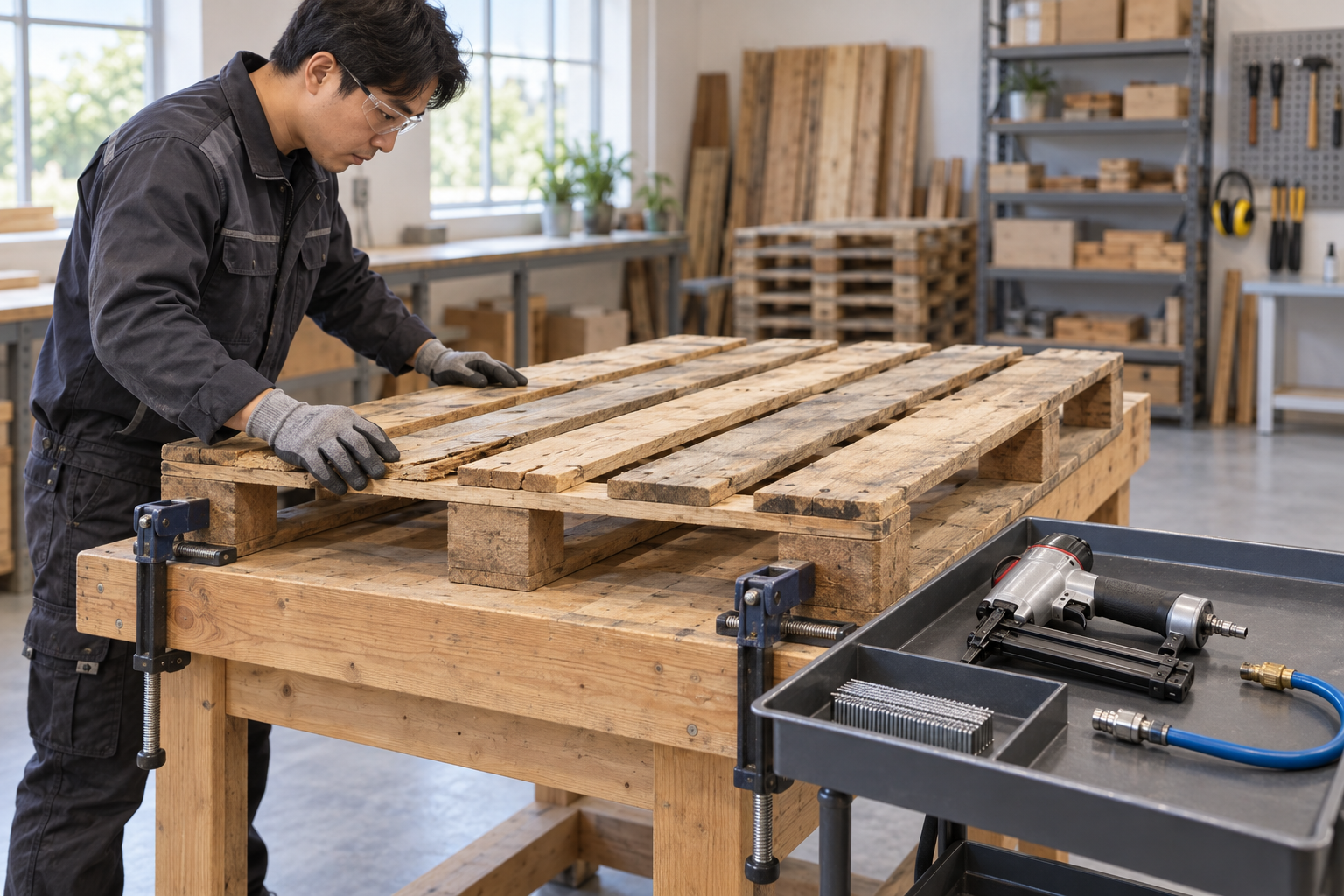
This illustration provides educational context. It is not an actual incident photograph or evidence of equipment suitability; any AI-generated depiction is illustrative only.
The scenario and record comparisons are fictional teaching examples, not records of real incidents, measurements, inspections, signatures or approvals.
| Stage | Fictional situation |
|---|---|
| Initial situation | A fictional repair worker encounters a bent nail and a jam near an old fastener. |
| Changed condition | A helper holds the board from behind while the hose remains connected. |
| Failure path | The worker starts opening the nose to clear the jam. |
| Possible outcome | An unexpected discharge or deflected fastener could cause a penetrating injury. |
| Prevention barrier | Keep everyone clear, isolate the air and residual energy by the tool method, inspect wood and tool, then restore an approved clamped repair setup before testing. |
Failure mechanisms
Full sequential actuation reduces unintended firing risk but does not remove the line of fire. The support hand and other people must remain away from the nail path, opposite face and possible deflection route; use suitable clamps instead of a hand behind the board.
Old fasteners, knots and split wood can deflect a new nail sideways or through the back. Inspect the repair location and approved fastener arrangement before firing. A flush nail head alone does not establish acceptable pallet strength or a new load rating.
A jammed nailer may retain pneumatic energy. Before clearing or adjustment, disconnect and control the air source and deal with residual energy as the model procedure requires. Do not defeat the contact safety or reopen the tool while a helper holds the work in the line of fire.
Work sequence: Accept pallet and repair → Inspect tool and hose → Connect and load → Clamp and position → Fasten approved repair → Clear jam safely → Inspect repaired pallet → Store and hand over. This is a teaching flow, not a device drawing or a complete operating procedure.
5. Conditional decisions and common errors
| Situation | Required action | Evidence | Proceed when |
|---|---|---|---|
| Repair limits unclear | Hold pallet | Approved damage and repair criteria | Repair permitted |
| Hands behind board | Stop positioning | Clamps and complete nail path | Line of fire clear |
| Nailer jammed | Isolate air and stored energy | Model clearing procedure | Tool safely restored |
| Repair finished | Inspect both faces | Fasteners, cracks and repair limits | Pallet disposition set |
Similar observations, different decisions
The scenario and record comparisons are fictional teaching examples, not records of real incidents, measurements, inspections, signatures or approvals.
| Observation | Insufficient conclusion | Required distinction |
|---|---|---|
| Full sequential trigger | Risk-reduction feature | Safe positioning still needed |
| Nail head flush | One visible feature | Pallet acceptance not proved |
| Hose disconnected | Supply separated | Residual energy still assessed |
6. Roles and responsibilities
| Role | Responsibility |
|---|---|
| Work supervisor | Confirm pallet and damage ids and the task scope, resources, interfaces and stop authority. |
| Qualified technical reviewer | Review tool model and trigger, model limits, compatibility and unresolved technical conditions within assigned competence. |
| Work crew | Apply the listed controls, report changes and stop when evidence or safeguards are missing. |
| Inspector / assessor | Record actual actuation behavior and other relevant checks; do not mark unverified conditions as accepted. |
| Handover authority | Reconcile tool safe storage, restrictions and outstanding actions before the next task. Role labels do not establish a legal credential. |
Supervision and handover focus
| Stage | Management action | Evidence |
|---|---|---|
| Accept pallet and repair | 1. Record pallet and damage ids2. Record repair limits3. Record wood condition | 1. Pallet and damage IDs2. Repair limits3. Wood condition |
| Inspect tool and hose | 1. Record tool model and trigger2. Record contact safety3. Record hose and coupling | 1. Tool model and trigger2. Contact safety3. Hose and coupling |
| Clamp and position | 1. Record clamp and support2. Record hands and opposite face3. Record knots splits old nails | 1. Clamp and support2. Hands and opposite face3. Knots splits old nails |
| Fasten approved repair | 1. Record actuation behavior2. Record people and hand positions3. Record protection checks | 1. Actuation behavior2. People and hand positions3. Protection checks |
| Inspect repaired pallet | 1. Record nail protrusion2. Record joint and board condition3. Record repair acceptance | 1. Nail protrusion2. Joint and board condition3. Repair acceptance |
| Store and hand over | 1. Record tool safe storage2. Record accepted and held pallets3. Record bench and route | 1. Tool safe storage2. Accepted and held pallets3. Bench and route |
7. Hold points and record comparison
| Hold point | Evidence before release | Actual approval |
|---|---|---|
| HP-0 Scope | Replacement of permitted boards on an identified pallet at a stable bench using approved wood, fasteners, repair criteria and a pneumatic nailer, preferably with full sequential actuation, followed by inspection and segregation. | |
| HP-1 Inspect tool and hose | Tool model and trigger; Contact safety; Hose and coupling; Pressure basis | |
| HP-2 Clamp and position | Clamp and support; Hands and opposite face; Knots splits old nails; Exclusion around bench | |
| HP-3 Inspect repaired pallet | Nail protrusion; Joint and board condition; Repair acceptance; Held pallet IDs | |
| HP-4 Store and hand over | Tool safe storage; Accepted and held pallets; Bench and route; Recipient and limits |
Hold points are internal project checks. They are not universal statutory permits and do not grant work permission. Reassess after defects, changed conditions and shift changes.
Record comparison
The scenario and record comparisons are fictional teaching examples, not records of real incidents, measurements, inspections, signatures or approvals.
The boxes are static record prompts, not interactive or saved approvals. A tick does not establish suitability or permission to restart. Record the evidence, person, time and unresolved issues; retain the change history.
| Record | Insufficient record | Record checklist |
|---|---|---|
| Accept pallet and repair | Only marked “OK” | □ Pallet and damage IDs□ Repair limits□ Wood condition□ Fastener specification |
| Clamp and position | Only marked “OK” | □ Clamp and support□ Hands and opposite face□ Knots splits old nails□ Exclusion around bench |
| Inspect repaired pallet | Only marked “OK” | □ Nail protrusion□ Joint and board condition□ Repair acceptance□ Held pallet IDs |
| Store and hand over | Only marked “OK” | □ Tool safe storage□ Accepted and held pallets□ Bench and route□ Recipient and limits |
8. Site checklist and emergency response
| Site check | Actual result | Person / action |
|---|---|---|
| Accept pallet and repair: Pallet and damage IDs; Repair limits; Wood condition; Fastener specification | ||
| Inspect tool and hose: Tool model and trigger; Contact safety; Hose and coupling; Pressure basis | ||
| Connect and load: Loading sequence; Safe orientation; Air connection check; Fastener identity | ||
| Clamp and position: Clamp and support; Hands and opposite face; Knots splits old nails; Exclusion around bench | ||
| Fasten approved repair: Actuation behavior; People and hand positions; Protection checks; Pattern and fastener depth | ||
| Clear jam safely: Isolation and residual air; Jam and tool condition; Clearing method; Controlled function check | ||
| Inspect repaired pallet: Nail protrusion; Joint and board condition; Repair acceptance; Held pallet IDs | ||
| Store and hand over: Tool safe storage; Accepted and held pallets; Bench and route; Recipient and limits |
Stop work
Stop for an altered trigger/contact safety, uncertain pressure, damaged hose, hands or people in the firing path, hidden metal, split wood, jams or a repair beyond the approved criteria. Hold an unverified finished pallet.
Emergency response
Secure the tool and prevent further discharge. Obtain immediate medical assessment for a penetrating nail injury, even when the wound appears small; do not resume work to test the injury. Preserve the tool and repair location for the site investigation after emergency care.
9. Sources and review limits
Public-source access/review: 2026-10-13.
| Official source | Reviewed scope and limits |
|---|---|
| OSHA and NIOSH Nail Gun Safety | Advisory trigger, line-of-fire, training and servicing guidance; construction context. |
| OSHA 1910.242 | General-industry portable-tool condition and use within scope. |
| OSHA 1910.147 | Hazardous-energy control for covered servicing; determine actual applicability. |
No actual equipment model, SDS, site measurements, design calculations or authorization record was supplied. Product-specific limits and methods must be verified before use. Federal OSHA is a baseline within its scope; determine the applicable State Plan and local requirements. Manufacturer guidance is not government approval; an incorporated standard differs from voluntary guidance. No nationwide-compliance or expert-approval claim is made.
10. PDF guidance and FAQ
PDF A covers basic task controls; B focuses on technical failures; C covers supervision, records and handover. The article has eight stages with four items per main cell; each PDF has six key stages with three items per main cell. P/S/R/A, measurements, confirmations and signatures remain blank for actual site assessment.
PDFs are complementary six-stage extracts. Apply all eight body stages and the actual equipment/site procedure.
Does a sequential trigger make hand backing safe?
No. Keep hands and people out of the nail and deflection paths and use suitable workholding.
Can a jam be cleared with the hose attached?
Follow the model isolation and residual-energy procedure before servicing; do not improvise a live clearing method.
Does this repair certify pallet capacity?
No. Apply the authorized pallet repair and acceptance criteria; this reference assigns no load rating.
Has a professional verified or approved this document?
No. Public sources and editorial, layout and consistency checks were reviewed using AI. No site inspection or professional technical approval has been performed. Obtain appropriate professional review before use.
11. Revision history and authorship
This is reference content written and revised with AI. It has not been verified or approved by a professional. Review by a suitably qualified professional and site authorization are required before use.
| Date | Version | Change | Review status |
|---|---|---|---|
| 2026-10-13 | US 1.0 | New US edition from assigned Korean source; task decisions, records and PDFs localized. | AI editorial review; no professional technical approval |
Korean edition revision history: 2026-09-25 (v1.0): initial article, sources, fictional analysis and PDF editorial checks. These are editorial records, not professional technical approval. US v1.0 adapts the earlier edition to United States requirements and terminology.
Site reviewers must add their actual qualifications, scope, date and approval only after the review occurs.