Keep the operator in control of both the process and foot switch. Never tie down or bypass the switch. Verify stop response before processing pipe; a helper must not run the switch for someone touching the work.
This reference material was written and revised with AI. It has not been verified or approved by a professional. Review by a suitably qualified professional and required site approval are necessary before field use.
Stop before proceeding
Do not start without verified foot-stop response, chuck engagement, full pipe support and rotation-area control. Stop and isolate for wobble, slipping stock, damaged dies, interrupted oil or any unexpected control response.
1. Legal and technical scope
General-industry machine guarding is addressed by 1910.212; covered cleaning, adjustment and servicing require 1910.147 energy control. Its cord-and-plug exception applies only when unplugging controls the hazard and the plug remains under exclusive control of the servicing employee. A foot switch is a control, not an energy isolator. Construction-shop use requires the applicable Part 1926 assessment. RIDGID guidance below is model-specific and does not approve an unidentified machine.
Confirm whether federal OSHA or an OSHA-approved State Plan covers this employer and worksite; state requirements and public-sector coverage can differ. Apply the task-specific provisions and limitations identified above.
| Basis | Application |
|---|---|
| OSHA 29 CFR 1910.212 | Point-of-operation and rotating-part guarding appropriate to actual machine and access. |
| OSHA 29 CFR 1910.147 | Covered servicing and the limited cord-and-plug exception; verify scope. |
| RIDGID 300 Compact/1233 manual, REV C | Reviewed operating safety, support, foot control and stopped inspection sections. Actual pipe/die/oil and machine instructions govern. |
| OSHA State Plans | Official overview of federal and State Plan jurisdiction and differing public-sector coverage, checked 2026-10-13. Individual state rules require a site-specific check. |
2. Scope and required inputs
Included scope
Use an identified bench/stand-mounted threading machine to cut, ream and externally thread permitted detached steel pipe, then inspect it at full stop.
Separate assessment
Rotating installed piping, handheld threaders, grooving, bolt threading, pressure testing and pipe with flammable residues require separate procedures.
| Input | Evidence needed |
|---|---|
| Match pipe and tooling | Pipe and thread IDs; Die size and state; Oil identification; Inspection criteria. |
| Chuck and set tools | Isolation state; Chuck and pipe contact; Die settings; Clothing and hand clearance. |
| Cut ream and thread | Cut and die response; Oil supply; Pipe stability; Hand and tool position. |
| Unload and handoff | Unload supports; Stock identification; Inspection disposition; Receiver and limits. |
No site measurements, equipment manuals for the actual installation, inspection records or signed technical approvals were supplied. Confirm the applicable requirements and actual product instructions before use; record each criterion with its units, source and equipment or work-area ID.
3. Eight-stage JSA
| Job stage | Hazards and effects | Failure factors | Technical and procedural controls | Site verification | P | S | R | A |
|---|---|---|---|---|---|---|---|---|
| 1. Match pipe and tooling | 1. Die breaks2. Bad thread leaks3. Wrong stock rotates4. Oil exposure | 1. Thread misidentified2. Material unknown3. Die mismatch4. Oil unsuitable | 1. Match thread instruction2. Verify pipe material3. Select correct dies4. Check oil and SDS | 1. Pipe and thread IDs2. Die size and state3. Oil identification4. Inspection criteria | ||||
| 2. Set machine and supports | 1. Machine tips2. Rear pipe whips3. Bystander struck4. Stock rolls | 1. Stand unstable2. Support omitted3. Rear path open4. Pipe unsecured | 1. Secure machine stand2. Support full pipe length3. Barricade rotation area4. Control stock storage | 1. Stand and fixing2. Front rear supports3. Full-length boundary4. Stock stability | ||||
| 3. Chuck and set tools | 1. Pipe slips2. Hand entangles3. Tool falls4. Unexpected start | 1. Poor jaw contact2. Loose clothing3. Head unsecured4. Control energized | 1. Isolate for setup2. Verify chuck engagement3. Secure selected tooling4. Prepare fitted clothing | 1. Isolation state2. Chuck and pipe contact3. Die settings4. Clothing and hand clearance | ||||
| 4. Verify startup controls | 1. Unstopped rotation2. Wrong-person start3. Entanglement4. Pipe strike | 1. Switch tied on2. Two operators3. Gloves at rotation4. Setup unchecked | 1. Test foot release2. Use single operator3. Follow no-glove warning4. Clear before startup | 1. Foot-stop response2. Operator position3. People and clothing4. Chuck and support test | ||||
| 5. Cut ream and thread | 1. Chip injury2. Entanglement3. Tool breaks4. Pipe whips | 1. Hands steady pipe2. Excess feed3. Oil flow lost4. Support shifts | 1. Use specified controls2. Keep clear of rotation3. Maintain correct oil flow4. Stop abnormal motion | 1. Cut and die response2. Oil supply3. Pipe stability4. Hand and tool position | ||||
| 6. Stop and inspect | 1. Residual motion injury2. Chip cut3. Bad thread accepted4. Oil slip | 1. Measured rotating2. Chips hand-picked3. No gauge4. Floor oily | 1. Wait full stop2. Isolate for cleaning3. Use specified gauge4. Contain and clean oil | 1. Stopped condition2. Thread gauge result3. Chip tools4. Floor condition | ||||
| 7. Hold abnormalities | 1. Pipe escapes2. Repeat defect3. Unsafe reversal4. Unexpected motion | 1. Chuck fault ignored2. Die damaged3. Reverse used for rescue4. Foot control trusted | 1. Stop and isolate2. Investigate die and chuck3. Use planned recovery4. Verify energy control | 1. Slip and wobble record2. Chuck die correction3. Recovery boundary4. Retest release | ||||
| 8. Unload and handoff | 1. Pipe drops2. Hand pinch3. Rejected stock mixed4. Sharp end injury | 1. Chuck released early2. No unloading support3. No disposition mark4. Threads unprotected | 1. Support before release2. Use planned stock handling3. Separate rejected stock4. Protect thread ends | 1. Unload supports2. Stock identification3. Inspection disposition4. Receiver and limits |
P = likelihood; S = severity; R = risk under the site method; A = the site-defined acceptance/authorization decision. Complete only after actual assessment. Blank cells and checklist prompts are not completed inspections.
4. Fictional scenario and failure mechanisms
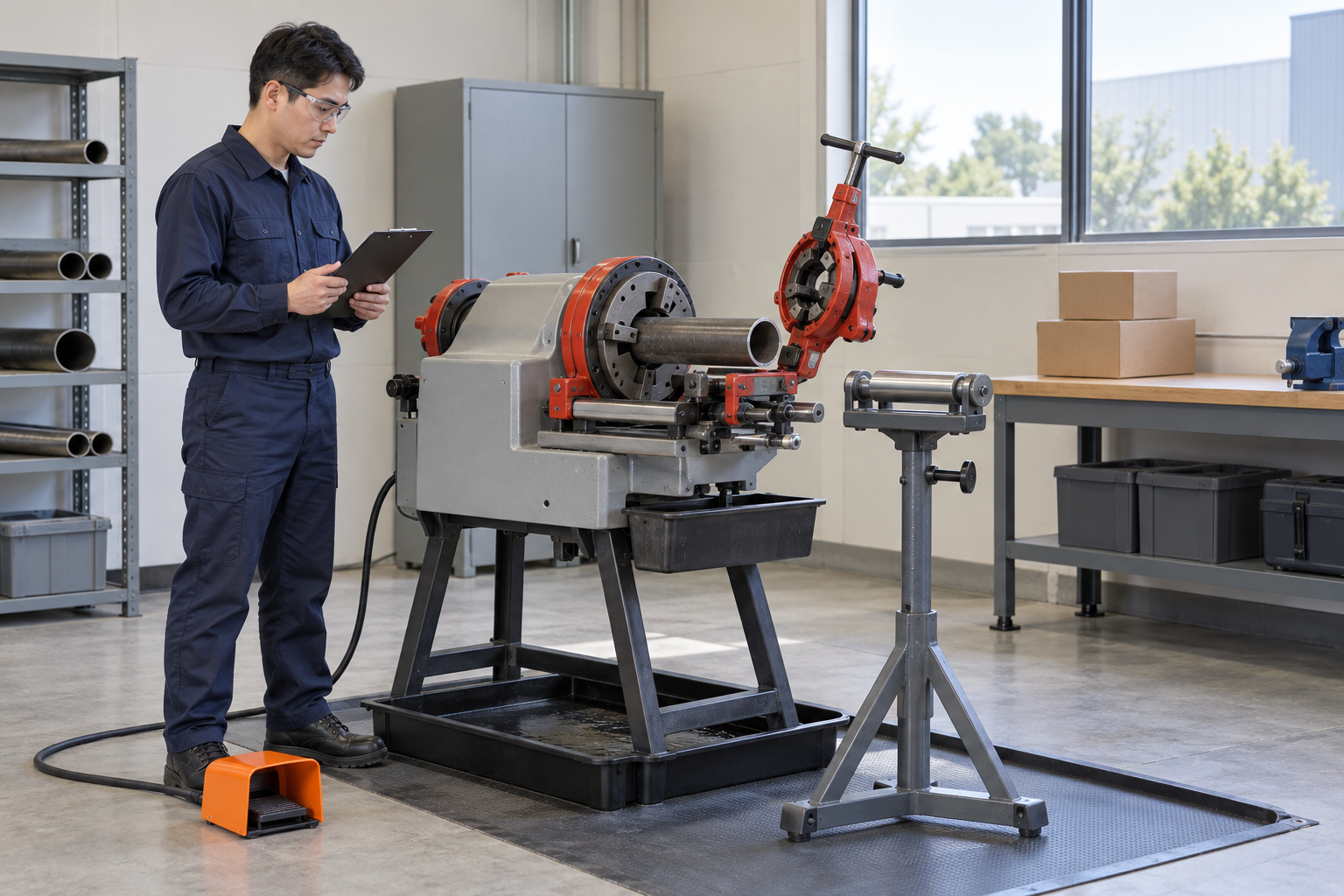
Retained AI-generated educational illustration from the source edition; not a real incident photograph, approved installation drawing or evidence of equipment suitability.
The scenario and record comparisons are fictional teaching examples, not records of real incidents, measurements, inspections, signatures or approvals.
| Item | Fictional scenario |
|---|---|
| Initial | A long pipe projects behind the machine. |
| Change | A helper holds the rear pipe while another person operates the foot switch. |
| Failure | Pipe support and immediate stop control are split between two people. |
| Outcome | The helper can be entangled or struck when the pipe whips. |
| Barrier | Hold startup, fit suitable supports and exclusion, then verify chucking and single-operator stop control. |
Why the controls matter
Keep the operator in control of both the process and foot switch. Never tie down or bypass the switch. Verify stop response before processing pipe; a helper must not run the switch for someone touching the work.
The pipe behind the chuck rotates too. Set supports and an exclusion boundary for the full length. Do not catch or steady a whipping pipe by hand. The reference manual prohibits gloves and loose clothing during operation because they can entangle; handling sharp stock after safe isolation is a different exposure.
A fitting screwing onto the thread is not the specified gauge inspection. Stop completely before measuring or touching pipe, isolate before cleaning or changing tools and segregate rejected threads from accepted stock.
Decision sequence
| Step | Decision |
|---|---|
| Known | A helper holds the rear pipe while another person operates the foot switch. |
| Unknown | Actual condition, extent of damage and suitability of cut and die response, oil supply remain to be established. |
| Hold | Pipe support and immediate stop control are split between two people. |
| Evidence | Link cut and die response, oil supply, pipe stability, hand and tool position, slip and wobble record, chuck die correction to the affected equipment or work area. |
| Next | Hold startup, fit suitable supports and exclusion, then verify chucking and single-operator stop control. |
5. Conditional decisions and common errors
| Condition | Action | Evidence | Proceed when |
|---|---|---|---|
| Stop response fails | Remove machine from use | Foot control repair and test | Stop function verified |
| Pipe wobbles | Stop and isolate | Chuck support and pipe check | Stable setup verified |
| Oil flow lost | Hold processing | Oil type supply and die check | Flow restored |
| Thread completed | Stop and gauge | Specified thread inspection | Stock disposition recorded |
Similar appearance, different evidence
The scenario and record comparisons are fictional teaching examples, not records of real incidents, measurements, inspections, signatures or approvals.
| Comparison | Supported decision | Insufficient basis |
|---|---|---|
| Condition | Foot control repair and test | Stop response fails has not been resolved. |
| Evidence | Oil type supply and die check | A photograph or a completed-looking task without the relevant inspection record. |
| Release | Stock disposition recorded | Completion of one step does not release the excluded tasks in section 2. |
6. Roles and responsibilities
| Role | Responsibility |
|---|---|
| Work supervisor | Assign the task boundary, stop authority, interfaces and emergency communication for stationary pipe threading machine. |
| Technical lead | Confirm Pipe and thread IDs; Die size and state; Oil identification; Inspection criteria. Resolve design and manufacturer limits before work. |
| Authorized crew | Apply Isolation state; Chuck and pipe contact; Die settings; Clothing and hand clearance. Stop when the working arrangement changes. |
| Inspector / receiving lead | Review Cut and die response; Oil supply; Pipe stability; Hand and tool position. Transfer Unload supports; Stock identification; Inspection disposition; Receiver and limits. |
Role labels allocate responsibilities; they do not confer a legal qualification. Verify the competence, training and authority required for the actual task.
Record and handoff perspective
| Stage | Record controls | Verification |
|---|---|---|
| Match pipe and tooling | 1. Record pipe and thread ids2. Record die size and state3. Record oil identification | 1. Die size and state2. Oil identification3. Inspection criteria |
| Chuck and set tools | 1. Record isolation state2. Record chuck and pipe contact3. Record die settings | 1. Chuck and pipe contact2. Die settings3. Clothing and hand clearance |
| Verify startup controls | 1. Record foot-stop response2. Record operator position3. Record people and clothing | 1. Operator position2. People and clothing3. Chuck and support test |
| Cut ream and thread | 1. Record cut and die response2. Record oil supply3. Record pipe stability | 1. Oil supply2. Pipe stability3. Hand and tool position |
| Hold abnormalities | 1. Record slip and wobble record2. Record chuck die correction3. Record recovery boundary | 1. Chuck die correction2. Recovery boundary3. Retest release |
| Unload and handoff | 1. Record unload supports2. Record stock identification3. Record inspection disposition | 1. Stock identification2. Inspection disposition3. Receiver and limits |
7. Hold points and record comparison
| Hold point | Evidence before release | Actual record |
|---|---|---|
| HP-0 Start | Use an identified bench/stand-mounted threading machine to cut, ream and externally thread permitted detached steel pipe, then inspect it at full stop. | |
| HP-1 Set machine and supports | Stand and fixing; Front rear supports; Full-length boundary; Stock stability | |
| HP-2 Verify startup controls | Foot-stop response; Operator position; People and clothing; Chuck and support test | |
| HP-3 Hold abnormalities | Slip and wobble record; Chuck die correction; Recovery boundary; Retest release | |
| HP-4 Unload and handoff | Unload supports; Stock identification; Inspection disposition; Receiver and limits |
These are internal hold points, not issued permits. Recheck affected points after a change, fault or shift handoff; link the actual approval record.
Record comparison
The scenario and record comparisons are fictional teaching examples, not records of real incidents, measurements, inspections, signatures or approvals.
The boxes are static record prompts, not interactive or saved approvals. A tick does not establish suitability or permission to restart. Record the evidence, person, time and unresolved issues; retain the change history.
| Record | Insufficient | Record checklist |
|---|---|---|
| Match pipe and tooling | "Checked" without target, criteria or result | □ Pipe and thread IDs□ Die size and state□ Oil identification□ Inspection criteria |
| Chuck and set tools | "Checked" without target, criteria or result | □ Isolation state□ Chuck and pipe contact□ Die settings□ Clothing and hand clearance |
| Cut ream and thread | "Checked" without target, criteria or result | □ Cut and die response□ Oil supply□ Pipe stability□ Hand and tool position |
| Unload and handoff | "Checked" without target, criteria or result | □ Unload supports□ Stock identification□ Inspection disposition□ Receiver and limits |
8. Site checklist and emergency response
| Check | Result | Person / action |
|---|---|---|
| □ Match pipe and tooling: Pipe and thread IDs | ||
| □ Set machine and supports: Stand and fixing | ||
| □ Chuck and set tools: Isolation state | ||
| □ Verify startup controls: Foot-stop response | ||
| □ Cut ream and thread: Cut and die response | ||
| □ Stop and inspect: Stopped condition | ||
| □ Hold abnormalities: Slip and wobble record | ||
| □ Unload and handoff: Unload supports | ||
| □ Emergency access and handoff restrictions |
Stop work
Do not start without verified foot-stop response, chuck engagement, full pipe support and rotation-area control. Stop and isolate for wobble, slipping stock, damaged dies, interrupted oil or any unexpected control response.
Emergency response
Stop from a safe control position and control power. Do not grab rotating pipe or reverse the machine as an improvised rescue. Call 911 and the site rescue team; maintain isolation and the unstable-pipe exclusion until controlled recovery is arranged.
9. Sources and review limits
Public-source review: 2026-10-13. Official regulation pages and specific technical references are distinguished below; no agency or manufacturer has approved this content.
| Source | Reviewed scope and limitation |
|---|---|
| OSHA 29 CFR 1910.212 | Point-of-operation and rotating-part guarding appropriate to actual machine and access. |
| OSHA 29 CFR 1910.147 | Covered servicing and the limited cord-and-plug exception; verify scope. |
| RIDGID 300 Compact/1233 manual, REV C | Reviewed operating safety, support, foot control and stopped inspection sections. Actual pipe/die/oil and machine instructions govern. |
| OSHA State Plans | Official overview of federal and State Plan jurisdiction and differing public-sector coverage, checked 2026-10-13. Individual state rules require a site-specific check. |
No site measurements, equipment manuals for the actual installation, inspection records or signed technical approvals were supplied. Confirm the applicable requirements and actual product instructions before use; record each criterion with its units, source and equipment or work-area ID.
10. PDF guidance and FAQ
PDF A covers basic task controls; B focuses on technical failures; C covers supervision, records and handover. The article has eight stages with four items per main cell; each PDF has six key stages with three items per main cell. P/S/R/A, measurements, confirmations and signatures remain blank for actual site assessment.
Content group
jsa-pipe-threading-machine
Can the foot switch be tied on?
No. Retain immediate operator stop control and verify release response.
Can a helper hold the rear pipe?
No. Use suitable supports and a controlled rotation area.
Should gloves be worn while threading?
The cited RIDGID operating instructions prohibit gloves because of entanglement; check the actual model and separate isolated sharp-stock handling.
Does a mating fitting prove the thread is acceptable?
No. Use the specified gauge, condition and inspection method.
Has a professional approved this JSA?
This reference material was written and revised with AI. It has not been verified or approved by a professional. Review by a suitably qualified professional and required site approval are necessary before field use.
11. Revision history and authorship
This reference material was written and revised with AI. It has not been verified or approved by a professional. Review by a suitably qualified professional and required site approval are necessary before field use.
Korean source created 2026-09-26. This US edition adapts the Korean source; earlier editorial revisions do not constitute professional approval of this edition.
| Date | Edition | Change | Review status |
|---|---|---|---|
| 2026-09-26 | Korean source v1.0 | Source editorial publication or revision; retained as provenance of the Korean edition. | Editorial record only; no professional approval of this US edition. |
| 2026-10-13 | 1.0 | US localization: preserve task judgments; replace Korean legal applicability with scoped US references. | AI editorial and output checks; no professional technical approval. |