A paused discharge is not an isolated mixer. The drum, chute and receiving equipment must share a controlled stop and restart arrangement.
This is reference content written and revised with AI. It has not been verified or approved by a professional. Review by a suitably qualified professional and required site authorization are necessary before use.
Stop conditions first
Stop for lost reversing signals, uncertain ground, chute lock defects, unexpected motion, blocked discharge, people in the chute zone or unverified energy control for recovery.
1. US legal and technical basis
Concrete delivery at a construction site: relevant OSHA construction vehicle and concrete-equipment provisions apply. Road operation and plant/depot servicing have separate scopes.
| Reference | Use and limit |
|---|---|
| OSHA 29 CFR 1926.702 | Selected paragraph (j) lockout/tagout for covered concrete-equipment maintenance/repair. Paragraph (b) loading-skip requirements are not treated as universal truck-chute rules. |
| OSHA 29 CFR 1926.601 | Selected off-highway construction vehicle inspection/reversing scope; separate road-law review required. |
| OSHA 29 CFR 1926.59 | Product hazard communication, SDS and worker information for wet concrete and cleaning products. |
| OSHA State Plans | Federal baseline and State Plan coverage reviewed. Confirm the applicable state program and employer coverage; this edition does not establish nationwide compliance. |
Determine whether Federal OSHA or an applicable State Plan governs the employer and work. Standards incorporated into a regulation must be read in their legally applicable edition. Other NFPA/ANSI guidance and manufacturer instructions have distinct roles; they are not automatically federal law.
2. Scope and required inputs
Included
Receive and position a ready-mix truck, deploy the chute, discharge into the agreed receiving system, wash the exterior chute at the designated station and secure for departure.
Separate assessment
Drum entry, chipping, pump-line blockage clearing, high-pressure system repair and improvised elevated access are excluded. Reclassify changed work before proceeding.
| Input | Evidence needed |
|---|---|
| Plan delivery and wash | Vehicle/ground plan; Traffic and signaller; Receiver readiness; Wash/recovery scope |
| Reverse and park | Signaller/escape; Brake/parking check; Ground and slope; Route visibility |
| Deploy chute | Hands/handles; Pin/lock engagement; Chute sweep clear; Stable position |
| Fold and depart | Folded/locked chute; Protrusions clear; Hose/tool count; Departure route/record |
Selected public official provisions were checked on October 14, 2026. This is not a complete legal audit. No actual equipment manual, site measurements, engineering calculations, product certification or professional technical approval was supplied. Full paid NFPA/ANSI standards and state/local amendments were not reviewed. Check actual equipment, jurisdiction and project requirements before use.
Select task-appropriate eye, hand, foot, skin and hearing protection from the exposure assessment. Where respiratory protection is necessary, use the applicable respiratory-protection program; PPE does not replace isolation, guarding, support or ventilation.
3. Eight-stage JSA
| Job stage | Hazards and effects | Failure factors | Controls | Site verification | P | S | R | A |
|---|---|---|---|---|---|---|---|---|
| 1. Plan delivery and wash | 1. Vehicle overturns2. Traffic collision3. Uncontrolled discharge4. Wrong wash scope | 1. Ground unverified2. Routes overlap3. Receiver unready4. Drum entry assumed routine | 1. Verify route/ground2. Coordinate site traffic3. Agree receiver signals4. Define external wash boundary | 1. Vehicle/ground plan2. Traffic and signaller3. Receiver readiness4. Wash/recovery scope | ||||
| 2. Reverse and park | 1. Person crushed2. Truck rolls3. Edge failure4. Blind collision | 1. Signaller trapped2. Brake unverified3. Ground weak4. Signal lost | 1. Use protected visible signal2. Secure model parking state3. Check support and edges4. Stop on lost contact | 1. Signaller/escape2. Brake/parking check3. Ground and slope4. Route visibility | ||||
| 3. Inspect chute and receiver | 1. Chute drops2. Hopper contact3. Concrete splash4. Skin burn | 1. Pin damaged2. Receiver guard absent3. People too close4. Protection unsuitable | 1. Inspect pins and locks2. Coordinate receiver protection3. Control discharge boundary4. Use SDS-based protection | 1. Chute retention2. Receiver guard/state3. People clear4. Eye/skin washing | ||||
| 4. Deploy chute | 1. Finger pinch2. Section swings3. Foot crush4. Overreach fall | 1. Hands at joint2. Lock released blindly3. Area occupied4. Access improvised | 1. Use designated handles2. Control section movement3. Clear folding/swing zone4. Use approved access | 1. Hands/handles2. Pin/lock engagement3. Chute sweep clear4. Stable position | ||||
| 5. Discharge concrete | 1. Moving-part contact2. Sudden material surge3. Hopper overflow4. Vehicle movement | 1. Tool reaches inside2. Blockage forced3. Receiver signal ignored4. Parking disturbed | 1. Keep clear of moving parts2. Stop abnormal flow3. Coordinate feed rate4. Maintain secured vehicle | 1. Drum/chute boundary2. Flow and receiver3. Shared stop signal4. Parking stability | ||||
| 6. Wash exterior chute | 1. Cement burn2. Splash injury3. Slip/fall4. Unexpected motion | 1. Residue on skin2. Nozzle aimed poorly3. Runoff uncontrolled4. Wash boundary unclear | 1. Use SDS/washing controls2. Direct wash safely3. Contain washwater4. Control motion for access | 1. Wash station/PPE2. Hose/nozzle condition3. Footing/drainage4. Energy/access method | ||||
| 7. Hold blockage or defect | 1. Entanglement2. Residual material falls3. Hydraulic movement4. Unauthorized entry | 1. Pause treated as isolation2. Stored load ignored3. Restart uncoordinated4. Scope expands | 1. Apply authorized isolation2. Control residual material3. Coordinate receiver lockout4. Require separate entry review | 1. Isolation verification2. Residual-load plan3. Recovery authority4. Scope/restart briefing | ||||
| 8. Fold and depart | 1. Chute strikes person2. Road protrusion3. Hose drag4. Unreported fault | 1. Lock omitted2. Section extended3. Hose not recovered4. Defect unrecorded | 1. Control folding zone2. Verify travel locks3. Recover all equipment4. Transfer defects before release | 1. Folded/locked chute2. Protrusions clear3. Hose/tool count4. Departure route/record |
Actual risk assessments, measurements, checks, approvals and signatures have not been performed. Keep unverified fields blank and link the actual site records. P/S/R/A mean likelihood, severity, site-method risk and site-defined acceptance/authorization; a score cannot waive a required control.
4. Failure mechanisms and hypothetical case
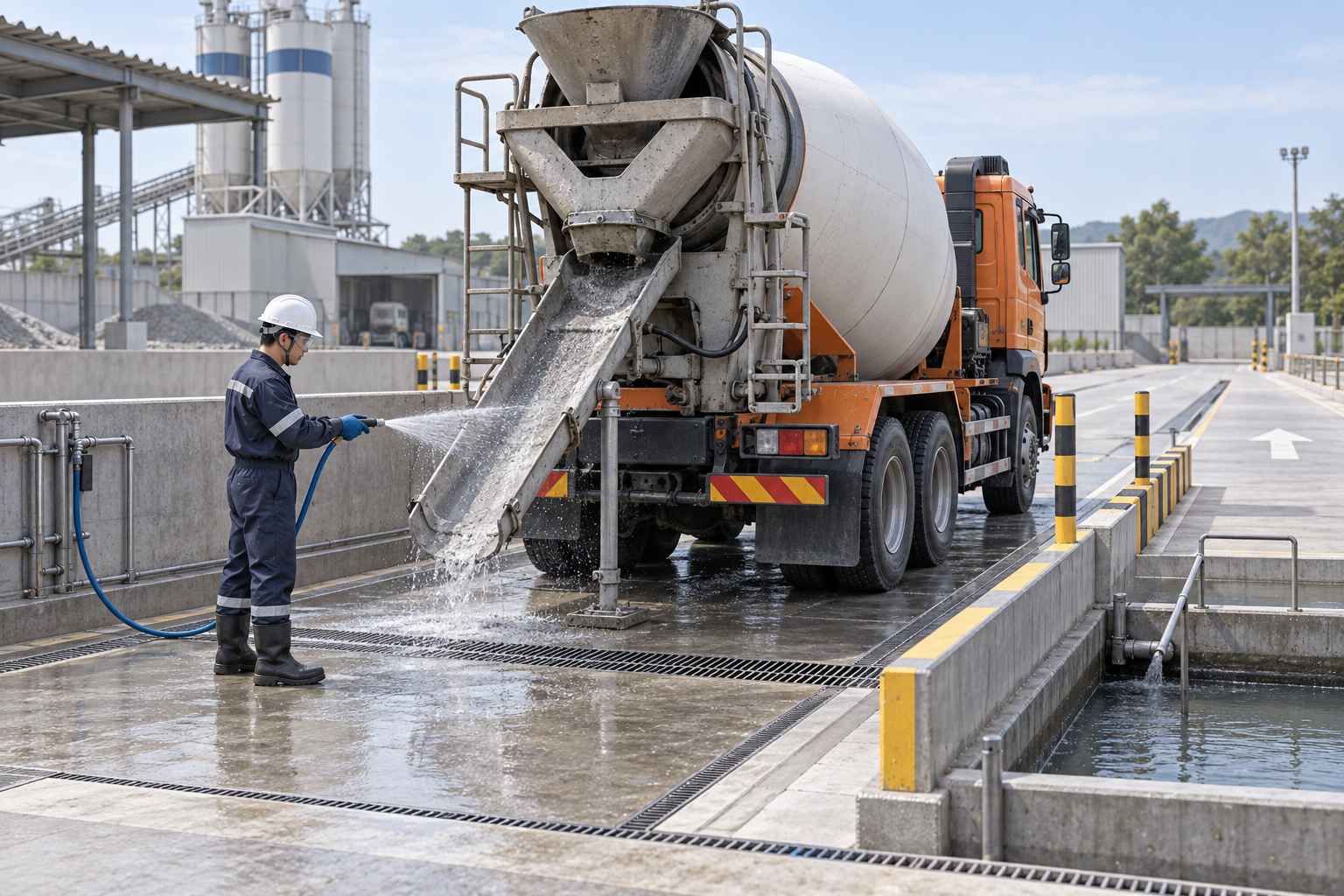
The retained illustration is an AI-generated educational image from the retained source edition. It is not an actual incident photograph, approved drawing, equipment certification or proof that the depicted arrangement is safe.
The driver and signaller need a clear route, protected signaller position and agreed stop signal. Do not stand between the truck and fixed objects. Reassess the parking surface and receiving arrangement after relocation.
Chute sections can rotate, fold or drop under gravity and hydraulic forces. Use the specified handles, pins and locks and keep hands outside joints. A truck that is parked can still expose people to moving discharge equipment.
Reduced flow is a fault indication, not permission to push a long tool toward moving equipment. Stop discharge, coordinate the receiving operator and change to the authorized recovery procedure. Applicable construction maintenance/repair requires hazardous-energy lockout and tagging; residual material movement also needs control.
Wet concrete can injure skin and eyes. Follow the actual SDS, avoid contaminated clothing against the skin and provide prompt washing. External washing does not authorize climbing into or entering the drum.
Hypothetical decision example
Hypothetical example: discharge slows above a pump hopper. A worker reaches with a long tool near the chute after the rotation control is briefly stopped, without contacting the receiving operator. Hold the intervention, secure the energy and material hazards through the correct recovery procedure, then re-establish the shared discharge signal.
The example is fictional; no incident, measurement, inspection or approval is asserted.
Task flow: Plan delivery and wash → Reverse and park → Inspect chute and receiver → Deploy chute → Discharge concrete → Wash exterior chute → Hold blockage or defect → Fold and depart
5. Hold and proceed decisions
| Condition | Action | Evidence | Proceed when |
|---|---|---|---|
| Signal lost | Stop truck movement | People and signal path | Contact restored |
| Chute lock faulty | Hold deployment/discharge | Pin and lock inspection | Retention restored |
| Discharge blocked | Prevent unsafe access | Isolation and recovery plan | Recovery authorized |
| Drum entry requested | Stop; change work scope | Entry and rescue assessment | Separate release required |
Similar observation, different conclusion
| Observation | Supported conclusion | What remains unresolved |
|---|---|---|
| Rotation button off | Command stopped | Restart and stored forces unresolved |
| External wash complete | Accessible surfaces cleaned | Internal entry remains separate |
6. Roles and supervision
| Role | Responsibility |
|---|---|
| Work supervisor | Coordinate plan delivery and wash, affected operations, stop signals and stage transitions. |
| Technical/equipment reviewer | Verify Vehicle/ground plan, Traffic and signaller, actual instructions and unresolved technical limits. |
| Task crew | Apply the stated controls, report changes and keep actual checks and signatures factual. |
| Inspector/test lead | Connect Wash station/PPE, Hose/nozzle condition to the required acceptance criteria. |
| Receiving authority | Accept the recorded restrictions, Hose/tool count, Departure route/record, and follow-up ownership. |
These are responsibility examples, not invented statutory credentials. Verify actual competence, training and authority for the assigned work.
Supervision and handover controls
| Stage | Management controls | Evidence |
|---|---|---|
| Plan review | 1. Assign technical owner2. Close task-specific questions3. Verify route/ground | 1. Vehicle/ground plan2. Traffic and signaller3. Wash/recovery scope |
| Competence | 1. Verify required competence2. Assign stop authority3. Use protected visible signal | 1. Signaller/escape2. Training and task briefing3. Route visibility |
| Prestart evidence | 1. Inspect actual equipment2. Link evidence to this stage3. Use designated handles | 1. Hands/handles2. Pin/lock engagement3. Stable position |
| Change control | 1. Stop and secure the area2. Review affected controls3. Apply authorized isolation | 1. Isolation verification2. Residual-load plan3. Scope/restart briefing |
| Shift handover | 1. Identify remaining restrictions2. Confirm receiving responsibility3. Control folding zone | 1. Folded/locked chute2. Protrusions clear3. Departure route/record |
| Closeout | 1. Record defect disposition2. Archive factual evidence3. Control folding zone | 1. Folded/locked chute2. Protrusions clear3. Departure route/record |
7. Hold points and record quality
| Hold point | Evidence before release | Actual record |
|---|---|---|
| HP-0 Start | Receive and position a ready-mix truck, deploy the chute, discharge into the agreed receiving system, wash the exterior chute at the designated station and secure for departure. | |
| HP-1 Reverse and park | Signaller/escape; Brake/parking check; Ground and slope; Route visibility | |
| HP-2 Deploy chute | Hands/handles; Pin/lock engagement; Chute sweep clear; Stable position | |
| HP-3 Hold blockage or defect | Isolation verification; Residual-load plan; Recovery authority; Scope/restart briefing | |
| HP-4 Fold and depart | Folded/locked chute; Protrusions clear; Hose/tool count; Departure route/record |
Hold points are internal evidence gates. They do not establish that a statutory permit exists or has been approved. Recheck affected gates after changes, faults and shift handover.
Record comparison - hypothetical templates
The 16 boxes below identify record elements, not completed checks or approvals. They are static symbols. Link equipment/location, date, actual findings and the separate record reference; preserve unresolved items.
| Record | Insufficient entry | Required record elements |
|---|---|---|
| Plan delivery and wash | "Checked" without supporting facts | □ Vehicle/ground plan□ Traffic and signaller□ Receiver readiness□ Wash/recovery scope |
| Inspect chute and receiver | "Checked" without supporting facts | □ Chute retention□ Receiver guard/state□ People clear□ Eye/skin washing |
| Discharge concrete | "Checked" without supporting facts | □ Drum/chute boundary□ Flow and receiver□ Shared stop signal□ Parking stability |
| Hold blockage or defect | "Checked" without supporting facts | □ Isolation verification□ Residual-load plan□ Recovery authority□ Scope/restart briefing |
8. Pre-work checks and emergency response
| Check required | Result | Checker/action |
|---|---|---|
| Plan delivery and wash: Vehicle/ground plan | ||
| Reverse and park: Signaller/escape | ||
| Inspect chute and receiver: Chute retention | ||
| Deploy chute: Hands/handles | ||
| Discharge concrete: Drum/chute boundary | ||
| Wash exterior chute: Wash station/PPE | ||
| Hold blockage or defect: Isolation verification | ||
| Fold and depart: Folded/locked chute |
Stop work
Stop for lost reversing signals, uncertain ground, chute lock defects, unexpected motion, blocked discharge, people in the chute zone or unverified energy control for recovery.
Emergency response
Stop truck, drum and receiving equipment from safe controls and isolate the zone. Do not reach into moving or blocked equipment to free a person. Call 911 for serious crush injury or chemical exposure and activate the site rescue plan. For wet-concrete contact, use immediate washing and the SDS/first-aid procedure; responders must control energy and unstable residual material before access.
9. Official sources and review limits
Official public-source check: October 14, 2026. The review concerns the selected passages described below, not endorsement of this article.
| Official source | Checked scope and limit |
|---|---|
| OSHA 29 CFR 1926.702 | Selected paragraph (j) lockout/tagout for covered concrete-equipment maintenance/repair. Paragraph (b) loading-skip requirements are not treated as universal truck-chute rules. |
| OSHA 29 CFR 1926.601 | Selected off-highway construction vehicle inspection/reversing scope; separate road-law review required. |
| OSHA 29 CFR 1926.59 | Product hazard communication, SDS and worker information for wet concrete and cleaning products. |
| OSHA State Plans | Federal baseline and State Plan coverage reviewed. Confirm the applicable state program and employer coverage; this edition does not establish nationwide compliance. |
Selected public official provisions were checked on October 14, 2026. This is not a complete legal audit. No actual equipment manual, site measurements, engineering calculations, product certification or professional technical approval was supplied. Full paid NFPA/ANSI standards and state/local amendments were not reviewed. Check actual equipment, jurisdiction and project requirements before use.
This is reference content written and revised with AI. It has not been verified or approved by a professional. Review by a suitably qualified professional and required site authorization are necessary before use.
10. PDF use and frequently asked questions
PDF A summarizes core controls; B emphasizes technical failures; C covers supervision, records and handover. Each uses six stages from or aligned with the eight-stage body. All actual risk, measurement, check and signature fields are blank. Use a separate linked record where more space is needed.
Can a long tool clear a running blockage?
No. Do not reach toward hazardous moving parts; use the authorized isolated recovery method.
May the signaller stand behind the chute?
Use the planned visible position outside vehicle, chute and fixed-object pinch zones.
Is drum entry part of routine washout?
No. It requires separate hazard, energy, entry and rescue assessment.
Can the truck leave after discharge?
Verify folded/locked chutes, recovered hoses, clean departure condition and a clear route.
Has a professional approved this JSA?
This is reference content written and revised with AI. It has not been verified or approved by a professional. Review by a suitably qualified professional and required site authorization are necessary before use.
11. Authorship and revision history
This is reference content written and revised with AI. It has not been verified or approved by a professional. Review by a suitably qualified professional and required site authorization are necessary before use.
| Date/version | Editorial history | Technical approval |
|---|---|---|
| September 19, 2026 / Korean v1.0 | Korean source: original public text retained in the recovery archive; no professional technical review asserted. | Professional technical approval not performed |
| October 02, 2026 / Korean v1.1 | Korean source: revised task decisions, record checklists, JSA and three PDFs; editorial/source and layout checks. | Professional technical approval not performed |
| October 14, 2026 / US v1.0 | US localization: Preserves brief-stop versus isolation case, chute handling and chemical exposure. Adds relevant US concrete-maintenance energy control without applying mixer skip specifications to all trucks. | Not performed |
Source topic: https://smartjsabridge.com/ko/case-study/jsa-mixer-unloading
Content group: jsa-mixer-unloading