An unglazed frame can still overturn, rotate or sweep into an opening. Several helpers holding it do not establish a reliable load path. Plan the handling aid, temporary restraint and protected working positions before standing it up.
This is reference content written and revised with AI. It has not been verified or approved by a professional. Review by a suitably qualified professional and site authorization are required before use.
Stop before starting
Stop for missing opening protection, unstable platform or temporary restraint, uncontrolled wind/frame movement, unknown services, anchor spin, cracking or an unapproved fixing detail. Keep temporary support until the release conditions are verified.
1. Legal and technical scope
| Basis | Scope and limits |
|---|---|
| OSHA 1926.501 | Construction fall protection, including applicable wall openings. |
| OSHA 1926.1153 | Construction silica controls for the actual drilling operation. |
This is construction work. Apply 1926.501 to the actual opening and fall exposure, including its wall-opening conditions, and 1926.1153 to silica-generating drilling. Match the drill and complete dust-control method to the regulation; a partial control is not Table 1 compliance. Anchor design, substrate acceptance and release criteria come from the approved project details and actual product instructions. Check State Plan requirements.
2. Scope and required inputs
Included work
Handling and installing unglazed metal outer frames from an accepted indoor work platform at protected openings, using specified shims, temporary restraints and mechanical anchors, then handing over to later trades.
Separate assessment
Glazing, sash lifting, large curtain-wall units, rope or suspended access, external sealing, old-frame removal, welding and structural opening alteration require separate methods.
| Required input | Evidence to obtain |
|---|---|
| Review frame and opening | Frame ID and orientation; Opening dimensions; Anchor and shim detail; Handling and fall plan |
| Receive and move | Weight and trolley; Load restraint; Travel and turns; Edge condition |
| Prepare supports | Opening safeguards; Platform acceptance; Shim and brace setup; Service information |
| Stand and align | Lift and guide positions; Temporary restraint; Plumb square and gap; Wind and access |
No actual equipment model, SDS, site measurements, design calculations or authorization record was supplied. Product-specific limits and methods must be verified before use. Federal OSHA is a baseline within its scope; determine the applicable State Plan and local requirements. Manufacturer guidance is not government approval; an incorporated standard differs from voluntary guidance. No nationwide-compliance or expert-approval claim is made.
3. Eight-stage JSA
| Job stage | Hazards and effects | Failure factors | Technical and procedural controls | Site verification | P | S | R | A |
|---|---|---|---|---|---|---|---|---|
| 1. Review frame and opening | 1. Wrong frame2. Opening fall3. Weak fixing4. Handling overload | 1. ID mismatch2. Protection absent3. Substrate unknown4. Weight assumed | 1. Match approved detail2. Plan opening protection3. Review anchor substrate4. Identify handling load | 1. Frame ID and orientation2. Opening dimensions3. Anchor and shim detail4. Handling and fall plan | ||||
| 2. Receive and move | 1. Frame overturn2. Hand crush3. Route collision4. Edge laceration | 1. Frame leaned loose2. Grip in pinch zone3. Turn space narrow4. Edges exposed | 1. Use restrained trolley2. Plan safe grips3. Clear full turning route4. Protect sharp edges | 1. Weight and trolley2. Load restraint3. Travel and turns4. Edge condition | ||||
| 3. Prepare supports | 1. Fall through opening2. Unstable platform3. Frame tilt4. Hidden-service strike | 1. Guard removed early2. Base weak3. Shims improvised4. Drill zone unchecked | 1. Maintain accepted protection2. Inspect work platform3. Use specified shims4. Review service locations | 1. Opening safeguards2. Platform acceptance3. Shim and brace setup4. Service information | ||||
| 4. Stand and align | 1. Frame rotation2. Finger crush3. Member drop4. Opening exposure | 1. Helpers substitute restraint2. Hands under frame3. Support moved early4. Wind changes | 1. Use planned handling aid2. Keep pinch zones clear3. Secure temporary braces4. Hold changed conditions | 1. Lift and guide positions2. Temporary restraint3. Plumb square and gap4. Wind and access | ||||
| 5. Drill and anchor | 1. Silica exposure2. Service contact3. Anchor failure4. Electric injury | 1. Dust control incomplete2. Location assumed3. Hole unprepared4. Supply damaged | 1. Apply drilling controls2. Verify safe hole location3. Follow anchor procedure4. Inspect tool and supply | 1. Dust-control method2. Hole and substrate3. Embedment and fastening4. Tool and supply checks | ||||
| 6. Inspect before release | 1. Frame shift2. Premature unclamping3. Hidden fixing fault4. Opening fall | 1. Geometry equals capacity2. Inspection omitted3. Torque guessed4. Protection not restored | 1. Inspect specified fixing2. Verify frame stability3. Record product criteria4. Maintain opening protection | 1. Anchor installation2. Geometry record3. Release authority4. Protection arrangement | ||||
| 7. Hold fixing defects | 1. Substrate breakout2. Repeated anchor failure3. Frame collapse4. Unapproved alteration | 1. Crack ignored2. Extra holes improvised3. Brace removed4. Repair not reviewed | 1. Retain safe support2. Mark affected opening3. Review repair detail4. Inspect corrected fixing | 1. Defect and location2. Support retained3. Repair approval4. Reinspection result | ||||
| 8. Hand over openings | 1. Wrong trade release2. Hidden defect3. Guard responsibility gap4. Loose material fall | 1. Held frame unmarked2. Records absent3. Protection owner unknown4. Debris left | 1. Separate accepted and held2. Transfer geometry records3. Assign guard responsibility4. Clear loose items | 1. Frame acceptance list2. Held items and limits3. Protection recipient4. Next-trade authorization |
P = likelihood; S = severity; R = risk under the site method; A = site-defined acceptance/authorization. These actual assessment cells are blank. A low score never overrides a missing safeguard or a legal or manufacturer restriction.
4. Fictional scenario and failure mechanisms
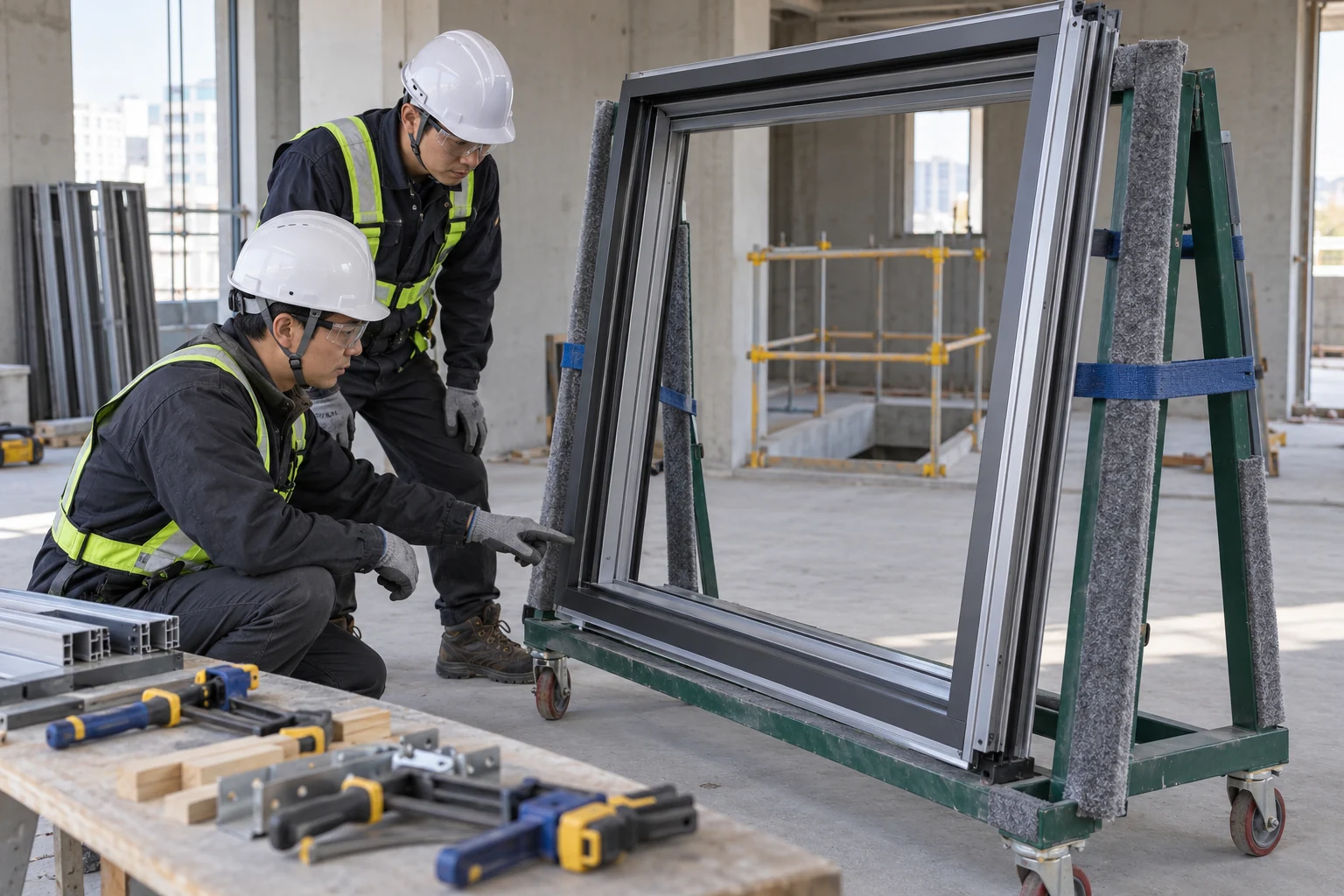
This illustration provides educational context. It is not an actual incident photograph or evidence of equipment suitability; any AI-generated depiction is illustrative only.
The scenario and record comparisons are fictional teaching examples, not records of real incidents, measurements, inspections, signatures or approvals.
| Stage | Fictional situation |
|---|---|
| Initial situation | A fictional crew aligns a bare frame at an exterior opening. |
| Changed condition | One anchor spins while the frame still appears vertical. |
| Failure path | A helper proposes releasing the temporary clamp to start the next opening. |
| Possible outcome | The frame could shift or fall before its permanent load path is established. |
| Prevention barrier | Retain safe support and opening protection, hold the frame, review substrate and anchor repair and inspect the completed fixing before release. |
Failure mechanisms
An unglazed frame can still overturn, rotate or sweep into an opening. Several helpers holding it do not establish a reliable load path. Plan the handling aid, temporary restraint and protected working positions before standing it up.
A plumb, square frame is not proof of anchor capacity. Check the specified substrate, hole preparation, embedment and installation criteria. A spinning anchor or cracked substrate requires a hold and reviewed repair, not arbitrary retightening or extra holes.
The frame is not an opening guard. If installation conflicts with existing protection, establish the accepted alternative before removing that protection. Temporary clamps are released only after the permanent fixing and frame stability have been accepted.
Work sequence: Review frame and opening → Receive and move → Prepare supports → Stand and align → Drill and anchor → Inspect before release → Hold fixing defects → Hand over openings. This is a teaching flow, not a device drawing or a complete operating procedure.
5. Conditional decisions and common errors
| Situation | Required action | Evidence | Proceed when |
|---|---|---|---|
| Opening guard conflicts | Establish alternative protection | Opening and access arrangement | Protection accepted |
| Frame unstable | Keep restraint in place | Handling and support plan | Stable support |
| Anchor spins | Hold permanent fixing | Substrate and repair review | Repair inspected |
| Clamp release requested | Check permanent stability | Anchor and geometry records | Release authorized |
Similar observations, different decisions
The scenario and record comparisons are fictional teaching examples, not records of real incidents, measurements, inspections, signatures or approvals.
| Observation | Insufficient conclusion | Required distinction |
|---|---|---|
| Frame is plumb | Geometry observed | Anchor capacity separate |
| No glass fitted | Lower component weight | Overturn and fall remain |
| Frame fills opening | Physical obstruction | Not accepted fall protection |
6. Roles and responsibilities
| Role | Responsibility |
|---|---|
| Work supervisor | Confirm frame id and orientation and the task scope, resources, interfaces and stop authority. |
| Qualified technical reviewer | Review weight and trolley, model limits, compatibility and unresolved technical conditions within assigned competence. |
| Work crew | Apply the listed controls, report changes and stop when evidence or safeguards are missing. |
| Inspector / assessor | Record actual dust-control method and other relevant checks; do not mark unverified conditions as accepted. |
| Handover authority | Reconcile frame acceptance list, restrictions and outstanding actions before the next task. Role labels do not establish a legal credential. |
Supervision and handover focus
| Stage | Management action | Evidence |
|---|---|---|
| Review frame and opening | 1. Record frame id and orientation2. Record opening dimensions3. Record anchor and shim detail | 1. Frame ID and orientation2. Opening dimensions3. Anchor and shim detail |
| Receive and move | 1. Record weight and trolley2. Record load restraint3. Record travel and turns | 1. Weight and trolley2. Load restraint3. Travel and turns |
| Stand and align | 1. Record lift and guide positions2. Record temporary restraint3. Record plumb square and gap | 1. Lift and guide positions2. Temporary restraint3. Plumb square and gap |
| Drill and anchor | 1. Record dust-control method2. Record hole and substrate3. Record embedment and fastening | 1. Dust-control method2. Hole and substrate3. Embedment and fastening |
| Hold fixing defects | 1. Record defect and location2. Record support retained3. Record repair approval | 1. Defect and location2. Support retained3. Repair approval |
| Hand over openings | 1. Record frame acceptance list2. Record held items and limits3. Record protection recipient | 1. Frame acceptance list2. Held items and limits3. Protection recipient |
7. Hold points and record comparison
| Hold point | Evidence before release | Actual approval |
|---|---|---|
| HP-0 Scope | Handling and installing unglazed metal outer frames from an accepted indoor work platform at protected openings, using specified shims, temporary restraints and mechanical anchors, then handing over to later trades. | |
| HP-1 Receive and move | Weight and trolley; Load restraint; Travel and turns; Edge condition | |
| HP-2 Stand and align | Lift and guide positions; Temporary restraint; Plumb square and gap; Wind and access | |
| HP-3 Hold fixing defects | Defect and location; Support retained; Repair approval; Reinspection result | |
| HP-4 Hand over openings | Frame acceptance list; Held items and limits; Protection recipient; Next-trade authorization |
Hold points are internal project checks. They are not universal statutory permits and do not grant work permission. Reassess after defects, changed conditions and shift changes.
Record comparison
The scenario and record comparisons are fictional teaching examples, not records of real incidents, measurements, inspections, signatures or approvals.
The boxes are static record prompts, not interactive or saved approvals. A tick does not establish suitability or permission to restart. Record the evidence, person, time and unresolved issues; retain the change history.
| Record | Insufficient record | Record checklist |
|---|---|---|
| Review frame and opening | Only marked “OK” | □ Frame ID and orientation□ Opening dimensions□ Anchor and shim detail□ Handling and fall plan |
| Stand and align | Only marked “OK” | □ Lift and guide positions□ Temporary restraint□ Plumb square and gap□ Wind and access |
| Hold fixing defects | Only marked “OK” | □ Defect and location□ Support retained□ Repair approval□ Reinspection result |
| Hand over openings | Only marked “OK” | □ Frame acceptance list□ Held items and limits□ Protection recipient□ Next-trade authorization |
8. Site checklist and emergency response
| Site check | Actual result | Person / action |
|---|---|---|
| Review frame and opening: Frame ID and orientation; Opening dimensions; Anchor and shim detail; Handling and fall plan | ||
| Receive and move: Weight and trolley; Load restraint; Travel and turns; Edge condition | ||
| Prepare supports: Opening safeguards; Platform acceptance; Shim and brace setup; Service information | ||
| Stand and align: Lift and guide positions; Temporary restraint; Plumb square and gap; Wind and access | ||
| Drill and anchor: Dust-control method; Hole and substrate; Embedment and fastening; Tool and supply checks | ||
| Inspect before release: Anchor installation; Geometry record; Release authority; Protection arrangement | ||
| Hold fixing defects: Defect and location; Support retained; Repair approval; Reinspection result | ||
| Hand over openings: Frame acceptance list; Held items and limits; Protection recipient; Next-trade authorization |
Stop work
Stop for missing opening protection, unstable platform or temporary restraint, uncontrolled wind/frame movement, unknown services, anchor spin, cracking or an unapproved fixing detail. Keep temporary support until the release conditions are verified.
Emergency response
Clear the possible frame-fall and opening zones and secure access. Use the site emergency and fall-rescue arrangements; do not reach under a moving frame or improvise support while someone remains exposed.
9. Sources and review limits
Public-source access/review: 2026-10-13.
| Official source | Reviewed scope and limits |
|---|---|
| OSHA 1926.501 | Construction fall protection, including applicable wall openings. |
| OSHA 1926.1153 | Construction silica controls for the actual drilling operation. |
No actual equipment model, SDS, site measurements, design calculations or authorization record was supplied. Product-specific limits and methods must be verified before use. Federal OSHA is a baseline within its scope; determine the applicable State Plan and local requirements. Manufacturer guidance is not government approval; an incorporated standard differs from voluntary guidance. No nationwide-compliance or expert-approval claim is made.
10. PDF guidance and FAQ
PDF A covers basic task controls; B focuses on technical failures; C covers supervision, records and handover. The article has eight stages with four items per main cell; each PDF has six key stages with three items per main cell. P/S/R/A, measurements, confirmations and signatures remain blank for actual site assessment.
PDFs are complementary six-stage extracts. Apply all eight body stages and the actual equipment/site procedure.
Can a spinning anchor simply be tightened harder?
No. Hold the fixing and use an accepted substrate and anchor repair decision.
When can temporary clamps be removed?
After the specified permanent fixing, geometry and stability are inspected and release is authorized.
Does a frame replace the opening guard?
No. Maintain fall protection appropriate to the actual opening and work.
Has a professional verified or approved this document?
No. Public sources and editorial, layout and consistency checks were reviewed using AI. No site inspection or professional technical approval has been performed. Obtain appropriate professional review before use.
11. Revision history and authorship
This is reference content written and revised with AI. It has not been verified or approved by a professional. Review by a suitably qualified professional and site authorization are required before use.
| Date | Version | Change | Review status |
|---|---|---|---|
| 2026-10-13 | US 1.0 | New US edition from assigned Korean source; task decisions, records and PDFs localized. | AI editorial review; no professional technical approval |
Korean edition revision history: 2026-10-08 (v1.0): initial article, sources, fictional analysis and PDF editorial checks. These are editorial records, not professional technical approval. US v1.0 adapts the earlier edition to United States requirements and terminology.
Site reviewers must add their actual qualifications, scope, date and approval only after the review occurs.