Manual sweeping, mopping and wiping of ordinary indoor floors, stairs and handrails using suitable tools and an identified cleaning product, with controlled access and adequate lighting.
Stop for uncontrolled access, blocked emergency routes, damaged steps, continuing leaks, unknown chemicals, hazardous waste or lighting and reach conditions that prevent safe cleaning.
Reference content written and revised with AI. It has not been verified or approved by a professional. Review by a suitably qualified professional and site approval are required before use.
1. Legal and technical scope
For covered general-industry workplaces, OSHA 1910.22 addresses walking-working surface condition, inspection and correction or guarding of hazards. OSHA 1910.37 requires free and unobstructed exit routes. Applicable hazardous cleaning chemicals require the 1910.1200 hazard-communication framework. Cleaning barriers must not defeat emergency egress.
Determine Federal OSHA or the applicable OSHA-approved State Plan, including public/private employer coverage. State Plans must be at least as effective and can impose different or additional requirements. The actual activity determines construction versus general-industry scope. Manufacturer instructions, consensus standards, project design and site approvals have distinct roles; this page is not a finding of nationwide compliance.
| Basis | Application and limits |
|---|---|
| OSHA 1910.22 | Walking-working surface condition, inspection and hazard correction. |
| OSHA 1910.37 | Exit-route availability and obstruction limits. |
| OSHA 1910.1200 | Applicable chemical labels, SDS and employee information. |
| HSE cleaning slips guidance | UK technical guidance on moisture, residue and separating cleaning from access. Not a US legal rule or permission to lock an exit. |
2. Scope and required inputs
Included: Manual sweeping, mopping and wiping of ordinary indoor floors, stairs and handrails using suitable tools and an identified cleaning product, with controlled access and adequate lighting.
Separate review: Powered scrubbers, pressure washing, ladder work, specialized toilet chemicals, blood or infectious material, hazardous spills and areas that cannot be separated safely require separate assessment.
| Input | Required evidence |
|---|---|
| Assess area and soil | Floor stairs and handrails; Soil and product label; Damage leak and sharp waste; Lighting and entry points |
| Prepare tools and product | Product and dilution basis; Required handling protection; Tool and bucket positions; Handle and tool condition |
| Clean controlled sections | Section and standing position; Liquid and product application; Handrail and edge condition; No spread to open routes |
| Reopen and hand over | Accepted and held areas; Dry clean route inspection; Equipment and waste removed; Receiving person and restrictions |
Match the product label, dilution and surface compatibility to the actual soil and flooring. Plan work sections, all entry points, safe standing positions and drying acceptance. Do not use a universal drying time or assume that keeping half a stairway open provides safe access.
3. Eight-stage JSA
P = likelihood; S = severity; R = risk under the site method; A = acceptance or authorization as defined by the site. Leave these blank until actual assessment and control verification. A low score does not override a legal requirement, product limit or unreleased hold point.
| Job stage | Hazards and effects | Failure factors | Required controls | Site verification | P | S | R | A |
|---|---|---|---|---|---|---|---|---|
| 1. Assess area and soil | 1. Stair slip or fall2. Chemical injury3. Sharp-waste cut4. Persistent wet surface | 1. Damage or leak overlooked2. Product unidentified3. Waste handled blindly4. Lighting inadequate | 1. Inspect surfaces and entries2. Identify product and soil3. Separate hazardous waste4. Review leak and lighting | 1. Floor stairs and handrails2. Soil and product label3. Damage leak and sharp waste4. Lighting and entry points | ||||
| 2. Control access and egress | 1. Person enters wet area2. Blocked emergency escape3. Collision at landing4. Cleaner struck by door | 1. Signs used as sole control2. Barrier blocks required route3. Intermediate door missed4. Other work uncoordinated | 1. Control all affected entries2. Maintain required egress3. Coordinate stair sections4. Brief occupants and nearby work | 1. Top bottom and door entries2. Safe alternate access3. Emergency route availability4. Boundaries and work timing | ||||
| 3. Prepare tools and product | 1. Chemical splash2. Incompatible mixture3. Trip on bucket4. Strain from poor reach | 1. Dilution improvised2. Products mixed3. Tools stored on treads4. Handle unsuitable | 1. Follow product label and SDS2. Do not mix incompatible products3. Store tools off walking route4. Choose stable-reach equipment | 1. Product and dilution basis2. Required handling protection3. Tool and bucket positions4. Handle and tool condition | ||||
| 4. Remove dry debris | 1. Dust inhalation2. Sharp-object cut3. Trip on loose material4. Loss of stair balance | 1. Dust raised excessively2. Waste picked by hand3. Debris pushed into route4. Worker overreaches | 1. Use suitable dust control2. Use tools for sharp waste3. Contain collected material4. Maintain stable supported stance | 1. Debris and waste separation2. Dust-control method3. Clear work position4. Contained waste and tools | ||||
| 5. Clean controlled sections | 1. Wet-surface slip2. Cleaner fall3. Chemical skin contact4. Water enters adjacent area | 1. Excess liquid applied2. Unsafe reach or movement3. Protection unsuitable4. Section boundary ineffective | 1. Use controlled liquid amount2. Reposition with stable footing3. Apply product-specific protection4. Keep runoff within controlled area | 1. Section and standing position2. Liquid and product application3. Handrail and edge condition4. No spread to open routes | ||||
| 6. Remove residue and dry | 1. Reopened-surface slip2. Residual chemical exposure3. Wet corner overlooked4. Premature access | 1. Timer used as sole proof2. Rinse requirement ignored3. Threshold not inspected4. Signs removed early | 1. Follow required residue removal2. Check full section condition3. Inspect corners and thresholds4. Hold access until accepted | 1. Moisture and residue evidence2. Product finish requirements3. Corners and entry thresholds4. Area acceptance and boundary | ||||
| 7. Hold recurring defects | 1. Repeated wet-floor fall2. Unsafe improvised repair3. Chemical exposure continued4. Uncontrolled reopening | 1. Leak source unresolved2. Maintenance not assigned3. Unknown residue ignored4. Hold passed verbally | 1. Stop and retain access controls2. Assign source correction3. Review changed conditions4. Record restart evidence | 1. Leak or damage location2. Responsible correction owner3. Cleaning and condition recheck4. Restart decision and limits | ||||
| 8. Reopen and hand over | 1. Hazard transferred to occupants2. Trip on leftover equipment3. Missed held section4. Waste exposure | 1. Inspection incomplete2. Tools left in route3. Boundary removed globally4. Waste left open | 1. Release only accepted sections2. Remove tools and waste3. Keep unresolved areas controlled4. Transfer cleaning and defect status | 1. Accepted and held areas2. Dry clean route inspection3. Equipment and waste removed4. Receiving person and restrictions |
4. Hypothetical scenario and failure mechanisms
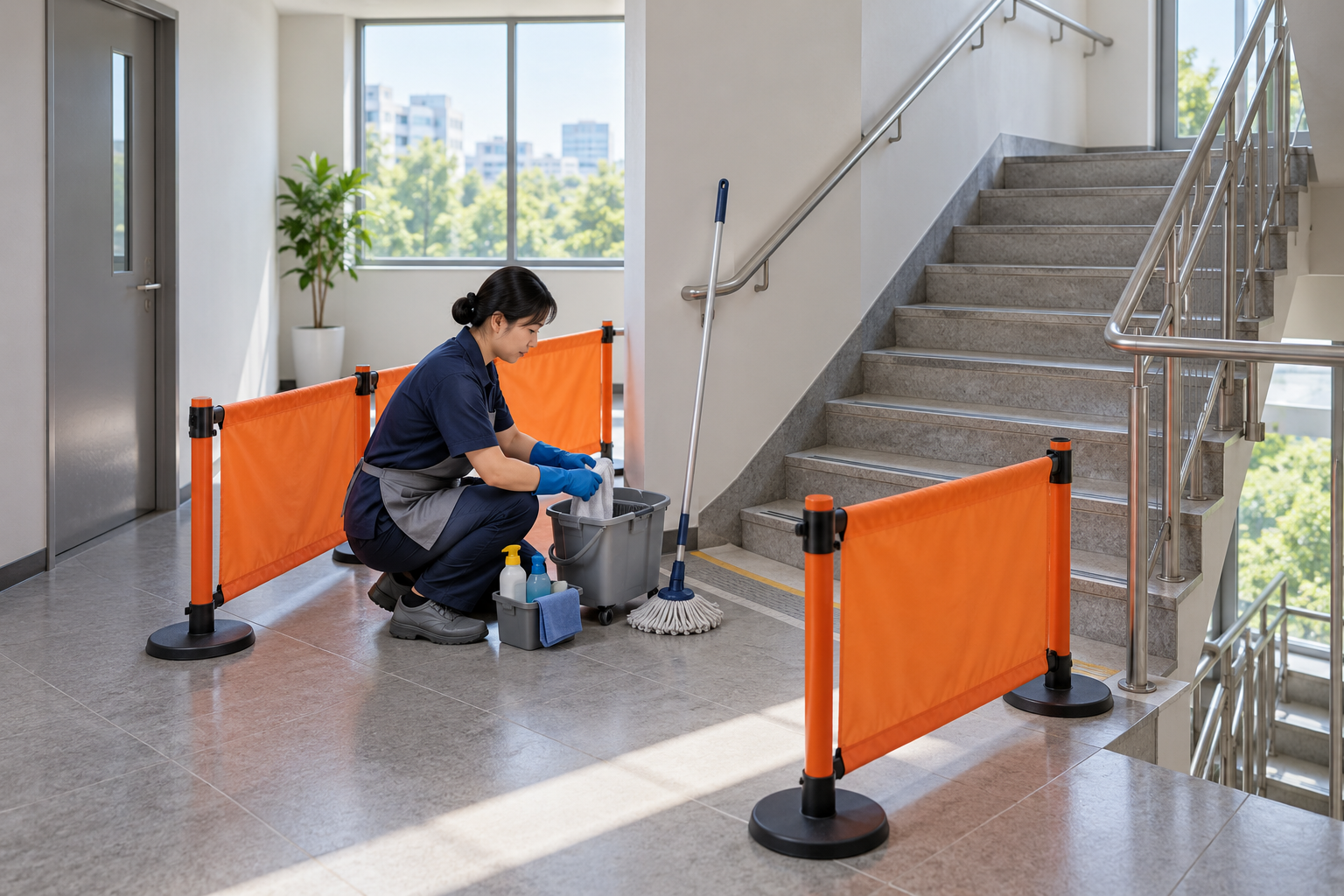 Retained source illustration: an AI-generated educational concept, not a real incident photograph or evidence of equipment suitability.
The following scenario, comparisons and example records are hypothetical teaching material. They do not reproduce actual incidents, measurements, signatures or approvals.
| Item | Hypothetical situation |
|---|---|
| Initial state | A cleaner is preparing to reopen a stair flight. |
| Change | Water continues to enter below a door on the intermediate landing. |
| Failure path | Most treads appear dry and the next shift wants the warning signs removed. |
| Possible harm | An uncontrolled wet patch can cause a slip on the stair or spread to the reopened area. |
| Barrier | Keep the affected access controlled, address the water source and verify the full walking surface and safe route before reopening. |
A warning sign communicates a hazard but does not physically prevent entry. Control the top, bottom and intermediate doors of a stair work section while retaining required emergency egress. If safe separation and egress cannot coexist, change the work timing or method before starting.
Manual cleaning requires a stable stance and controlled reach. Keep buckets and tools off treads and access routes, use suitable handles and reposition safely. Do not prescribe blind backward movement or reaching over an unprotected stair edge.
A surface can remain slippery after visible water is removed. Check residue, corners, thresholds and continuing leakage using the site acceptance method; do not test grip by deliberately walking onto a suspected slippery surface.
Repeated wetting is a defect to investigate, not a reason to repeat mopping indefinitely. Record the leak or drainage source, responsible maintenance owner and held boundary. Reopening is a separate decision after cleaning and underlying hazards are resolved.
| Decision | Reason and evidence |
|---|---|
| Known facts | Water continues to enter below a door on the intermediate landing. |
| Unresolved | Most treads appear dry and the next shift wants the warning signs removed. |
| Hold reason | Stop for uncontrolled access, blocked emergency routes, damaged steps, continuing leaks, unknown chemicals, hazardous waste or lighting and reach conditions that prevent safe cleaning. |
| Evidence needed | Moisture and residue evidence; Product finish requirements; Corners and entry thresholds; Area acceptance and boundary. |
| Next decision | Keep the affected access controlled, address the water source and verify the full walking surface and safe route before reopening. |
5. Conditional decisions and common errors
| Condition | Action | Evidence | Proceed when |
|---|---|---|---|
| Intermediate door uncontrolled | Hold the affected section. | All access points and egress plan. | Access safely coordinated. |
| Unknown product | Do not dilute or apply. | Label SDS and surface compatibility. | Suitable product identified. |
| Water returns | Maintain hold and assign source correction. | Leak cause and full surface recheck. | Source and surface accepted. |
| Surface appears mostly dry | Check the complete route. | Thresholds corners and residue. | Entire released section accepted. |
| Comparison | Situation A | Situation B |
|---|---|---|
| Warning sign placed | Affected entries are controlled and egress maintained. | People can still walk into the wet section. |
| Most floor looks dry | The full accepted route has no hazardous moisture or residue. | A wet threshold remains in the walking path. |
6. Roles and responsibilities
| Role | Responsibility |
|---|---|
| Work supervisor | Confirm scope, task sequence, exclusion and stop authority. Coordinate assess area and soil with affected operations. |
| Technical reviewer | Resolve the actual design and equipment limits: Floor stairs and handrails; Soil and product label; Damage leak and sharp waste; Lighting and entry points. |
| Work crew | Perform prepare tools and product using the approved procedure; report any mismatch before proceeding. |
| Inspector / assessor | Verify Moisture and residue evidence; Product finish requirements; Corners and entry thresholds; Area acceptance and boundary. Record what was actually checked and what remains unresolved. |
| Release / receiving authority | Confirm Accepted and held areas; Dry clean route inspection; Equipment and waste removed; Receiving person and restrictions. Transfer restrictions and the next permitted stage. |
These are responsibility examples, not invented statutory credentials. Meet the actual training, competent-person, qualified-person and licensing requirements for the assigned work. Anyone may raise a hazard and request a stop; only the designated authority may release the affected stage after evidence is reviewed.
7. Hold points and record comparison
| Hold point | Evidence before release | Confirmation / approval |
|---|---|---|
| HP-0 Start | Scope, jurisdiction, equipment identity, responsible people and emergency arrangements. | |
| HP-1 Control access and egress | Top bottom and door entries; Safe alternate access; Emergency route availability; Boundaries and work timing | |
| HP-2 Prepare tools and product | Product and dilution basis; Required handling protection; Tool and bucket positions; Handle and tool condition | |
| HP-3 Hold recurring defects | Leak or damage location; Responsible correction owner; Cleaning and condition recheck; Restart decision and limits | |
| HP-4 Reopen and hand over | Accepted and held areas; Dry clean route inspection; Equipment and waste removed; Receiving person and restrictions |
Hold points are internal evidence gates. They do not replace statutory permits or actual signatures. Recheck affected gates after a change, abnormal event or shift transfer. The blank record must identify the evidence, person, time, limits and release scope.
| Record | Insufficient record | Record checklist |
|---|---|---|
| Access | Signs placed | □ Top bottom and door entries□ Safe alternate access□ Emergency route availability□ Boundaries and work timing |
| Preparation | Cleaner ready | □ Product and dilution basis□ Required handling protection□ Tool and bucket positions□ Handle and tool condition |
| Dryness | Time elapsed | □ Moisture and residue evidence□ Product finish requirements□ Corners and entry thresholds□ Area acceptance and boundary |
| Transfer | Cleaning finished | □ Accepted and held areas□ Dry clean route inspection□ Equipment and waste removed□ Receiving person and restrictions |
The □ boxes are static prompts, not saved or interactive approvals. Each checks one record element. A tick alone does not establish suitability or permission to restart. Link equipment IDs and supporting records; retain unresolved matters and the earlier record when conditions change.
8. Site checklist and emergency response
| Check item | Result | Person / action |
|---|---|---|
| Floor stairs and handrails | ||
| Top bottom and door entries | ||
| Product and dilution basis | ||
| Debris and waste separation | ||
| Section and standing position | ||
| Moisture and residue evidence | ||
| Leak or damage location | ||
| Accepted and held areas | ||
| Emergency arrangements and unresolved restrictions communicated |
Stop work: Stop for uncontrolled access, blocked emergency routes, damaged steps, continuing leaks, unknown chemicals, hazardous waste or lighting and reach conditions that prevent safe cleaning.
Emergency response: Stop work and control access around a fall or spill. Call 911 for serious injury and follow the site first-aid plan; avoid unnecessary movement of an injured person. For chemical exposure, use the product SDS and emergency flushing provisions and seek appropriate medical assistance. Keep response routes clear and do not mix chemicals during cleanup.
9. Sources and review limits
Official-source review date: October 14, 2026. The following review is limited to the public provisions or selected manufacturer material identified below. It does not establish that any authority approved this article or the actual installation.
- OSHA 1910.22: Walking-working surface condition, inspection and hazard correction.
- OSHA 1910.37: Exit-route availability and obstruction limits.
- OSHA 1910.1200: Applicable chemical labels, SDS and employee information.
- HSE cleaning slips guidance: UK technical guidance on moisture, residue and separating cleaning from access. Not a US legal rule or permission to lock an exit.
- OSHA State Plans: jurisdiction and coverage overview; identify the actual state program before use.
Paid consensus standards and site-specific calculations, manuals, inspection records and product certificates were not independently obtained or verified unless specifically identified. Korean legal citations remain in the preserved Korean source as source history; they are not represented as US legal duties.
10. PDF guidance and FAQ
PDF A covers basic task controls; B examines technical failures; C focuses on supervision, evidence and handover. Each has six rows and three items per main cell. They are complementary extracts: apply all eight body stages and the applicable site procedure. An omitted stage is not permission to omit its controls. PDF HP-0 through HP-4 are worksheet labels; match the event, evidence and authority rather than assuming they match another permit by number.
P/S/R/A, actual measurements, confirmations and signatures remain blank. The PDFs are uncompleted reference worksheets, not issued work permits.
Content group ID: jsa-manual-floor-stair-cleaning
Are wet-floor signs enough?
Signs warn. Use appropriate access control while preserving required emergency routes and all relevant entry points.
Can a fixed drying time release the stairs?
No. Verify the actual walking surface, residue, thresholds and continuing water sources.
Can products be mixed for stronger cleaning?
Follow the label and SDS. Do not mix products without a specifically authorized compatible procedure.
What if the stairs cannot be closed safely?
Revise the timing, section plan or method so cleaning and required access can both be controlled before work starts.
Has a professional verified or approved this document?
No. This is AI-assisted reference material. Editorial and layout checks are not a physical inspection or professional technical approval. Obtain qualified professional review and required site approval before use.
11. Revision history and authorship
Reference content written and revised with AI. It has not been verified or approved by a professional. Review by a suitably qualified professional and site approval are required before use.
This system has not physically inspected the equipment, structures, ground, atmosphere or worksite. The document does not replace legal advice, manufacturer procedures, engineering design, inspection certificates, qualification evidence, the site risk assessment or an actual work permit.
Before use, a suitably qualified and authorized person must review the actual equipment, loads, methods, protection, inspection and emergency arrangements and resolve open issues. Record the real reviewer, organization, qualifications, delegated authority, reviewed documents, date, signature, exclusions and conditions of approval separately.
| Date | Version | Change | Review status |
|---|---|---|---|
| 2026-09-30 | 1.0 | Korean source revision retained in the source snapshot. | Historical editorial status; not US professional approval. |
| 2026-10-14 | US 1.0 | US localization of the assigned Korean source; task reasoning, educational image and history retained; US scope and sources reviewed. | AI-assisted editorial work; professional approval not performed. |