The same box imposes different demands at different reach distances and heights. An easy lift at the middle of a pallet does not represent its lowest or highest layer. Change supply position, packaging unit or handling equipment before relying only on posture training.
This is reference content written and revised with AI. It has not been verified or approved by a professional. Review by a suitably qualified professional and site authorization are required before use.
Stop before starting
Hold unknown, wet, torn or sagging boxes and any task without safe grip, close access, visibility or landing space. Stop for pain, tingling, weaker grip, damaged handles or stack movement. Do not catch falling boxes with the body.
1. Legal and technical scope
| Basis | Scope and limits |
|---|---|
| OSHA 1910.176 | Safe material handling routes and stable storage; no universal box weight limit. |
| NIOSH Revised Lifting Equation | Two-handed lifting risk-assessment tool; use within its scope. |
| NIOSH applications manual | Task variables, limitations and evaluation of actual lifting arrangements. |
For general-industry work, apply relevant material-storage and safe-surface requirements and determine State Plan obligations. NIOSH lifting guidance is a risk-assessment/design aid, not an OSHA universal legal weight limit or a medical clearance. Its Revised Lifting Equation has defined applicability and limitations for two-handed lifting; do not apply it mechanically to carrying, unstable loads or team lifting. Korean weight-label thresholds are not US lifting permissions.
2. Scope and required inputs
Included work
One identified ordinary box at a time, handled indoors on a level floor between stable benches, pallets or accepted stacking surfaces. Assess short movement, turning and the full range from the lowest to highest layer.
Separate assessment
Hazardous/hot contents, shifting liquids, long loads, people, stairs, ladders, vehicle loading and moving conveyors are excluded. Two-person handling and powered aids need their own coordinated method and pinch/drop assessment.
| Required input | Evidence to obtain |
|---|---|
| Identify load and package | Product and weight basis; Mass variation; Handle and bottom; Contents and center |
| Plan method and exposure | Method and aids; Frequency and duration; Start and end heights; Recovery arrangement |
| Prepare route and landing | Floor and route; Turning room; Support condition; Stacking criteria |
| Approach and grip | Grip and gloves; Hand clearance; Reach distance; Body and load space |
No actual equipment model, SDS, site measurements, design calculations or authorization record was supplied. Product-specific limits and methods must be verified before use. Federal OSHA is a baseline within its scope; determine the applicable State Plan and local requirements. Manufacturer guidance is not government approval; an incorporated standard differs from voluntary guidance. No nationwide-compliance or expert-approval claim is made.
3. Eight-stage JSA
| Job stage | Hazards and effects | Failure factors | Technical and procedural controls | Site verification | P | S | R | A |
|---|---|---|---|---|---|---|---|---|
| 1. Identify load and package | 1. Unexpected strain2. Dropped contents3. Grip failure4. Shifting center | 1. Wrong weight label2. Wet carton3. Bottom seam split4. Contents unknown | 1. Match product and mass2. Inspect entire package3. Identify grip and center4. Hold uncertain loads | 1. Product and weight basis2. Mass variation3. Handle and bottom4. Contents and center | ||||
| 2. Plan method and exposure | 1. Cumulative strain2. Excessive solo load3. High-reach injury4. Repeated twisting | 1. Posture training only2. Aid not considered3. Height changes missed4. Frequency unmeasured | 1. Reduce manual lifts first2. Review suitable aids3. Assess every layer4. Plan pace and recovery | 1. Method and aids2. Frequency and duration3. Start and end heights4. Recovery arrangement | ||||
| 3. Prepare route and landing | 1. Slip2. Pedestrian collision3. Load fall4. Unstable placement | 1. Packing debris2. Shared path3. Support weak4. Landing occupied | 1. Clear standing space2. Separate travel path3. Check receiving support4. Provide safe landing | 1. Floor and route2. Turning room3. Support condition4. Stacking criteria | ||||
| 4. Approach and grip | 1. Finger pinch2. Box slip3. Long-reach strain4. Twisted posture | 1. Grip strength unknown2. Glove unsuitable3. Only arms reach4. Space too narrow | 1. Secure suitable handholds2. Match hand protection3. Approach close safely4. Change layout if needed | 1. Grip and gloves2. Hand clearance3. Reach distance4. Body and load space | ||||
| 5. Lift and move | 1. Dropped box2. Foot injury3. Balance loss4. Back strain | 1. Jerking load2. View obstructed3. Torso twisted4. Grip weakening | 1. Move smoothly2. Keep view clear3. Turn with feet4. Stop loss of control | 1. Load stability2. Travel sightline3. Pain and grip4. Movement control | ||||
| 6. Lower and stack | 1. Hand crush2. Stack collapse3. Top load fall4. Package crushing | 1. Hands under base2. Off-center stack3. Weak lower box4. Height unsupported | 1. Use stable landing2. Withdraw hands safely3. Follow package limits4. Check stack stability | 1. Hand and foot clearance2. Landing condition3. Tilt and crushing4. Stack arrangement | ||||
| 7. Hold damage or symptoms | 1. Repeated injury2. Falling-load strike3. Worsening symptoms4. Unsafe restart | 1. Cause unresolved2. Box caught by body3. Pain ignored4. Only carton changed | 1. Stabilize load if safe2. Control access3. Report and assess symptoms4. Change and verify method | 1. Symptoms and time2. Package damage3. Method correction4. Restart disposition | ||||
| 8. Clean and hand over | 1. Bad box reused2. Next-shift strain3. Blocked route4. Unstable storage | 1. Hold not marked2. Changes not passed3. Waste left4. Stack not checked | 1. Separate damaged cartons2. Transfer exposure limits3. Clear route4. Confirm stored stability | 1. Held product IDs2. Stack and floor3. Method and restrictions4. Recipient and record |
P = likelihood; S = severity; R = risk under the site method; A = site-defined acceptance/authorization. These actual assessment cells are blank. A low score never overrides a missing safeguard or a legal or manufacturer restriction.
4. Fictional scenario and failure mechanisms
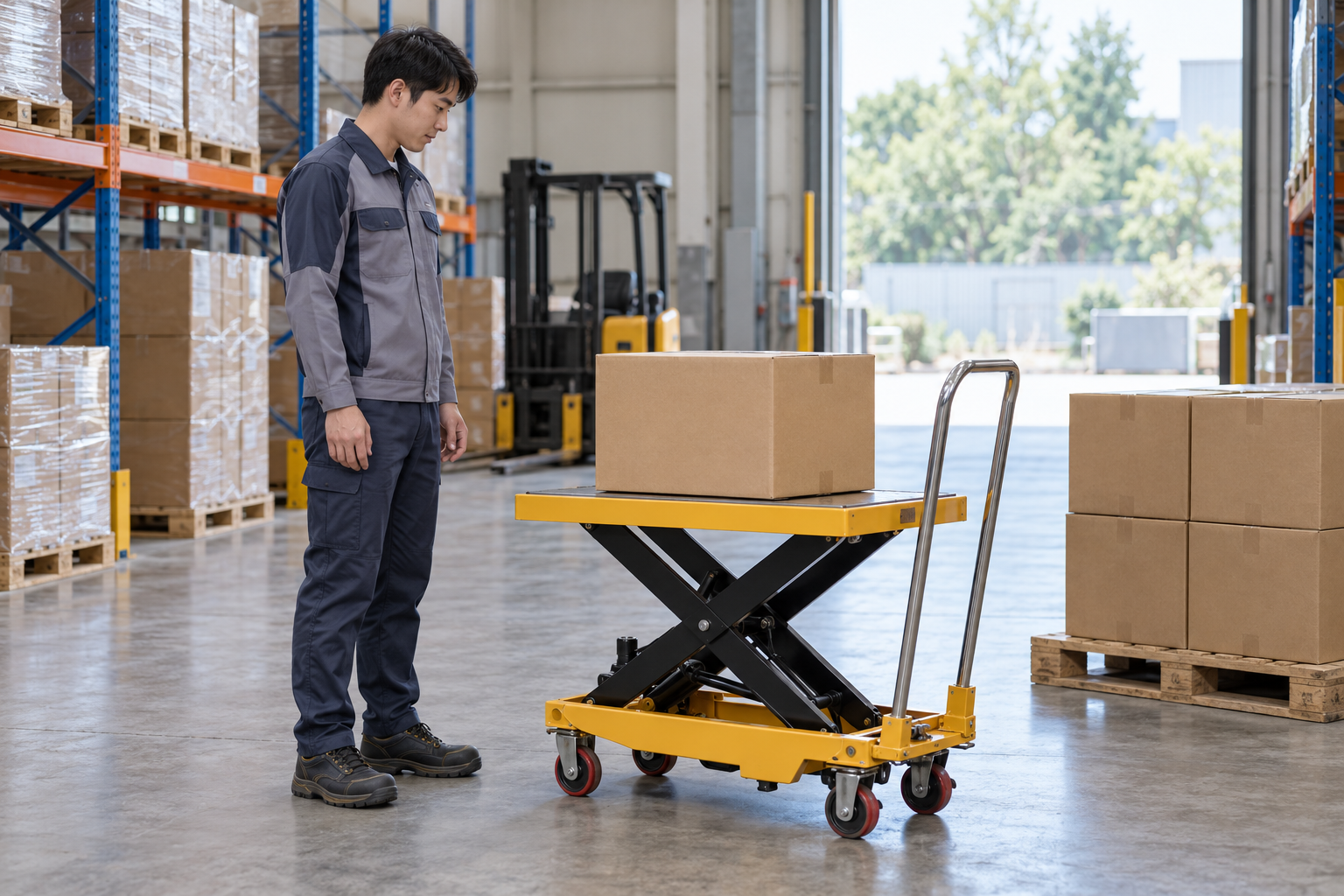
This illustration provides educational context. It is not an actual incident photograph or evidence of equipment suitability; any AI-generated depiction is illustrative only.
The scenario and record comparisons are fictional teaching examples, not records of real incidents, measurements, inspections, signatures or approvals.
| Stage | Fictional situation |
|---|---|
| Initial situation | A fictional worker transfers boxes from a pallet to a bench. |
| Changed condition | The final layer is near floor level, one handle is damp and the worker reports weaker grip. |
| Failure path | Replacing only that carton is proposed so the remaining quantity can be finished. |
| Possible outcome | The unassessed low reach and accumulated demand could still cause loss of control or injury. |
| Prevention barrier | Hold the repetitive task, support any held load safely, review packaging, supply height, aids and work duration, and address the reported symptoms before release. |
Failure mechanisms
The same box imposes different demands at different reach distances and heights. An easy lift at the middle of a pallet does not represent its lowest or highest layer. Change supply position, packaging unit or handling equipment before relying only on posture training.
A sound handle does not prove the whole carton can carry its contents. Wet cardboard, torn grips and separated bottom seams are independent failure paths. Check actual contents, mass variation, center of gravity and packaging condition; a label for another product is not evidence.
Frequency, pace and continuous duration can increase demand after an initially comfortable lift. A rotation to another task using the same muscles may not reduce exposure sufficiently. Report pain, tingling or weaker grip; do not repeat a symptomatic task to demonstrate safety.
Team lifting does not simply halve each person's demand. Grips, coordination, body positions and simultaneous placement need a separate assessment. Mechanical assistance also creates new pinch and falling-load hazards that must be controlled.
Work sequence: Identify load and package → Plan method and exposure → Prepare route and landing → Approach and grip → Lift and move → Lower and stack → Hold damage or symptoms → Clean and hand over. This is a teaching flow, not a device drawing or a complete operating procedure.
5. Conditional decisions and common errors
| Situation | Required action | Evidence | Proceed when |
|---|---|---|---|
| Weight or contents unknown | Do not test by lifting | Product and weight evidence | Load identified |
| Low/high layer differs | Reassess method | Reach, height and frequency | Arrangement accepted |
| Pain or grip loss | Stop and report | Symptoms and task review | Work disposition set |
| Stack unstable | Keep people clear | Packaging and support assessment | Stack made stable |
Similar observations, different decisions
The scenario and record comparisons are fictional teaching examples, not records of real incidents, measurements, inspections, signatures or approvals.
| Observation | Insufficient conclusion | Required distinction |
|---|---|---|
| Lifted once | One successful attempt | Repeated exposure not evaluated |
| Handle intact | One part looks sound | Bottom and carton still matter |
| Same weight | Mass unchanged | Reach and height may change |
6. Roles and responsibilities
| Role | Responsibility |
|---|---|
| Work supervisor | Confirm product and weight basis and the task scope, resources, interfaces and stop authority. |
| Qualified technical reviewer | Review method and aids, model limits, compatibility and unresolved technical conditions within assigned competence. |
| Work crew | Apply the listed controls, report changes and stop when evidence or safeguards are missing. |
| Inspector / assessor | Record actual load stability and other relevant checks; do not mark unverified conditions as accepted. |
| Handover authority | Reconcile held product ids, restrictions and outstanding actions before the next task. Role labels do not establish a legal credential. |
Supervision and handover focus
| Stage | Management action | Evidence |
|---|---|---|
| Identify load and package | 1. Record product and weight basis2. Record mass variation3. Record handle and bottom | 1. Product and weight basis2. Mass variation3. Handle and bottom |
| Plan method and exposure | 1. Record method and aids2. Record frequency and duration3. Record start and end heights | 1. Method and aids2. Frequency and duration3. Start and end heights |
| Approach and grip | 1. Record grip and gloves2. Record hand clearance3. Record reach distance | 1. Grip and gloves2. Hand clearance3. Reach distance |
| Lift and move | 1. Record load stability2. Record travel sightline3. Record pain and grip | 1. Load stability2. Travel sightline3. Pain and grip |
| Hold damage or symptoms | 1. Record symptoms and time2. Record package damage3. Record method correction | 1. Symptoms and time2. Package damage3. Method correction |
| Clean and hand over | 1. Record held product ids2. Record stack and floor3. Record method and restrictions | 1. Held product IDs2. Stack and floor3. Method and restrictions |
7. Hold points and record comparison
| Hold point | Evidence before release | Actual approval |
|---|---|---|
| HP-0 Scope | One identified ordinary box at a time, handled indoors on a level floor between stable benches, pallets or accepted stacking surfaces. Assess short movement, turning and the full range from the lowest to highest layer. | |
| HP-1 Plan method and exposure | Method and aids; Frequency and duration; Start and end heights; Recovery arrangement | |
| HP-2 Approach and grip | Grip and gloves; Hand clearance; Reach distance; Body and load space | |
| HP-3 Hold damage or symptoms | Symptoms and time; Package damage; Method correction; Restart disposition | |
| HP-4 Clean and hand over | Held product IDs; Stack and floor; Method and restrictions; Recipient and record |
Hold points are internal project checks. They are not universal statutory permits and do not grant work permission. Reassess after defects, changed conditions and shift changes.
Record comparison
The scenario and record comparisons are fictional teaching examples, not records of real incidents, measurements, inspections, signatures or approvals.
The boxes are static record prompts, not interactive or saved approvals. A tick does not establish suitability or permission to restart. Record the evidence, person, time and unresolved issues; retain the change history.
| Record | Insufficient record | Record checklist |
|---|---|---|
| Identify load and package | Only marked “OK” | □ Product and weight basis□ Mass variation□ Handle and bottom□ Contents and center |
| Approach and grip | Only marked “OK” | □ Grip and gloves□ Hand clearance□ Reach distance□ Body and load space |
| Hold damage or symptoms | Only marked “OK” | □ Symptoms and time□ Package damage□ Method correction□ Restart disposition |
| Clean and hand over | Only marked “OK” | □ Held product IDs□ Stack and floor□ Method and restrictions□ Recipient and record |
8. Site checklist and emergency response
| Site check | Actual result | Person / action |
|---|---|---|
| Identify load and package: Product and weight basis; Mass variation; Handle and bottom; Contents and center | ||
| Plan method and exposure: Method and aids; Frequency and duration; Start and end heights; Recovery arrangement | ||
| Prepare route and landing: Floor and route; Turning room; Support condition; Stacking criteria | ||
| Approach and grip: Grip and gloves; Hand clearance; Reach distance; Body and load space | ||
| Lift and move: Load stability; Travel sightline; Pain and grip; Movement control | ||
| Lower and stack: Hand and foot clearance; Landing condition; Tilt and crushing; Stack arrangement | ||
| Hold damage or symptoms: Symptoms and time; Package damage; Method correction; Restart disposition | ||
| Clean and hand over: Held product IDs; Stack and floor; Method and restrictions; Recipient and record |
Stop work
Hold unknown, wet, torn or sagging boxes and any task without safe grip, close access, visibility or landing space. Stop for pain, tingling, weaker grip, damaged handles or stack movement. Do not catch falling boxes with the body.
Emergency response
Set an already held load on a safe support if possible without further exposure, keep people away from unstable stacks and obtain site first aid or medical assistance for injury. Do not repeat the provoking movement to test recovery; a competent review must resolve the task conditions.
9. Sources and review limits
Public-source access/review: 2026-10-13.
| Official source | Reviewed scope and limits |
|---|---|
| OSHA 1910.176 | Safe material handling routes and stable storage; no universal box weight limit. |
| NIOSH Revised Lifting Equation | Two-handed lifting risk-assessment tool; use within its scope. |
| NIOSH applications manual | Task variables, limitations and evaluation of actual lifting arrangements. |
No actual equipment model, SDS, site measurements, design calculations or authorization record was supplied. Product-specific limits and methods must be verified before use. Federal OSHA is a baseline within its scope; determine the applicable State Plan and local requirements. Manufacturer guidance is not government approval; an incorporated standard differs from voluntary guidance. No nationwide-compliance or expert-approval claim is made.
10. PDF guidance and FAQ
PDF A covers basic task controls; B focuses on technical failures; C covers supervision, records and handover. The article has eight stages with four items per main cell; each PDF has six key stages with three items per main cell. P/S/R/A, measurements, confirmations and signatures remain blank for actual site assessment.
PDFs are complementary six-stage extracts. Apply all eight body stages and the actual equipment/site procedure.
Is there one safe lifting weight for everyone?
No. Evaluate the actual load, reach, height, grip, frequency, duration and worker/task conditions; no universal limit is set here.
Does a new carton resolve reported grip weakness?
It addresses packaging only. Review symptoms and the full handling arrangement before returning to the task.
Should a falling box be caught?
Do not use the body to catch a falling load; protect people and arrange safe recovery.
Has a professional verified or approved this document?
No. Public sources and editorial, layout and consistency checks were reviewed using AI. No site inspection or professional technical approval has been performed. Obtain appropriate professional review before use.
11. Revision history and authorship
This is reference content written and revised with AI. It has not been verified or approved by a professional. Review by a suitably qualified professional and site authorization are required before use.
| Date | Version | Change | Review status |
|---|---|---|---|
| 2026-10-13 | US 1.0 | New US edition from assigned Korean source; task decisions, records and PDFs localized. | AI editorial review; no professional technical approval |
Korean edition revision history: 2026-09-26 (v1.0): initial article, sources, fictional analysis and PDF editorial checks. These are editorial records, not professional technical approval. US v1.0 adapts the earlier edition to United States requirements and terminology.
Site reviewers must add their actual qualifications, scope, date and approval only after the review occurs.