Acceptable air and a deenergized cable are separate conditions. An open cover, a running blower or an earlier gas reading cannot replace current entry controls and verified electrical isolation.
This is reference content written and revised with AI. It has not been verified or approved by a professional. Review by a suitably qualified professional and required site authorization are necessary before use.
Stop conditions first
Stop and exit for a gas alarm, loss of ventilation or communication, rising water or any prohibited entry condition. Hold cable cutting, splicing and testing for uncertain identity, isolation, charge control or kit suitability.
1. US legal and technical basis
General-industry maintenance of a non-utility premises-wiring cable in a permit-required manhole: OSHA 1910.146 and Subpart S electrical work practices are the selected baseline. Utility generation/transmission/distribution work requires a separate 1910.269 or construction Subpart V assessment; construction confined-space work requires the applicable 1926 framework.
| Reference | Use and limit |
|---|---|
| OSHA 29 CFR 1910.146 | Selected permit-space program, atmospheric testing/monitoring, attendant, exit and rescue requirements. Ventilation-only alternative conditions are not assumed. |
| OSHA 29 CFR 1910.333 | Selected deenergization/lockout-tagging and qualified-person verification, including induced voltage and backfeed. Testing and reenergization require their applicable controls. |
| OSHA State Plans | Federal baseline and State Plan coverage reviewed. Confirm the applicable state program and employer coverage; this edition does not establish nationwide compliance. |
Determine whether Federal OSHA or an applicable State Plan governs the employer and work. Standards incorporated into a regulation must be read in their legally applicable edition. Other NFPA/ANSI guidance and manufacturer instructions have distinct roles; they are not automatically federal law.
2. Scope and required inputs
Included
Plan permitted manhole entry, atmospheric monitoring and attendance; identify and isolate a premises-wiring circuit; splice with a matched kit; perform specified tests and controlled exit/restoration.
Separate assessment
Energized splicing, flooded electrical work, unprotected rescue entry, utility work and use of ventilation-only exceptions without establishing all applicable legal conditions are excluded.
| Input | Evidence needed |
|---|---|
| Plan space and circuit | Manhole/hazard IDs; Weather/water assessment; Circuit/isolation plan; Attendant/rescue readiness |
| Protect opening and access | Cover/barrier state; Traffic boundary; Intake/duct route; Ladder/escape path |
| Identify and isolate cable | Cable/both-end evidence; Lockout and test record; Charge/induction controls; Cable support/protection |
| Restore and hand over | Entry/exit reconciliation; Test holds/authority; Cover/barrier restoration; Kit/records/receiver |
Selected public official provisions were checked on October 13, 2026. This is not a complete legal audit. No actual equipment manual, site measurements, engineering calculations, product certification or professional technical approval was supplied. Full paid NFPA/ANSI standards and state/local amendments were not reviewed. Check actual equipment, jurisdiction and project requirements before use.
Select task-appropriate eye, hand, foot, skin and hearing protection from the exposure assessment. Where respiratory protection is necessary, use the applicable respiratory-protection program; PPE does not replace isolation, guarding, support or ventilation.
3. Eight-stage JSA
| Job stage | Hazards and effects | Failure factors | Controls | Site verification | P | S | R | A |
|---|---|---|---|---|---|---|---|---|
| 1. Plan space and circuit | 1. Asphyxiation2. Water engulfment3. Wrong cable cut4. Delayed rescue | 1. Sources unassessed2. Inflows unknown3. Circuit plan absent4. Rescue unavailable | 1. Identify space hazards2. Assess water/inflow sources3. Plan circuit identification4. Arrange entry/rescue program | 1. Manhole/hazard IDs2. Weather/water assessment3. Circuit/isolation plan4. Attendant/rescue readiness | ||||
| 2. Protect opening and access | 1. Fall into opening2. Vehicle strike3. Exhaust drawn inside4. Exit obstructed | 1. Cover area unguarded2. Traffic route open3. Intake by exhaust4. Duct blocks ladder | 1. Guard opening2. Control traffic/pedestrians3. Provide clean air intake4. Maintain clear access | 1. Cover/barrier state2. Traffic boundary3. Intake/duct route4. Ladder/escape path | ||||
| 3. Authorize and monitor entry | 1. Oxygen deficiency2. Toxic exposure3. Flammable atmosphere4. Unnoticed entrant distress | 1. Pre-entry test absent2. Wrong sensors/locations3. Attendant absent4. Ventilation ineffective | 1. Apply permit conditions2. Test and monitor hazards3. Maintain attendant/contact4. Verify ventilation/rescue | 1. Instrument/locations/time2. Actual air/flow record3. Entrant/contact roster4. Permit and rescue state | ||||
| 4. Identify and isolate cable | 1. Wrong-circuit shock2. Backfeed3. Induced/stored voltage4. Adjacent cable damage | 1. Label trusted alone2. Sources missed3. Charge not controlled4. Cable unsupported | 1. Verify circuit by procedure2. Isolate all supplies3. Verify deenergized state4. Protect adjacent cables | 1. Cable/both-end evidence2. Lockout and test record3. Charge/induction controls4. Cable support/protection | ||||
| 5. Prepare and splice | 1. Knife injury2. Insulation defect3. Moisture inclusion4. Heating-process fire | 1. Strip dimensions wrong2. Insulation scored3. Dirty/wet kit4. Heat work unassessed | 1. Follow matched kit dimensions2. Use suitable tools3. Maintain dry clean assembly4. Separately control heat work | 1. Cable/kit identity2. Dimensions/insulation check3. Clean/dry conditions4. Heat/air/permit controls | ||||
| 6. Test and make safe | 1. Test-voltage shock2. Residual charge3. Entry monitoring gap4. Premature cover closure | 1. Boundary unguarded2. Discharge omitted3. Attendant leaves4. People count incomplete | 1. Control test boundary2. Discharge/verify after test3. Maintain entry controls4. Account for people/tools | 1. Test scope/results2. Post-test safe state3. Attendant/air status4. People/tool count | ||||
| 7. Exit on changed conditions | 1. Toxic exposure2. Rescuer casualty3. Unsafe reentry4. Uncontrolled test energy | 1. Alarm ignored2. Unprotected rescue3. Old reading reused4. Test boundary lost | 1. Stop and exit2. Activate planned rescue3. Reevaluate before reentry4. Safely stop test energy | 1. Alarm/time/headcount2. Rescue notification3. Fresh evaluation/permit4. Isolation/charge state | ||||
| 8. Restore and hand over | 1. Person left inside2. Unauthorized energization3. Public fall4. Lost splice traceability | 1. Exit count missing2. Restriction omitted3. Cover unsecured4. Test record detached | 1. Reconcile entrants/tools2. Control restoration authority3. Secure cover and area4. Link air/splice/test records | 1. Entry/exit reconciliation2. Test holds/authority3. Cover/barrier restoration4. Kit/records/receiver |
Actual risk assessments, measurements, checks, approvals and signatures have not been performed. Keep unverified fields blank and link the actual site records. P/S/R/A mean likelihood, severity, site-method risk and site-defined acceptance/authorization; a score cannot waive a required control.
4. Failure mechanisms and hypothetical case
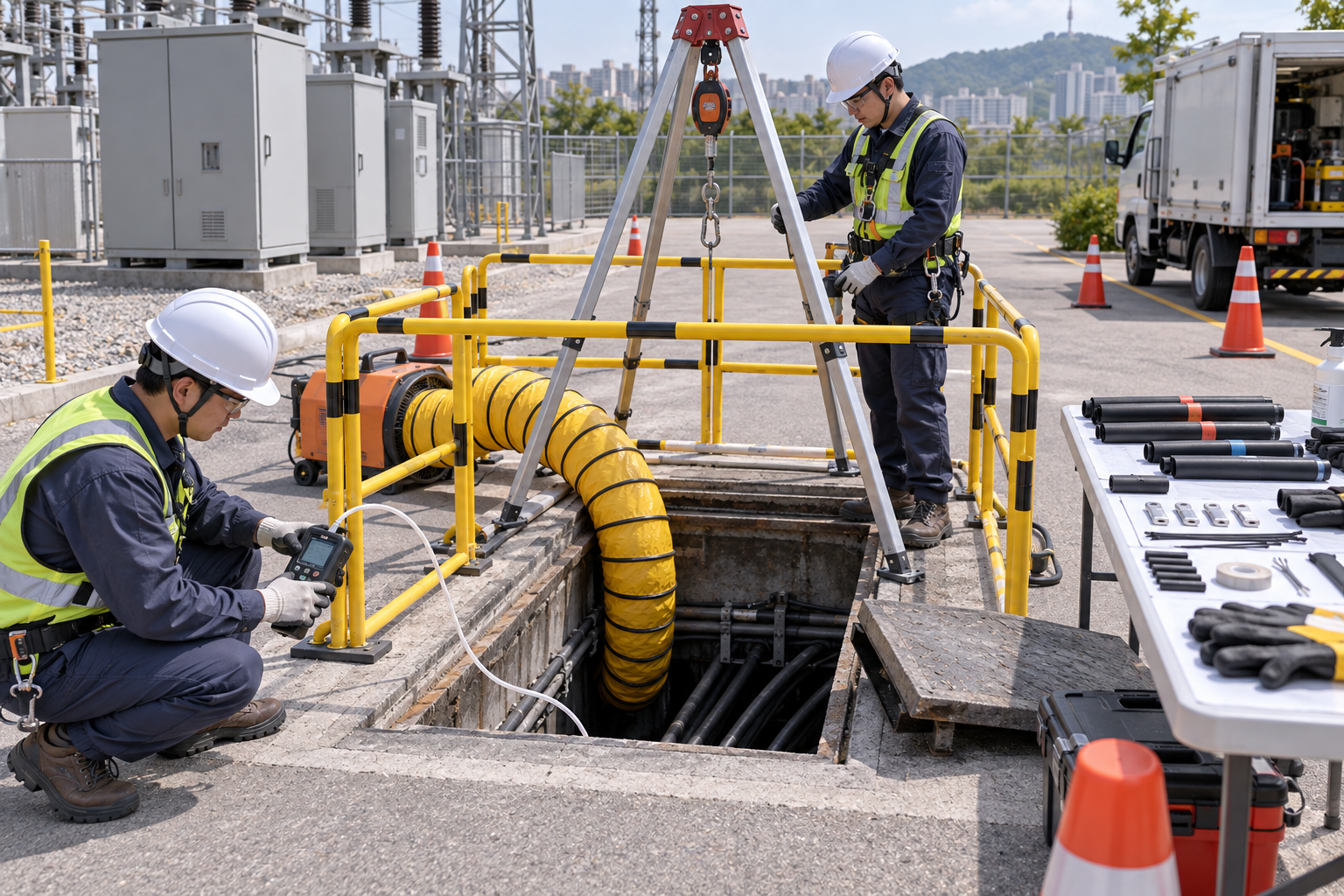
The retained illustration is an AI-generated educational image from the Korean source. It is not an actual incident photograph, approved drawing, equipment certification or proof that the depicted arrangement is safe.
Atmospheric readings apply to the sampled substances, locations and times and the instrument capabilities. A standard multigas detector cannot prove absence of substances it cannot detect. Test oxygen, combustibles and toxics in the applicable order and maintain the required monitoring.
A blower can run while its duct is displaced or its intake draws exhaust. Reentry after ventilation failure needs cause correction, renewed evaluation and the applicable permit decision; do not copy the old readings.
Air acceptance does not identify a cable or prove the absence of electrical energy. Qualified electrical personnel must address all sources, backfeed, induced voltage and stored charge using the applicable procedure.
Splice dimensions and tests are specific to the cable, kit and design. Test voltage creates its own boundary; post-test discharge/verification and authorized restoration are distinct from completing the splice.
Hypothetical decision example
Hypothetical example: pre-entry air checks were acceptable, then the blower stops during splicing. The crew proposes continuing because the first readings passed. Entrants leave, the attendant accounts for them, and reentry awaits corrected ventilation, current evaluation and renewed entry/electrical checks.
The example is fictional; no incident, measurement, inspection or approval is asserted.
Task flow: Plan space and circuit → Protect opening and access → Authorize and monitor entry → Identify and isolate cable → Prepare and splice → Test and make safe → Exit on changed conditions → Restore and hand over
5. Hold and proceed decisions
| Condition | Action | Evidence | Proceed when |
|---|---|---|---|
| Ventilation/air alarm | Exit and account for entrants | Cause, fresh readings and permit review | Reentry authorized |
| Circuit identity unclear | Hold cutting/splicing | Both-end identity and isolation evidence | Electrical state verified |
| Kit or dimensions unclear | Hold assembly | Cable/kit instructions and inspection | Assembly defined |
| Test completed | Keep boundary until safe | Discharge, verification and headcount | Restoration authorized |
Similar observation, different conclusion
| Observation | Supported conclusion | What remains unresolved |
|---|---|---|
| Air reading acceptable | Sampled atmosphere met criteria then | Cable energy remains separate |
| Blower restarted | Power to blower restored | Effective airflow and reentry unproved |
6. Roles and supervision
| Role | Responsibility |
|---|---|
| Work supervisor | Coordinate plan space and circuit, affected operations, stop signals and stage transitions. |
| Technical/equipment reviewer | Verify Manhole/hazard IDs, Weather/water assessment, actual instructions and unresolved technical limits. |
| Task crew | Apply the stated controls, report changes and keep actual checks and signatures factual. |
| Inspector/test lead | Connect Test scope/results, Post-test safe state to the required acceptance criteria. |
| Receiving authority | Accept the recorded restrictions, Cover/barrier restoration, Kit/records/receiver, and follow-up ownership. |
These are responsibility examples, not invented statutory credentials. Verify actual competence, training and authority for the assigned work.
Supervision and handover controls
| Stage | Management controls | Evidence |
|---|---|---|
| Plan review | 1. Assign technical owner2. Close task-specific questions3. Identify space hazards | 1. Manhole/hazard IDs2. Weather/water assessment3. Attendant/rescue readiness |
| Competence | 1. Verify required competence2. Assign stop authority3. Guard opening | 1. Cover/barrier state2. Training and task briefing3. Ladder/escape path |
| Prestart evidence | 1. Inspect actual equipment2. Link evidence to this stage3. Verify circuit by procedure | 1. Cable/both-end evidence2. Lockout and test record3. Cable support/protection |
| Change control | 1. Stop and secure the area2. Review affected controls3. Stop and exit | 1. Alarm/time/headcount2. Rescue notification3. Isolation/charge state |
| Shift handover | 1. Identify remaining restrictions2. Confirm receiving responsibility3. Reconcile entrants/tools | 1. Entry/exit reconciliation2. Test holds/authority3. Kit/records/receiver |
| Closeout | 1. Record defect disposition2. Archive factual evidence3. Reconcile entrants/tools | 1. Entry/exit reconciliation2. Test holds/authority3. Kit/records/receiver |
7. Hold points and record quality
| Hold point | Evidence before release | Actual record |
|---|---|---|
| HP-0 Start | Plan permitted manhole entry, atmospheric monitoring and attendance; identify and isolate a premises-wiring circuit; splice with a matched kit; perform specified tests and controlled exit/restoration. | |
| HP-1 Protect opening and access | Cover/barrier state; Traffic boundary; Intake/duct route; Ladder/escape path | |
| HP-2 Identify and isolate cable | Cable/both-end evidence; Lockout and test record; Charge/induction controls; Cable support/protection | |
| HP-3 Exit on changed conditions | Alarm/time/headcount; Rescue notification; Fresh evaluation/permit; Isolation/charge state | |
| HP-4 Restore and hand over | Entry/exit reconciliation; Test holds/authority; Cover/barrier restoration; Kit/records/receiver |
Hold points are internal evidence gates. They do not establish that a statutory permit exists or has been approved. Recheck affected gates after changes, faults and shift handover.
Record comparison - hypothetical templates
The 16 boxes below identify record elements, not completed checks or approvals. They are static symbols. Link equipment/location, date, actual findings and the separate record reference; preserve unresolved items.
| Record | Insufficient entry | Required record elements |
|---|---|---|
| Plan space and circuit | "Checked" without supporting facts | □ Manhole/hazard IDs□ Weather/water assessment□ Circuit/isolation plan□ Attendant/rescue readiness |
| Authorize and monitor entry | "Checked" without supporting facts | □ Instrument/locations/time□ Actual air/flow record□ Entrant/contact roster□ Permit and rescue state |
| Prepare and splice | "Checked" without supporting facts | □ Cable/kit identity□ Dimensions/insulation check□ Clean/dry conditions□ Heat/air/permit controls |
| Exit on changed conditions | "Checked" without supporting facts | □ Alarm/time/headcount□ Rescue notification□ Fresh evaluation/permit□ Isolation/charge state |
8. Pre-work checks and emergency response
| Check required | Result | Checker/action |
|---|---|---|
| Plan space and circuit: Manhole/hazard IDs | ||
| Protect opening and access: Cover/barrier state | ||
| Authorize and monitor entry: Instrument/locations/time | ||
| Identify and isolate cable: Cable/both-end evidence | ||
| Prepare and splice: Cable/kit identity | ||
| Test and make safe: Test scope/results | ||
| Exit on changed conditions: Alarm/time/headcount | ||
| Restore and hand over: Entry/exit reconciliation |
Stop work
Stop and exit for a gas alarm, loss of ventilation or communication, rising water or any prohibited entry condition. Hold cable cutting, splicing and testing for uncertain identity, isolation, charge control or kit suitability.
Emergency response
Entrants must leave on alarms, ventilation/communication loss or prohibited conditions. The attendant calls the planned rescue service, accounts for entrants and calls 911 as required; do not enter unprotected or rely on a dust mask for rescue. Keep the opening and traffic boundary controlled. Tell responders about the manhole, atmosphere, water, circuit and test-energy state. Only appropriately trained and equipped rescuers may perform an entry rescue under the plan.
9. Official sources and review limits
Official public-source check: October 13, 2026. The review concerns the selected passages described below, not endorsement of this article.
| Official source | Checked scope and limit |
|---|---|
| OSHA 29 CFR 1910.146 | Selected permit-space program, atmospheric testing/monitoring, attendant, exit and rescue requirements. Ventilation-only alternative conditions are not assumed. |
| OSHA 29 CFR 1910.333 | Selected deenergization/lockout-tagging and qualified-person verification, including induced voltage and backfeed. Testing and reenergization require their applicable controls. |
| OSHA State Plans | Federal baseline and State Plan coverage reviewed. Confirm the applicable state program and employer coverage; this edition does not establish nationwide compliance. |
Selected public official provisions were checked on October 13, 2026. This is not a complete legal audit. No actual equipment manual, site measurements, engineering calculations, product certification or professional technical approval was supplied. Full paid NFPA/ANSI standards and state/local amendments were not reviewed. Check actual equipment, jurisdiction and project requirements before use.
This is reference content written and revised with AI. It has not been verified or approved by a professional. Review by a suitably qualified professional and required site authorization are necessary before use.
10. PDF use and frequently asked questions
PDF A summarizes core controls; B emphasizes technical failures; C covers supervision, records and handover. Each uses six stages from or aligned with the eight-stage body. All actual risk, measurement, check and signature fields are blank. Use a separate linked record where more space is needed.
Does opening the cover make entry safe?
No. Evaluate the space and apply the required entry, atmospheric, attendant and rescue controls.
Can workers reenter as soon as the blower restarts?
Reevaluate current conditions, correct the cause and obtain the applicable entry authorization; verify electrical controls separately.
Does a gas test allow cable cutting?
No. Confirm cable identity and the safe electrical state through the required qualified-person procedure.
Should the attendant enter to rescue a collapsed worker?
Do not make an unprotected entry. Activate the planned rescue service and use trained, equipped response under the rescue plan.
Has a professional approved this JSA?
This is reference content written and revised with AI. It has not been verified or approved by a professional. Review by a suitably qualified professional and required site authorization are necessary before use.
11. Authorship and revision history
This is reference content written and revised with AI. It has not been verified or approved by a professional. Review by a suitably qualified professional and required site authorization are necessary before use.
| Date/version | Editorial history | Technical approval |
|---|---|---|
| September 20, 2026 / Korean v1.0 | Korean source: initial article, evidence, hypothetical decisions and body/PDF editorial checks. | Professional technical approval not performed |
| September 23, 2026 / Korean v1.1 | Korean source: revised task decisions, record checklists, JSA and three PDFs; editorial/source and layout checks. | Professional technical approval not performed |
| October 13, 2026 / US v1.0 | US localization: Preserves ventilation-loss case, independent atmospheric/electrical checks, sensor limits, kit-specific assembly and post-test charge control. Selects non-utility maintenance scope and separates US utility and construction applicability. | Not performed |
Source topic: https://smartjsabridge.com/ko/case-study/jsa-manhole-cablesplice
Content group: jsa-manhole-cablesplice