A raised loaded bucket changes the center of gravity. Articulation, steering acceleration and uneven ground add to the effect; a stationary capacity does not establish safe travel through a turn. Restore the specified travel position before moving.
This is reference content written and revised with AI. It has not been verified or approved by a professional. Review by a suitably qualified professional and site authorization are required before use.
Stop before starting
Stop for stockpile cracks/falling material, uncertain coupler locking, brake defects, unstable ground or anyone entering the loading envelope. Reassess a changed truck position before travel or dumping.
1. Legal and technical scope
| Basis | Scope and limits |
|---|---|
| OSHA 1926.602 | Construction loader classification, roadways, brakes, operator safeguards and reverse warning/signaling within scope. |
This edition assumes construction earthmoving under 1926.602, including safe roadways, braking, applicable operator protection and reverse movement with an obstructed rear view. The rule permits the specified audible reverse alarm or an employee signaling that reversing is safe; a camera alone is not that provision. Mining/quarry operations may have different jurisdiction, and general-industry yards need separate review. Check State Plan and actual loader/truck instructions.
2. Scope and required inputs
Included work
Scooping aggregate from a stable stockpile and loading a truck bed within an arranged loading area, including loader inspection, short travel, controlled dumping and release of the truck.
Separate assessment
Rock breaking, suspended-load lifting, carrying people, unstable-face removal and repairs under unsupported raised equipment require separate plans.
| Required input | Evidence to obtain |
|---|---|
| Plan stockpile and load | Face stability; Ground and drainage; Truck loading limits; Approach plan |
| Control trucks and people | Loading zone clear; Truck position; Driver location; Signal arrangement |
| Inspect loader and bucket | Coupler check; Brakes and alarms; Tires and articulation; Hydraulic condition |
| Approach and scoop | Face changes; Material and load; Approach direction; People excluded |
No actual equipment model, SDS, site measurements, design calculations or authorization record was supplied. Product-specific limits and methods must be verified before use. Federal OSHA is a baseline within its scope; determine the applicable State Plan and local requirements. Manufacturer guidance is not government approval; an incorporated standard differs from voluntary guidance. No nationwide-compliance or expert-approval claim is made.
3. Eight-stage JSA
| Job stage | Hazards and effects | Failure factors | Technical and procedural controls | Site verification | P | S | R | A |
|---|---|---|---|---|---|---|---|---|
| 1. Plan stockpile and load | 1. Face collapse2. Machine overturn3. Overhang fall4. Ground settlement | 1. Material unknown2. Yard too weak3. Undercut missed4. Drainage changed | 1. Inspect face and material2. Check bearing and room3. Identify overhangs4. Set loading arrangement | 1. Face stability2. Ground and drainage3. Truck loading limits4. Approach plan | ||||
| 2. Control trucks and people | 1. Vehicle collision2. Blind-zone crush3. Driver struck4. Departure collision | 1. Waiting area unclear2. Signals mixed3. Driver location unknown4. Truck leaves early | 1. Separate traffic stages2. Use agreed signals3. Define driver safe location4. Control departure | 1. Loading zone clear2. Truck position3. Driver location4. Signal arrangement | ||||
| 3. Inspect loader and bucket | 1. Brake failure2. Bucket release3. Tire failure4. Hydraulic leakage | 1. Coupler uncertain2. Lock display misread3. Tire damaged4. Hose worn | 1. Verify actual attachment lock2. Check brakes and warnings3. Inspect tires and joints4. Hold equipment defects | 1. Coupler check2. Brakes and alarms3. Tires and articulation4. Hydraulic condition | ||||
| 4. Approach and scoop | 1. Material burial2. Forward tip3. Flying rock4. Face collapse | 1. Undercut increased2. Bucket overloaded3. Hard impact4. Cracks ignored | 1. Scoop stable face2. Match load to conditions3. Avoid forced impact4. Stop changed face | 1. Face changes2. Material and load3. Approach direction4. People excluded | ||||
| 5. Travel and approach truck | 1. Raised-load overturn2. Truck strike3. Wheel lift4. Blind-zone collision | 1. High bucket turn2. Radius too tight3. Rough ground4. View blocked | 1. Use specified travel position2. Control speed and turn3. Use accepted route4. Keep people separated | 1. Bucket and articulation2. Ground condition3. Visibility4. Truck clearance | ||||
| 6. Dump and distribute | 1. Cab strike2. Truck overturn3. Falling aggregate4. Overloading | 1. Bucket crosses cab2. Load one-sided3. Person enters zone4. Mass guessed | 1. Dump over bed only2. Distribute accepted load3. Keep exclusion effective4. Verify truck limits | 1. Cab clearance2. Load amount3. Distribution4. Dump position | ||||
| 7. Hold and maintain | 1. Bucket descent crush2. Articulation crush3. Hydraulic release4. Unexpected start | 1. Raised bucket unsupported2. Lock not applied3. Pressure retained4. Engine stop only | 1. Use prescribed support2. Control articulation3. Follow energy procedure4. Use qualified maintenance | 1. Bucket and chassis support2. Articulation lock3. Pressure control4. Maintenance release | ||||
| 8. Depart park hand over | 1. Traffic collision2. Road spillage3. Rollaway4. Defect reused | 1. No departure signal2. Load insecure3. Parking incomplete4. Fault not logged | 1. Check load and route2. Authorize departure3. Park per instructions4. Transfer faults and cleanup | 1. Load and route2. Departure signal3. Parked safe state4. Defects and recipient |
P = likelihood; S = severity; R = risk under the site method; A = site-defined acceptance/authorization. These actual assessment cells are blank. A low score never overrides a missing safeguard or a legal or manufacturer restriction.
4. Fictional scenario and failure mechanisms
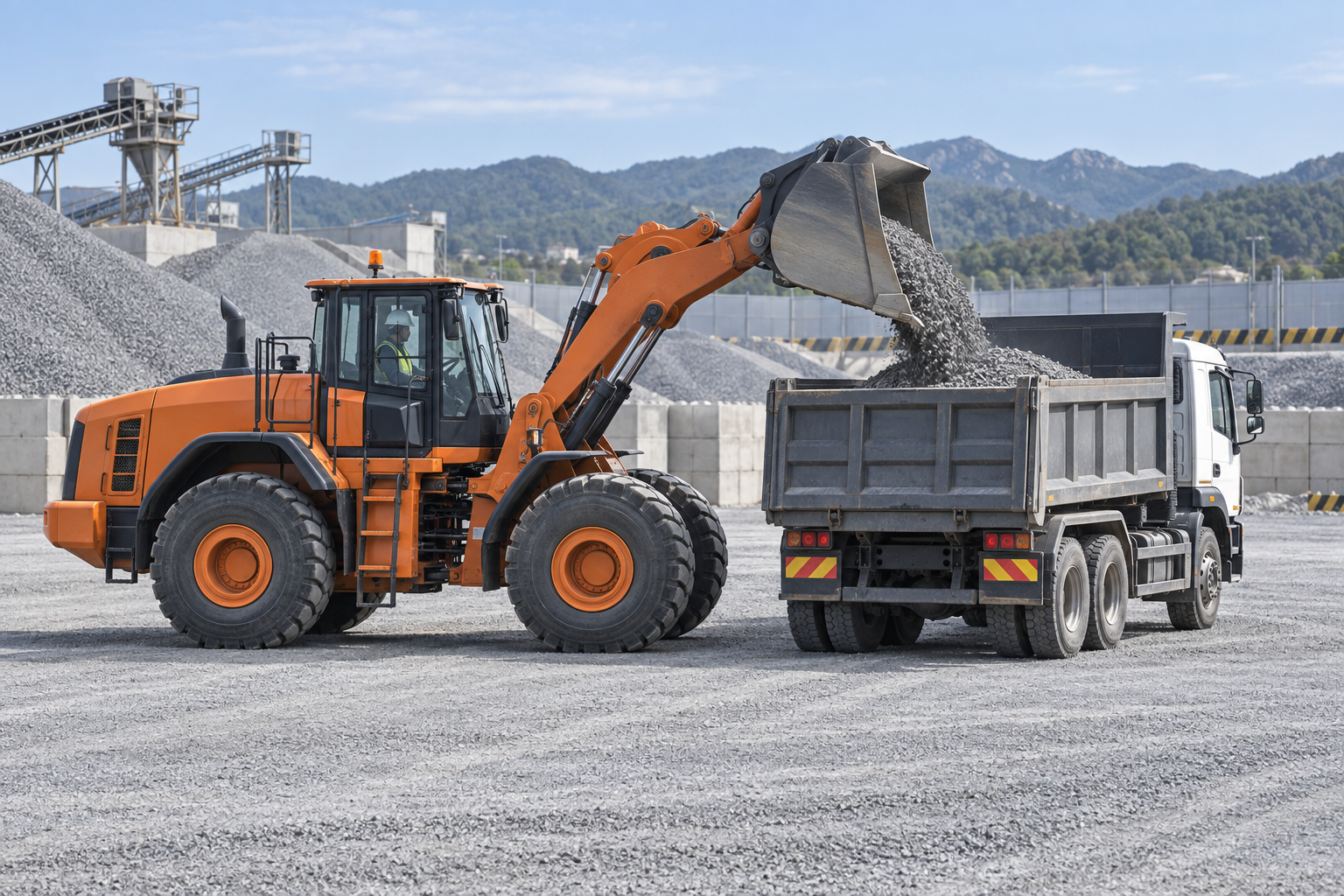
This illustration provides educational context. It is not an actual incident photograph or evidence of equipment suitability; any AI-generated depiction is illustrative only.
The scenario and record comparisons are fictional teaching examples, not records of real incidents, measurements, inspections, signatures or approvals.
| Stage | Fictional situation |
|---|---|
| Initial situation | A fictional loader operator repeats an aggregate loading cycle. |
| Changed condition | The truck moves to a different position and the operator intends to turn sharply with a raised bucket. |
| Failure path | Stability from the previous cycle is assumed to apply to the changed articulation and load height. |
| Possible outcome | The loader may lean or aggregate may fall toward the truck cab. |
| Prevention barrier | Stop, restore vehicle placement and the specified travel posture, and re-establish a clear dump path before continuing. |
Failure mechanisms
A raised loaded bucket changes the center of gravity. Articulation, steering acceleration and uneven ground add to the effect; a stationary capacity does not establish safe travel through a turn. Restore the specified travel position before moving.
Undercutting the stockpile can leave an overhang. Cracks or falling material mean exclusion and face reassessment, not one more scoop. Bucket volume alone cannot establish load mass because material density and moisture vary.
Bucket attachment locking, truck placement and dump path must be checked together. Keep the bucket and falling aggregate away from the cab and people. Maintenance must control bucket gravity, articulation and stored hydraulic energy by the actual procedure.
Work sequence: Plan stockpile and load → Control trucks and people → Inspect loader and bucket → Approach and scoop → Travel and approach truck → Dump and distribute → Hold and maintain → Depart park hand over. This is a teaching flow, not a device drawing or a complete operating procedure.
5. Conditional decisions and common errors
| Situation | Required action | Evidence | Proceed when |
|---|---|---|---|
| Stockpile cracks | Stop approach | Face and ground review | Stable face accepted |
| Coupler lock uncertain | Hold operation | Actual lock and prescribed check | Attachment secured |
| Truck position changes | Replan approach | Visibility, cab and dump path | Layout restored |
| Blockage or repair | Secure and isolate | Bucket support and articulation control | Safe maintenance state |
Similar observations, different decisions
The scenario and record comparisons are fictional teaching examples, not records of real incidents, measurements, inspections, signatures or approvals.
| Observation | Insufficient conclusion | Required distinction |
|---|---|---|
| Bucket looks half full | Volume estimate | Mass and stability remain uncertain |
| Alarm sounds | Warning operates | People still need separation |
| Bucket holds still | No current movement | Hydraulics are not a safe prop |
6. Roles and responsibilities
| Role | Responsibility |
|---|---|
| Work supervisor | Confirm face stability and the task scope, resources, interfaces and stop authority. |
| Qualified technical reviewer | Review loading zone clear, model limits, compatibility and unresolved technical conditions within assigned competence. |
| Work crew | Apply the listed controls, report changes and stop when evidence or safeguards are missing. |
| Inspector / assessor | Record actual bucket and articulation and other relevant checks; do not mark unverified conditions as accepted. |
| Handover authority | Reconcile load and route, restrictions and outstanding actions before the next task. Role labels do not establish a legal credential. |
Supervision and handover focus
| Stage | Management action | Evidence |
|---|---|---|
| Plan stockpile and load | 1. Record face stability2. Record ground and drainage3. Record truck loading limits | 1. Face stability2. Ground and drainage3. Truck loading limits |
| Control trucks and people | 1. Record loading zone clear2. Record truck position3. Record driver location | 1. Loading zone clear2. Truck position3. Driver location |
| Approach and scoop | 1. Record face changes2. Record material and load3. Record approach direction | 1. Face changes2. Material and load3. Approach direction |
| Travel and approach truck | 1. Record bucket and articulation2. Record ground condition3. Record visibility | 1. Bucket and articulation2. Ground condition3. Visibility |
| Hold and maintain | 1. Record bucket and chassis support2. Record articulation lock3. Record pressure control | 1. Bucket and chassis support2. Articulation lock3. Pressure control |
| Depart park hand over | 1. Record load and route2. Record departure signal3. Record parked safe state | 1. Load and route2. Departure signal3. Parked safe state |
7. Hold points and record comparison
| Hold point | Evidence before release | Actual approval |
|---|---|---|
| HP-0 Scope | Scooping aggregate from a stable stockpile and loading a truck bed within an arranged loading area, including loader inspection, short travel, controlled dumping and release of the truck. | |
| HP-1 Control trucks and people | Loading zone clear; Truck position; Driver location; Signal arrangement | |
| HP-2 Approach and scoop | Face changes; Material and load; Approach direction; People excluded | |
| HP-3 Hold and maintain | Bucket and chassis support; Articulation lock; Pressure control; Maintenance release | |
| HP-4 Depart park hand over | Load and route; Departure signal; Parked safe state; Defects and recipient |
Hold points are internal project checks. They are not universal statutory permits and do not grant work permission. Reassess after defects, changed conditions and shift changes.
Record comparison
The scenario and record comparisons are fictional teaching examples, not records of real incidents, measurements, inspections, signatures or approvals.
The boxes are static record prompts, not interactive or saved approvals. A tick does not establish suitability or permission to restart. Record the evidence, person, time and unresolved issues; retain the change history.
| Record | Insufficient record | Record checklist |
|---|---|---|
| Plan stockpile and load | Only marked “OK” | □ Face stability□ Ground and drainage□ Truck loading limits□ Approach plan |
| Approach and scoop | Only marked “OK” | □ Face changes□ Material and load□ Approach direction□ People excluded |
| Hold and maintain | Only marked “OK” | □ Bucket and chassis support□ Articulation lock□ Pressure control□ Maintenance release |
| Depart park hand over | Only marked “OK” | □ Load and route□ Departure signal□ Parked safe state□ Defects and recipient |
8. Site checklist and emergency response
| Site check | Actual result | Person / action |
|---|---|---|
| Plan stockpile and load: Face stability; Ground and drainage; Truck loading limits; Approach plan | ||
| Control trucks and people: Loading zone clear; Truck position; Driver location; Signal arrangement | ||
| Inspect loader and bucket: Coupler check; Brakes and alarms; Tires and articulation; Hydraulic condition | ||
| Approach and scoop: Face changes; Material and load; Approach direction; People excluded | ||
| Travel and approach truck: Bucket and articulation; Ground condition; Visibility; Truck clearance | ||
| Dump and distribute: Cab clearance; Load amount; Distribution; Dump position | ||
| Hold and maintain: Bucket and chassis support; Articulation lock; Pressure control; Maintenance release | ||
| Depart park hand over: Load and route; Departure signal; Parked safe state; Defects and recipient |
Stop work
Stop for stockpile cracks/falling material, uncertain coupler locking, brake defects, unstable ground or anyone entering the loading envelope. Reassess a changed truck position before travel or dumping.
Emergency response
Stop safely, clear the machine/stockpile danger zone and summon site emergency response. Do not approach a failing face or enter articulation/raised-bucket areas for improvised rescue. Qualified personnel establish support and isolation before recovery.
9. Sources and review limits
Public-source access/review: 2026-10-13.
| Official source | Reviewed scope and limits |
|---|---|
| OSHA 1926.602 | Construction loader classification, roadways, brakes, operator safeguards and reverse warning/signaling within scope. |
No actual equipment model, SDS, site measurements, design calculations or authorization record was supplied. Product-specific limits and methods must be verified before use. Federal OSHA is a baseline within its scope; determine the applicable State Plan and local requirements. Manufacturer guidance is not government approval; an incorporated standard differs from voluntary guidance. No nationwide-compliance or expert-approval claim is made.
10. PDF guidance and FAQ
PDF A covers basic task controls; B focuses on technical failures; C covers supervision, records and handover. The article has eight stages with four items per main cell; each PDF has six key stages with three items per main cell. P/S/R/A, measurements, confirmations and signatures remain blank for actual site assessment.
PDFs are complementary six-stage extracts. Apply all eight body stages and the actual equipment/site procedure.
Can the bucket pass over the cab?
Arrange the loading path to keep the bucket and falling aggregate clear of the cab and people.
Does a rear camera replace reverse requirements?
Do not assume so. Apply the applicable alarm/signaling requirement and maintain effective separation.
Can a worker clear material under a raised bucket?
Only after a separately accepted maintenance method establishes the prescribed support and energy control.
Has a professional verified or approved this document?
No. Public sources and editorial, layout and consistency checks were reviewed using AI. No site inspection or professional technical approval has been performed. Obtain appropriate professional review before use.
11. Revision history and authorship
This is reference content written and revised with AI. It has not been verified or approved by a professional. Review by a suitably qualified professional and site authorization are required before use.
| Date | Version | Change | Review status |
|---|---|---|---|
| 2026-10-13 | US 1.0 | New US edition from assigned Korean source; task decisions, records and PDFs localized. | AI editorial review; no professional technical approval |
Korean edition revision history: 2026-09-19 (v1.0): earlier published draft/version retained in the source history; 2026-10-02 (v1.1): task decisions, record checklist, JSA and three PDF variants revised. These are editorial records, not professional technical approval. US v1.0 adapts the earlier edition to United States requirements and terminology.
Site reviewers must add their actual qualifications, scope, date and approval only after the review occurs.