A lightning conductor is part of a complete designed system. Maintain its route, supports and relationship to surrounding metal while controlling rooftop access, dropped objects and weather exposure.
This is reference content written and revised with AI. It has not been verified or approved by a professional. Review by a suitably qualified professional and required site authorization are necessary before use.
Stop conditions first
Hold for missing design details, uncertain roof support, absent independent fall protection, incompatible materials or a route conflict. Stop and seek designated shelter when thunderstorms threaten; do not finish a connection before retreating.
1. US legal and technical basis
Construction installation on a building: apply the relevant OSHA 1926 access and fall-protection provisions. Lightning-system design follows the project and adopted code requirements. UL 96A and NFPA 780 are installation standards with a distinct role; no full paid standard or local adoption review is asserted.
| Reference | Use and limit |
|---|---|
| OSHA 29 CFR 1926.501 | Construction fall-protection duties for applicable walking/working surfaces, holes and edges; scaffolds/lifts also require their own applicable provisions. |
| UL Lightning Protection Application Guide | Public explanation of complete-system design/installation and UL 96A/NFPA 780 roles. No full standard, adopted edition, separation calculation or certification verified. |
| NOAA Lightning Safety on the Job | Outdoor work warning, timely stop/shelter and lightning-victim emergency guidance; does not approve any roof or lightning installation. |
| OSHA State Plans | Federal baseline and State Plan coverage reviewed. Confirm the applicable state program and employer coverage; this edition does not establish nationwide compliance. |
Determine whether Federal OSHA or an applicable State Plan governs the employer and work. Standards incorporated into a regulation must be read in their legally applicable edition. Other NFPA/ANSI guidance and manufacturer instructions have distinct roles; they are not automatically federal law.
2. Scope and required inputs
Included
Install specified air terminals, downconductors, supports and connections along reviewed routes, then perform the designated inspection and tests.
Separate assessment
Designing protection zones, approving unreviewed routing/bonding changes, using the lightning system as a fall anchor and work during threatening thunderstorms are excluded. Maintenance work needs its applicable 1910 assessment.
| Input | Evidence needed |
|---|---|
| Review system route | Drawing/revision; Route and metal interfaces; Bonding/separation detail; Test/acceptance plan |
| Check materials and base | Base/anchor detail; Material compatibility; Support layout; Weather work plan |
| Set air terminals | Temporary stability; Position/alignment; Fastening evidence; Area below |
| Close and transfer | As-built/photos; Roof and debris check; Restored links/holds; Inspection scope/receiver |
Selected public official provisions were checked on October 13, 2026. This is not a complete legal audit. No actual equipment manual, site measurements, engineering calculations, product certification or professional technical approval was supplied. Full paid NFPA/ANSI standards and state/local amendments were not reviewed. Check actual equipment, jurisdiction and project requirements before use.
Select task-appropriate eye, hand, foot, skin and hearing protection from the exposure assessment. Where respiratory protection is necessary, use the applicable respiratory-protection program; PPE does not replace isolation, guarding, support or ventilation.
3. Eight-stage JSA
| Job stage | Hazards and effects | Failure factors | Controls | Site verification | P | S | R | A |
|---|---|---|---|---|---|---|---|---|
| 1. Review system route | 1. Ineffective protection2. Unwanted flashover3. Wrong current path4. Unplanned change | 1. Route drawing missing2. Nearby metal ignored3. Bonding undefined4. Test scope unclear | 1. Match reviewed drawings2. Identify nearby services3. Confirm bonding/separation design4. Define inspection limits | 1. Drawing/revision2. Route and metal interfaces3. Bonding/separation detail4. Test/acceptance plan | ||||
| 2. Check materials and base | 1. Terminal overturns2. Anchor pulls out3. Galvanic damage4. Conductor falls | 1. Substrate unknown2. Anchor detail wrong3. Metals incompatible4. Support spacing guessed | 1. Verify substrate/detail2. Use specified anchors3. Match compatible materials4. Plan weight support | 1. Base/anchor detail2. Material compatibility3. Support layout4. Weather work plan | ||||
| 3. Establish safe access | 1. Roof fall2. Fragile-surface collapse3. Dropped object strike4. Blocked retreat | 1. Edge protection absent2. Roof strength unknown3. Lower zone open4. Shelter inaccessible | 1. Use planned fall protection2. Verify roof/access support3. Exclude area below4. Keep shelter route clear | 1. Access and roof condition2. Independent fall system3. Drop zone4. Weather/retreat readiness | ||||
| 4. Set air terminals | 1. Falling terminal2. Hand crush3. Dropped fastener4. Incomplete anchorage | 1. Temporary support weak2. Hands in pinch point3. Loose tools above people4. Fixing sequence changed | 1. Support before release2. Control positioning3. Secure tools/materials4. Follow fastening detail | 1. Temporary stability2. Position/alignment3. Fastening evidence4. Area below | ||||
| 5. Route downconductors | 1. Conductor falls2. Connection overloaded3. Changed flashover path4. Corrosion | 1. Weight hung on joint2. Sharp detour improvised3. Duct clearance reduced4. Dissimilar metals mixed | 1. Use specified supports2. Follow reviewed route3. Hold obstructions for review4. Use designed connections | 1. Route/dimensions2. Support/weight transfer3. Adjacent metal relationship4. Material/connection detail | ||||
| 6. Connect and inspect | 1. Incomplete bonding2. Misleading test pass3. Test link left open4. Wrong completion claim | 1. Connection hidden early2. Continuity scope overstated3. Restoration omitted4. Design changes unreviewed | 1. Inspect designated joints2. Record test points/method3. Restore test links4. Check route/bonding scope | 1. Connection inspection2. Test values and limits3. Link restoration4. Outstanding design issues | ||||
| 7. Hold change or weather | 1. Lightning exposure2. Unstable temporary work3. Unreviewed detour4. Premature restart | 1. Thunder ignored2. Loose section abandoned3. Extra bond improvised4. Old release reused | 1. Stop and seek shelter2. Secure only when safe3. Review changed design4. Recheck affected work gates | 1. Weather/retreat facts2. Temporary stability3. Change review evidence4. Restart conditions | ||||
| 8. Close and transfer | 1. Hidden incomplete joint2. Falling leftovers3. Unverified section used4. Missing maintenance record | 1. As-built absent2. Tools left on roof3. Hold omitted4. Test scope lost | 1. Record actual route2. Clear loose materials3. Transfer excluded sections4. Link inspection and limits | 1. As-built/photos2. Roof and debris check3. Restored links/holds4. Inspection scope/receiver |
Actual risk assessments, measurements, checks, approvals and signatures have not been performed. Keep unverified fields blank and link the actual site records. P/S/R/A mean likelihood, severity, site-method risk and site-defined acceptance/authorization; a score cannot waive a required control.
4. Failure mechanisms and hypothetical case
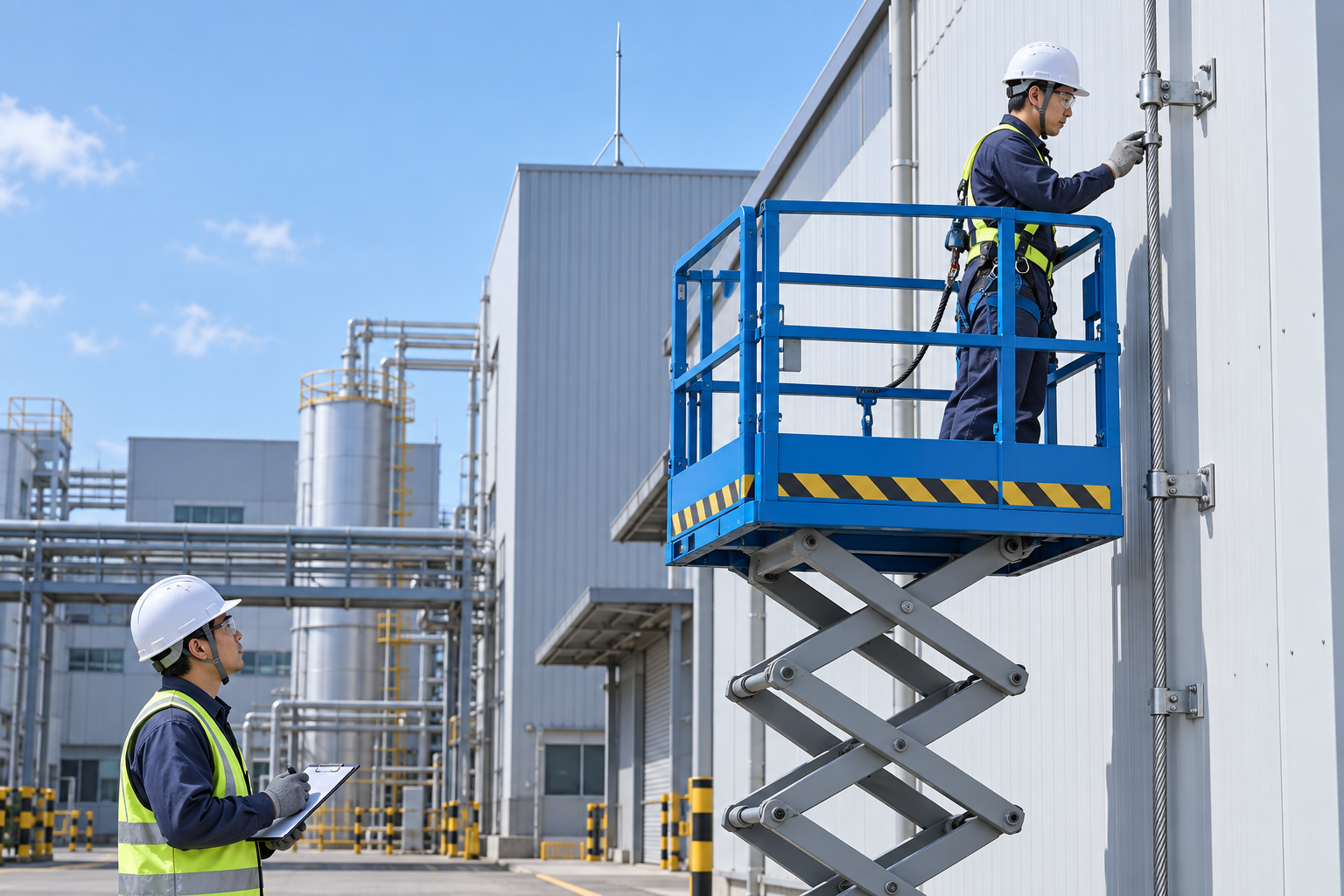
The retained illustration is an AI-generated educational image from the Korean source. It is not an actual incident photograph, approved drawing, equipment certification or proof that the depicted arrangement is safe.
A continuity result concerns connection between the selected test points. It does not establish protection coverage or the adequacy of changed separation, bonding and current paths.
Moving a downconductor around a duct changes geometry and nearby metal relationships. Have the design owner review the actual route; neither arbitrary extra bonding nor a convenient detour proves suitability.
Temporary support of an air terminal and permanent anchorage serve different stages. Support conductor weight by the specified details instead of loading connections unintentionally. The lightning system is not an assumed personal fall-protection anchor.
Weather plans need warning responsibility, a timely retreat route and a suitable shelter. A newly installed lightning rod does not make an exposed roof safe during a thunderstorm.
Hypothetical decision example
Hypothetical example: a metal duct blocks the planned downconductor route. The crew moves the conductor close to the duct and proposes accepting it because continuity passes. The changed section is held for review of dimensions, support, separation and designed bonding before completion.
The example is fictional; no incident, measurement, inspection or approval is asserted.
Task flow: Review system route → Check materials and base → Establish safe access → Set air terminals → Route downconductors → Connect and inspect → Hold change or weather → Close and transfer
5. Hold and proceed decisions
| Condition | Action | Evidence | Proceed when |
|---|---|---|---|
| Duct blocks route | Hold changed section | Before/after route and design review | Route accepted |
| Roof/anchor uncertain | Stop access | Structural and fall-system assessment | Access protected |
| Thunderstorm threatens | Stop and seek shelter | Weather and retreat plan | Site restart criteria met |
| Continuity passes | Complete remaining inspections | Route/bonding/support evidence | Scope accepted |
Similar observation, different conclusion
| Observation | Supported conclusion | What remains unresolved |
|---|---|---|
| Continuity confirmed | Selected points are connected | Whole-system protection unproved |
| Air terminal installed | A component is present | Roof work and fall anchorage remain separate |
6. Roles and supervision
| Role | Responsibility |
|---|---|
| Work supervisor | Coordinate review system route, affected operations, stop signals and stage transitions. |
| Technical/equipment reviewer | Verify Drawing/revision, Route and metal interfaces, actual instructions and unresolved technical limits. |
| Task crew | Apply the stated controls, report changes and keep actual checks and signatures factual. |
| Inspector/test lead | Connect Connection inspection, Test values and limits to the required acceptance criteria. |
| Receiving authority | Accept the recorded restrictions, Restored links/holds, Inspection scope/receiver, and follow-up ownership. |
These are responsibility examples, not invented statutory credentials. Verify actual competence, training and authority for the assigned work.
Supervision and handover controls
| Stage | Management controls | Evidence |
|---|---|---|
| Plan review | 1. Assign technical owner2. Close task-specific questions3. Match reviewed drawings | 1. Drawing/revision2. Route and metal interfaces3. Test/acceptance plan |
| Competence | 1. Verify required competence2. Assign stop authority3. Verify substrate/detail | 1. Base/anchor detail2. Training and task briefing3. Weather work plan |
| Prestart evidence | 1. Inspect actual equipment2. Link evidence to this stage3. Support before release | 1. Temporary stability2. Position/alignment3. Area below |
| Change control | 1. Stop and secure the area2. Review affected controls3. Stop and seek shelter | 1. Weather/retreat facts2. Temporary stability3. Restart conditions |
| Shift handover | 1. Identify remaining restrictions2. Confirm receiving responsibility3. Record actual route | 1. As-built/photos2. Roof and debris check3. Inspection scope/receiver |
| Closeout | 1. Record defect disposition2. Archive factual evidence3. Record actual route | 1. As-built/photos2. Roof and debris check3. Inspection scope/receiver |
7. Hold points and record quality
| Hold point | Evidence before release | Actual record |
|---|---|---|
| HP-0 Start | Install specified air terminals, downconductors, supports and connections along reviewed routes, then perform the designated inspection and tests. | |
| HP-1 Check materials and base | Base/anchor detail; Material compatibility; Support layout; Weather work plan | |
| HP-2 Set air terminals | Temporary stability; Position/alignment; Fastening evidence; Area below | |
| HP-3 Hold change or weather | Weather/retreat facts; Temporary stability; Change review evidence; Restart conditions | |
| HP-4 Close and transfer | As-built/photos; Roof and debris check; Restored links/holds; Inspection scope/receiver |
Hold points are internal evidence gates. They do not establish that a statutory permit exists or has been approved. Recheck affected gates after changes, faults and shift handover.
Record comparison - hypothetical templates
The 16 boxes below identify record elements, not completed checks or approvals. They are static symbols. Link equipment/location, date, actual findings and the separate record reference; preserve unresolved items.
| Record | Insufficient entry | Required record elements |
|---|---|---|
| Review system route | "Checked" without supporting facts | □ Drawing/revision□ Route and metal interfaces□ Bonding/separation detail□ Test/acceptance plan |
| Establish safe access | "Checked" without supporting facts | □ Access and roof condition□ Independent fall system□ Drop zone□ Weather/retreat readiness |
| Route downconductors | "Checked" without supporting facts | □ Route/dimensions□ Support/weight transfer□ Adjacent metal relationship□ Material/connection detail |
| Hold change or weather | "Checked" without supporting facts | □ Weather/retreat facts□ Temporary stability□ Change review evidence□ Restart conditions |
8. Pre-work checks and emergency response
| Check required | Result | Checker/action |
|---|---|---|
| Review system route: Drawing/revision | ||
| Check materials and base: Base/anchor detail | ||
| Establish safe access: Access and roof condition | ||
| Set air terminals: Temporary stability | ||
| Route downconductors: Route/dimensions | ||
| Connect and inspect: Connection inspection | ||
| Hold change or weather: Weather/retreat facts | ||
| Close and transfer: As-built/photos |
Stop work
Hold for missing design details, uncertain roof support, absent independent fall protection, incompatible materials or a route conflict. Stop and seek designated shelter when thunderstorms threaten; do not finish a connection before retreating.
Emergency response
For thunder or lightning threat, stop exposed work and reach the designated safe shelter without touching unnecessary conductive paths. Do not attempt a rooftop rescue through uncontrolled fall hazards. Call 911 for lightning strike, fall or serious electrical injury; lightning-strike victims do not retain an electrical charge, but the surrounding location can remain dangerous. Trained responders should provide first aid/CPR/AED as appropriate and use the site fall-rescue plan.
9. Official sources and review limits
Official public-source check: October 13, 2026. The review concerns the selected passages described below, not endorsement of this article.
| Official source | Checked scope and limit |
|---|---|
| OSHA 29 CFR 1926.501 | Construction fall-protection duties for applicable walking/working surfaces, holes and edges; scaffolds/lifts also require their own applicable provisions. |
| UL Lightning Protection Application Guide | Public explanation of complete-system design/installation and UL 96A/NFPA 780 roles. No full standard, adopted edition, separation calculation or certification verified. |
| NOAA Lightning Safety on the Job | Outdoor work warning, timely stop/shelter and lightning-victim emergency guidance; does not approve any roof or lightning installation. |
| OSHA State Plans | Federal baseline and State Plan coverage reviewed. Confirm the applicable state program and employer coverage; this edition does not establish nationwide compliance. |
Selected public official provisions were checked on October 13, 2026. This is not a complete legal audit. No actual equipment manual, site measurements, engineering calculations, product certification or professional technical approval was supplied. Full paid NFPA/ANSI standards and state/local amendments were not reviewed. Check actual equipment, jurisdiction and project requirements before use.
This is reference content written and revised with AI. It has not been verified or approved by a professional. Review by a suitably qualified professional and required site authorization are necessary before use.
10. PDF use and frequently asked questions
PDF A summarizes core controls; B emphasizes technical failures; C covers supervision, records and handover. Each uses six stages from or aligned with the eight-stage body. All actual risk, measurement, check and signature fields are blank. Use a separate linked record where more space is needed.
Can the downconductor be a lifeline anchor?
Do not assume so. Use the independently designed and accepted fall-protection system.
Can nearby metal simply be bonded on site?
Follow the reviewed system design; an unreviewed bond changes the current path and may be unsuitable.
Does low resistance approve a route change?
No. The design review must address geometry, separation, bonding and the required installation criteria.
Is an installed rod a safe place during thunder?
No. Stop exposed work and seek the designated substantial building or other suitable shelter.
Has a professional approved this JSA?
This is reference content written and revised with AI. It has not been verified or approved by a professional. Review by a suitably qualified professional and required site authorization are necessary before use.
11. Authorship and revision history
This is reference content written and revised with AI. It has not been verified or approved by a professional. Review by a suitably qualified professional and required site authorization are necessary before use.
| Date/version | Editorial history | Technical approval |
|---|---|---|
| September 20, 2026 / Korean v1.0 | Korean source: initial article, evidence, hypothetical decisions and body/PDF editorial checks. | Professional technical approval not performed |
| September 23, 2026 / Korean v1.1 | Korean source: revised task decisions, record checklists, JSA and three PDFs; editorial/source and layout checks. | Professional technical approval not performed |
| October 13, 2026 / US v1.0 | US localization: Preserves route-versus-continuity distinction, duct-detour case, temporary supports and independent fall anchorage. Adds US construction and NOAA context and clearly limits the UL/NFPA reference to public installation-program guidance. | Not performed |
Source topic: https://smartjsabridge.com/ko/case-study/jsa-lightning-downlead
Content group: jsa-lightning-downlead