The workpiece, guard and push-block grip must remain effective through the entire pass. A flat finished face is a quality observation, not proof that the cutterhead was safely guarded.
This is reference content written and revised with AI. It has not been verified or approved by a professional. Review by a suitably qualified professional and required site authorization are necessary before use.
Stop conditions first
Hold for stock outside the actual machine limits, loose knots/hidden metal, failed guard return, poor push-block grip or unsupported travel. Stop for a jam, unusual vibration or guard malfunction; do not pull material back across a running cutterhead.
1. US legal and technical basis
General-industry woodworking with a hand-fed horizontal cutterhead jointer. OSHA 1910.213(j) requires guarding on the working and rear sides of the fence; covered servicing also requires appropriate hazardous-energy control.
| Reference | Use and limit |
|---|---|
| OSHA 29 CFR 1910.213 | Paragraph (j), particularly automatic working-side and rear-of-fence guards; paragraph (s) operating aids. Selected provisions, not a complete machine compliance evaluation. |
| OSHA 29 CFR 1910.147 | Covered clearing, adjustment and servicing require energy control; ordinary production and servicing applicability must be assessed. |
| OSHA State Plans | Federal baseline and State Plan coverage reviewed. Confirm the applicable state program and employer coverage; this edition does not establish nationwide compliance. |
Determine whether Federal OSHA or an applicable State Plan governs the employer and work. Standards incorporated into a regulation must be read in their legally applicable edition. Other NFPA/ANSI guidance and manufacturer instructions have distinct roles; they are not automatically federal law.
2. Scope and required inputs
Included
Create a reference face on suitable wood using a stationary hand-fed jointer, its automatic cutterhead guard, rear guard and suitable push blocks.
Separate assessment
Thickness planing, routing, end-grain work, rabbeting, undersized stock, cutter replacement and table alignment/repair are outside this operating scope. Construction use requires a separate applicable-standard assessment.
| Input | Evidence needed |
|---|---|
| Select suitable wood | Stock dimensions; Defects/foreign objects; Grain and warp; Machine limits |
| Set while isolated | Energy state; Depth/setup basis; Table/cutter relationship; Fence and locks |
| Start controlled trial | Clear tables; Guarded startup; Capture operation; Control/stop response |
| Clean and hand over | Stopped/isolated state; Chip collection; Machine defect status; Settings and restrictions |
Selected public official provisions were checked on October 13, 2026. This is not a complete legal audit. No actual equipment manual, site measurements, engineering calculations, product certification or professional technical approval was supplied. Full paid NFPA/ANSI standards and state/local amendments were not reviewed. Check actual equipment, jurisdiction and project requirements before use.
Select task-appropriate eye, hand, foot, skin and hearing protection from the exposure assessment. Where respiratory protection is necessary, use the applicable respiratory-protection program; PPE does not replace isolation, guarding, support or ventilation.
3. Eight-stage JSA
| Job stage | Hazards and effects | Failure factors | Controls | Site verification | P | S | R | A |
|---|---|---|---|---|---|---|---|---|
| 1. Select suitable wood | 1. Kickback2. Cutter damage3. Hand approaches head4. Loss of support | 1. Nails hidden2. Knots/splits ignored3. Stock too small4. Severe warp forced | 1. Inspect wood and grain2. Remove unsuitable stock3. Match model size limits4. Define permitted face pass | 1. Stock dimensions2. Defects/foreign objects3. Grain and warp4. Machine limits | ||||
| 2. Set while isolated | 1. Unexpected rotation2. Deep cut overload3. Outfeed mismatch4. Loose fence | 1. Power connected2. Depth guessed3. Wrong cutter setting4. Locks not secured | 1. Apply required isolation2. Follow actual depth limits3. Use instructed table settings4. Secure adjustment locks | 1. Energy state2. Depth/setup basis3. Table/cutter relationship4. Fence and locks | ||||
| 3. Check guards and aids | 1. Hand contacts knives2. Rear cutter contact3. Block slips4. Board tips | 1. Guard tied open2. Rear guard missing3. Block grip worn4. End support absent | 1. Verify automatic return2. Guard behind fence3. Use sound gripping blocks4. Support full board travel | 1. Working guard action2. Rear coverage3. Block grip/hand path4. Infeed/outfeed support | ||||
| 4. Start controlled trial | 1. Ejected debris2. Dust exposure3. Unexpected movement4. Unreachable stop | 1. Tools left on table2. Capture absent3. Board touches cutter4. Stop route blocked | 1. Clear adjustment tools2. Start with head clear3. Check dust control4. Verify stop access | 1. Clear tables2. Guarded startup3. Capture operation4. Control/stop response | ||||
| 5. Feed reference face | 1. Hand reaches head2. Kickback3. Board lifts4. Excess cut load | 1. Grip lost2. Feed direction wrong3. Support changes ignored4. Depth excessive | 1. Maintain push-block grip2. Use instructed feed path3. Support onto outfeed4. Stay within cut limits | 1. Grip and hand position2. Feed direction3. Board support4. Cut/load response | ||||
| 6. Inspect away from head | 1. Coasting contact2. Shortened stock recut3. Quality defect missed4. Unsafe next pass | 1. Board checked at cutter2. Remaining size unchecked3. Flatness assumed4. Settings copied | 1. Keep clear of cutter2. Check remaining dimensions3. Inspect reference face4. Reassess next pass | 1. Cutter clearance2. Remaining stock size3. Face quality4. Next-pass suitability | ||||
| 7. Hold jam or guard fault | 1. Cutter contact2. Unexpected restart3. Repeated kickback4. Unfixed guard reused | 1. Jam pulled backward2. Energy not controlled3. Cause ignored4. Good finish accepted | 1. Stop to standstill2. Control hazardous energy3. Inspect stock/setup/guard4. Verify corrected safe trial | 1. Fault and board ID2. Isolation state3. Guard/cutter findings4. Repair and trial evidence | ||||
| 8. Clean and hand over | 1. Knife cut2. Dust exposure3. Defect reused4. Wrong setup copied | 1. Hands clear chips2. Power retained3. Guard issue unmarked4. Settings undocumented | 1. Isolate before cleaning2. Use suitable chip tools3. Mark unresolved defects4. Transfer model-specific setup | 1. Stopped/isolated state2. Chip collection3. Machine defect status4. Settings and restrictions |
Actual risk assessments, measurements, checks, approvals and signatures have not been performed. Keep unverified fields blank and link the actual site records. P/S/R/A mean likelihood, severity, site-method risk and site-defined acceptance/authorization; a score cannot waive a required control.
4. Failure mechanisms and hypothetical case
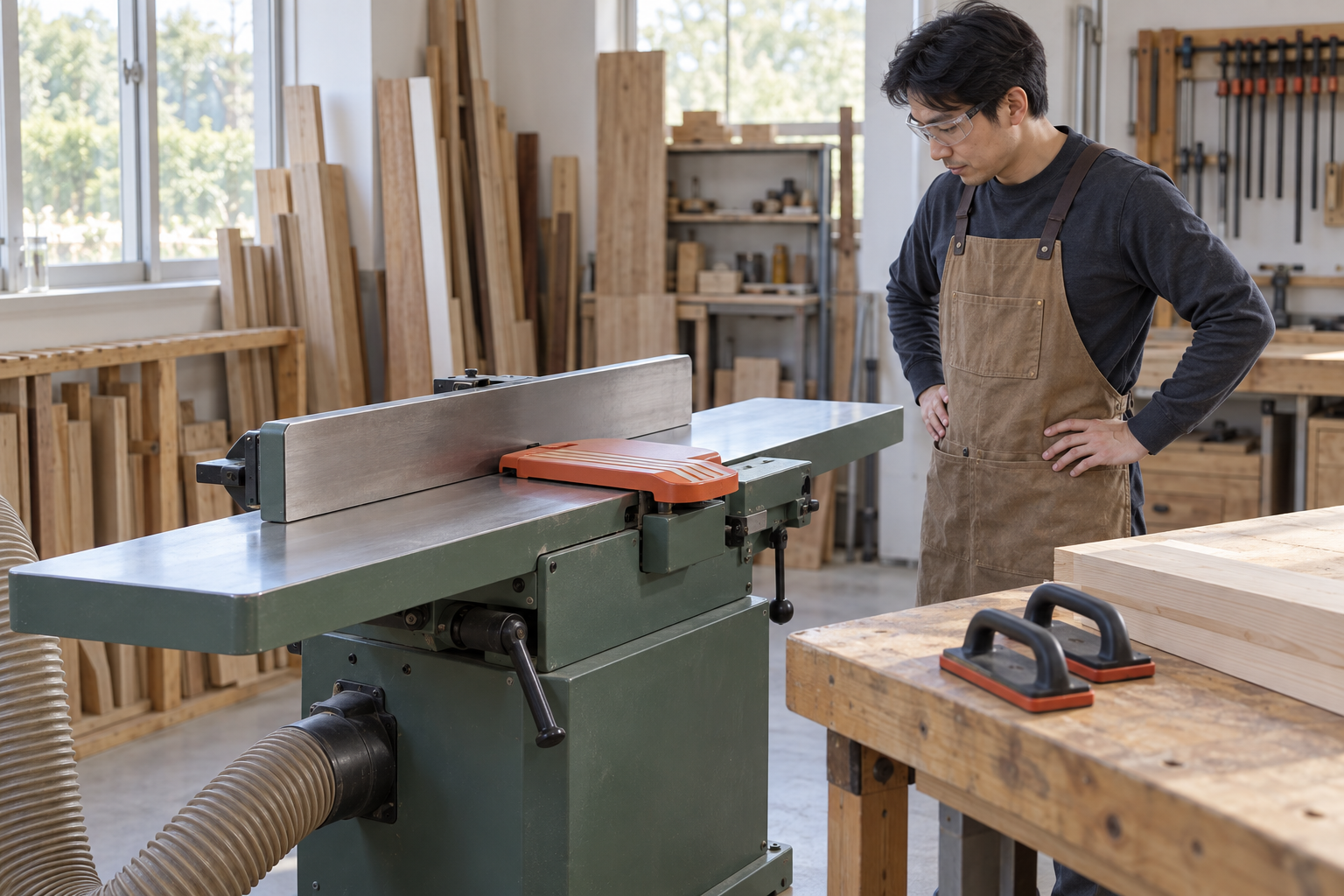
The retained illustration is an AI-generated educational image from the Korean source. It is not an actual incident photograph, approved drawing, equipment certification or proof that the depicted arrangement is safe.
The automatic guard must cover the unused working portion of the cutterhead, with separate protection behind the fence. Tying the guard open defeats the intended barrier even when push blocks are used.
Push blocks must grip the actual wood and maintain control across the cutterhead and onto the outfeed table. Their presence alone does not prove a safe hand path or workpiece support.
Minimum stock dimensions, permitted depth and cutter/table settings depend on the machine. Reject unsuitable short, thin, split or contaminated stock instead of inventing a universal limit.
A jam or poor surface may indicate setup, stock or cutter problems. Stop, wait for standstill and apply the required energy control before clearing or adjustment; do not test a faulty guard by feeding another piece.
Hypothetical decision example
Hypothetical example: a board has a flat face, but the guard does not fully return after the pass. The operator wants to continue because the result looks good. The machine is held, isolated for examination and released only after the guarding fault and required checks are resolved.
The example is fictional; no incident, measurement, inspection or approval is asserted.
Task flow: Select suitable wood → Set while isolated → Check guards and aids → Start controlled trial → Feed reference face → Inspect away from head → Hold jam or guard fault → Clean and hand over
5. Hold and proceed decisions
| Condition | Action | Evidence | Proceed when |
|---|---|---|---|
| Guard fails return | Stop and isolate for repair | Guard travel and rear coverage | Guard restored |
| Stock below limits | Reject for this process | Actual manual and wood dimensions | Suitable stock selected |
| Push block slips | Stop; review grip/fixture | Block face and full feed path | Control verified |
| Jam or vibration | Stop and control energy | Stock, setup and cutter inspection | Cause resolved |
Similar observation, different conclusion
| Observation | Supported conclusion | What remains unresolved |
|---|---|---|
| Flat finished board | One quality result observed | Guard performance not established |
| Push block available | An aid is present | Actual grip and hand path unproved |
6. Roles and supervision
| Role | Responsibility |
|---|---|
| Work supervisor | Coordinate select suitable wood, affected operations, stop signals and stage transitions. |
| Technical/equipment reviewer | Verify Stock dimensions, Defects/foreign objects, actual instructions and unresolved technical limits. |
| Task crew | Apply the stated controls, report changes and keep actual checks and signatures factual. |
| Inspector/test lead | Connect Cutter clearance, Remaining stock size to the required acceptance criteria. |
| Receiving authority | Accept the recorded restrictions, Machine defect status, Settings and restrictions, and follow-up ownership. |
These are responsibility examples, not invented statutory credentials. Verify actual competence, training and authority for the assigned work.
Supervision and handover controls
| Stage | Management controls | Evidence |
|---|---|---|
| Plan review | 1. Assign technical owner2. Close task-specific questions3. Inspect wood and grain | 1. Stock dimensions2. Defects/foreign objects3. Machine limits |
| Competence | 1. Verify required competence2. Assign stop authority3. Apply required isolation | 1. Energy state2. Training and task briefing3. Fence and locks |
| Prestart evidence | 1. Inspect actual equipment2. Link evidence to this stage3. Clear adjustment tools | 1. Clear tables2. Guarded startup3. Control/stop response |
| Change control | 1. Stop and secure the area2. Review affected controls3. Stop to standstill | 1. Fault and board ID2. Isolation state3. Repair and trial evidence |
| Shift handover | 1. Identify remaining restrictions2. Confirm receiving responsibility3. Isolate before cleaning | 1. Stopped/isolated state2. Chip collection3. Settings and restrictions |
| Closeout | 1. Record defect disposition2. Archive factual evidence3. Isolate before cleaning | 1. Stopped/isolated state2. Chip collection3. Settings and restrictions |
7. Hold points and record quality
| Hold point | Evidence before release | Actual record |
|---|---|---|
| HP-0 Start | Create a reference face on suitable wood using a stationary hand-fed jointer, its automatic cutterhead guard, rear guard and suitable push blocks. | |
| HP-1 Set while isolated | Energy state; Depth/setup basis; Table/cutter relationship; Fence and locks | |
| HP-2 Start controlled trial | Clear tables; Guarded startup; Capture operation; Control/stop response | |
| HP-3 Hold jam or guard fault | Fault and board ID; Isolation state; Guard/cutter findings; Repair and trial evidence | |
| HP-4 Clean and hand over | Stopped/isolated state; Chip collection; Machine defect status; Settings and restrictions |
Hold points are internal evidence gates. They do not establish that a statutory permit exists or has been approved. Recheck affected gates after changes, faults and shift handover.
Record comparison - hypothetical templates
The 16 boxes below identify record elements, not completed checks or approvals. They are static symbols. Link equipment/location, date, actual findings and the separate record reference; preserve unresolved items.
| Record | Insufficient entry | Required record elements |
|---|---|---|
| Select suitable wood | "Checked" without supporting facts | □ Stock dimensions□ Defects/foreign objects□ Grain and warp□ Machine limits |
| Check guards and aids | "Checked" without supporting facts | □ Working guard action□ Rear coverage□ Block grip/hand path□ Infeed/outfeed support |
| Feed reference face | "Checked" without supporting facts | □ Grip and hand position□ Feed direction□ Board support□ Cut/load response |
| Hold jam or guard fault | "Checked" without supporting facts | □ Fault and board ID□ Isolation state□ Guard/cutter findings□ Repair and trial evidence |
8. Pre-work checks and emergency response
| Check required | Result | Checker/action |
|---|---|---|
| Select suitable wood: Stock dimensions | ||
| Set while isolated: Energy state | ||
| Check guards and aids: Working guard action | ||
| Start controlled trial: Clear tables | ||
| Feed reference face: Grip and hand position | ||
| Inspect away from head: Cutter clearance | ||
| Hold jam or guard fault: Fault and board ID | ||
| Clean and hand over: Stopped/isolated state |
Stop work
Hold for stock outside the actual machine limits, loose knots/hidden metal, failed guard return, poor push-block grip or unsupported travel. Stop for a jam, unusual vibration or guard malfunction; do not pull material back across a running cutterhead.
Emergency response
Stop the jointer from a safe position and keep hands away from the cutterhead until complete standstill. Isolate hazardous energy before releasing a trapped piece or accessing the cutter area. Call 911 for severe cuts or entanglement and activate trained site first aid. Do not restart to free a person or reach past a defective guard. Preserve machine and workpiece identification for fault review.
9. Official sources and review limits
Official public-source check: October 13, 2026. The review concerns the selected passages described below, not endorsement of this article.
| Official source | Checked scope and limit |
|---|---|
| OSHA 29 CFR 1910.213 | Paragraph (j), particularly automatic working-side and rear-of-fence guards; paragraph (s) operating aids. Selected provisions, not a complete machine compliance evaluation. |
| OSHA 29 CFR 1910.147 | Covered clearing, adjustment and servicing require energy control; ordinary production and servicing applicability must be assessed. |
| OSHA State Plans | Federal baseline and State Plan coverage reviewed. Confirm the applicable state program and employer coverage; this edition does not establish nationwide compliance. |
Selected public official provisions were checked on October 13, 2026. This is not a complete legal audit. No actual equipment manual, site measurements, engineering calculations, product certification or professional technical approval was supplied. Full paid NFPA/ANSI standards and state/local amendments were not reviewed. Check actual equipment, jurisdiction and project requirements before use.
This is reference content written and revised with AI. It has not been verified or approved by a professional. Review by a suitably qualified professional and required site authorization are necessary before use.
10. PDF use and frequently asked questions
PDF A summarizes core controls; B emphasizes technical failures; C covers supervision, records and handover. Each uses six stages from or aligned with the eight-stage body. All actual risk, measurement, check and signature fields are blank. Use a separate linked record where more space is needed.
Can the guard be tied open for wide stock?
No. Preserve the required automatic guard action and follow the machine limits.
Can I pull a stalled board backward?
Stop and apply the required isolation before resolving the jam; do not reverse it over a running cutterhead.
Is there one minimum board size for every jointer?
No. Use the actual machine instructions and assess stock condition and control.
What must be checked after a guard repair?
Verify the corrected guard action, rear coverage and required safe trial before returning the machine to use.
Has a professional approved this JSA?
This is reference content written and revised with AI. It has not been verified or approved by a professional. Review by a suitably qualified professional and required site authorization are necessary before use.
11. Authorship and revision history
This is reference content written and revised with AI. It has not been verified or approved by a professional. Review by a suitably qualified professional and required site authorization are necessary before use.
| Date/version | Editorial history | Technical approval |
|---|---|---|
| September 26, 2026 / Korean v1.0 | Korean source: initial article, evidence, hypothetical decisions and body/PDF editorial checks. | Professional technical approval not performed |
| October 13, 2026 / US v1.0 | US localization: Preserves reference-face scope, guard-return fictional case and full-path push-block control. Uses US jointer guarding requirements and equipment-specific stock limits instead of universal dimensions or thickness-planer instructions. | Not performed |
Source topic: https://smartjsabridge.com/ko/case-study/jsa-jointer-wood-face
Content group: jsa-jointer-wood-face