Taking a foot off the pedal does not isolate the drive. Before hands approach the needle for threading, use the actual power-off and full-stop procedure and maintain safe task lighting.
This reference material was written and revised with AI. It has not been verified or approved by a professional. Review by a suitably qualified professional and required site approval are necessary before field use.
Stop before proceeding
Stop if threading needed, fabric drags, needle breaks. Keep the affected operation on hold until the listed evidence and proceed conditions are satisfied; a low risk score does not release missing safeguards.
1. Legal and technical scope
For general-industry sewing, apply 1910.212 machine guarding and 1910.147 to covered servicing. Do not assume a minor-servicing exception: evaluate its conditions and effective protection. HSE sewing advice is foreign technical guidance, and the JUKI DDL-8700 manual is a model example. Neither establishes a universal US inspection interval, speed or needle setting.
Confirm whether federal OSHA or an OSHA-approved State Plan covers this employer and worksite; state requirements and public-sector coverage can differ. Apply the task-specific provisions and limitations identified above.
| Basis | Application |
|---|---|
| OSHA 29 CFR 1910.212 | Point-of-operation and moving-part guarding. |
| OSHA 29 CFR 1910.147 | Covered servicing isolation and control of stored energy. |
| HSE sewing machines | Needle/belt guards, safe lighting, seating and pedal/power precautions; reviewed 2026-10-13. |
| JUKI DDL-8700 instructions | Threading warnings require power off and motor stopped; reviewed 2026-10-13. Model dimensions and speed not generalized. |
| OSHA State Plans | Official overview of federal and State Plan jurisdiction and differing public-sector coverage, checked 2026-10-13. Individual state rules require a site-specific check. |
2. Scope and required inputs
Included scope
Sew flat textile pieces on a guarded industrial single-needle lockstitch machine with suitable fabric, needle and thread; perform only permitted routine threading and settings while safely stopped.
Separate assessment
Overlock, cutting attachments, embroidery automation, bag closing, nontextile heavy materials, head tilting, belt work, timing adjustment, needle replacement and broken-fragment recovery need their own servicing procedure.
| Input | Evidence needed |
|---|---|
| Match sewing work | Fabric and layer count; Needle and thread; Batch identity; Approved settings. |
| Stop and thread | Power state; Complete stop; Needle and belt guards; Thread path. |
| Sew fabric | Finger clearance; Drive covers; Fabric support; Seam resistance. |
| Clean and handoff | Safe power state; Guard and fault status; Batch and fragments; Receiver and setup. |
No site measurements, equipment manuals for the actual installation, inspection records or signed technical approvals were supplied. Confirm the applicable requirements and actual product instructions before use; record each criterion with its units, source and equipment or work-area ID.
3. Eight-stage JSA
| Job stage | Hazards and effects | Failure factors | Technical and procedural controls | Site verification | P | S | R | A |
|---|---|---|---|---|---|---|---|---|
| 1. Match sewing work | 1. Needle breaks2. Fabric jams3. Product fragment4. Wrong setting | 1. Layers too thick2. Needle mismatch3. Prior defect unknown4. Instruction unclear | 1. Match fabric and needle2. Check thread combination3. Review batch status4. Confirm sewing instruction | 1. Fabric and layer count2. Needle and thread3. Batch identity4. Approved settings | ||||
| 2. Set workstation | 1. Wrist strain2. Pedal triggered3. Trip4. Poor vision | 1. Fabric hangs2. Pedal misplaced3. Cable loose4. Light inadequate | 1. Support fabric weight2. Set chair and pedal3. Protect cable route4. Provide task lighting | 1. Reach and support2. Pedal return3. Chair and posture4. Light and route | ||||
| 3. Stop and thread | 1. Needle puncture2. Drive entanglement3. Unexpected start4. Hand strain | 1. Foot only removed2. Motor coasting3. Helper touches pedal4. Thread path obscured | 1. Power off per procedure2. Verify motor at rest3. Prevent inadvertent restart4. Use safe threading light | 1. Power state2. Complete stop3. Needle and belt guards4. Thread path | ||||
| 4. Test sample | 1. Needle fragment2. Sudden feed3. Poor seam4. Fabric snags | 1. Guard absent2. Wrong speed3. Combination untested4. Support obstructed | 1. Restore guards2. Test controlled sample3. Inspect stitch result4. Check feed support | 1. Guard function2. Sample and settings3. Stitch result4. Safe guiding position | ||||
| 5. Sew fabric | 1. Finger puncture2. Hair entangles3. Strain4. Needle bends | 1. Hand too close2. Loose hair or clothing3. Fabric weight unsupported4. Forceful feed | 1. Keep fingers protected2. Secure hair and clothing3. Use fabric support4. Stop increased resistance | 1. Finger clearance2. Drive covers3. Fabric support4. Seam resistance | ||||
| 6. Stop and remove work | 1. Needle contact2. Unexpected feed3. Cut from snips4. Stack falls | 1. Needle moving2. Pedal pressed3. Snips mishandled4. Output piled high | 1. Wait for safe stop2. Keep pedal clear3. Use suitable snips4. Place stable output | 1. Needle stop2. Pedal clearance3. Cutting tool4. Output location | ||||
| 7. Hold break or jam | 1. Hand injury2. Fragment retained3. Unexpected restart4. Repeat break | 1. Cleared energized2. Batch released3. Isolation missing4. Cause ignored | 1. Stop and prevent restart2. Hold affected batch3. Use servicing procedure4. Resolve cause before test | 1. Machine status2. Fragment accounting3. Batch disposition4. Repair and test | ||||
| 8. Clean and handoff | 1. Lint at drive2. Defect reused3. Fragment lost4. Poor next setup | 1. Cleaning energized2. Fault unmarked3. Records absent4. Pedal not reset | 1. Clean by safe procedure2. Tag unresolved faults3. Transfer batch records4. Reset operator layout | 1. Safe power state2. Guard and fault status3. Batch and fragments4. Receiver and setup |
P = likelihood; S = severity; R = risk under the site method; A = the site-defined acceptance/authorization decision. Complete only after actual assessment. Blank cells and checklist prompts are not completed inspections.
4. Fictional scenario and failure mechanisms
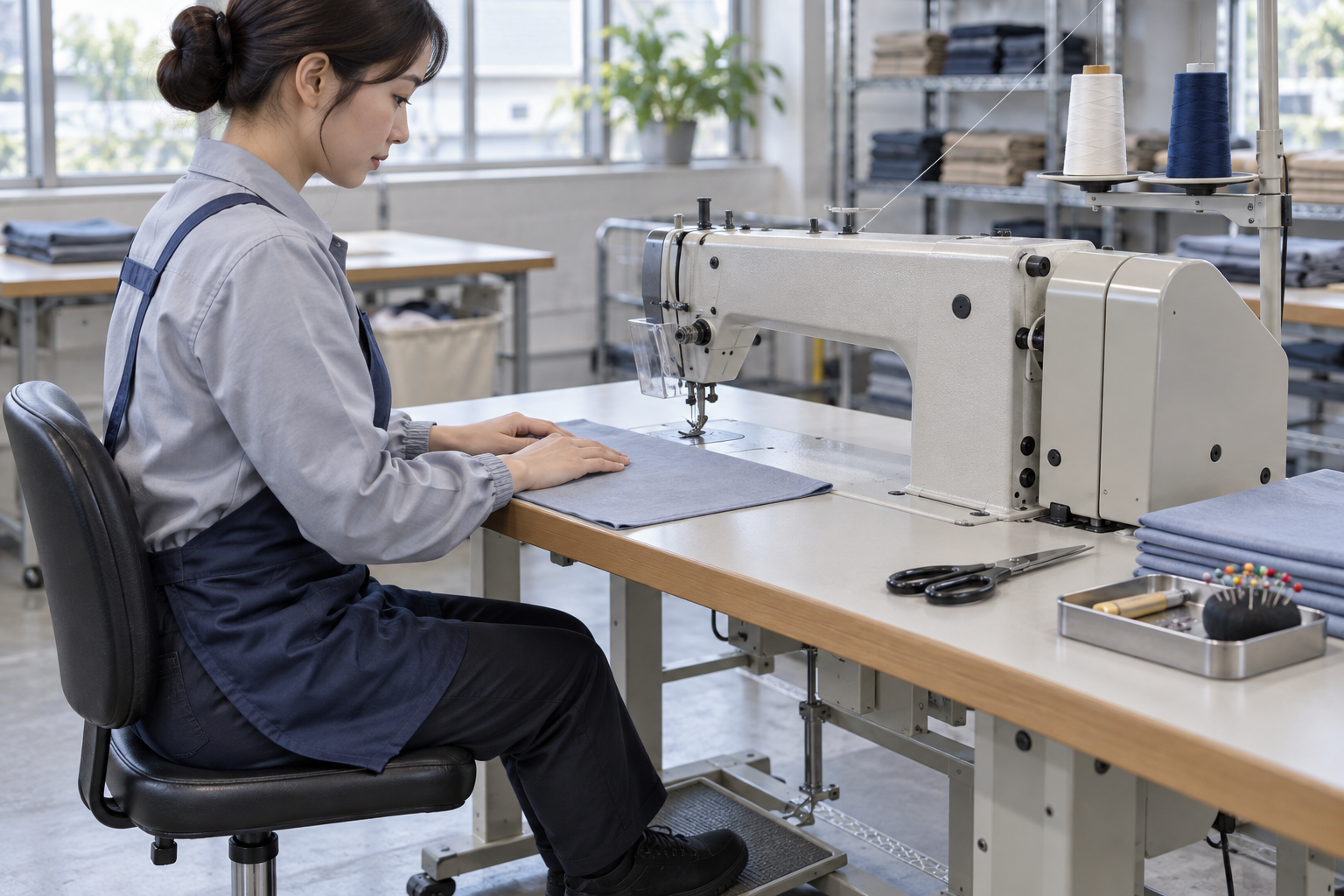
Retained AI-generated educational illustration from the source edition; not a real incident photograph, approved installation drawing or evidence of equipment suitability.
The scenario and record comparisons are fictional teaching examples, not records of real incidents, measurements, inspections, signatures or approvals.
| Item | Fictional scenario |
|---|---|
| Initial | The needle breaks at a thick seam and thread tangles. |
| Change | The operator removes a foot from the pedal and reaches toward the needle. |
| Failure | Drive isolation and fragment location remain unverified. |
| Outcome | Unexpected motion can injure the hand and fragments can remain in the batch. |
| Barrier | Power off, confirm complete stop, prevent restart and hold machine and affected fabric for the separate servicing and product decisions. |
Why the controls matter
Taking a foot off the pedal does not isolate the drive. Before hands approach the needle for threading, use the actual power-off and full-stop procedure and maintain safe task lighting.
Support large fabric instead of holding its hanging weight with the wrists. Adjust chair, pedal, lighting and reach together so guiding the seam does not push fingers into the needle zone.
A broken needle affects both the machine and the fabric batch. Hold them separately until servicing and controlled sewing tests establish machine readiness and the missing-fragment/product disposition establishes whether the batch can proceed.
Decision sequence
| Step | Decision |
|---|---|
| Known | The operator removes a foot from the pedal and reaches toward the needle. |
| Unknown | Actual condition, extent of damage and suitability of finger clearance, drive covers remain to be established. |
| Hold | Drive isolation and fragment location remain unverified. |
| Evidence | Link finger clearance, drive covers, fabric support, seam resistance, machine status, fragment accounting to the affected equipment or work area. |
| Next | Power off, confirm complete stop, prevent restart and hold machine and affected fabric for the separate servicing and product decisions. |
5. Conditional decisions and common errors
| Condition | Action | Evidence | Proceed when |
|---|---|---|---|
| Threading needed | Power off and stop | Motor rest and safe light | Safe access established |
| Fabric drags | Hold feed | Support and reach setup | Hands remain clear |
| Needle breaks | Hold machine and batch | Fragment and cause record | Both dispositions complete |
| Shift changes | Reset workstation | Pedal guard light and reach | Operator setup checked |
Similar appearance, different evidence
The scenario and record comparisons are fictional teaching examples, not records of real incidents, measurements, inspections, signatures or approvals.
| Comparison | Supported decision | Insufficient basis |
|---|---|---|
| Condition | Motor rest and safe light | Threading needed has not been resolved. |
| Evidence | Fragment and cause record | A photograph or a completed-looking task without the relevant inspection record. |
| Release | Operator setup checked | Completion of one step does not release the excluded tasks in section 2. |
6. Roles and responsibilities
| Role | Responsibility |
|---|---|
| Work supervisor | Assign the task boundary, stop authority, interfaces and emergency communication for industrial single-needle lockstitch sewing. |
| Technical lead | Confirm Fabric and layer count; Needle and thread; Batch identity; Approved settings. Resolve design and manufacturer limits before work. |
| Authorized crew | Apply Power state; Complete stop; Needle and belt guards; Thread path. Stop when the working arrangement changes. |
| Inspector / receiving lead | Review Finger clearance; Drive covers; Fabric support; Seam resistance. Transfer Safe power state; Guard and fault status; Batch and fragments; Receiver and setup. |
Role labels allocate responsibilities; they do not confer a legal qualification. Verify the competence, training and authority required for the actual task.
Record and handoff perspective
| Stage | Record controls | Verification |
|---|---|---|
| Match sewing work | 1. Record fabric and layer count2. Record needle and thread3. Record batch identity | 1. Needle and thread2. Batch identity3. Approved settings |
| Stop and thread | 1. Record power state2. Record complete stop3. Record needle and belt guards | 1. Complete stop2. Needle and belt guards3. Thread path |
| Test sample | 1. Record guard function2. Record sample and settings3. Record stitch result | 1. Sample and settings2. Stitch result3. Safe guiding position |
| Sew fabric | 1. Record finger clearance2. Record drive covers3. Record fabric support | 1. Drive covers2. Fabric support3. Seam resistance |
| Hold break or jam | 1. Record machine status2. Record fragment accounting3. Record batch disposition | 1. Fragment accounting2. Batch disposition3. Repair and test |
| Clean and handoff | 1. Record safe power state2. Record guard and fault status3. Record batch and fragments | 1. Guard and fault status2. Batch and fragments3. Receiver and setup |
7. Hold points and record comparison
| Hold point | Evidence before release | Actual record |
|---|---|---|
| HP-0 Start | Sew flat textile pieces on a guarded industrial single-needle lockstitch machine with suitable fabric, needle and thread; perform only permitted routine threading and settings while safely stopped. | |
| HP-1 Set workstation | Reach and support; Pedal return; Chair and posture; Light and route | |
| HP-2 Stop and thread | Power state; Complete stop; Needle and belt guards; Thread path | |
| HP-3 Hold break or jam | Machine status; Fragment accounting; Batch disposition; Repair and test | |
| HP-4 Clean and handoff | Safe power state; Guard and fault status; Batch and fragments; Receiver and setup |
These are internal hold points, not issued permits. Recheck affected points after a change, fault or shift handoff; link the actual approval record.
Record comparison
The scenario and record comparisons are fictional teaching examples, not records of real incidents, measurements, inspections, signatures or approvals.
The boxes are static record prompts, not interactive or saved approvals. A tick does not establish suitability or permission to restart. Record the evidence, person, time and unresolved issues; retain the change history.
| Record | Insufficient | Record checklist |
|---|---|---|
| Match sewing work | "Checked" without target, criteria or result | □ Fabric and layer count□ Needle and thread□ Batch identity□ Approved settings |
| Stop and thread | "Checked" without target, criteria or result | □ Power state□ Complete stop□ Needle and belt guards□ Thread path |
| Sew fabric | "Checked" without target, criteria or result | □ Finger clearance□ Drive covers□ Fabric support□ Seam resistance |
| Clean and handoff | "Checked" without target, criteria or result | □ Safe power state□ Guard and fault status□ Batch and fragments□ Receiver and setup |
8. Site checklist and emergency response
| Check | Result | Person / action |
|---|---|---|
| □ Match sewing work: Fabric and layer count | ||
| □ Set workstation: Reach and support | ||
| □ Stop and thread: Power state | ||
| □ Test sample: Guard function | ||
| □ Sew fabric: Finger clearance | ||
| □ Stop and remove work: Needle stop | ||
| □ Hold break or jam: Machine status | ||
| □ Clean and handoff: Safe power state | ||
| □ Emergency access and handoff restrictions |
Stop work
Stop if threading needed, fabric drags, needle breaks. Keep the affected operation on hold until the listed evidence and proceed conditions are satisfied; a low risk score does not release missing safeguards.
Emergency response
Stop from a safe location, exclude people from the affected danger zone and activate the site emergency plan. Call 911 for injury or immediate danger. Do not enter an unstable, energized or confined danger area for an improvised rescue; trained responders must control the specific energy and access hazards.
9. Sources and review limits
Public-source review: 2026-10-14. Official regulation pages and specific technical references are distinguished below; no agency or manufacturer has approved this content.
| Source | Reviewed scope and limitation |
|---|---|
| OSHA 29 CFR 1910.212 | Point-of-operation and moving-part guarding. |
| OSHA 29 CFR 1910.147 | Covered servicing isolation and control of stored energy. |
| HSE sewing machines | Needle/belt guards, safe lighting, seating and pedal/power precautions; reviewed 2026-10-13. |
| JUKI DDL-8700 instructions | Threading warnings require power off and motor stopped; reviewed 2026-10-13. Model dimensions and speed not generalized. |
| OSHA State Plans | Official overview of federal and State Plan jurisdiction and differing public-sector coverage, checked 2026-10-13. Individual state rules require a site-specific check. |
No site measurements, equipment manuals for the actual installation, inspection records or signed technical approvals were supplied. Confirm the applicable requirements and actual product instructions before use; record each criterion with its units, source and equipment or work-area ID.
10. PDF guidance and FAQ
PDF A covers basic task controls; B focuses on technical failures; C covers supervision, records and handover. The article has eight stages with four items per main cell; each PDF has six key stages with three items per main cell. P/S/R/A, measurements, confirmations and signatures remain blank for actual site assessment.
Content group
jsa-industrial-lockstitch-sewing
Is a foot off the pedal enough?
No. Verify the specified safe power state and complete stop.
May fabric be pulled through a thick seam?
Use an approved combination and feed method; stop if resistance changes.
Does a new needle release the fabric batch?
No. Resolve fragment accountability and product disposition separately.
Can motor power stay on to retain light?
Provide safe independent task lighting rather than exposing hands to unexpected drive.
Has a professional approved this JSA?
This reference material was written and revised with AI. It has not been verified or approved by a professional. Review by a suitably qualified professional and required site approval are necessary before field use.
11. Revision history and authorship
This reference material was written and revised with AI. It has not been verified or approved by a professional. Review by a suitably qualified professional and required site approval are necessary before field use.
Korean source created 2026-10-07. This US edition adapts the Korean source; earlier editorial revisions do not constitute professional approval of this edition.
| Date | Edition | Change | Review status |
|---|---|---|---|
| 2026-10-08 | Korean source v1.0 | Source editorial publication or revision; retained as provenance of the Korean edition. | Editorial record only; no professional approval of this US edition. |
| 2026-10-14 | 1.0 | US localization: preserve task judgments; replace Korean legal applicability with scoped US references. | AI editorial and output checks; no professional technical approval. |