Identify what the last bolt is restraining before loosening the first. Review supports and fixtures for the bolt-removed condition and exclude the movement path; a coworker hand is not a support.
This reference material was written and revised with AI. It has not been verified or approved by a professional. Review by a suitably qualified professional and required site approval are necessary before field use.
Stop before proceeding
Do not loosen with unverified load, stored energy or last-bolt support. Stop for socket damage, poor retention, tool faults, unusual thread resistance or member movement. Preliminary assembly is not released for service.
1. Legal and technical scope
For general-industry work, assess portable tool provisions in 1910.243 and hazardous-energy control under 1910.147 when servicing is covered. Tool battery removal does not isolate the assembly being worked on. Construction uses applicable Part 1926 requirements. Manufacturer maximum or breakaway torque is not the assembly acceptance criterion.
Confirm whether federal OSHA or an OSHA-approved State Plan covers this employer and worksite; state requirements and public-sector coverage can differ. Apply the task-specific provisions and limitations identified above.
| Basis | Application |
|---|---|
| OSHA 29 CFR 1910.243 | Portable powered-tool controls and applicable guarding/electrical provisions. |
| OSHA 29 CFR 1910.147 | Covered assembly servicing: control all relevant energy, not only the handheld tool. |
| Makita US XWT14/XWT15 manual listing | Official US manual located in search; full PDF retrieval failed. No model-specific torque, mode or timing imported. Obtain actual tool and assembly instructions before use. |
| OSHA State Plans | Official overview of federal and State Plan jurisdiction and differing public-sector coverage, checked 2026-10-12. Individual state rules require a site-specific check. |
2. Scope and required inputs
Included scope
Remove bolts and perform preliminary assembly on a verified, supported general assembly at ground or bench level using a cordless electric impact wrench. Follow the assembly-specific sequence.
Separate assessment
Final structural high-strength bolting, vehicle wheels, pressure flange opening, spring-energy disassembly, suspended members, elevated work and pneumatic tools are excluded. Final torque/angle tightening and inspection require their specified procedure.
| Input | Evidence needed |
|---|---|
| Define assembly | Assembly and bolt IDs; Instruction revision; Energy isolation; Removal scope. |
| Prepare socket | Socket size and condition; Retention fit; Battery and switch; Eye and hearing protection. |
| Start and snug | Thread and seat; Fastener specification; Preliminary locations; Use restriction. |
| Clear and handoff | Tools and removed bolts; Incomplete locations; Final inspection link; Receiver and restrictions. |
No site measurements, equipment manuals for the actual installation, inspection records or signed technical approvals were supplied. Confirm the applicable requirements and actual product instructions before use; record each criterion with its units, source and equipment or work-area ID.
3. Eight-stage JSA
| Job stage | Hazards and effects | Failure factors | Technical and procedural controls | Site verification | P | S | R | A |
|---|---|---|---|---|---|---|---|---|
| 1. Define assembly | 1. Stored energy release2. Member falls3. Wrong bolt removed4. Unapproved disassembly | 1. Bolt function unknown2. Sequence missing3. Drawing mismatch4. Energy overlooked | 1. Identify bolt function2. Confirm removal sequence3. Match assembly drawing4. Control assembly energy | 1. Assembly and bolt IDs2. Instruction revision3. Energy isolation4. Removal scope | ||||
| 2. Support member | 1. Last-bolt drop2. Finger crush3. Fixture overturn4. Unexpected member slide | 1. Bolts are sole support2. Hand used as prop3. Support undersized4. Load path unreviewed | 1. Fit planned supports2. Keep hands out3. Verify fixture stability4. Control removed-part path | 1. Weight and center2. Supports and clamps3. Last-bolt condition4. Movement exclusion | ||||
| 3. Prepare socket | 1. Socket shatters2. Socket ejects3. Unexpected rotation4. Battery fault | 1. Non-impact socket2. Retention missing3. Battery fitted during change4. Damaged battery | 1. Remove battery for setup2. Match impact socket3. Check retention device4. Inspect tool and battery | 1. Socket size and condition2. Retention fit3. Battery and switch4. Eye and hearing protection | ||||
| 4. Loosen bolts | 1. Member moves2. Tool recoil3. Rotating-part contact4. Flying fragment | 1. Misaligned socket2. Poor grip3. Hand on socket4. Damaged fastener | 1. Maintain planned support2. Align tool axis3. Keep hands and clothing clear4. Stop abnormal resistance | 1. Support changes2. Socket engagement3. Hand and body position4. Bolt response | ||||
| 5. Start and snug | 1. Cross-threading2. Bolt fracture3. Alignment pinch4. False completion | 1. Forced thread start2. Excess impact3. Hands in joint4. Snug state unmarked | 1. Check thread without power2. Use specified preliminary mode3. Keep alignment tools clear4. Mark incomplete assembly | 1. Thread and seat2. Fastener specification3. Preliminary locations4. Use restriction | ||||
| 6. Transfer tightening | 1. Unfinished assembly used2. Wrong torque3. Missed inspection4. Untraceable bolt | 1. Tool maximum copied2. Method not specified3. No inspector4. Locations unrecorded | 1. Link final procedure2. Use assembly criteria3. Hold use until acceptance4. Identify every pending bolt | 1. Torque method and source2. Final tool requirements3. Inspection responsibility4. Complete and hold map | ||||
| 7. Hold faults | 1. Repeated impact breakage2. Hot socket burn3. Support loss4. Battery incident | 1. Seizure ignored2. Immediate handling3. Fixture movement4. Heat or smoke ignored | 1. Stop and disconnect2. Allow safe handling3. Maintain member support4. Follow battery response | 1. Seizure and damage2. Socket heat3. Support state4. Repair and restart method | ||||
| 8. Clear and handoff | 1. Loose item falls2. Preliminary work reused3. Defective socket reused4. Status lost | 1. Tool count omitted2. Tag removed3. Fault not marked4. Receiver absent | 1. Collect stopped tooling2. Preserve incomplete labels3. Quarantine defects4. Transfer final-work status | 1. Tools and removed bolts2. Incomplete locations3. Final inspection link4. Receiver and restrictions |
P = likelihood; S = severity; R = risk under the site method; A = the site-defined acceptance/authorization decision. Complete only after actual assessment. Blank cells and checklist prompts are not completed inspections.
4. Fictional scenario and failure mechanisms
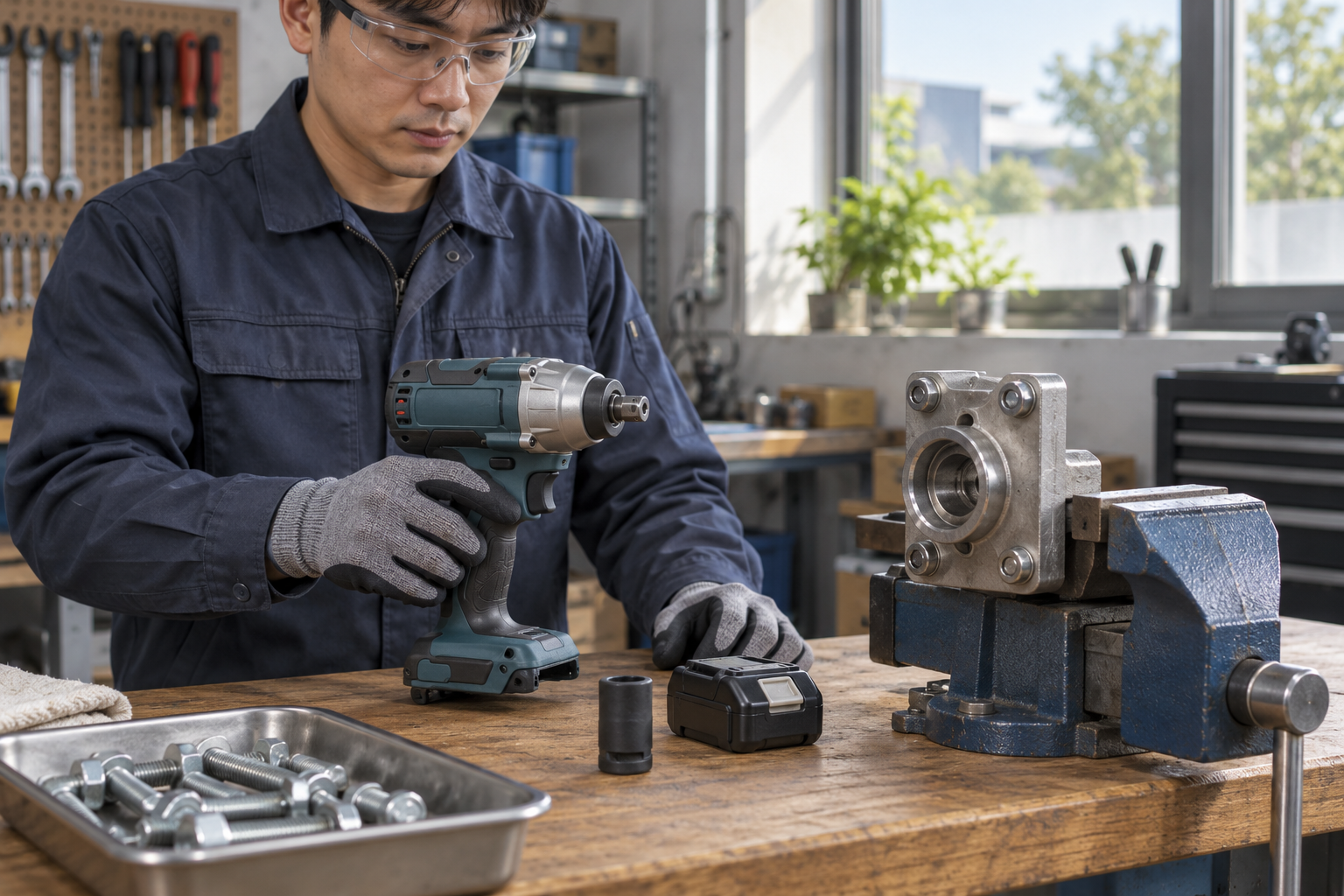
Retained AI-generated educational illustration from the source edition; not a real incident photograph, approved installation drawing or evidence of equipment suitability.
The scenario and record comparisons are fictional teaching examples, not records of real incidents, measurements, inspections, signatures or approvals.
| Item | Fictional scenario |
|---|---|
| Initial | Most cover bolts have been removed. |
| Change | The cover tips as the final bolt loosens and a coworker reaches into the gap. |
| Failure | Bolt support is lost before an independent support is established. |
| Outcome | The member can fall or trap the hand; later preliminary fastening may also be mistaken for final acceptance. |
| Barrier | Stop, keep people out, restore planned support and distinguish preliminary assembly from final tightening and inspection. |
Why the controls matter
Identify what the last bolt is restraining before loosening the first. Review supports and fixtures for the bolt-removed condition and exclude the movement path; a coworker hand is not a support.
Maximum tool torque describes a tool capability, not the required bolt condition. The assembly specification determines fastener, seat, lubrication/reuse conditions and final tightening method. Do not copy an advertised maximum into the blank site record.
Automatic stopping does not demonstrate final torque or correct thread engagement. Record preliminary assembly distinctly, preserve its use restriction and transfer final tightening and inspection to the responsible person. A stalled bolt may be seized or cross-threaded.
Decision sequence
| Step | Decision |
|---|---|
| Known | The cover tips as the final bolt loosens and a coworker reaches into the gap. |
| Unknown | Actual condition, extent of damage and suitability of thread and seat, fastener specification remain to be established. |
| Hold | Bolt support is lost before an independent support is established. |
| Evidence | Link thread and seat, fastener specification, preliminary locations, use restriction, seizure and damage, socket heat to the affected equipment or work area. |
| Next | Stop, keep people out, restore planned support and distinguish preliminary assembly from final tightening and inspection. |
5. Conditional decisions and common errors
| Condition | Action | Evidence | Proceed when |
|---|---|---|---|
| Last-bolt support unknown | Hold loosening | Weight, fixture and sequence | Removal support verified |
| Socket defective | Disconnect and replace | Impact rating and retention | Socket verified |
| Bolt stalls | Stop repeated impacts | Thread, load and damage | Approved method confirmed |
| Preliminary assembly | Keep use restriction | Final method and inspector | Final acceptance completed |
Similar appearance, different evidence
The scenario and record comparisons are fictional teaching examples, not records of real incidents, measurements, inspections, signatures or approvals.
| Comparison | Supported decision | Insufficient basis |
|---|---|---|
| Condition | Weight, fixture and sequence | Last-bolt support unknown has not been resolved. |
| Evidence | Thread, load and damage | A photograph or a completed-looking task without the relevant inspection record. |
| Release | Final acceptance completed | Completion of one step does not release the excluded tasks in section 2. |
6. Roles and responsibilities
| Role | Responsibility |
|---|---|
| Work supervisor | Assign the task boundary, stop authority, interfaces and emergency communication for cordless impact wrench bolt removal and preliminary assembly. |
| Technical lead | Confirm Assembly and bolt IDs; Instruction revision; Energy isolation; Removal scope. Resolve design and manufacturer limits before work. |
| Authorized crew | Apply Socket size and condition; Retention fit; Battery and switch; Eye and hearing protection. Stop when the working arrangement changes. |
| Inspector / receiving lead | Review Thread and seat; Fastener specification; Preliminary locations; Use restriction. Transfer Tools and removed bolts; Incomplete locations; Final inspection link; Receiver and restrictions. |
Role labels allocate responsibilities; they do not confer a legal qualification. Verify the competence, training and authority required for the actual task.
Record and handoff perspective
| Stage | Record controls | Verification |
|---|---|---|
| Define assembly | 1. Record assembly and bolt ids2. Record instruction revision3. Record energy isolation | 1. Instruction revision2. Energy isolation3. Removal scope |
| Prepare socket | 1. Record socket size and condition2. Record retention fit3. Record battery and switch | 1. Retention fit2. Battery and switch3. Eye and hearing protection |
| Loosen bolts | 1. Record support changes2. Record socket engagement3. Record hand and body position | 1. Socket engagement2. Hand and body position3. Bolt response |
| Start and snug | 1. Record thread and seat2. Record fastener specification3. Record preliminary locations | 1. Fastener specification2. Preliminary locations3. Use restriction |
| Hold faults | 1. Record seizure and damage2. Record socket heat3. Record support state | 1. Socket heat2. Support state3. Repair and restart method |
| Clear and handoff | 1. Record tools and removed bolts2. Record incomplete locations3. Record final inspection link | 1. Incomplete locations2. Final inspection link3. Receiver and restrictions |
7. Hold points and record comparison
| Hold point | Evidence before release | Actual record |
|---|---|---|
| HP-0 Start | Remove bolts and perform preliminary assembly on a verified, supported general assembly at ground or bench level using a cordless electric impact wrench. Follow the assembly-specific sequence. | |
| HP-1 Support member | Weight and center; Supports and clamps; Last-bolt condition; Movement exclusion | |
| HP-2 Prepare socket | Socket size and condition; Retention fit; Battery and switch; Eye and hearing protection | |
| HP-3 Start and snug | Thread and seat; Fastener specification; Preliminary locations; Use restriction | |
| HP-4 Clear and handoff | Tools and removed bolts; Incomplete locations; Final inspection link; Receiver and restrictions |
These are internal hold points, not issued permits. Recheck affected points after a change, fault or shift handoff; link the actual approval record.
Record comparison
The scenario and record comparisons are fictional teaching examples, not records of real incidents, measurements, inspections, signatures or approvals.
The boxes are static record prompts, not interactive or saved approvals. A tick does not establish suitability or permission to restart. Record the evidence, person, time and unresolved issues; retain the change history.
| Record | Insufficient | Record checklist |
|---|---|---|
| Define assembly | "Checked" without target, criteria or result | □ Assembly and bolt IDs□ Instruction revision□ Energy isolation□ Removal scope |
| Prepare socket | "Checked" without target, criteria or result | □ Socket size and condition□ Retention fit□ Battery and switch□ Eye and hearing protection |
| Start and snug | "Checked" without target, criteria or result | □ Thread and seat□ Fastener specification□ Preliminary locations□ Use restriction |
| Clear and handoff | "Checked" without target, criteria or result | □ Tools and removed bolts□ Incomplete locations□ Final inspection link□ Receiver and restrictions |
8. Site checklist and emergency response
| Check | Result | Person / action |
|---|---|---|
| □ Define assembly: Assembly and bolt IDs | ||
| □ Support member: Weight and center | ||
| □ Prepare socket: Socket size and condition | ||
| □ Loosen bolts: Support changes | ||
| □ Start and snug: Thread and seat | ||
| □ Transfer tightening: Torque method and source | ||
| □ Hold faults: Seizure and damage | ||
| □ Clear and handoff: Tools and removed bolts | ||
| □ Emergency access and handoff restrictions |
Stop work
Do not loosen with unverified load, stored energy or last-bolt support. Stop for socket damage, poor retention, tool faults, unusual thread resistance or member movement. Preliminary assembly is not released for service.
Emergency response
Stop the tool if the member moves; do not catch or prop it with a hand. Call 911/site response for entrapment or serious injury. Do not turn bolts to improvise a rescue. For battery heat or smoke, stop use/charging and follow the site battery emergency procedure.
9. Sources and review limits
Public-source review: 2026-10-12. Official regulation pages and specific technical references are distinguished below; no agency or manufacturer has approved this content.
| Source | Reviewed scope and limitation |
|---|---|
| OSHA 29 CFR 1910.243 | Portable powered-tool controls and applicable guarding/electrical provisions. |
| OSHA 29 CFR 1910.147 | Covered assembly servicing: control all relevant energy, not only the handheld tool. |
| Makita US XWT14/XWT15 manual listing | Official US manual located in search; full PDF retrieval failed. No model-specific torque, mode or timing imported. Obtain actual tool and assembly instructions before use. |
| OSHA State Plans | Official overview of federal and State Plan jurisdiction and differing public-sector coverage, checked 2026-10-12. Individual state rules require a site-specific check. |
No site measurements, equipment manuals for the actual installation, inspection records or signed technical approvals were supplied. Confirm the applicable requirements and actual product instructions before use; record each criterion with its units, source and equipment or work-area ID.
10. PDF guidance and FAQ
PDF A covers basic task controls; B focuses on technical failures; C covers supervision, records and handover. The article has eight stages with four items per main cell; each PDF has six key stages with three items per main cell. P/S/R/A, measurements, confirmations and signatures remain blank for actual site assessment.
Content group
jsa-impact-wrench-bolt-removal
Can a hand-tool socket be used?
Use an impact-rated socket matched to the tool, fastener and retention arrangement; inspect it before use.
Should a stuck bolt be struck repeatedly?
Stop and investigate load, thread direction, damage and seizure under the assembly procedure.
Does automatic stop prove final torque?
No. Apply and record the specified final tightening and inspection method.
Does removing the battery isolate the assembly?
No. Separately control the assembly power, pressure, gravity and other stored energy.
Has a professional approved this JSA?
This reference material was written and revised with AI. It has not been verified or approved by a professional. Review by a suitably qualified professional and required site approval are necessary before field use.
11. Revision history and authorship
This reference material was written and revised with AI. It has not been verified or approved by a professional. Review by a suitably qualified professional and required site approval are necessary before field use.
Korean source created 2026-10-04. This US edition adapts the Korean source; earlier editorial revisions do not constitute professional approval of this edition.
| Date | Edition | Change | Review status |
|---|---|---|---|
| 2026-10-12 | 1.0 | US localization: preserve task judgments; replace Korean legal applicability with scoped US references. | AI editorial and output checks; no professional technical approval. |