Drilling changes nearby soil support and water conditions. An initially level platform does not prove continued support after a bore is opened. Track settlement, water, bore stability and the rig response throughout the sequence.
This is reference content written and revised with AI. It has not been verified or approved by a professional. Review by a suitably qualified professional and site authorization are required before use.
Stop before starting
Stop for platform settlement, mast tilt, bore collapse, sudden water inflow, abnormal resistance, member binding or unexpected inclination. Exclude the affected area and preserve support until a qualified recovery review.
1. Legal and technical scope
| Basis | Scope and limits |
|---|---|
| OSHA 1926.651 | Excavation utilities, access and changing ground/water conditions within scope. |
| OSHA 1926.1402 | Ground support for covered cranes; actual rig platform needs its own load review. |
| OSHA 1926.1417 | Covered-crane operating limitations, including no sideways dragging/pulling. |
Apply construction excavation safeguards and the actual drilling/hoisting equipment requirements. For cranes covered by Subpart CC, 1926.1402 addresses ground support and 1926.1417 prohibits dragging or pulling loads sideways. The crane rating is not a pressing or side-pulling capacity. Determine applicable State Plan requirements and the engineered shoring sequence; do not apply driven-pile procedures automatically to drilled insertion.
2. Scope and required inputs
Included work
Investigation, working-platform preparation, drilling, lifting and insertion of steel H-section soldier piles into drilled holes, specified fixing/backfill and handover to the next excavation-support stage.
Separate assessment
Impact or vibratory driving, overturn recovery, bore-collapse repair and redesign of the retaining system require separate plans. Installed piles alone do not authorize excavation.
| Required input | Evidence to obtain |
|---|---|
| Review ground and design | Ground and utilities; Method and drawing; Platform basis; Shoring sequence |
| Set rig and boundaries | Support and level; Drainage and travel; Mast clearance; Access boundary |
| Inspect point and pile | Bore and pile IDs; Tooling and rigging; Length weight center; Orientation and lift points |
| Drill and protect bore | Depth and geology; Water and bore condition; Platform response; Opening safeguards |
No actual equipment model, SDS, site measurements, design calculations or authorization record was supplied. Product-specific limits and methods must be verified before use. Federal OSHA is a baseline within its scope; determine the applicable State Plan and local requirements. Manufacturer guidance is not government approval; an incorporated standard differs from voluntary guidance. No nationwide-compliance or expert-approval claim is made.
3. Eight-stage JSA
| Job stage | Hazards and effects | Failure factors | Technical and procedural controls | Site verification | P | S | R | A |
|---|---|---|---|---|---|---|---|---|
| 1. Review ground and design | 1. Utility strike2. Rig overturn3. Support failure4. Wrong location | 1. Ground differs2. Void unknown3. Method confused4. Sequence omitted | 1. Review soils and utilities2. Confirm drilled method3. Approve staged support4. Identify hold conditions | 1. Ground and utilities2. Method and drawing3. Platform basis4. Shoring sequence | ||||
| 2. Set rig and boundaries | 1. Rig settlement2. Swing-zone crush3. Overhead contact4. Route collapse | 1. Weak support2. People near machine3. Mast unchecked4. Route changed | 1. Verify platform loads2. Exclude machine envelope3. Review overhead clearance4. Use accepted route | 1. Support and level2. Drainage and travel3. Mast clearance4. Access boundary | ||||
| 3. Inspect point and pile | 1. Wrong bore2. Dropped tooling3. Member rotation4. Wrong orientation | 1. Survey point mistaken2. Rigging damaged3. Center unknown4. Lift point altered | 1. Match point and member2. Inspect tooling and rigging3. Identify weight and center4. Use specified lift points | 1. Bore and pile IDs2. Tooling and rigging3. Length weight center4. Orientation and lift points | ||||
| 4. Drill and protect bore | 1. Auger entanglement2. Bore collapse3. Rig settlement4. Fall into opening | 1. Live auger approach2. Water change ignored3. Spoil surcharge4. Bore left open | 1. Exclude rotating zone2. Apply bore-stability plan3. Manage spoil and water4. Protect every opening | 1. Depth and geology2. Water and bore condition3. Platform response4. Opening safeguards | ||||
| 5. Lift and orient pile | 1. Long-member swing2. Overload3. Rigging damage4. Person struck | 1. Balance unplanned2. Wrong radius3. Attachment changed4. People below | 1. Follow actual lift plan2. Trial lift and balance3. Use accepted guiding4. Clear sweep and drop zone | 1. Balance and rigging2. Load configuration3. Signals and guide position4. Exclusion maintained | ||||
| 6. Insert fix and fill | 1. Bore-edge fall2. Pile tilt3. Bore damage4. Early release | 1. Edge unprotected2. Fixing omitted3. Binding forced4. Hook released early | 1. Verify insertion geometry2. Apply designed fixing3. Hold any binding4. Release after stability | 1. Depth and direction2. Binding observations3. Fixing and fill4. Support release | ||||
| 7. Hold bore or rig fault | 1. Open-hole collapse2. Tool release3. Adjacent settlement4. Residual-load movement | 1. Bore abandoned2. Excessive extraction3. Traffic near fault4. Improvised dismantling | 1. Secure bore and machine2. Review recovery method3. Exclude affected ground4. Control residual load | 1. Fault bore ID2. Ground support changes3. Recovery review4. Restart authority | ||||
| 8. Record next stage | 1. Premature excavation2. Hidden embedment fault3. Shoring collapse4. Monitoring missed | 1. Pile equals shoring2. Survey absent3. Stage skipped4. Defect unreported | 1. Record each pile2. Review complete support stage3. Transfer monitoring duties4. Mark unresolved holes | 1. Survey and embedment2. Fixing and fill record3. Stage release4. Monitoring and recipient |
P = likelihood; S = severity; R = risk under the site method; A = site-defined acceptance/authorization. These actual assessment cells are blank. A low score never overrides a missing safeguard or a legal or manufacturer restriction.
4. Fictional scenario and failure mechanisms
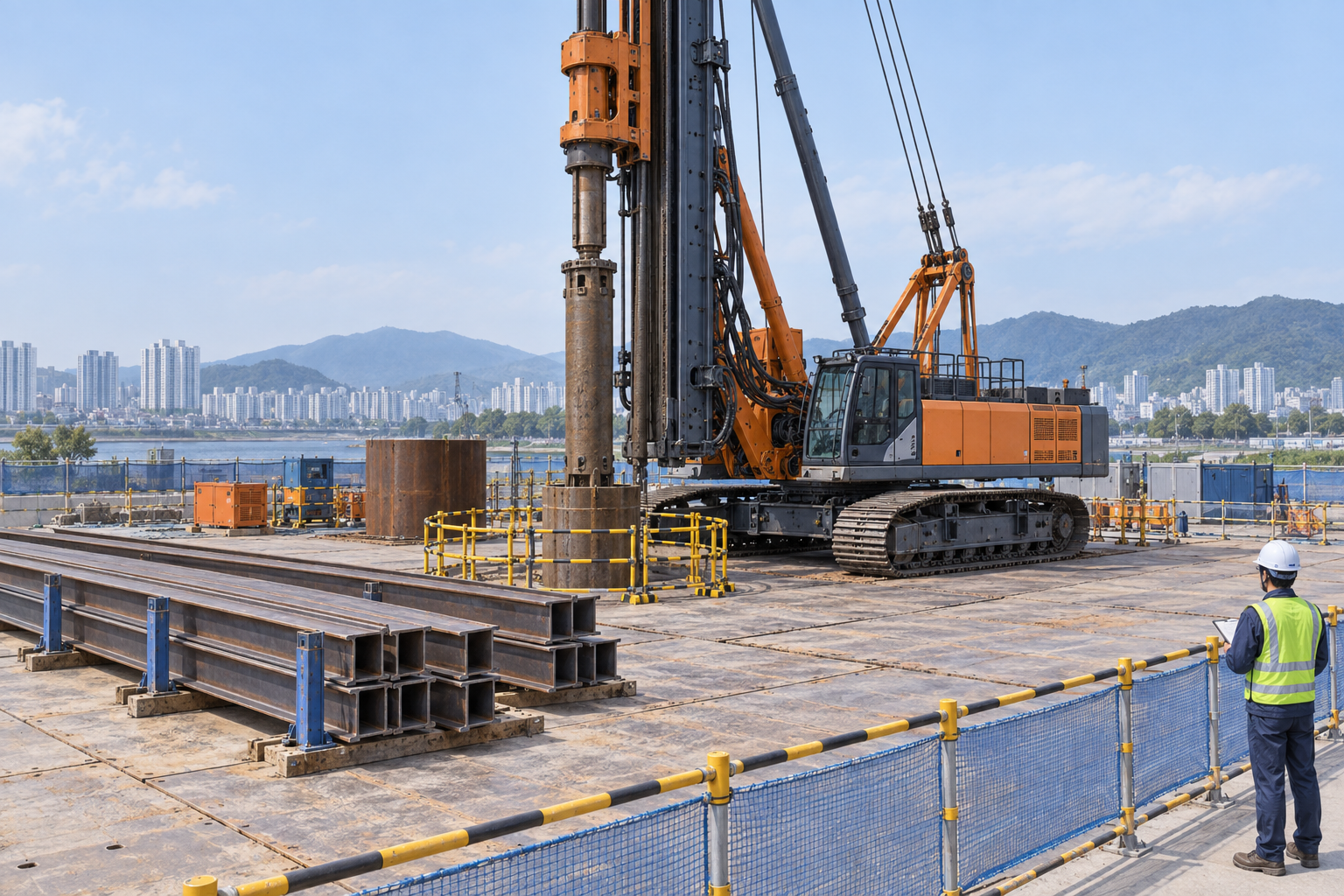
This illustration provides educational context. It is not an actual incident photograph or evidence of equipment suitability; any AI-generated depiction is illustrative only.
The scenario and record comparisons are fictional teaching examples, not records of real incidents, measurements, inspections, signatures or approvals.
| Stage | Fictional situation |
|---|---|
| Initial situation | A fictional crew lowers a long H-section into a drilled hole. |
| Changed condition | It catches partway down and the hoist line moves out of vertical. |
| Failure path | The crew considers dragging it sideways to force insertion. |
| Possible outcome | Unexpected forces could damage the bore, member or rigging and cause sudden rotation. |
| Prevention barrier | Hold the load in a safe condition, exclude access and review bore obstruction, alignment, residual load and recovery before another attempt. |
Failure mechanisms
Drilling changes nearby soil support and water conditions. An initially level platform does not prove continued support after a bore is opened. Track settlement, water, bore stability and the rig response throughout the sequence.
A long member has a large sweep even after a small change in center of gravity or rigging. Keep guides and tag-line personnel outside the suspended-member, rotation and pinch zones. Binding requires a reviewed recovery, not crane side loading or pushing.
Insertion and backfill are only part of a retaining system. Required lagging, walers, struts, anchors and monitoring must be completed for the particular excavation stage before the next cut is released.
Work sequence: Review ground and design → Set rig and boundaries → Inspect point and pile → Drill and protect bore → Lift and orient pile → Insert fix and fill → Hold bore or rig fault → Record next stage. This is a teaching flow, not a device drawing or a complete operating procedure.
5. Conditional decisions and common errors
| Situation | Required action | Evidence | Proceed when |
|---|---|---|---|
| Platform settles | Stop movement and drilling | Bearing, drainage and load review | Support accepted |
| Water or bore changes | Protect opening | Bore log and stabilization plan | Bore accepted |
| Pile catches | Do not side-pull | Depth, orientation and recovery review | Method released |
| Pile installed | Check next support stage | Fixing, backfill and shoring records | Excavation authorized |
Similar observations, different decisions
The scenario and record comparisons are fictional teaching examples, not records of real incidents, measurements, inspections, signatures or approvals.
| Observation | Insufficient conclusion | Required distinction |
|---|---|---|
| Platform was level | Initial condition | Drilling can change support |
| Crane can lift weight | Hoisting capacity | No side-pull permission |
| Pile in place | One component installed | Retaining system may be incomplete |
6. Roles and responsibilities
| Role | Responsibility |
|---|---|
| Work supervisor | Confirm ground and utilities and the task scope, resources, interfaces and stop authority. |
| Qualified technical reviewer | Review support and level, model limits, compatibility and unresolved technical conditions within assigned competence. |
| Work crew | Apply the listed controls, report changes and stop when evidence or safeguards are missing. |
| Inspector / assessor | Record actual balance and rigging and other relevant checks; do not mark unverified conditions as accepted. |
| Handover authority | Reconcile survey and embedment, restrictions and outstanding actions before the next task. Role labels do not establish a legal credential. |
Supervision and handover focus
| Stage | Management action | Evidence |
|---|---|---|
| Review ground and design | 1. Record ground and utilities2. Record method and drawing3. Record platform basis | 1. Ground and utilities2. Method and drawing3. Platform basis |
| Set rig and boundaries | 1. Record support and level2. Record drainage and travel3. Record mast clearance | 1. Support and level2. Drainage and travel3. Mast clearance |
| Drill and protect bore | 1. Record depth and geology2. Record water and bore condition3. Record platform response | 1. Depth and geology2. Water and bore condition3. Platform response |
| Lift and orient pile | 1. Record balance and rigging2. Record load configuration3. Record signals and guide position | 1. Balance and rigging2. Load configuration3. Signals and guide position |
| Hold bore or rig fault | 1. Record fault bore id2. Record ground support changes3. Record recovery review | 1. Fault bore ID2. Ground support changes3. Recovery review |
| Record next stage | 1. Record survey and embedment2. Record fixing and fill record3. Record stage release | 1. Survey and embedment2. Fixing and fill record3. Stage release |
7. Hold points and record comparison
| Hold point | Evidence before release | Actual approval |
|---|---|---|
| HP-0 Scope | Investigation, working-platform preparation, drilling, lifting and insertion of steel H-section soldier piles into drilled holes, specified fixing/backfill and handover to the next excavation-support stage. | |
| HP-1 Set rig and boundaries | Support and level; Drainage and travel; Mast clearance; Access boundary | |
| HP-2 Drill and protect bore | Depth and geology; Water and bore condition; Platform response; Opening safeguards | |
| HP-3 Hold bore or rig fault | Fault bore ID; Ground support changes; Recovery review; Restart authority | |
| HP-4 Record next stage | Survey and embedment; Fixing and fill record; Stage release; Monitoring and recipient |
Hold points are internal project checks. They are not universal statutory permits and do not grant work permission. Reassess after defects, changed conditions and shift changes.
Record comparison
The scenario and record comparisons are fictional teaching examples, not records of real incidents, measurements, inspections, signatures or approvals.
The boxes are static record prompts, not interactive or saved approvals. A tick does not establish suitability or permission to restart. Record the evidence, person, time and unresolved issues; retain the change history.
| Record | Insufficient record | Record checklist |
|---|---|---|
| Review ground and design | Only marked “OK” | □ Ground and utilities□ Method and drawing□ Platform basis□ Shoring sequence |
| Drill and protect bore | Only marked “OK” | □ Depth and geology□ Water and bore condition□ Platform response□ Opening safeguards |
| Hold bore or rig fault | Only marked “OK” | □ Fault bore ID□ Ground support changes□ Recovery review□ Restart authority |
| Record next stage | Only marked “OK” | □ Survey and embedment□ Fixing and fill record□ Stage release□ Monitoring and recipient |
8. Site checklist and emergency response
| Site check | Actual result | Person / action |
|---|---|---|
| Review ground and design: Ground and utilities; Method and drawing; Platform basis; Shoring sequence | ||
| Set rig and boundaries: Support and level; Drainage and travel; Mast clearance; Access boundary | ||
| Inspect point and pile: Bore and pile IDs; Tooling and rigging; Length weight center; Orientation and lift points | ||
| Drill and protect bore: Depth and geology; Water and bore condition; Platform response; Opening safeguards | ||
| Lift and orient pile: Balance and rigging; Load configuration; Signals and guide position; Exclusion maintained | ||
| Insert fix and fill: Depth and direction; Binding observations; Fixing and fill; Support release | ||
| Hold bore or rig fault: Fault bore ID; Ground support changes; Recovery review; Restart authority | ||
| Record next stage: Survey and embedment; Fixing and fill record; Stage release; Monitoring and recipient |
Stop work
Stop for platform settlement, mast tilt, bore collapse, sudden water inflow, abnormal resistance, member binding or unexpected inclination. Exclude the affected area and preserve support until a qualified recovery review.
Emergency response
Clear the possible collapse and suspended-load zones. Activate site emergency response; do not enter an unstable bore or approach a leaning rig to recover equipment. Qualified personnel stabilize and isolate before rescue or recovery.
9. Sources and review limits
Public-source access/review: 2026-10-13.
| Official source | Reviewed scope and limits |
|---|---|
| OSHA 1926.651 | Excavation utilities, access and changing ground/water conditions within scope. |
| OSHA 1926.1402 | Ground support for covered cranes; actual rig platform needs its own load review. |
| OSHA 1926.1417 | Covered-crane operating limitations, including no sideways dragging/pulling. |
No actual equipment model, SDS, site measurements, design calculations or authorization record was supplied. Product-specific limits and methods must be verified before use. Federal OSHA is a baseline within its scope; determine the applicable State Plan and local requirements. Manufacturer guidance is not government approval; an incorporated standard differs from voluntary guidance. No nationwide-compliance or expert-approval claim is made.
10. PDF guidance and FAQ
PDF A covers basic task controls; B focuses on technical failures; C covers supervision, records and handover. The article has eight stages with four items per main cell; each PDF has six key stages with three items per main cell. P/S/R/A, measurements, confirmations and signatures remain blank for actual site assessment.
PDFs are complementary six-stage extracts. Apply all eight body stages and the actual equipment/site procedure.
Can the crane force a stuck pile down?
No. Hold and review the obstruction, member position and recovery method.
When can rigging be removed?
Only after the specified embedment, fixing and stability conditions are verified.
Does completed pile insertion release excavation?
No. Release the next excavation stage only after its complete support and monitoring conditions are accepted.
Has a professional verified or approved this document?
No. Public sources and editorial, layout and consistency checks were reviewed using AI. No site inspection or professional technical approval has been performed. Obtain appropriate professional review before use.
11. Revision history and authorship
This is reference content written and revised with AI. It has not been verified or approved by a professional. Review by a suitably qualified professional and site authorization are required before use.
| Date | Version | Change | Review status |
|---|---|---|---|
| 2026-10-13 | US 1.0 | New US edition from assigned Korean source; task decisions, records and PDFs localized. | AI editorial review; no professional technical approval |
Korean edition revision history: 2026-09-19 (v1.0): earlier published draft/version retained in the source history; 2026-09-30 (v1.1): task decisions, record checklist, JSA and three PDF variants revised. These are editorial records, not professional technical approval. US v1.0 adapts the earlier edition to United States requirements and terminology.
Site reviewers must add their actual qualifications, scope, date and approval only after the review occurs.