Pump silence is not necessarily cycle completion. Some models still rinse or condense steam. Identify the actual completion indication and permitted hood-opening method; a familiar indicator color from another model is insufficient.
This is reference content written and revised with AI. It has not been verified or approved by a professional. Review by a suitably qualified professional and site authorization are required before use.
Stop before starting
Hold operation for hood support, handle or interlock defects, leakage, alarms, excess steam, unstable racks or broken dishes. Do not open before the actual model cycle and opening conditions are satisfied or repeatedly reset an unresolved fault.
1. Legal and technical scope
| Basis | Scope and limits |
|---|---|
| OSHA 1910.212 | Applicable moving-part and point-of-operation guarding. |
| OSHA 1910.22 | Wet-floor and access controls. |
| Hobart AM16 instructions F41173 | Model-family example of wash and condense completion; do not transfer cycles or settings between models. |
For general-industry food service, apply actual guarding under 1910.212, safe floors under 1910.22 and product hazard communication under 1910.1200. Servicing may require 1910.147 controls and is outside this normal-operation scope. Manufacturer instructions determine the model opening/completion conditions. Check State Plan and applicable local food-safety requirements; an indicated temperature alone proves neither safe skin contact nor sanitation acceptance.
2. Scope and required inputs
Included work
Normal loading, washing and unloading of a commissioned single-rack hood-type commercial dishwasher by trained operators, using permitted racks/programs and verified automatic chemical supply.
Separate assessment
Conveyor or domestic machines, concentrate replacement/mixing, deliming, hot-tank draining, internal cleaning, pump/heater/electrical repair and interlock adjustment require separate procedures. Food-hygiene acceptance is a separate responsibility.
| Required input | Evidence to obtain |
|---|---|
| Match machine and cycle | Model start and finish; Rack and program; Opening conditions; Operator training |
| Inspect hood and area | Hood and handle; Interlock condition; Chemical and water leaks; Floor and exhaust |
| Arrange rack | Sharp and broken items; Rack loading pattern; Load stability; Transfer height |
| Load and close | Rack guide position; Hands and nearby people; Hood closure; Start response |
No actual equipment model, SDS, site measurements, design calculations or authorization record was supplied. Product-specific limits and methods must be verified before use. Federal OSHA is a baseline within its scope; determine the applicable State Plan and local requirements. Manufacturer guidance is not government approval; an incorporated standard differs from voluntary guidance. No nationwide-compliance or expert-approval claim is made.
3. Eight-stage JSA
| Job stage | Hazards and effects | Failure factors | Technical and procedural controls | Site verification | P | S | R | A |
|---|---|---|---|---|---|---|---|---|
| 1. Match machine and cycle | 1. Early-opening burn2. Dish breakage3. Wrong automatic start4. Incomplete wash | 1. Other model assumed2. Wrong rack3. Start mode unknown4. Program mismatched | 1. Review model instructions2. Match rack and dishes3. Identify start behavior4. Confirm complete cycle | 1. Model start and finish2. Rack and program3. Opening conditions4. Operator training | ||||
| 2. Inspect hood and area | 1. Hood drop2. Finger pinch3. Chemical leak4. Floor slip | 1. Support defective2. Handle loose3. Hose leaking4. Drainage poor | 1. Check hood support2. Inspect handle and interlock3. Hold any leak4. Maintain drainage ventilation | 1. Hood and handle2. Interlock condition3. Chemical and water leaks4. Floor and exhaust | ||||
| 3. Arrange rack | 1. Broken-glass cut2. Heavy rack strain3. Dish fall4. Unstable load | 1. Damaged dish included2. Rack overloaded3. Stacking unsuitable4. Table height wrong | 1. Separate damaged dishes2. Use permitted loading3. Support dishes correctly4. Arrange handling height | 1. Sharp and broken items2. Rack loading pattern3. Load stability4. Transfer height | ||||
| 4. Load and close | 1. Hand crush2. Rack jam3. Unexpected cycle4. Hood damage | 1. Hand in guide2. Rack skewed3. Start mode ignored4. Hood forced | 1. Slide on stable guides2. Align without force3. Withdraw hands before close4. Use designated controls | 1. Rack guide position2. Hands and nearby people3. Hood closure4. Start response | ||||
| 5. Observe complete cycle | 1. Steam scald2. Hot-water exposure3. Chemical fault4. Electrical fault | 1. Hood opened midcycle2. Completion guessed3. Alarm repeatedly reset4. Leak ignored | 1. Keep hood closed as required2. Observe actual cycle phase3. Stop abnormal operation4. Report leaks and alarms | 1. Wash rinse condense state2. Steam behavior3. Alarm display4. Leaks and supply condition | ||||
| 6. Open and unload | 1. Steam burn2. Hot-dish contact3. Rack drop4. Wrist strain | 1. Face over opening2. Protection unsuitable3. Landing occupied4. Rack unsupported | 1. Wait for permitted opening2. Keep clear of steam path3. Use suitable heat protection4. Support rack on clear table | 1. Completion and steam2. Opening method3. Protection and dish state4. Receiving support | ||||
| 7. Hold fault or jam | 1. Repeated burn2. Leak exposure3. Interlock bypass4. Unsafe dish use | 1. Reset without cause2. Leak continues3. Safety held defeated4. Affected rack unmarked | 1. Stop further loading2. Control access3. Use qualified repair route4. Hold affected racks | 1. Error and leak details2. Hood and guard condition3. Repair and function result4. Rack identity and hold | ||||
| 8. Close and transfer | 1. Hot internal exposure2. Incomplete rack mixed3. Unexpected restart4. Lost service restriction | 1. Cleaning started immediately2. Cycle status missing3. Shutdown skipped4. Fault not handed over | 1. Use specified shutdown2. Switch to separate cleaning plan3. Identify held racks4. Transfer machine restrictions | 1. Shutdown and cleaning state2. Hot-water restrictions3. Held racks and checks4. Recipient and service status |
P = likelihood; S = severity; R = risk under the site method; A = site-defined acceptance/authorization. These actual assessment cells are blank. A low score never overrides a missing safeguard or a legal or manufacturer restriction.
4. Fictional scenario and failure mechanisms
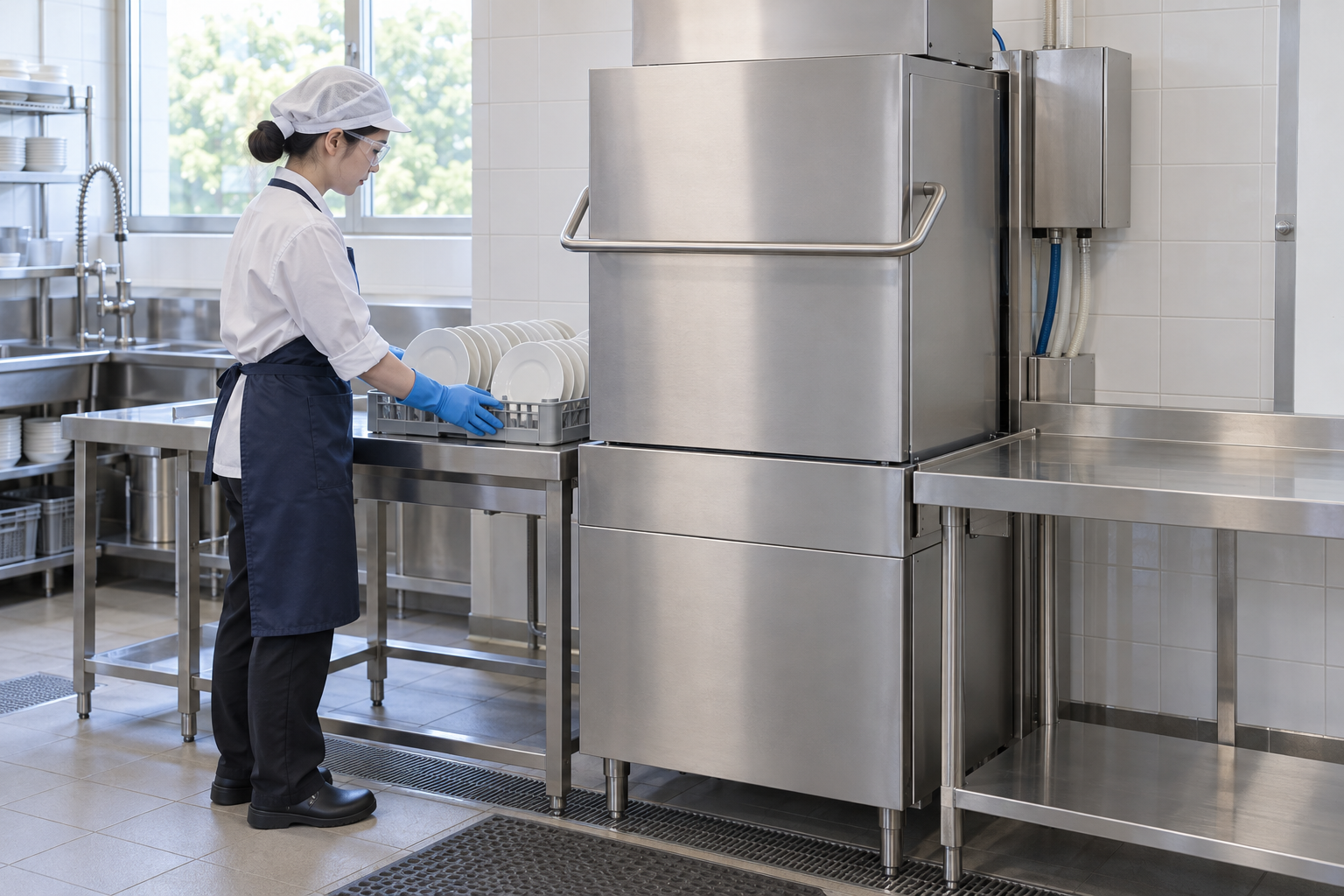
This illustration provides educational context. It is not an actual incident photograph or evidence of equipment suitability; any AI-generated depiction is illustrative only.
The scenario and record comparisons are fictional teaching examples, not records of real incidents, measurements, inspections, signatures or approvals.
| Stage | Fictional situation |
|---|---|
| Initial situation | A fictional operator hears the wash pump stop. |
| Changed condition | The display still shows condensation and the unloading table holds the previous rack. |
| Failure path | The operator starts to pull the hood to unload. |
| Possible outcome | Steam exposure and unstable handling of hot dishes could follow. |
| Prevention barrier | Wait for the model completion/opening conditions and clear the landing support before opening and unloading by the trained method. |
Failure mechanisms
Pump silence is not necessarily cycle completion. Some models still rinse or condense steam. Identify the actual completion indication and permitted hood-opening method; a familiar indicator color from another model is insufficient.
Clear the unloading support before starting. A hot rack should not be held while someone searches for landing space or simultaneously supports a defective hood. Plan stable sliding/support height and separate clean and soiled routes.
Equipment restoration and dish sanitation are different decisions. When a fault interrupts a rack, identify and hold that rack for the hygiene procedure even if the error clears. Heat-contact protection and chemical-resistant gloves are also separate selections.
Work sequence: Match machine and cycle → Inspect hood and area → Arrange rack → Load and close → Observe complete cycle → Open and unload → Hold fault or jam → Close and transfer. This is a teaching flow, not a device drawing or a complete operating procedure.
5. Conditional decisions and common errors
| Situation | Required action | Evidence | Proceed when |
|---|---|---|---|
| Cycle phase unclear | Keep hood closed | Model completion indication | Opening permitted |
| Landing table occupied | Delay unloading safely | Stable clear receiving space | Support available |
| Leak or hood defect | Stop further racks | Qualified cause and repair check | Machine accepted |
| Interrupted rack looks clean | Hold for hygiene decision | Cycle and reprocessing record | Rack disposition set |
Similar observations, different decisions
The scenario and record comparisons are fictional teaching examples, not records of real incidents, measurements, inspections, signatures or approvals.
| Observation | Insufficient conclusion | Required distinction |
|---|---|---|
| Pump quiet | One sound stopped | Rinse or condense may remain |
| Normal temperature display | Machine indication | Touch and sanitation separate |
| Error reset | Alarm cleared | Affected rack still on hold |
6. Roles and responsibilities
| Role | Responsibility |
|---|---|
| Work supervisor | Confirm model start and finish and the task scope, resources, interfaces and stop authority. |
| Qualified technical reviewer | Review hood and handle, model limits, compatibility and unresolved technical conditions within assigned competence. |
| Work crew | Apply the listed controls, report changes and stop when evidence or safeguards are missing. |
| Inspector / assessor | Record actual wash rinse condense state and other relevant checks; do not mark unverified conditions as accepted. |
| Handover authority | Reconcile shutdown and cleaning state, restrictions and outstanding actions before the next task. Role labels do not establish a legal credential. |
Supervision and handover focus
| Stage | Management action | Evidence |
|---|---|---|
| Match machine and cycle | 1. Record model start and finish2. Record rack and program3. Record opening conditions | 1. Model start and finish2. Rack and program3. Opening conditions |
| Inspect hood and area | 1. Record hood and handle2. Record interlock condition3. Record chemical and water leaks | 1. Hood and handle2. Interlock condition3. Chemical and water leaks |
| Load and close | 1. Record rack guide position2. Record hands and nearby people3. Record hood closure | 1. Rack guide position2. Hands and nearby people3. Hood closure |
| Observe complete cycle | 1. Record wash rinse condense state2. Record steam behavior3. Record alarm display | 1. Wash rinse condense state2. Steam behavior3. Alarm display |
| Hold fault or jam | 1. Record error and leak details2. Record hood and guard condition3. Record repair and function result | 1. Error and leak details2. Hood and guard condition3. Repair and function result |
| Close and transfer | 1. Record shutdown and cleaning state2. Record hot-water restrictions3. Record held racks and checks | 1. Shutdown and cleaning state2. Hot-water restrictions3. Held racks and checks |
7. Hold points and record comparison
| Hold point | Evidence before release | Actual approval |
|---|---|---|
| HP-0 Scope | Normal loading, washing and unloading of a commissioned single-rack hood-type commercial dishwasher by trained operators, using permitted racks/programs and verified automatic chemical supply. | |
| HP-1 Inspect hood and area | Hood and handle; Interlock condition; Chemical and water leaks; Floor and exhaust | |
| HP-2 Load and close | Rack guide position; Hands and nearby people; Hood closure; Start response | |
| HP-3 Hold fault or jam | Error and leak details; Hood and guard condition; Repair and function result; Rack identity and hold | |
| HP-4 Close and transfer | Shutdown and cleaning state; Hot-water restrictions; Held racks and checks; Recipient and service status |
Hold points are internal project checks. They are not universal statutory permits and do not grant work permission. Reassess after defects, changed conditions and shift changes.
Record comparison
The scenario and record comparisons are fictional teaching examples, not records of real incidents, measurements, inspections, signatures or approvals.
The boxes are static record prompts, not interactive or saved approvals. A tick does not establish suitability or permission to restart. Record the evidence, person, time and unresolved issues; retain the change history.
| Record | Insufficient record | Record checklist |
|---|---|---|
| Match machine and cycle | Only marked “OK” | □ Model start and finish□ Rack and program□ Opening conditions□ Operator training |
| Load and close | Only marked “OK” | □ Rack guide position□ Hands and nearby people□ Hood closure□ Start response |
| Hold fault or jam | Only marked “OK” | □ Error and leak details□ Hood and guard condition□ Repair and function result□ Rack identity and hold |
| Close and transfer | Only marked “OK” | □ Shutdown and cleaning state□ Hot-water restrictions□ Held racks and checks□ Recipient and service status |
8. Site checklist and emergency response
| Site check | Actual result | Person / action |
|---|---|---|
| Match machine and cycle: Model start and finish; Rack and program; Opening conditions; Operator training | ||
| Inspect hood and area: Hood and handle; Interlock condition; Chemical and water leaks; Floor and exhaust | ||
| Arrange rack: Sharp and broken items; Rack loading pattern; Load stability; Transfer height | ||
| Load and close: Rack guide position; Hands and nearby people; Hood closure; Start response | ||
| Observe complete cycle: Wash rinse condense state; Steam behavior; Alarm display; Leaks and supply condition | ||
| Open and unload: Completion and steam; Opening method; Protection and dish state; Receiving support | ||
| Hold fault or jam: Error and leak details; Hood and guard condition; Repair and function result; Rack identity and hold | ||
| Close and transfer: Shutdown and cleaning state; Hot-water restrictions; Held racks and checks; Recipient and service status |
Stop work
Hold operation for hood support, handle or interlock defects, leakage, alarms, excess steam, unstable racks or broken dishes. Do not open before the actual model cycle and opening conditions are satisfied or repeatedly reset an unresolved fault.
Emergency response
Stop further operation safely and keep clear of hot liquid, steam and leaking chemicals. Use site first aid and the actual chemical SDS for exposure; obtain medical assistance for serious burns or injury. Qualified personnel isolate and cool the machine before internal recovery.
9. Sources and review limits
Public-source access/review: 2026-10-14.
| Official source | Reviewed scope and limits |
|---|---|
| OSHA 1910.212 | Applicable moving-part and point-of-operation guarding. |
| OSHA 1910.22 | Wet-floor and access controls. |
| Hobart AM16 instructions F41173 | Model-family example of wash and condense completion; do not transfer cycles or settings between models. |
No actual equipment model, SDS, site measurements, design calculations or authorization record was supplied. Product-specific limits and methods must be verified before use. Federal OSHA is a baseline within its scope; determine the applicable State Plan and local requirements. Manufacturer guidance is not government approval; an incorporated standard differs from voluntary guidance. No nationwide-compliance or expert-approval claim is made.
10. PDF guidance and FAQ
PDF A covers basic task controls; B focuses on technical failures; C covers supervision, records and handover. The article has eight stages with four items per main cell; each PDF has six key stages with three items per main cell. P/S/R/A, measurements, confirmations and signatures remain blank for actual site assessment.
PDFs are complementary six-stage extracts. Apply all eight body stages and the actual equipment/site procedure.
Can the hood open when the pump stops?
Follow the actual completion and opening indication, including any condense stage.
Are chemical gloves enough for hot racks?
Confirm protection for the actual heat-contact and handling conditions; chemical resistance alone does not establish heat protection.
Can a stopped rack be used because dishes look clean?
Hold it for the responsible food-hygiene procedure and any required reprocessing.
Has a professional verified or approved this document?
No. Public sources and editorial, layout and consistency checks were reviewed using AI. No site inspection or professional technical approval has been performed. Obtain appropriate professional review before use.
11. Revision history and authorship
This is reference content written and revised with AI. It has not been verified or approved by a professional. Review by a suitably qualified professional and site authorization are required before use.
| Date | Version | Change | Review status |
|---|---|---|---|
| 2026-10-14 | US 1.0 | New US edition from assigned Korean source; task decisions, records and PDFs localized. | AI editorial review; no professional technical approval |
Korean edition revision history: 2026-10-08 (v1.0): initial article, sources, fictional analysis and PDF editorial checks. These are editorial records, not professional technical approval. US v1.0 adapts the earlier edition to United States requirements and terminology.
Site reviewers must add their actual qualifications, scope, date and approval only after the review occurs.