Initial mast erection and staged extension of an identified rack-and-pinion construction hoist using the actual engineered foundation, tie arrangement and manufacturer erection procedure. Determine whether the approved configuration is material-only or personnel service.
Stop for mast, foundation or tie deformation, uncertain component compatibility or fastening, incomplete stage support, worsening weather, lost signals, uncontrolled car motion or safety-device faults. Secure the permitted stable state before withdrawal.
Reference content written and revised with AI. It has not been verified or approved by a professional. Review by a suitably qualified professional and site approval are required before use.
1. Legal and technical scope
OSHA 1926.552 distinguishes material and personnel hoists. Its general provisions require compliance with applicable manufacturer limits; material-hoist tower design is addressed in (b)(7). Personnel-hoist tie and pre-service inspection provisions include (c)(3) and (c)(15). Do not generalize one category to another. Incorporated ANSI editions and the actual equipment-specific erection procedure were not obtained in full; resolve them and state requirements before field use.
Determine Federal OSHA or the applicable OSHA-approved State Plan, including public/private employer coverage. State Plans must be at least as effective and can impose different or additional requirements. The actual activity determines construction versus general-industry scope. Manufacturer instructions, consensus standards, project design and site approvals have distinct roles; this page is not a finding of nationwide compliance.
| Basis | Application and limits |
|---|---|
| OSHA 1926.552 | Selected classification, manufacturer-limit, tower-design, personnel tie and inspection provisions. No complete incorporated ANSI review or manufacturer erection approval. |
| OSHA 1926.251 | Applicable construction rigging capacity and inspection. Does not establish mast or building-connection capacity. |
2. Scope and required inputs
Included: Initial mast erection and staged extension of an identified rack-and-pinion construction hoist using the actual engineered foundation, tie arrangement and manufacturer erection procedure. Determine whether the approved configuration is material-only or personnel service.
Separate review: Tower-crane climbing, mast-climbing work platforms, general lifting hoists, permanent elevators, improvised rescue and changes outside reviewed erection drawings require separate plans.
| Input | Required evidence |
|---|---|
| Review model and support | Model and drawing revision; Erection load and projection; Foundation and building basis; Existing tie completion |
| Inspect parts and lifting | Parts and damage record; Rigging and lifting points; Rack and joint compatibility; Appliance and load rating |
| Align and connect | Required joints complete; Tool method and values; Rack and mast alignment; Support-release authority |
| Inspect and transfer | Inspection and test records; Defect correction; Landing and service range; Operator handover acceptance |
Confirm mast and rack versions, erection loads, tie locations, unsupported projection, foundation and building reactions, fastener method, erection appliance capacity and weather limits from the actual reviewed documents. Establish protected access, suitable fall-protection anchorage and rescue arrangements independently of an unverified new mast section.
3. Eight-stage JSA
P = likelihood; S = severity; R = risk under the site method; A = acceptance or authorization as defined by the site. Leave these blank until actual assessment and control verification. A low score does not override a legal requirement, product limit or unreleased hold point.
| Job stage | Hazards and effects | Failure factors | Required controls | Site verification | P | S | R | A |
|---|---|---|---|---|---|---|---|---|
| 1. Review model and support | 1. Mast collapse2. Foundation settlement3. Building-anchor failure4. Wrong-component use | 1. Final state used for erection2. Support reaction unverified3. Tie omitted4. Mast versions mixed | 1. Match model and drawings2. Review each erection state3. Trace foundation and ties4. Verify compatible components | 1. Model and drawing revision2. Erection load and projection3. Foundation and building basis4. Existing tie completion | ||||
| 2. Control access and energy | 1. Falling-object strike2. Weather control loss3. Unexpected car movement4. Installer fall | 1. Exclusion zone absent2. Wind limit unknown3. Restart not controlled4. Unverified anchor used | 1. Separate work and exclusion2. Review weather stop limits3. Apply required isolation4. Provide protected access | 1. Boundaries and signal owner2. Weather and interference3. Energy and support state4. Fall protection and rescue | ||||
| 3. Inspect parts and lifting | 1. Section failure2. Rigging release3. Rack mismatch4. Erection appliance overload | 1. Damaged joint face2. Wrong lifting point3. Rack version mismatch4. Capacity unverified | 1. Inspect identified sections2. Use specified lifting points3. Match component list4. Check erection appliance | 1. Parts and damage record2. Rigging and lifting points3. Rack and joint compatibility4. Appliance and load rating | ||||
| 4. Lift and approach | 1. Suspended-section strike2. Pinch injury3. Adjacent collision4. Platform overload | 1. Signals conflict2. Hands align joint3. Route changes unseen4. Staged load overlooked | 1. Use designated signaler2. Keep hands out of gaps3. Clear lifting path4. Check platform loading | 1. Load path and visibility2. Safe guiding method3. Stop signal understood4. People and material load | ||||
| 5. Align and connect | 1. Section overturn2. Joint failure on release3. Fastener loss4. Car interference | 1. Support removed too early2. Some bolts incomplete3. Mark used as sole proof4. Rack alignment wrong | 1. Follow connection sequence2. Retain lifting support3. Record specified fastening4. Verify alignment before release | 1. Required joints complete2. Tool method and values3. Rack and mast alignment4. Support-release authority | ||||
| 6. Tie and extend | 1. Unsupported mast buckling2. Tie anchor failure3. Building connection failure4. Excess top projection | 1. Tie work deferred2. Wrong anchor detail3. Final-state check only4. Next stage unreviewed | 1. Complete stage ties2. Verify building connections3. Check current geometry4. Release each next cycle | 1. Stage height and tie location2. Anchor and structure evidence3. Unsupported projection4. Next-stage hold release | ||||
| 7. Restore and hold | 1. Overtravel collision2. Cable snag or shock3. Unstable interrupted mast4. Restart with loose joint | 1. Limit bypass retained2. Cable route too short3. Stop state not marked4. Shift change unbriefed | 1. Restore actual safeguards2. Check full travel route3. Secure stable stopped state4. Recheck after interruption | 1. Limits interlocks and brakes2. Cable guide and clearance3. Stopped stage and restrictions4. Weather joint and tie recheck | ||||
| 8. Inspect and transfer | 1. Unverified hoist operation2. Landing access fall3. Use beyond accepted height4. Safety fault retained | 1. Trial run treated as release2. Required inspection missing3. Operating range unmarked4. Defect not closed | 1. Complete applicable inspection2. Verify landing protection3. Mark permitted service range4. Transfer defects and limits | 1. Inspection and test records2. Defect correction3. Landing and service range4. Operator handover acceptance |
4. Hypothetical scenario and failure mechanisms
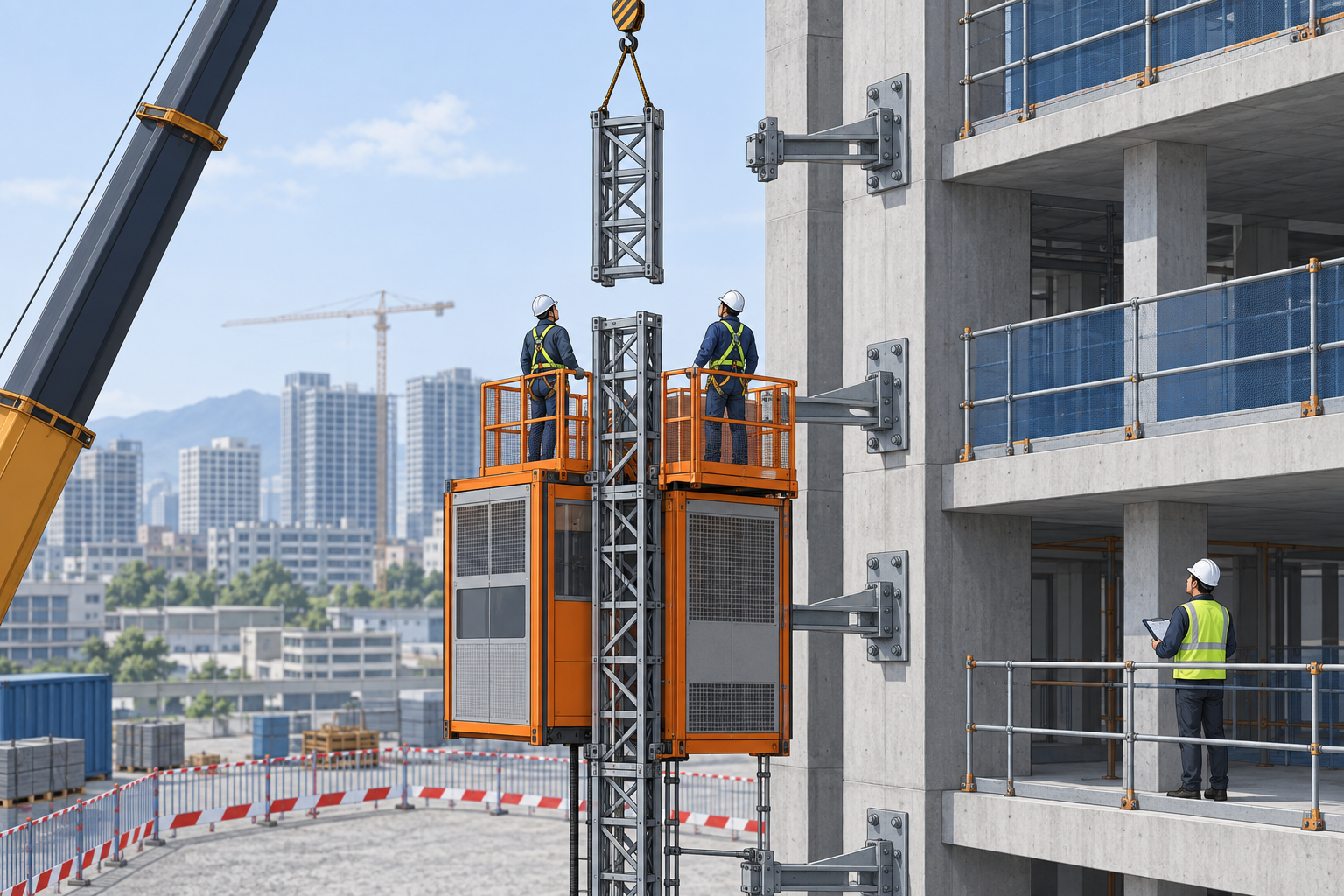 Retained source illustration: an AI-generated educational concept, not a real incident photograph or evidence of equipment suitability.
The following scenario, comparisons and example records are hypothetical teaching material. They do not reproduce actual incidents, measurements, signatures or approvals.
| Item | Hypothetical situation |
|---|---|
| Initial state | A crew extends a construction hoist to reach the next landing. |
| Change | The next mast section is prepared while the required wall tie remains incomplete. |
| Failure path | The final design height is treated as permission to exceed the current erection-stage projection. |
| Possible harm | Incomplete joints or excessive unsupported length can deform, fail or release a section. |
| Barrier | Hold the next lift, complete and verify the current connection and ties, then release the next erection stage against its own load and geometry limits. |
A completed installation drawing does not automatically validate every temporary erection state. Review the changing load path from foundation through mast joints and ties into the building, including eccentric lifting loads, installers and staged materials.
Placing a section is not the same as completing its connection. Retain lifting support until the specified joints, alignment and checks are complete. Paint marks support traceability but cannot prove the tightening method, value or connection capacity.
Some manufacturer erection sequences require controlled car movement. Treat that as a defined operating state with people in permitted positions and a designated controller. Return to the required isolation and mechanical support before exposed connection work; do not normalize improvised safety bypasses.
Materials-only and personnel-hoist provisions differ. Classify the equipment before selecting inspections, safeguards and tie requirements. Complete the applicable pre-service inspection and testing after extension; a test movement alone does not release normal operation or every landing.
| Decision | Reason and evidence |
|---|---|
| Known facts | The next mast section is prepared while the required wall tie remains incomplete. |
| Unresolved | The final design height is treated as permission to exceed the current erection-stage projection. |
| Hold reason | Stop for mast, foundation or tie deformation, uncertain component compatibility or fastening, incomplete stage support, worsening weather, lost signals, uncontrolled car motion or safety-device faults. Secure the permitted stable state before withdrawal. |
| Evidence needed | Limits interlocks and brakes; Cable guide and clearance; Stopped stage and restrictions; Weather joint and tie recheck. |
| Next decision | Hold the next lift, complete and verify the current connection and ties, then release the next erection stage against its own load and geometry limits. |
5. Conditional decisions and common errors
| Condition | Action | Evidence | Proceed when |
|---|---|---|---|
| Tie incomplete | Hold additional extension. | Current stage tie and projection basis. | Stage support complete. |
| Joint partly fastened | Retain lifting support. | Fastening and alignment evidence. | Required connection complete. |
| Cable interference | Hold travel testing and resolve route. | Full extension clearance check. | Route clear. |
| Shift interruption | Secure and mark the unfinished state. | Joints, ties and prohibited movement. | Restart review complete. |
| Comparison | Situation A | Situation B |
|---|---|---|
| Same mast height | Current joints and engineered ties are complete for the erection stage. | Final height is acceptable but an intermediate tie is missing. |
| Bolt marked | Specified method and inspection support the mark. | Paint is present without a fastening record. |
6. Roles and responsibilities
| Role | Responsibility |
|---|---|
| Work supervisor | Confirm scope, task sequence, exclusion and stop authority. Coordinate review model and support with affected operations. |
| Technical reviewer | Resolve the actual design and equipment limits: Model and drawing revision; Erection load and projection; Foundation and building basis; Existing tie completion. |
| Work crew | Perform inspect parts and lifting using the approved procedure; report any mismatch before proceeding. |
| Inspector / assessor | Verify Stage height and tie location; Anchor and structure evidence; Unsupported projection; Next-stage hold release. Record what was actually checked and what remains unresolved. |
| Release / receiving authority | Confirm Inspection and test records; Defect correction; Landing and service range; Operator handover acceptance. Transfer restrictions and the next permitted stage. |
These are responsibility examples, not invented statutory credentials. Meet the actual training, competent-person, qualified-person and licensing requirements for the assigned work. Anyone may raise a hazard and request a stop; only the designated authority may release the affected stage after evidence is reviewed.
7. Hold points and record comparison
| Hold point | Evidence before release | Confirmation / approval |
|---|---|---|
| HP-0 Start | Scope, jurisdiction, equipment identity, responsible people and emergency arrangements. | |
| HP-1 Inspect parts and lifting | Parts and damage record; Rigging and lifting points; Rack and joint compatibility; Appliance and load rating | |
| HP-2 Align and connect | Required joints complete; Tool method and values; Rack and mast alignment; Support-release authority | |
| HP-3 Tie and extend | Stage height and tie location; Anchor and structure evidence; Unsupported projection; Next-stage hold release | |
| HP-4 Inspect and transfer | Inspection and test records; Defect correction; Landing and service range; Operator handover acceptance |
Hold points are internal evidence gates. They do not replace statutory permits or actual signatures. Recheck affected gates after a change, abnormal event or shift transfer. The blank record must identify the evidence, person, time, limits and release scope.
| Record | Insufficient record | Record checklist |
|---|---|---|
| Support | Height reached | □ Stage height and tie location□ Anchor and structure evidence□ Unsupported projection□ Next-stage hold release |
| Connection | Paint marked | □ Required joints complete□ Tool method and values□ Rack and mast alignment□ Support-release authority |
| Restoration | Car moves | □ Limits interlocks and brakes□ Cable guide and clearance□ Stopped stage and restrictions□ Weather joint and tie recheck |
| Service | Test completed | □ Inspection and test records□ Defect correction□ Landing and service range□ Operator handover acceptance |
The □ boxes are static prompts, not saved or interactive approvals. Each checks one record element. A tick alone does not establish suitability or permission to restart. Link equipment IDs and supporting records; retain unresolved matters and the earlier record when conditions change.
8. Site checklist and emergency response
| Check item | Result | Person / action |
|---|---|---|
| Model and drawing revision | ||
| Boundaries and signal owner | ||
| Parts and damage record | ||
| Load path and visibility | ||
| Required joints complete | ||
| Stage height and tie location | ||
| Limits interlocks and brakes | ||
| Inspection and test records | ||
| Emergency arrangements and unresolved restrictions communicated |
Stop work: Stop for mast, foundation or tie deformation, uncertain component compatibility or fastening, incomplete stage support, worsening weather, lost signals, uncontrolled car motion or safety-device faults. Secure the permitted stable state before withdrawal.
Emergency response: For mast deformation, loss of power or stranded personnel, stop movement, control the area below and maintain the designed stable condition. Activate the equipment-specific rescue plan and call 911 for urgent rescue or injury. Do not use incomplete mastwork as an improvised rescue attachment or bypass safeguards to move the car.
9. Sources and review limits
Official-source review date: October 13, 2026. The following review is limited to the public provisions or selected manufacturer material identified below. It does not establish that any authority approved this article or the actual installation.
- OSHA 1926.552: Selected classification, manufacturer-limit, tower-design, personnel tie and inspection provisions. No complete incorporated ANSI review or manufacturer erection approval.
- OSHA 1926.251: Applicable construction rigging capacity and inspection. Does not establish mast or building-connection capacity.
- OSHA State Plans: jurisdiction and coverage overview; identify the actual state program before use.
Paid consensus standards and site-specific calculations, manuals, inspection records and product certificates were not independently obtained or verified unless specifically identified. Korean legal citations remain in the preserved Korean source as source history; they are not represented as US legal duties.
10. PDF guidance and FAQ
PDF A covers basic task controls; B examines technical failures; C focuses on supervision, evidence and handover. Each has six rows and three items per main cell. They are complementary extracts: apply all eight body stages and the applicable site procedure. An omitted stage is not permission to omit its controls. PDF HP-0 through HP-4 are worksheet labels; match the event, evidence and authority rather than assuming they match another permit by number.
P/S/R/A, actual measurements, confirmations and signatures remain blank. The PDFs are uncompleted reference worksheets, not issued work permits.
Content group ID: jsa-hoist-mast
May another section be added below the final height limit?
Only after the current erection-stage joints, ties, loads and unsupported projection are accepted.
Do paint marks prove bolt tightening?
No. Link the specified tool, method, values and inspection record.
Is the three-month inspection clause universal?
1926.552(c)(15) is in the personnel-hoist provisions. Classify the installed equipment and apply all relevant federal, state and manufacturer requirements.
Can an incomplete mast be a fall-arrest anchor?
Do not use an unverified section as an anchor. The actual anchorage and rescue plan require appropriate review before work.
Has a professional verified or approved this document?
No. This is AI-assisted reference material. Editorial and layout checks are not a physical inspection or professional technical approval. Obtain qualified professional review and required site approval before use.
11. Revision history and authorship
Reference content written and revised with AI. It has not been verified or approved by a professional. Review by a suitably qualified professional and site approval are required before use.
This system has not physically inspected the equipment, structures, ground, atmosphere or worksite. The document does not replace legal advice, manufacturer procedures, engineering design, inspection certificates, qualification evidence, the site risk assessment or an actual work permit.
Before use, a suitably qualified and authorized person must review the actual equipment, loads, methods, protection, inspection and emergency arrangements and resolve open issues. Record the real reviewer, organization, qualifications, delegated authority, reviewed documents, date, signature, exclusions and conditions of approval separately.
| Date | Version | Change | Review status |
|---|---|---|---|
| 2026-09-19 | Unmarked | Korean source revision retained in the source snapshot. | Historical editorial status; not US professional approval. |
| 2026-10-02 | 1.1 | Korean source revision retained in the source snapshot. | Historical editorial status; not US professional approval. |
| 2026-10-13 | US 1.0 | US localization of the assigned Korean source; task reasoning, educational image and history retained; US scope and sources reviewed. | AI-assisted editorial work; professional approval not performed. |