A detector showing no signal does not prove the concrete is clear. The drilling location, collection system and later anchor acceptance are separate checks.
This is reference content written and revised with AI. It has not been verified or approved by a professional. Review by a suitably qualified professional and required site authorization are necessary before use.
Stop conditions first
Stop for unknown structure/services, metallic resistance, binding, dust escape, unstable footing, damaged bits or holes outside the specified condition. Do not repeatedly trigger a bound drill.
1. US legal and technical basis
Construction concrete drilling: OSHA 1926.1153 silica controls and applicable electrical/tool protection. Anchor structural acceptance comes from the actual design and approved anchor instructions.
| Reference | Use and limit |
|---|---|
| OSHA 29 CFR 1926.1153 | Selected Table 1 (vii), indoor exhaust and exposure-assessment alternatives; all conditions must be applied together. |
| OSHA FS-3630, Handheld and Stand-Mounted Drills | Selected pages 1-2 on dust collection, HEPA hole cleaning, filter handling and indoor exhaust. Guidance supports the regulation; not anchor approval. |
| OSHA 29 CFR 1926.416 | Selected concealed electrical-circuit identification and protection; no permission to drill an uncertain circuit location. |
| OSHA State Plans | Federal baseline and State Plan coverage reviewed. Confirm the applicable state program and employer coverage; this edition does not establish nationwide compliance. |
Determine whether Federal OSHA or an applicable State Plan governs the employer and work. Standards incorporated into a regulation must be read in their legally applicable edition. Other NFPA/ANSI guidance and manufacturer instructions have distinct roles; they are not automatically federal law.
2. Scope and required inputs
Included
Use a cordless rotary hammer and compatible dust collection to drill specified small anchor holes from stable ground within a controlled two-hand working position.
Separate assessment
Overhead or ladder work, large cores, demolition, prestressed or unidentified structure, cutting reinforcement, anchor installation, pull testing and load release require separate assessment.
| Input | Evidence needed |
|---|---|
| Confirm hole location | Hole design/revision; Service/structure review; Scanner limits/findings; Anchor specification |
| Control access and rear face | Rear-face clearance; Footing and reach; Access boundary; Service isolation needs |
| Align and drill | Grip/body position; Bit alignment; Capture function; Material response |
| Transfer to installer | Hole map/dimensions; Cleaning record; Installation boundary; Receiver/restrictions |
Selected public official provisions were checked on October 14, 2026. This is not a complete legal audit. No actual equipment manual, site measurements, engineering calculations, product certification or professional technical approval was supplied. Full paid NFPA/ANSI standards and state/local amendments were not reviewed. Check actual equipment, jurisdiction and project requirements before use.
Select task-appropriate eye, hand, foot, skin and hearing protection from the exposure assessment. Where respiratory protection is necessary, use the applicable respiratory-protection program; PPE does not replace isolation, guarding, support or ventilation.
3. Eight-stage JSA
| Job stage | Hazards and effects | Failure factors | Controls | Site verification | P | S | R | A |
|---|---|---|---|---|---|---|---|---|
| 1. Confirm hole location | 1. Utility strike2. Structural damage3. Wrong anchor position4. Unapproved redesign | 1. Scan overtrusted2. Prestress unknown3. Drawing outdated4. Location moved casually | 1. Compare drawings and scan2. Resolve structural uncertainty3. Mark approved locations4. Obtain change disposition | 1. Hole design/revision2. Service/structure review3. Scanner limits/findings4. Anchor specification | ||||
| 2. Control access and rear face | 1. Breakthrough injury2. Trip/fall3. Bystander exposure4. Utility contact | 1. Rear area occupied2. Footing unstable3. Boundary absent4. Service not controlled | 1. Protect both faces2. Provide stable position3. Separate nearby people4. Apply service safeguards | 1. Rear-face clearance2. Footing and reach3. Access boundary4. Service isolation needs | ||||
| 3. Prepare bit and capture | 1. Bit ejection2. Silica release3. Tool kick4. Unexpected start | 1. Bit not locked2. Collector mismatched3. Handle loose4. Battery connected for setup | 1. Fit correct locked bit2. Match shroud and collector3. Secure auxiliary handle4. Isolate before adjustments | 1. Bit/model match2. Flow/filter/cleaning3. Handle and grip4. Power isolation | ||||
| 4. Align and drill | 1. Wrist twist2. Flying fragments3. Silica inhalation4. Hidden-service strike | 1. One-hand use2. Misalignment3. Shroud gap4. Resistance forced | 1. Use controlled two-hand grip2. Maintain alignment3. Maintain point capture4. Stop unexpected resistance | 1. Grip/body position2. Bit alignment3. Capture function4. Material response | ||||
| 5. Check finished hole | 1. Deficient anchor hole2. Crack concealed3. Wrong depth4. Hot-bit burn | 1. Stop setting trusted2. Damage ignored3. Measurement omitted4. Bit touched early | 1. Measure actual hole2. Inspect surrounding concrete3. Compare approved criteria4. Handle hot tools safely | 1. Diameter/depth2. Location and damage3. Hole disposition4. Bit temperature | ||||
| 6. Collect dust and tools | 1. Dust exposure2. Sharp debris cut3. Battery injury4. Residue dispersed | 1. Bag emptied openly2. Hands collect debris3. Tool poorly stored4. Air blast used | 1. Contain collected dust2. Use cleanup tools3. Isolate and store tool4. Use required HEPA cleaning | 1. Waste containment2. Cleanup/PPE3. Tool/battery state4. Hole-cleaning method | ||||
| 7. Hold binding or faults | 1. Repeated kick2. Service damage grows3. Dust-control bypass4. Defect reused | 1. Trigger pulsed2. Metal contact ignored3. Vacuum alarm dismissed4. Hole unmarked | 1. Stop and isolate2. Obtain service review3. Restore capture system4. Mark deficient holes | 1. Binding/cause record2. Structure disposition3. Corrected capture test4. Restart authorization | ||||
| 8. Transfer to installer | 1. Wrong hole used2. Cleaning omitted3. Load assumed safe4. Changes lost | 1. ID absent2. Procedure not linked3. Drilling treated as approval4. Handover skipped | 1. Identify each hole2. Link cleaning requirements3. Separate anchor acceptance4. Transfer defects/changes | 1. Hole map/dimensions2. Cleaning record3. Installation boundary4. Receiver/restrictions |
Actual risk assessments, measurements, checks, approvals and signatures have not been performed. Keep unverified fields blank and link the actual site records. P/S/R/A mean likelihood, severity, site-method risk and site-defined acceptance/authorization; a score cannot waive a required control.
4. Failure mechanisms and hypothetical case
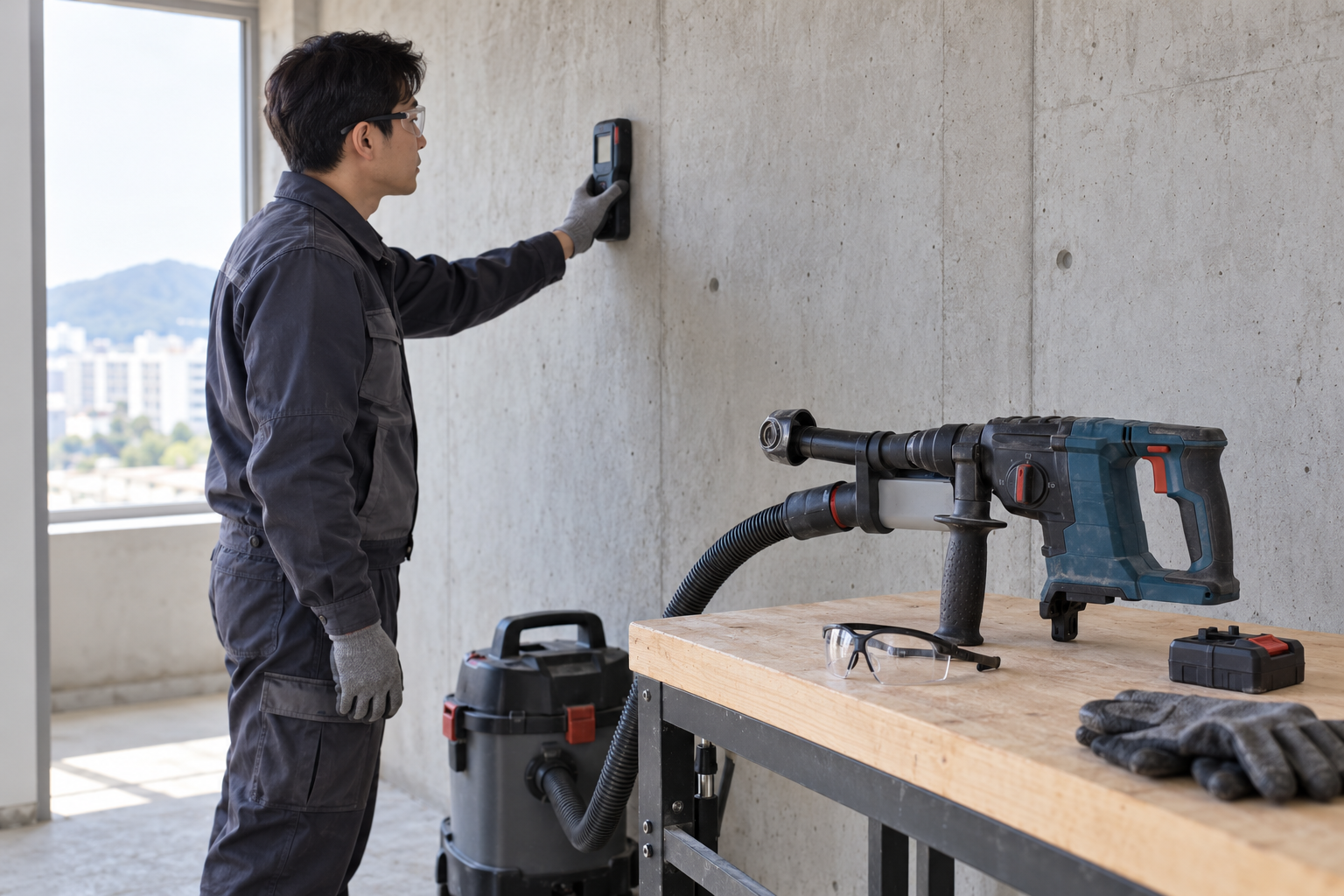
The retained illustration is an AI-generated educational image from the retained source edition. It is not an actual incident photograph, approved drawing, equipment certification or proof that the depicted arrangement is safe.
Compare drawings, scanning limits and actual routes before drilling. No signal may reflect depth, material or instrument limits. Resolve possible reinforcement, prestressing and electrical contact with the responsible reviewer; do not use an exploratory hole to bypass uncertainty.
For OSHA Table 1 handheld/stand-mounted drills, the shroud and collector must meet the listed airflow, filtration and filter-cleaning conditions, and hole cleaning uses a HEPA-filtered vacuum. Fully implement the applicable method or use the permitted exposure-assessment route. Low visible dust alone is not proof.
A running vacuum may have a blocked hose, full collection bag or leaking shroud. Check capture at the drilling point and control exposure while emptying the collector. Additional indoor exhaust may be needed.
The depth stop is a setup aid, not the finished-hole measurement. Record location, diameter, depth and damage; resolve the required anchor cleaning method together with dust controls. Do not improvise an air blast or hand over a deficient hole as accepted.
Hypothetical decision example
Hypothetical example: the bit meets metallic resistance and dust leaks from the shroud. A worker proposes repeated triggering and passing the shallow hole to the installer. Stop, isolate the tool, restrict the far side and obtain structural/service and capture-system review before a controlled restart.
The example is fictional; no incident, measurement, inspection or approval is asserted.
Task flow: Confirm hole location → Control access and rear face → Prepare bit and capture → Align and drill → Check finished hole → Collect dust and tools → Hold binding or faults → Transfer to installer
5. Hold and proceed decisions
| Condition | Action | Evidence | Proceed when |
|---|---|---|---|
| Metallic resistance | Stop; isolate tool | Structure/service review | Location released |
| Dust escapes | Hold drilling; correct capture | Shroud/flow/filter check | Capture restored |
| Hole off specification | Mark and quarantine hole | Actual dimensions/damage | Disposition approved |
| Back face unprotected | Close affected access | Breakthrough boundary | People protected |
Similar observation, different conclusion
| Observation | Supported conclusion | What remains unresolved |
|---|---|---|
| Scanner has no signal | No detectable response found | Hidden service absence unproved |
| Depth stop set | Target stop adjusted | Actual hole dimensions unverified |
6. Roles and supervision
| Role | Responsibility |
|---|---|
| Work supervisor | Coordinate confirm hole location, affected operations, stop signals and stage transitions. |
| Technical/equipment reviewer | Verify Hole design/revision, Service/structure review, actual instructions and unresolved technical limits. |
| Task crew | Apply the stated controls, report changes and keep actual checks and signatures factual. |
| Inspector/test lead | Connect Waste containment, Cleanup/PPE to the required acceptance criteria. |
| Receiving authority | Accept the recorded restrictions, Installation boundary, Receiver/restrictions, and follow-up ownership. |
These are responsibility examples, not invented statutory credentials. Verify actual competence, training and authority for the assigned work.
Supervision and handover controls
| Stage | Management controls | Evidence |
|---|---|---|
| Plan review | 1. Assign technical owner2. Close task-specific questions3. Compare drawings and scan | 1. Hole design/revision2. Service/structure review3. Anchor specification |
| Competence | 1. Verify required competence2. Assign stop authority3. Protect both faces | 1. Rear-face clearance2. Training and task briefing3. Service isolation needs |
| Prestart evidence | 1. Inspect actual equipment2. Link evidence to this stage3. Use controlled two-hand grip | 1. Grip/body position2. Bit alignment3. Material response |
| Change control | 1. Stop and secure the area2. Review affected controls3. Stop and isolate | 1. Binding/cause record2. Structure disposition3. Restart authorization |
| Shift handover | 1. Identify remaining restrictions2. Confirm receiving responsibility3. Identify each hole | 1. Hole map/dimensions2. Cleaning record3. Receiver/restrictions |
| Closeout | 1. Record defect disposition2. Archive factual evidence3. Identify each hole | 1. Hole map/dimensions2. Cleaning record3. Receiver/restrictions |
7. Hold points and record quality
| Hold point | Evidence before release | Actual record |
|---|---|---|
| HP-0 Start | Use a cordless rotary hammer and compatible dust collection to drill specified small anchor holes from stable ground within a controlled two-hand working position. | |
| HP-1 Control access and rear face | Rear-face clearance; Footing and reach; Access boundary; Service isolation needs | |
| HP-2 Align and drill | Grip/body position; Bit alignment; Capture function; Material response | |
| HP-3 Hold binding or faults | Binding/cause record; Structure disposition; Corrected capture test; Restart authorization | |
| HP-4 Transfer to installer | Hole map/dimensions; Cleaning record; Installation boundary; Receiver/restrictions |
Hold points are internal evidence gates. They do not establish that a statutory permit exists or has been approved. Recheck affected gates after changes, faults and shift handover.
Record comparison - hypothetical templates
The 16 boxes below identify record elements, not completed checks or approvals. They are static symbols. Link equipment/location, date, actual findings and the separate record reference; preserve unresolved items.
| Record | Insufficient entry | Required record elements |
|---|---|---|
| Confirm hole location | "Checked" without supporting facts | □ Hole design/revision□ Service/structure review□ Scanner limits/findings□ Anchor specification |
| Prepare bit and capture | "Checked" without supporting facts | □ Bit/model match□ Flow/filter/cleaning□ Handle and grip□ Power isolation |
| Check finished hole | "Checked" without supporting facts | □ Diameter/depth□ Location and damage□ Hole disposition□ Bit temperature |
| Hold binding or faults | "Checked" without supporting facts | □ Binding/cause record□ Structure disposition□ Corrected capture test□ Restart authorization |
8. Pre-work checks and emergency response
| Check required | Result | Checker/action |
|---|---|---|
| Confirm hole location: Hole design/revision | ||
| Control access and rear face: Rear-face clearance | ||
| Prepare bit and capture: Bit/model match | ||
| Align and drill: Grip/body position | ||
| Check finished hole: Diameter/depth | ||
| Collect dust and tools: Waste containment | ||
| Hold binding or faults: Binding/cause record | ||
| Transfer to installer: Hole map/dimensions |
Stop work
Stop for unknown structure/services, metallic resistance, binding, dust escape, unstable footing, damaged bits or holes outside the specified condition. Do not repeatedly trigger a bound drill.
Emergency response
Release the trigger, isolate the tool when safe and restrict the area for suspected utility contact. Do not touch a suspected energized tool, service or casualty until the electrical hazard is controlled by qualified responders. Call site emergency response and 911 for serious injury; provide service location and access information. Avoid unplanned entry to the far side.
9. Official sources and review limits
Official public-source check: October 14, 2026. The review concerns the selected passages described below, not endorsement of this article.
| Official source | Checked scope and limit |
|---|---|
| OSHA 29 CFR 1926.1153 | Selected Table 1 (vii), indoor exhaust and exposure-assessment alternatives; all conditions must be applied together. |
| OSHA FS-3630, Handheld and Stand-Mounted Drills | Selected pages 1-2 on dust collection, HEPA hole cleaning, filter handling and indoor exhaust. Guidance supports the regulation; not anchor approval. |
| OSHA 29 CFR 1926.416 | Selected concealed electrical-circuit identification and protection; no permission to drill an uncertain circuit location. |
| OSHA State Plans | Federal baseline and State Plan coverage reviewed. Confirm the applicable state program and employer coverage; this edition does not establish nationwide compliance. |
Selected public official provisions were checked on October 14, 2026. This is not a complete legal audit. No actual equipment manual, site measurements, engineering calculations, product certification or professional technical approval was supplied. Full paid NFPA/ANSI standards and state/local amendments were not reviewed. Check actual equipment, jurisdiction and project requirements before use.
This is reference content written and revised with AI. It has not been verified or approved by a professional. Review by a suitably qualified professional and required site authorization are necessary before use.
10. PDF use and frequently asked questions
PDF A summarizes core controls; B emphasizes technical failures; C covers supervision, records and handover. Each uses six stages from or aligned with the eight-stage body. All actual risk, measurement, check and signature fields are blank. Use a separate linked record where more space is needed.
May a small test hole resolve an unknown service?
No. Resolve the uncertainty through the approved survey and review process first.
Does Table 1 cover every drill automatically?
The task, equipment and all listed controls must match and be fully implemented; otherwise use the applicable alternative route.
Can any vacuum clean the hole?
Use the required HEPA-filtered hole-cleaning system and compatible anchor installation procedure.
Does a drilled hole authorize loading an anchor?
No. Installation, testing and load acceptance are separate subsequent decisions.
Has a professional approved this JSA?
This is reference content written and revised with AI. It has not been verified or approved by a professional. Review by a suitably qualified professional and required site authorization are necessary before use.
11. Authorship and revision history
This is reference content written and revised with AI. It has not been verified or approved by a professional. Review by a suitably qualified professional and required site authorization are necessary before use.
| Date/version | Editorial history | Technical approval |
|---|---|---|
| October 04, 2026 / Korean v1.0 | Korean source: initial article, evidence, hypothetical decisions and body/PDF editorial checks. | Professional technical approval not performed |
| October 14, 2026 / US v1.0 | US localization: Retains metallic resistance plus dust escape and deficient-hole handover. Adds US Table 1 drill conditions without treating a running vacuum or set depth stop as proof. | Not performed |
Source topic: https://smartjsabridge.com/ko/case-study/jsa-hammer-drill-anchor-holes
Content group: jsa-hammer-drill-anchor-holes