A bag can conceal a sharp object even when no hand enters it. Pressing it with a foot or bracing it against a thigh can drive the object through the bag. Use visual checks and the established abnormal-bag procedure; gloves alone do not resolve the hazard.
This is reference content written and revised with AI. It has not been verified or approved by a professional. Review by a suitably qualified professional and site authorization are required before use.
Stop before starting
Hold bags with protrusions, suspected needles, leaks, tears, heat, smoke, unexplained odor or unsafe weight. Stop for a blocked or slippery route. Do not compress, sniff closely, open or hand-search a suspect bag.
1. Legal and technical scope
| Basis | Scope and limits |
|---|---|
| OSHA 1910.1030 | Occupational-exposure applicability, contaminated sharps and post-exposure arrangements. |
| OSHA 1910.22 | General-industry walking-working surface cleanliness and safe conditions. |
| OSHA 1910.138 | Hand-protection selection based on actual hazards; gloves are not universal puncture protection. |
This is general-industry custodial work. Determine task-specific housekeeping, PPE and handling controls and applicable State Plan requirements. The bloodborne-pathogens standard applies when occupational exposure is reasonably anticipated, not automatically to every office bag. Suspected contaminated sharps trigger the employer exposure-control/incident process; this article does not authorize hazardous-waste classification or disposal under state/local rules.
2. Scope and required inputs
Included work
Visual checking, closing and collecting segregated general-waste bags from offices/common areas, then moving them by a dedicated cart on a level route to the designated collection point. No hand sorting inside bags.
Separate assessment
Medical, infectious, chemical or asbestos waste, batteries/cylinders, direct collection of loose sharps, bulky loads, vehicle loading, compactors, heavy stair carrying and roadside collection require separate methods.
| Required input | Evidence to obtain |
|---|---|
| Confirm zone and waste | Zone and criteria; Responsible contact; Excluded items; Public movement |
| Prepare cart and PPE | Cart condition; Load limits; Hand and foot PPE; Route and wash point |
| Inspect bag visually | Protrusions and tears; Leak observations; Closure and fill; Handling difficulty |
| Close and remove | Hand and body clearance; Pull resistance; Bag deformation; Closure result |
No actual equipment model, SDS, site measurements, design calculations or authorization record was supplied. Product-specific limits and methods must be verified before use. Federal OSHA is a baseline within its scope; determine the applicable State Plan and local requirements. Manufacturer guidance is not government approval; an incorporated standard differs from voluntary guidance. No nationwide-compliance or expert-approval claim is made.
3. Eight-stage JSA
| Job stage | Hazards and effects | Failure factors | Technical and procedural controls | Site verification | P | S | R | A |
|---|---|---|---|---|---|---|---|---|
| 1. Confirm zone and waste | 1. Hazardous waste contact2. Bystander exposure3. Wrong collection4. Unreported exception | 1. General waste assumed2. Routes overlap3. Zone unclear4. Labels ignored | 1. Check segregation rules2. Coordinate collection time3. Identify assigned zone4. Hold excluded waste | 1. Zone and criteria2. Responsible contact3. Excluded items4. Public movement | ||||
| 2. Prepare cart and PPE | 1. Push strain2. Cart overturn3. Hand exposure4. Foot injury | 1. Wheel defective2. Capacity unknown3. Glove damaged4. Route blocked | 1. Inspect wheels and capacity2. Select suitable protection3. Provide handwashing4. Clear level route | 1. Cart condition2. Load limits3. Hand and foot PPE4. Route and wash point | ||||
| 3. Inspect bag visually | 1. Puncture2. Leak contact3. Bag rupture4. Unexpected heavy load | 1. Bag squeezed2. Leak ignored3. Tear hidden4. Weight assumed | 1. Inspect without pressing2. Hold suspect bags3. Check closure condition4. Assess handling method | 1. Protrusions and tears2. Leak observations3. Closure and fill4. Handling difficulty | ||||
| 4. Close and remove | 1. Hidden sharp cut2. Back strain3. Bag rupture4. Pinched hand | 1. Foot compression2. Body used as support3. Forceful pulling4. Overfilled container | 1. Close without compression2. Keep bag away from body3. Hold difficult removal4. Use accepted handling | 1. Hand and body clearance2. Pull resistance3. Bag deformation4. Closure result | ||||
| 5. Load cart and move | 1. Falling bags2. Wheel pinch3. Pedestrian collision4. Slip | 1. Unstable stacking2. Hands near wheels3. View blocked4. Wet route | 1. Load within cart2. Keep hands clear3. Maintain forward view4. Separate pedestrian path | 1. Load stability2. Leaks and cart3. Doors and thresholds4. People and floor | ||||
| 6. Place at collection point | 1. Bag burst2. Waste mixing3. Blocked exit4. Residual contamination | 1. Bags thrown2. Area changed3. Stack in route4. Spill left | 1. Place bags gently2. Use designated zone3. Keep exits clear4. Manage residual spill | 1. Collection location2. Bag condition3. Waste separation4. Clear access | ||||
| 7. Hold abnormal bag | 1. Puncture2. Exposure spread3. Heat or fire4. Repeat contact | 1. Hand searching2. Area unmarked3. Hot bag moved4. Status not reported | 1. Do not open or compress2. Control access3. Escalate heat or fumes4. Assign special collection | 1. Location and symptoms2. Exposure report3. Special handling4. Area release | ||||
| 8. Hygiene and handover | 1. Contamination transfer2. Dirty tool reuse3. Held bag removed4. Incomplete collection | 1. Dirty glove on handles2. Tools mixed3. Hold omitted4. List not updated | 1. Follow glove removal2. Clean designated equipment3. Transfer held locations4. Update collection record | 1. Hand hygiene2. Cart and tools3. Held items and owner4. Next action and recipient |
P = likelihood; S = severity; R = risk under the site method; A = site-defined acceptance/authorization. These actual assessment cells are blank. A low score never overrides a missing safeguard or a legal or manufacturer restriction.
4. Fictional scenario and failure mechanisms
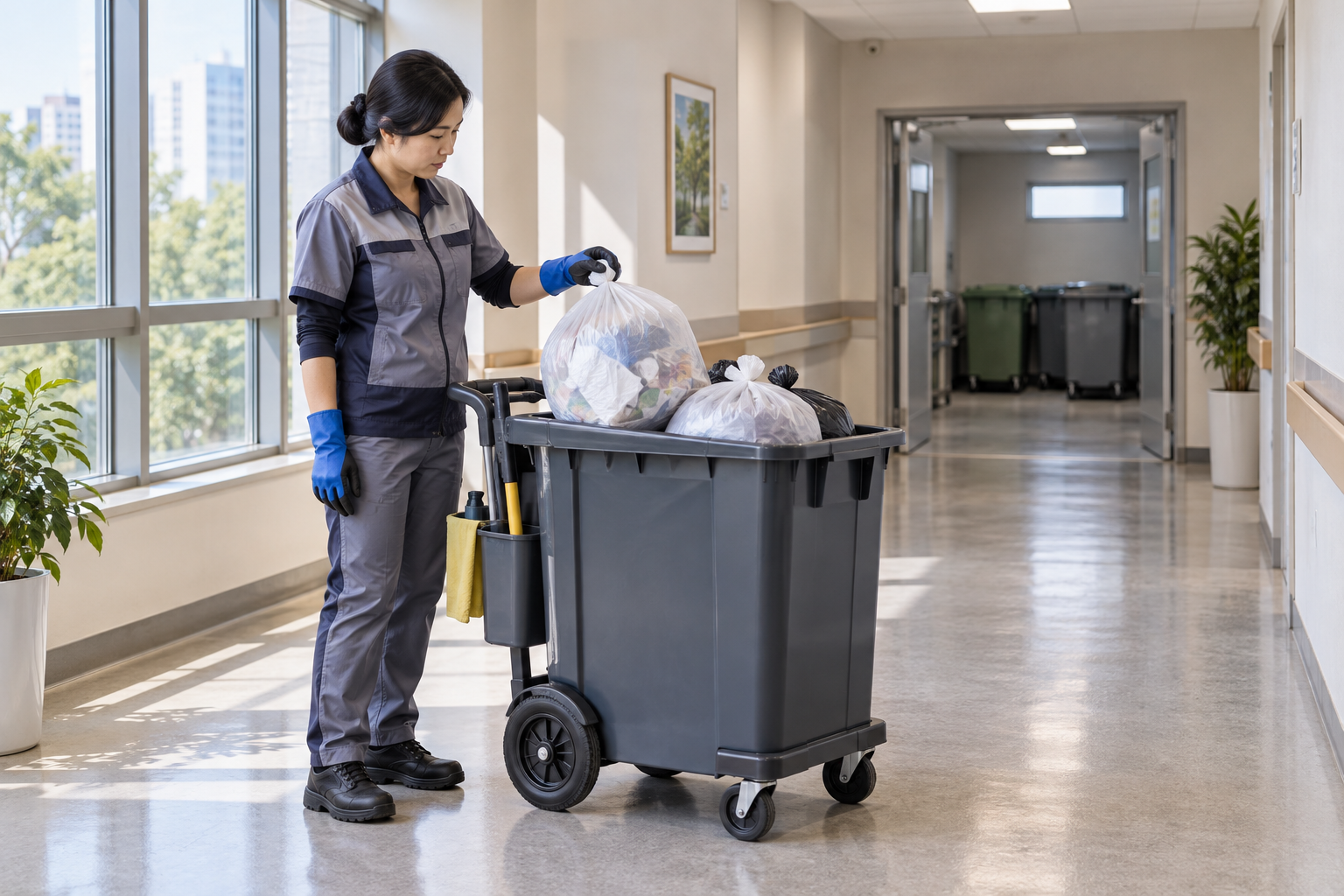
This illustration provides educational context. It is not an actual incident photograph or evidence of equipment suitability; any AI-generated depiction is illustrative only.
The scenario and record comparisons are fictional teaching examples, not records of real incidents, measurements, inspections, signatures or approvals.
| Stage | Fictional situation |
|---|---|
| Initial situation | A fictional custodian prepares to remove an office waste bag. |
| Changed condition | It is heavier than expected and a pointed object is visible through its side. |
| Failure path | A suggestion is made to compress it by foot before placing it on the cart. |
| Possible outcome | A puncture, spill or handling injury could result. |
| Prevention barrier | Do not compress or search it; restrict access and refer its location and observations for an appropriate collection method. |
Failure mechanisms
A bag can conceal a sharp object even when no hand enters it. Pressing it with a foot or bracing it against a thigh can drive the object through the bag. Use visual checks and the established abnormal-bag procedure; gloves alone do not resolve the hazard.
Setting an abnormal bag beside a route is not a completed control. Prevent access, identify its original location and visible condition, notify the responsible person and mark the collection record so another worker does not pick it up unknowingly.
Dirty gloves can transfer contamination to doors and elevator controls. Plan cart movement, door handling, glove removal and hand hygiene together. Keep reusable collection equipment separate from clean supplies.
Work sequence: Confirm zone and waste → Prepare cart and PPE → Inspect bag visually → Close and remove → Load cart and move → Place at collection point → Hold abnormal bag → Hygiene and handover. This is a teaching flow, not a device drawing or a complete operating procedure.
5. Conditional decisions and common errors
| Situation | Required action | Evidence | Proceed when |
|---|---|---|---|
| Sharp object suspected | Leave undisturbed | Location and visible condition | Special handling arranged |
| Bag leaks | Control access | Leak type and containment review | Area restored |
| Load too difficult | Hold lifting | Weight, grip and cart method | Handling accepted |
| Route blocked | Replan movement | Clear level path | Route available |
Similar observations, different decisions
The scenario and record comparisons are fictional teaching examples, not records of real incidents, measurements, inspections, signatures or approvals.
| Observation | Insufficient conclusion | Required distinction |
|---|---|---|
| Gloves worn | Some protection provided | Not proof against every sharp |
| Bag sealed | Closure completed | Waste classification unproved |
| Moved aside | Location changed | People may still contact it |
6. Roles and responsibilities
| Role | Responsibility |
|---|---|
| Work supervisor | Confirm zone and criteria and the task scope, resources, interfaces and stop authority. |
| Qualified technical reviewer | Review cart condition, model limits, compatibility and unresolved technical conditions within assigned competence. |
| Work crew | Apply the listed controls, report changes and stop when evidence or safeguards are missing. |
| Inspector / assessor | Record actual load stability and other relevant checks; do not mark unverified conditions as accepted. |
| Handover authority | Reconcile hand hygiene, restrictions and outstanding actions before the next task. Role labels do not establish a legal credential. |
Supervision and handover focus
| Stage | Management action | Evidence |
|---|---|---|
| Confirm zone and waste | 1. Record zone and criteria2. Record responsible contact3. Record excluded items | 1. Zone and criteria2. Responsible contact3. Excluded items |
| Prepare cart and PPE | 1. Record cart condition2. Record load limits3. Record hand and foot ppe | 1. Cart condition2. Load limits3. Hand and foot PPE |
| Close and remove | 1. Record hand and body clearance2. Record pull resistance3. Record bag deformation | 1. Hand and body clearance2. Pull resistance3. Bag deformation |
| Load cart and move | 1. Record load stability2. Record leaks and cart3. Record doors and thresholds | 1. Load stability2. Leaks and cart3. Doors and thresholds |
| Hold abnormal bag | 1. Record location and symptoms2. Record exposure report3. Record special handling | 1. Location and symptoms2. Exposure report3. Special handling |
| Hygiene and handover | 1. Record hand hygiene2. Record cart and tools3. Record held items and owner | 1. Hand hygiene2. Cart and tools3. Held items and owner |
7. Hold points and record comparison
| Hold point | Evidence before release | Actual approval |
|---|---|---|
| HP-0 Scope | Visual checking, closing and collecting segregated general-waste bags from offices/common areas, then moving them by a dedicated cart on a level route to the designated collection point. No hand sorting inside bags. | |
| HP-1 Prepare cart and PPE | Cart condition; Load limits; Hand and foot PPE; Route and wash point | |
| HP-2 Close and remove | Hand and body clearance; Pull resistance; Bag deformation; Closure result | |
| HP-3 Hold abnormal bag | Location and symptoms; Exposure report; Special handling; Area release | |
| HP-4 Hygiene and handover | Hand hygiene; Cart and tools; Held items and owner; Next action and recipient |
Hold points are internal project checks. They are not universal statutory permits and do not grant work permission. Reassess after defects, changed conditions and shift changes.
Record comparison
The scenario and record comparisons are fictional teaching examples, not records of real incidents, measurements, inspections, signatures or approvals.
The boxes are static record prompts, not interactive or saved approvals. A tick does not establish suitability or permission to restart. Record the evidence, person, time and unresolved issues; retain the change history.
| Record | Insufficient record | Record checklist |
|---|---|---|
| Confirm zone and waste | Only marked “OK” | □ Zone and criteria□ Responsible contact□ Excluded items□ Public movement |
| Close and remove | Only marked “OK” | □ Hand and body clearance□ Pull resistance□ Bag deformation□ Closure result |
| Hold abnormal bag | Only marked “OK” | □ Location and symptoms□ Exposure report□ Special handling□ Area release |
| Hygiene and handover | Only marked “OK” | □ Hand hygiene□ Cart and tools□ Held items and owner□ Next action and recipient |
8. Site checklist and emergency response
| Site check | Actual result | Person / action |
|---|---|---|
| Confirm zone and waste: Zone and criteria; Responsible contact; Excluded items; Public movement | ||
| Prepare cart and PPE: Cart condition; Load limits; Hand and foot PPE; Route and wash point | ||
| Inspect bag visually: Protrusions and tears; Leak observations; Closure and fill; Handling difficulty | ||
| Close and remove: Hand and body clearance; Pull resistance; Bag deformation; Closure result | ||
| Load cart and move: Load stability; Leaks and cart; Doors and thresholds; People and floor | ||
| Place at collection point: Collection location; Bag condition; Waste separation; Clear access | ||
| Hold abnormal bag: Location and symptoms; Exposure report; Special handling; Area release | ||
| Hygiene and handover: Hand hygiene; Cart and tools; Held items and owner; Next action and recipient |
Stop work
Hold bags with protrusions, suspected needles, leaks, tears, heat, smoke, unexplained odor or unsafe weight. Stop for a blocked or slippery route. Do not compress, sniff closely, open or hand-search a suspect bag.
Emergency response
Keep people clear of smoke, heat or unknown leakage and activate the site emergency plan. For a puncture or suspected blood exposure, promptly follow the employer exposure-reporting and medical-evaluation process; do not delay to identify contents by hand. Serious symptoms require emergency medical assistance.
9. Sources and review limits
Public-source access/review: 2026-10-13.
| Official source | Reviewed scope and limits |
|---|---|
| OSHA 1910.1030 | Occupational-exposure applicability, contaminated sharps and post-exposure arrangements. |
| OSHA 1910.22 | General-industry walking-working surface cleanliness and safe conditions. |
| OSHA 1910.138 | Hand-protection selection based on actual hazards; gloves are not universal puncture protection. |
No actual equipment model, SDS, site measurements, design calculations or authorization record was supplied. Product-specific limits and methods must be verified before use. Federal OSHA is a baseline within its scope; determine the applicable State Plan and local requirements. Manufacturer guidance is not government approval; an incorporated standard differs from voluntary guidance. No nationwide-compliance or expert-approval claim is made.
10. PDF guidance and FAQ
PDF A covers basic task controls; B focuses on technical failures; C covers supervision, records and handover. The article has eight stages with four items per main cell; each PDF has six key stages with three items per main cell. P/S/R/A, measurements, confirmations and signatures remain blank for actual site assessment.
PDFs are complementary six-stage extracts. Apply all eight body stages and the actual equipment/site procedure.
Can bags be pressed down to save space?
Do not compress them with hands, feet or the body; hidden sharps can penetrate.
Should an unknown bag be opened to identify it?
Do not search by hand. Refer it through the designated abnormal-waste process.
What must the next shift receive?
The location and status of uncollected bags, access restrictions, responsible contact and pending action.
Has a professional verified or approved this document?
No. Public sources and editorial, layout and consistency checks were reviewed using AI. No site inspection or professional technical approval has been performed. Obtain appropriate professional review before use.
11. Revision history and authorship
This is reference content written and revised with AI. It has not been verified or approved by a professional. Review by a suitably qualified professional and site authorization are required before use.
| Date | Version | Change | Review status |
|---|---|---|---|
| 2026-10-13 | US 1.0 | New US edition from assigned Korean source; task decisions, records and PDFs localized. | AI editorial review; no professional technical approval |
Korean edition revision history: 2026-10-08 (v1.0): initial article, sources, fictional analysis and PDF editorial checks. These are editorial records, not professional technical approval. US v1.0 adapts the earlier edition to United States requirements and terminology.
Site reviewers must add their actual qualifications, scope, date and approval only after the review occurs.