The required clear path is wider than the hook centerline: include the load ends, possible rotation/sway, gantry legs and wheel pinch zones. A load within rated capacity can still strike a person or structure.
This reference material was written and revised with AI. It has not been verified or approved by a professional. Review by a suitably qualified professional and required site approval are necessary before field use.
Stop before proceeding
Stop safely for rail or wheel defects, abnormal sway, lost signal or sightline, pedestrian entry or an operating weather limit. Keep personnel away from suspended loads and travel pinch zones.
1. Legal and technical scope
Assess 1910.179 for general-industry overhead and gantry cranes. In construction, 1926.1438 distinguishes permanently installed facility cranes from cranes not permanently installed and specifies which 1910.179/Subpart CC provisions apply. Do not apply a mobile-crane rule by equipment name alone. Check the incorporated ANSI/ASME edition and actual manufacturer instructions; a current consensus edition is not automatically the incorporated edition.
Confirm whether federal OSHA or an OSHA-approved State Plan covers this employer and worksite; state requirements and public-sector coverage can differ. Apply the task-specific provisions and limitations identified above.
| Basis | Application |
|---|---|
| OSHA 29 CFR 1910.179 | Gantry scope, equipment inspection, load handling and maintenance controls. |
| OSHA 29 CFR 1926.1438 | Construction applicability differs for permanently installed and other gantry cranes. |
| OSHA 29 CFR 1910.147 | Applicable hazardous-energy control during covered servicing, coordinated with crane-specific provisions. |
| OSHA State Plans | Official overview of federal and State Plan jurisdiction and differing public-sector coverage, checked 2026-10-12. Individual state rules require a site-specific check. |
2. Scope and required inputs
Included scope
Plan, inspect, rig, trial-lift, travel, land and park a rail-mounted gantry moving material within a controlled yard or facility.
Separate assessment
Rubber-tired gantries, tandem lifts, runway/foundation modifications and recovery of a disabled crane with a suspended load require separate plans. This task plan excludes dragging grounded loads and freeing stuck objects.
| Input | Evidence needed |
|---|---|
| Plan load and path | Weight and center; Route and load ends; Adjacent operations; Landing support. |
| Inspect crane | Crane and rigging IDs; Brake and control results; Limit and alarm; Defect disposition. |
| Travel smoothly | Sway and clearances; Rail corridor; Weather conditions; Communication. |
| Park and transfer | Parking location; Power and control state; Clamp or anchor state; Shift and weather handoff. |
No site measurements, equipment manuals for the actual installation, inspection records or signed technical approvals were supplied. Confirm the applicable requirements and actual product instructions before use; record each criterion with its units, source and equipment or work-area ID.
3. Eight-stage JSA
| Job stage | Hazards and effects | Failure factors | Technical and procedural controls | Site verification | P | S | R | A |
|---|---|---|---|---|---|---|---|---|
| 1. Plan load and path | 1. Overload2. End collision3. Leg crush4. Landing failure | 1. Weight unknown2. Hook-only route3. People in leg path4. Weak dunnage | 1. Verify weight and rating2. Map full load envelope3. Separate travel zone4. Prepare stable supports | 1. Weight and center2. Route and load ends3. Adjacent operations4. Landing support | ||||
| 2. Clear rails and signal | 1. Wheel entrapment2. Crane collision3. End-stop impact4. Wrong motion | 1. Rail access open2. Shared runway conflict3. Obstruction missed4. Signal confusion | 1. Exclude rail corridor2. Coordinate other cranes3. Inspect travel limits4. Use designated signals | 1. Rail and wheel zone2. Neighbor crane boundary3. Ends and clearances4. Signal and sightline | ||||
| 3. Inspect crane | 1. Dropped load2. Brake failure3. Overhoist4. Uncontrolled travel | 1. Damaged rope2. Brake defect3. Limit misused4. Fault ignored | 1. Inspect rigging and hook2. Verify braking3. Check limit functions4. Isolate defective equipment | 1. Crane and rigging IDs2. Brake and control results3. Limit and alarm4. Defect disposition | ||||
| 4. Rig and trial lift | 1. Load rotation2. Sling release3. Side pull4. Dragged obstacle | 1. Center offset2. Wrong attachment3. Hook not vertical4. Load stuck | 1. Match attachment plan2. Check sling engagement3. Align hook above load4. Confirm load lifts free | 1. Rigging and angles2. Low trial balance3. Brake response4. Free load and clear people | ||||
| 5. Travel smoothly | 1. Load collision2. Wheel crush3. Excessive sway4. Person struck | 1. Sudden control input2. Route entered3. Clearance lost4. Signal lost | 1. Use controlled motion2. Maintain exclusion3. Monitor full envelope4. Stop on lost signal | 1. Sway and clearances2. Rail corridor3. Weather conditions4. Communication | ||||
| 6. Land and detach | 1. Load overturn2. Crushed hand3. Support collapse4. Sling recoil | 1. Uneven support2. Hand in gap3. Weak bearing4. Residual sling load | 1. Land on planned supports2. Keep body clear3. Verify stable bearing4. Unload rigging before release | 1. Contact and restraint2. Body position3. Support condition4. Residual rigging load | ||||
| 7. Handle faults | 1. Storm movement2. Maintenance startup3. Adjacent crane impact4. Unsafe suspended repair | 1. Wind limits confused2. Isolation incomplete3. Shared rail unprotected4. Recovery improvised | 1. Apply weather procedure2. Isolate for service3. Control adjacent cranes4. Use planned load recovery | 1. Operating and park limits2. Locks and access3. Shared runway controls4. Recovery restrictions | ||||
| 8. Park and transfer | 1. Unattended movement2. Defective reuse3. Hook collision4. Storm damage | 1. Restraint omitted2. Defect not logged3. Wrong hook position4. Weather not transferred | 1. Follow parking sequence2. Tag unresolved defects3. Set specified hook state4. Verify storm restraints | 1. Parking location2. Power and control state3. Clamp or anchor state4. Shift and weather handoff |
P = likelihood; S = severity; R = risk under the site method; A = the site-defined acceptance/authorization decision. Complete only after actual assessment. Blank cells and checklist prompts are not completed inspections.
4. Fictional scenario and failure mechanisms
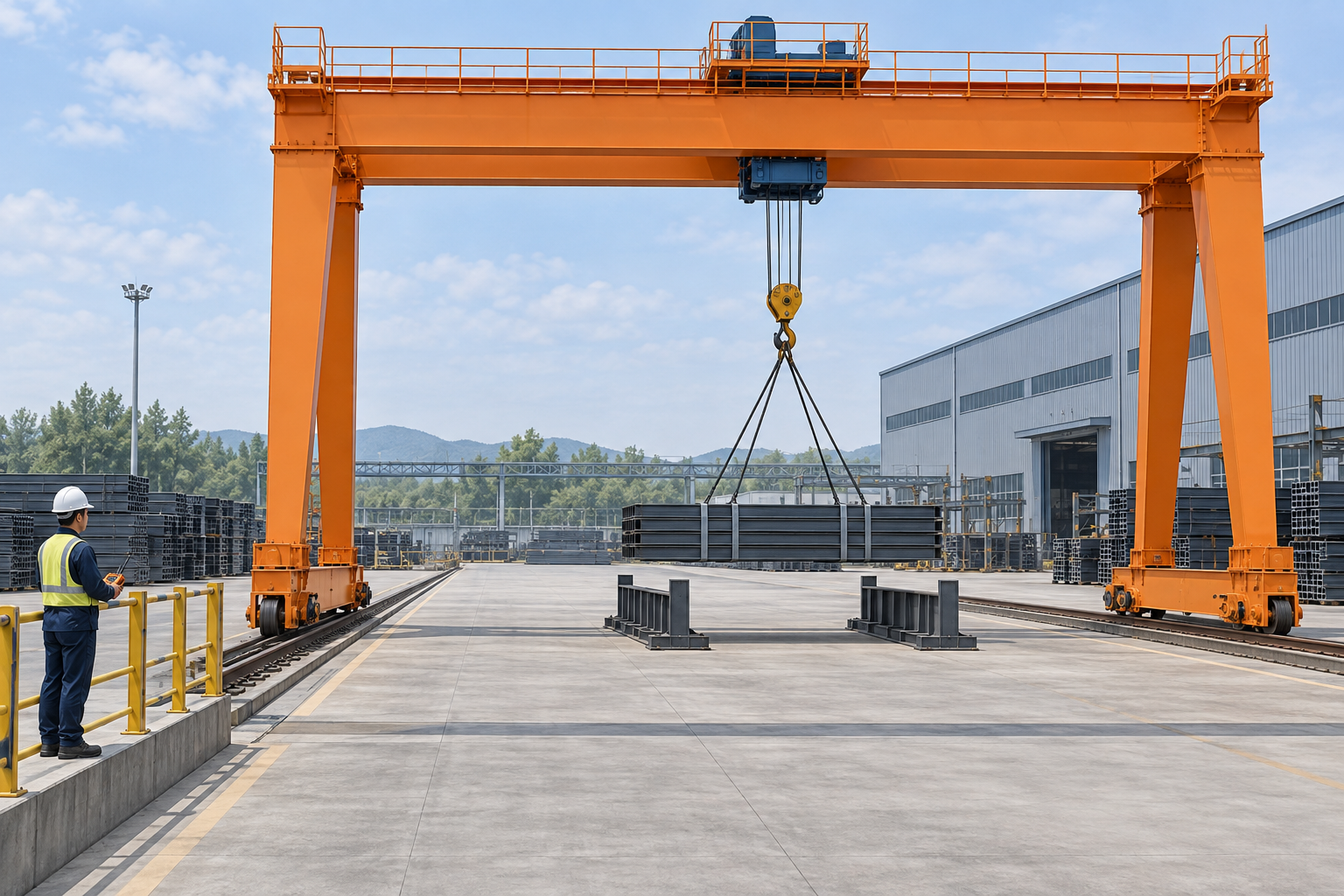
Retained AI-generated educational illustration from the source edition; not a real incident photograph, approved installation drawing or evidence of equipment suitability.
The scenario and record comparisons are fictional teaching examples, not records of real incidents, measurements, inspections, signatures or approvals.
| Item | Fictional scenario |
|---|---|
| Initial | A rail gantry transports a long bundle. |
| Change | A projecting load end sways toward a walkway and the signaler disappears from view. |
| Failure | The operator continues based on an assumed signal and hook-center clearance. |
| Outcome | The load or gantry structure can strike or trap someone in the shared route. |
| Barrier | Stop safely, restore the full load-envelope exclusion and communication, and verify stability before travel. |
Why the controls matter
The required clear path is wider than the hook centerline: include the load ends, possible rotation/sway, gantry legs and wheel pinch zones. A load within rated capacity can still strike a person or structure.
Smooth acceleration and stopping help control sway but cannot cure a blocked route or lost communication. Stop safely if the designated signal or view is lost. Do not push a moving load by hand to squeeze it past an obstruction.
The hoist upper limit is not a routine operating stop. Distinguish operational wind limits from out-of-service parking and storm restraints; one does not imply permission below the other. The restrictive no-dragging scope here is not a claim that every US side-pull provision has no exceptions.
Decision sequence
| Step | Decision |
|---|---|
| Known | A projecting load end sways toward a walkway and the signaler disappears from view. |
| Unknown | Actual condition, extent of damage and suitability of sway and clearances, rail corridor remain to be established. |
| Hold | The operator continues based on an assumed signal and hook-center clearance. |
| Evidence | Link sway and clearances, rail corridor, weather conditions, communication, operating and park limits, locks and access to the affected equipment or work area. |
| Next | Stop safely, restore the full load-envelope exclusion and communication, and verify stability before travel. |
5. Conditional decisions and common errors
| Condition | Action | Evidence | Proceed when |
|---|---|---|---|
| Signal lost | Stop affected motion | Contact test and sightline | Signal restored |
| Rail defect | Remove from operation | Location and inspection | Defect corrected |
| Load sways | Secure and reassess travel | Center and envelope | Path and load stable |
| Weather changes | Apply stop and parking plan | Weather and restraint criteria | Applicable limits met |
Similar appearance, different evidence
The scenario and record comparisons are fictional teaching examples, not records of real incidents, measurements, inspections, signatures or approvals.
| Comparison | Supported decision | Insufficient basis |
|---|---|---|
| Condition | Contact test and sightline | Signal lost has not been resolved. |
| Evidence | Center and envelope | A photograph or a completed-looking task without the relevant inspection record. |
| Release | Applicable limits met | Completion of one step does not release the excluded tasks in section 2. |
6. Roles and responsibilities
| Role | Responsibility |
|---|---|
| Work supervisor | Assign the task boundary, stop authority, interfaces and emergency communication for rail-mounted gantry crane yard transport. |
| Technical lead | Confirm Weight and center; Route and load ends; Adjacent operations; Landing support. Resolve design and manufacturer limits before work. |
| Authorized crew | Apply Crane and rigging IDs; Brake and control results; Limit and alarm; Defect disposition. Stop when the working arrangement changes. |
| Inspector / receiving lead | Review Sway and clearances; Rail corridor; Weather conditions; Communication. Transfer Parking location; Power and control state; Clamp or anchor state; Shift and weather handoff. |
Role labels allocate responsibilities; they do not confer a legal qualification. Verify the competence, training and authority required for the actual task.
Record and handoff perspective
| Stage | Record controls | Verification |
|---|---|---|
| Plan load and path | 1. Record weight and center2. Record route and load ends3. Record adjacent operations | 1. Route and load ends2. Adjacent operations3. Landing support |
| Inspect crane | 1. Record crane and rigging ids2. Record brake and control results3. Record limit and alarm | 1. Brake and control results2. Limit and alarm3. Defect disposition |
| Rig and trial lift | 1. Record rigging and angles2. Record low trial balance3. Record brake response | 1. Low trial balance2. Brake response3. Free load and clear people |
| Travel smoothly | 1. Record sway and clearances2. Record rail corridor3. Record weather conditions | 1. Rail corridor2. Weather conditions3. Communication |
| Handle faults | 1. Record operating and park limits2. Record locks and access3. Record shared runway controls | 1. Locks and access2. Shared runway controls3. Recovery restrictions |
| Park and transfer | 1. Record parking location2. Record power and control state3. Record clamp or anchor state | 1. Power and control state2. Clamp or anchor state3. Shift and weather handoff |
7. Hold points and record comparison
| Hold point | Evidence before release | Actual record |
|---|---|---|
| HP-0 Start | Plan, inspect, rig, trial-lift, travel, land and park a rail-mounted gantry moving material within a controlled yard or facility. | |
| HP-1 Inspect crane | Crane and rigging IDs; Brake and control results; Limit and alarm; Defect disposition | |
| HP-2 Rig and trial lift | Rigging and angles; Low trial balance; Brake response; Free load and clear people | |
| HP-3 Land and detach | Contact and restraint; Body position; Support condition; Residual rigging load | |
| HP-4 Park and transfer | Parking location; Power and control state; Clamp or anchor state; Shift and weather handoff |
These are internal hold points, not issued permits. Recheck affected points after a change, fault or shift handoff; link the actual approval record.
Record comparison
The scenario and record comparisons are fictional teaching examples, not records of real incidents, measurements, inspections, signatures or approvals.
The boxes are static record prompts, not interactive or saved approvals. A tick does not establish suitability or permission to restart. Record the evidence, person, time and unresolved issues; retain the change history.
| Record | Insufficient | Record checklist |
|---|---|---|
| Plan load and path | "Checked" without target, criteria or result | □ Weight and center□ Route and load ends□ Adjacent operations□ Landing support |
| Inspect crane | "Checked" without target, criteria or result | □ Crane and rigging IDs□ Brake and control results□ Limit and alarm□ Defect disposition |
| Travel smoothly | "Checked" without target, criteria or result | □ Sway and clearances□ Rail corridor□ Weather conditions□ Communication |
| Park and transfer | "Checked" without target, criteria or result | □ Parking location□ Power and control state□ Clamp or anchor state□ Shift and weather handoff |
8. Site checklist and emergency response
| Check | Result | Person / action |
|---|---|---|
| □ Plan load and path: Weight and center | ||
| □ Clear rails and signal: Rail and wheel zone | ||
| □ Inspect crane: Crane and rigging IDs | ||
| □ Rig and trial lift: Rigging and angles | ||
| □ Travel smoothly: Sway and clearances | ||
| □ Land and detach: Contact and restraint | ||
| □ Handle faults: Operating and park limits | ||
| □ Park and transfer: Parking location | ||
| □ Emergency access and handoff restrictions |
Stop work
Stop safely for rail or wheel defects, abnormal sway, lost signal or sightline, pedestrian entry or an operating weather limit. Keep personnel away from suspended loads and travel pinch zones.
Emergency response
Stop and exclude the load and crane travel area. Activate site response and call 911 for injury or immediate danger. Do not improvise repairs under a suspended load; use a planned load-recovery and isolation procedure with adjacent cranes controlled.
9. Sources and review limits
Public-source review: 2026-10-12. Official regulation pages and specific technical references are distinguished below; no agency or manufacturer has approved this content.
| Source | Reviewed scope and limitation |
|---|---|
| OSHA 29 CFR 1910.179 | Gantry scope, equipment inspection, load handling and maintenance controls. |
| OSHA 29 CFR 1926.1438 | Construction applicability differs for permanently installed and other gantry cranes. |
| OSHA 29 CFR 1910.147 | Applicable hazardous-energy control during covered servicing, coordinated with crane-specific provisions. |
| OSHA State Plans | Official overview of federal and State Plan jurisdiction and differing public-sector coverage, checked 2026-10-12. Individual state rules require a site-specific check. |
No site measurements, equipment manuals for the actual installation, inspection records or signed technical approvals were supplied. Confirm the applicable requirements and actual product instructions before use; record each criterion with its units, source and equipment or work-area ID.
10. PDF guidance and FAQ
PDF A covers basic task controls; B focuses on technical failures; C covers supervision, records and handover. The article has eight stages with four items per main cell; each PDF has six key stages with three items per main cell. P/S/R/A, measurements, confirmations and signatures remain blank for actual site assessment.
Content group
jsa-gantry-transport
Is rated capacity the only travel condition?
No. Verify load envelope, wheels, rails, adjacent equipment, people, weather and communication.
Can travel continue slowly after losing the signal?
Stop safely and restore communication before resuming.
Can this plan be used to drag a grounded load?
No. Dragging and freeing stuck objects are outside this task scope.
Does the storm-clamp criterion define an operating wind limit?
No. Confirm separate operating-stop and out-of-service restraint requirements for the actual gantry.
Has a professional approved this JSA?
This reference material was written and revised with AI. It has not been verified or approved by a professional. Review by a suitably qualified professional and required site approval are necessary before field use.
11. Revision history and authorship
This reference material was written and revised with AI. It has not been verified or approved by a professional. Review by a suitably qualified professional and required site approval are necessary before field use.
Korean source created 2026-09-19. This US edition adapts the Korean source; earlier editorial revisions do not constitute professional approval of this edition.
| Date | Edition | Change | Review status |
|---|---|---|---|
| 2026-10-12 | 1.0 | US localization: preserve task judgments; replace Korean legal applicability with scoped US references. | AI editorial and output checks; no professional technical approval. |