Transporting stable palletized loads within an industrial workplace and placing them onto an approved floor location or rack using a suitable powered industrial truck and trained, evaluated operator.
Stop for uncertain mass or load center, capacity mismatch, damaged pallets or racks, load shift, brake defects, loss of a clear travel view or pedestrian entry into the operating area.
Reference content written and revised with AI. It has not been verified or approved by a professional. Review by a suitably qualified professional and site approval are required before use.
1. Legal and technical scope
OSHA 1910.178 applies to covered powered industrial trucks in general industry, including operator training, travel, load handling, parking and removal of unsafe trucks. Construction use requires its applicable Part 1926 framework. Rack suitability and manufacturer configuration limits require actual evidence; this article does not certify an installation.
Determine Federal OSHA or the applicable OSHA-approved State Plan, including public/private employer coverage. State Plans must be at least as effective and can impose different or additional requirements. The actual activity determines construction versus general-industry scope. Manufacturer instructions, consensus standards, project design and site approvals have distinct roles; this page is not a finding of nationwide compliance.
| Basis | Application and limits |
|---|---|
| OSHA 1910.178 | Selected operator training (l), operating (m), travel (n), loading (o), unsafe-truck (p) and maintenance (q) provisions. No product-specific capacity determination or rack engineering performed. |
2. Scope and required inputs
Included: Transporting stable palletized loads within an industrial workplace and placing them onto an approved floor location or rack using a suitable powered industrial truck and trained, evaluated operator.
Separate review: Personnel lifting, suspended loads, trailer loading and unloading, unfamiliar special attachments, refueling and battery charging require separate assessment.
| Input | Required evidence |
|---|---|
| Plan load and route | Mass and load geometry; Capacity plate and attachment; Lift and overhead clearance; Rack and floor basis |
| Inspect truck and pallet | Fork spacing and locks; Brakes tires and warnings; Pallet condition and rating; Operator restraint condition |
| Travel and turn | Load and route compatible; Speed and stopping distance; Grade and travel direction; Clear path and signals |
| Park and hand over | Forks and controls safe; Brake and incline blocking; Power and key control; Defects and loads transferred |
Match actual load mass, center, lift height and attachment configuration to the correct capacity plate. Confirm floor and rack limits, clearances and route grades. Use the truck restraint system and required handling protection. Do not treat one nameplate capacity as valid for every load shape or height.
3. Eight-stage JSA
P = likelihood; S = severity; R = risk under the site method; A = acceptance or authorization as defined by the site. Leave these blank until actual assessment and control verification. A low score does not override a legal requirement, product limit or unreleased hold point.
| Job stage | Hazards and effects | Failure factors | Required controls | Site verification | P | S | R | A |
|---|---|---|---|---|---|---|---|---|
| 1. Plan load and route | 1. Truck overturn2. Rack collapse3. Long-load instability4. Attachment overload | 1. Load center unknown2. Rack limits unverified3. Height capacity ignored4. Wrong capacity plate | 1. Establish mass and center2. Verify floor and rack limits3. Check actual lift height4. Match truck configuration | 1. Mass and load geometry2. Capacity plate and attachment3. Lift and overhead clearance4. Rack and floor basis | ||||
| 2. Separate pedestrians | 1. Blind-corner collision2. Reversing crush injury3. Crossing collision4. Spotter trapped | 1. Shared routes uncontrolled2. Signals not agreed3. Crossing entry unobserved4. Spotter in pinch zone | 1. Separate travel routes2. Agree visible signals3. Control crossings4. Provide safe waiting places | 1. Route and barriers2. Driver and spotter visibility3. Intersection controls4. People clear of crush zones | ||||
| 3. Inspect truck and pallet | 1. Fork failure2. Brake-loss collision3. Pallet collapse4. Operator ejection | 1. Fork lock defective2. Inspection omitted3. Pallet damage hidden4. Restraint not used | 1. Check before service2. Remove unsafe truck3. Use sound rated pallet4. Use provided restraint | 1. Fork spacing and locks2. Brakes tires and warnings3. Pallet condition and rating4. Operator restraint condition | ||||
| 4. Engage and trial lift | 1. Forward overturn2. Load falls rearward3. Fork-tip overload4. Loose bundle falls | 1. Forks partly inserted2. Upper items unrestrained3. Load off center4. People close to load | 1. Engage as far as possible2. Secure and arrange load3. Check low lift stability4. Clear surrounding people | 1. Fork engagement and support2. Bundle restraint3. Load balance and center4. Clear area and stable lift | ||||
| 5. Travel and turn | 1. Turning overturn2. Grade load slide3. Overhead strike4. Pedestrian impact | 1. Load carried high2. Grade direction wrong3. Clearance overlooked4. Travel view obstructed | 1. Use required travel position2. Follow grade requirements3. Check overhead clearance4. Maintain clear travel view | 1. Load and route compatible2. Speed and stopping distance3. Grade and travel direction4. Clear path and signals | ||||
| 6. Place and withdraw | 1. Rack impact collapse2. Pallet dragged from support3. Uneven load bearing4. Fork withdrawal strike | 1. Wrong rack location2. Forks bind under load3. Pallet partly seated4. Withdrawal rushed | 1. Use approved rack position2. Lower to stable support3. Check full load transfer4. Stop if pallet moves | 1. Rack and level identity2. Pallet bearing and stability3. Load within rack limits4. No movement during withdrawal | ||||
| 7. Hold on defect | 1. Crush below raised forks2. Unstable-load collapse3. Unexpected restart4. Repair-worker injury | 1. Raised load abandoned2. Hands steady load3. Fault repeatedly ignored4. Load not made safe | 1. Stop and control access2. Arrange safe load recovery3. Remove unsafe truck4. Use authorized repair | 1. Residual load and movement2. Recovery method and owner3. Out-of-service status4. Repair and return evidence | ||||
| 8. Park and hand over | 1. Unattended rollaway2. Trip on projecting forks3. Unauthorized operation4. Aisle obstruction | 1. Forks left elevated2. Brake not applied3. Power and key left active4. Parking blocks access | 1. Lower forks fully2. Neutralize and set brake3. Shut down unattended truck4. Use designated parking | 1. Forks and controls safe2. Brake and incline blocking3. Power and key control4. Defects and loads transferred |
4. Hypothetical scenario and failure mechanisms
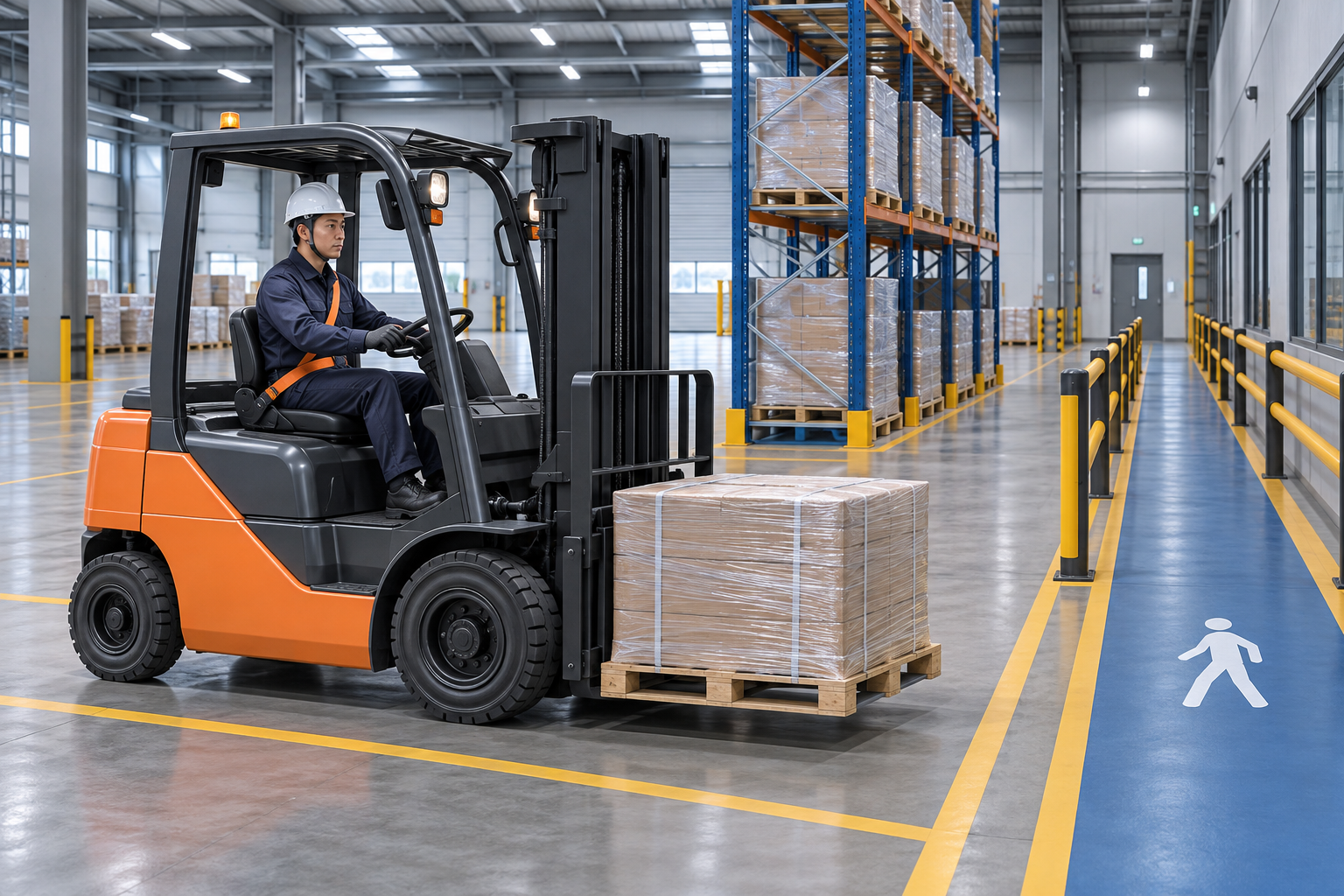 Retained source illustration: an AI-generated educational concept, not a real incident photograph or evidence of equipment suitability.
The following scenario, comparisons and example records are hypothetical teaching material. They do not reproduce actual incidents, measurements, signatures or approvals.
| Item | Hypothetical situation |
|---|---|
| Initial state | An operator changes from a short pallet to a longer bundle of equal mass. |
| Change | Only the total weight is checked against the capacity plate. |
| Failure path | The forward load-center shift and actual lift-height capacity remain unresolved. |
| Possible harm | The larger overturning moment can destabilize the truck or cause movement during rack placement. |
| Barrier | Hold the lift, establish the actual load geometry and correct capacity basis, then plan stable engagement, travel and placement. |
Equal mass does not mean equal stability. Forward load-center movement increases the overturning moment. Attachment mass and its effect on the truck configuration must be reflected in the applicable capacity information.
The operator must retain a clear view in the travel direction. OSHA 1910.178(n)(4) requires load-trailing travel when the load blocks forward vision; grade rules also apply. If visibility and required load orientation cannot both be maintained, stop and obtain a suitable route and method rather than improvising.
Contact with a rack is not proof of completed load transfer. Verify the intended rack location, load limits, full pallet support and stability. During fork withdrawal, stop if the pallet follows the forks or the rack moves.
A pedestrian signal is effective only if the person can remain outside crushing zones and is visible to the operator. Separate routes, control crossings and stop on lost communication. Never use a person to steady an unstable raised load.
| Decision | Reason and evidence |
|---|---|
| Known facts | Only the total weight is checked against the capacity plate. |
| Unresolved | The forward load-center shift and actual lift-height capacity remain unresolved. |
| Hold reason | Stop for uncertain mass or load center, capacity mismatch, damaged pallets or racks, load shift, brake defects, loss of a clear travel view or pedestrian entry into the operating area. |
| Evidence needed | Rack and level identity; Pallet bearing and stability; Load within rack limits; No movement during withdrawal. |
| Next decision | Hold the lift, establish the actual load geometry and correct capacity basis, then plan stable engagement, travel and placement. |
5. Conditional decisions and common errors
| Condition | Action | Evidence | Proceed when |
|---|---|---|---|
| Longer load | Hold and recalculate the configuration basis. | Mass, center and capacity plate. | Actual capacity suitable. |
| Travel view lost | Stop movement and resolve route or method. | Visibility and grade requirements. | Clear compliant travel path. |
| Rack damaged | Keep affected storage unavailable. | Rack identity and competent assessment. | Support accepted. |
| Pallet follows forks | Stop withdrawal; reassess load transfer. | Bearing and fork clearance. | Stable independent support. |
| Comparison | Situation A | Situation B |
|---|---|---|
| Same mass | Actual center, height and configuration match capacity. | Only the nominal mass is checked. |
| Rack contact | Pallet is stably supported and forks withdraw freely. | A corner touches but the pallet remains partly carried. |
6. Roles and responsibilities
| Role | Responsibility |
|---|---|
| Work supervisor | Confirm scope, task sequence, exclusion and stop authority. Coordinate plan load and route with affected operations. |
| Technical reviewer | Resolve the actual design and equipment limits: Mass and load geometry; Capacity plate and attachment; Lift and overhead clearance; Rack and floor basis. |
| Work crew | Perform inspect truck and pallet using the approved procedure; report any mismatch before proceeding. |
| Inspector / assessor | Verify Rack and level identity; Pallet bearing and stability; Load within rack limits; No movement during withdrawal. Record what was actually checked and what remains unresolved. |
| Release / receiving authority | Confirm Forks and controls safe; Brake and incline blocking; Power and key control; Defects and loads transferred. Transfer restrictions and the next permitted stage. |
These are responsibility examples, not invented statutory credentials. Meet the actual training, competent-person, qualified-person and licensing requirements for the assigned work. Anyone may raise a hazard and request a stop; only the designated authority may release the affected stage after evidence is reviewed.
7. Hold points and record comparison
| Hold point | Evidence before release | Confirmation / approval |
|---|---|---|
| HP-0 Start | Scope, jurisdiction, equipment identity, responsible people and emergency arrangements. | |
| HP-1 Separate pedestrians | Route and barriers; Driver and spotter visibility; Intersection controls; People clear of crush zones | |
| HP-2 Engage and trial lift | Fork engagement and support; Bundle restraint; Load balance and center; Clear area and stable lift | |
| HP-3 Hold on defect | Residual load and movement; Recovery method and owner; Out-of-service status; Repair and return evidence | |
| HP-4 Park and hand over | Forks and controls safe; Brake and incline blocking; Power and key control; Defects and loads transferred |
Hold points are internal evidence gates. They do not replace statutory permits or actual signatures. Recheck affected gates after a change, abnormal event or shift transfer. The blank record must identify the evidence, person, time, limits and release scope.
| Record | Insufficient record | Record checklist |
|---|---|---|
| Load | Below rating | □ Mass and load geometry□ Capacity plate and attachment□ Lift and overhead clearance□ Rack and floor basis |
| Traffic | Aisle clear | □ Route and barriers□ Driver and spotter visibility□ Intersection controls□ People clear of crush zones |
| Placement | Pallet touched | □ Rack and level identity□ Pallet bearing and stability□ Load within rack limits□ No movement during withdrawal |
| Parking | Engine stopped | □ Forks and controls safe□ Brake and incline blocking□ Power and key control□ Defects and loads transferred |
The □ boxes are static prompts, not saved or interactive approvals. Each checks one record element. A tick alone does not establish suitability or permission to restart. Link equipment IDs and supporting records; retain unresolved matters and the earlier record when conditions change.
8. Site checklist and emergency response
| Check item | Result | Person / action |
|---|---|---|
| Mass and load geometry | ||
| Route and barriers | ||
| Fork spacing and locks | ||
| Fork engagement and support | ||
| Load and route compatible | ||
| Rack and level identity | ||
| Residual load and movement | ||
| Forks and controls safe | ||
| Emergency arrangements and unresolved restrictions communicated |
Stop work: Stop for uncertain mass or load center, capacity mismatch, damaged pallets or racks, load shift, brake defects, loss of a clear travel view or pedestrian entry into the operating area.
Emergency response: Stop movement, warn others and isolate the unstable load or damaged-rack area. Do not catch a load by hand or enter below raised forks. Use designated recovery personnel and a reviewed load-recovery method. Call 911 for serious injury; make the truck and load safe before rescuers approach.
9. Sources and review limits
Official-source review date: October 13, 2026. The following review is limited to the public provisions or selected manufacturer material identified below. It does not establish that any authority approved this article or the actual installation.
- OSHA 1910.178: Selected operator training (l), operating (m), travel (n), loading (o), unsafe-truck (p) and maintenance (q) provisions. No product-specific capacity determination or rack engineering performed.
- OSHA State Plans: jurisdiction and coverage overview; identify the actual state program before use.
Paid consensus standards and site-specific calculations, manuals, inspection records and product certificates were not independently obtained or verified unless specifically identified. Korean legal citations remain in the preserved Korean source as source history; they are not represented as US legal duties.
10. PDF guidance and FAQ
PDF A covers basic task controls; B examines technical failures; C focuses on supervision, evidence and handover. Each has six rows and three items per main cell. They are complementary extracts: apply all eight body stages and the applicable site procedure. An omitted stage is not permission to omit its controls. PDF HP-0 through HP-4 are worksheet labels; match the event, evidence and authority rather than assuming they match another permit by number.
P/S/R/A, actual measurements, confirmations and signatures remain blank. The PDFs are uncompleted reference worksheets, not issued work permits.
Content group ID: jsa-forklift-handling,ko
Is the same load mass always acceptable?
No. Match load center, lift height and attachment configuration to the actual truck capacity information.
What if the load blocks forward vision?
Apply 1910.178(n)(4) load-trailing travel and the applicable grade rules while maintaining a clear view. Stop if the planned route cannot meet the required conditions.
May someone stand below empty raised forks?
No. Keep people out from beneath elevated portions of the truck whether loaded or empty.
Can forks be withdrawn as soon as the pallet touches the rack?
First verify stable bearing and load transfer; stop if the pallet moves with the forks.
Has a professional verified or approved this document?
No. This is AI-assisted reference material. Editorial and layout checks are not a physical inspection or professional technical approval. Obtain qualified professional review and required site approval before use.
11. Revision history and authorship
Reference content written and revised with AI. It has not been verified or approved by a professional. Review by a suitably qualified professional and site approval are required before use.
This system has not physically inspected the equipment, structures, ground, atmosphere or worksite. The document does not replace legal advice, manufacturer procedures, engineering design, inspection certificates, qualification evidence, the site risk assessment or an actual work permit.
Before use, a suitably qualified and authorized person must review the actual equipment, loads, methods, protection, inspection and emergency arrangements and resolve open issues. Record the real reviewer, organization, qualifications, delegated authority, reviewed documents, date, signature, exclusions and conditions of approval separately.
| Date | Version | Change | Review status |
|---|---|---|---|
| 2026-09-19 | 1.0 | Korean source revision retained in the source snapshot. | Historical editorial status; not US professional approval. |
| 2026-10-02 | 1.1 | Korean source revision retained in the source snapshot. | Historical editorial status; not US professional approval. |
| 2026-10-13 | US 1.0 | US localization of the assigned Korean source; task reasoning, educational image and history retained; US scope and sources reviewed. | AI-assisted editorial work; professional approval not performed. |