Dust can escape while opening, emptying and folding a flour bag. Assess flour as an inhalation and combustible-dust hazard even though it is a food ingredient; a running fan alone does not prove effective capture.
This is reference content written and revised with AI. It has not been verified or approved by a professional. Review by a suitably qualified professional and required site authorization are necessary before use.
Stop conditions first
Stop feed for abnormal capture indications, escaping dust, missing guards, blocked flow, burning odor or respiratory symptoms. Do not shake bags aggressively or insert hands or rods into a running hopper.
1. US legal and technical basis
General-industry bakery operations: OSHA 1910.263(d)(3) addresses dumpbin hood capacity, working height and nearby stop controls where applicable. 1910.272 has a defined grain-handling-facility scope and is not automatically the rule for every bakery handling flour. Combustible-dust requirements depend on the actual process and jurisdiction.
| Reference | Use and limit |
|---|---|
| OSHA 29 CFR 1910.263 | Bakery flour-handling dumpbins: hood capture, suitable working height/bag support and operator-accessible stopping device in paragraph (d)(3); match actual equipment. |
| OSHA 29 CFR 1910.147 | Covered jam clearing/servicing requires hazardous-energy assessment and isolation, not merely a feed stop. |
| OSHA Combustible Dust | Flour is among dust-form materials that can present fire/explosion hazards; hazard assessment does not itself select certified equipment. |
| OSHA Combustible Dust Standards | Different mandatory standards address aspects of dust hazards; scope-specific review is required. |
| NIOSH Work-related Asthma | Flour/grain dust is identified as a work-related asthma exposure; health guidance, not a task-specific exposure limit. |
| OSHA State Plans | Federal baseline and State Plan coverage reviewed. Confirm the applicable state program and employer coverage; this edition does not establish nationwide compliance. |
Determine whether Federal OSHA or an applicable State Plan governs the employer and work. Standards incorporated into a regulation must be read in their legally applicable edition. Other NFPA/ANSI guidance and manufacturer instructions have distinct roles; they are not automatically federal law.
2. Scope and required inputs
Included
Open identified ordinary flour bags on a supported tipping station and feed a guarded hopper with verified dust capture and a site combustible-dust assessment.
Separate assessment
Enzyme/additive blends, bulk bags, silos, pneumatic transfer, hopper entry, blockage clearing, collector maintenance, guard removal and ignition-source work require separate assessment.
| Input | Evidence needed |
|---|---|
| Match ingredient | Product/bag/hopper ID; Dust-control basis; Ingredient composition; Work instruction |
| Support bags | Bag weight/reach; Support and aids; Floor condition; Material route |
| Open bag | Cutter/hand position; Packaging count; Hood and bag position; Bag support |
| Clean and transfer | Method/equipment suitability; Residual dust; Defect and restriction; Product balance and receiver |
Selected public official provisions were checked on October 12, 2026. This is not a complete legal audit. No actual equipment manual, site measurements, engineering calculations, product certification or professional technical approval was supplied. Full paid NFPA/ANSI standards and state/local amendments were not reviewed. Check actual equipment, jurisdiction and project requirements before use.
Select task-appropriate eye, hand, foot, skin and hearing protection from the exposure assessment. Where respiratory protection is necessary, use the applicable respiratory-protection program; PPE does not replace isolation, guarding, support or ventilation.
3. Eight-stage JSA
| Job stage | Hazards and effects | Failure factors | Controls | Site verification | P | S | R | A |
|---|---|---|---|---|---|---|---|---|
| 1. Match ingredient | 1. Wrong material exposure2. Dust explosion3. Respiratory sensitization4. Wrong hopper feed | 1. Bag label unchecked2. Dust review absent3. Additives changed4. Hopper ID confused | 1. Match product and instruction2. Verify dust-hazard assessment3. Assess ingredient changes4. Confirm destination | 1. Product/bag/hopper ID2. Dust-control basis3. Ingredient composition4. Work instruction | ||||
| 2. Support bags | 1. Back strain2. Falling bag3. Dusty-floor slip4. Blocked walkway | 1. Lift too high2. Support unstable3. Spillage ignored4. Bags in route | 1. Set suitable tipping height2. Use handling assistance3. Provide stable bag support4. Keep floor and route clear | 1. Bag weight/reach2. Support and aids3. Floor condition4. Material route | ||||
| 3. Check capture | 1. Dust inhalation2. Moving-part contact3. Ignition of dust4. Uncontrolled feed | 1. Hood misplaced2. Guard damaged3. Equipment unsuitable4. Stop inaccessible | 1. Verify capture indication2. Maintain guards/interlocks3. Confirm dust-compatible equipment4. Check nearby stop function | 1. Airflow/capture evidence2. Guard/interlock state3. Dust equipment review4. Stop access/function | ||||
| 4. Open bag | 1. Blade cut2. Packaging contamination3. Dust release4. Bag falls into hopper | 1. Cut toward hand2. Scraps not recovered3. Bag opened outside hood4. Bag unsupported | 1. Use designated safe cutter2. Recover packaging pieces3. Open within capture zone4. Keep bag supported | 1. Cutter/hand position2. Packaging count3. Hood and bag position4. Bag support | ||||
| 5. Feed hopper | 1. Dust cloud2. Hand entanglement3. Flour spill4. Operator strain | 1. High fast dump2. Hand pushes residue3. Feed exceeds capacity4. Awkward bag hold | 1. Control drop and rate2. Handle outside guard3. Monitor flow and capture4. Maintain supported posture | 1. Visible dust/capture2. Hand boundary3. Flow and sound4. Support and workload | ||||
| 6. Collect empty bags | 1. Residual dust release2. Contaminated route3. Trip from bags4. Exposure outside hood | 1. Bag shaken hard2. Thrown into open bin3. Waste piles up4. Folding elsewhere | 1. Fold by low-dust method2. Use designated collection3. Keep route clear4. Remain within capture area | 1. Residual powder2. Collection container3. Floor and waste route4. Capture at folding point | ||||
| 7. Hold abnormal feed | 1. Entrapment at blockage2. Dust ignition3. Respiratory harm4. Unexpected linked start | 1. Rod inserted running2. Capture fault ignored3. Cough dismissed4. Stop mistaken for isolation | 1. Stop further feed2. Restrict hopper access3. Transfer isolated fault clearing4. Review exposure symptoms | 1. Blockage and material2. Capture/guard condition3. Health report4. Restoration/restart evidence | ||||
| 8. Clean and transfer | 1. Dust resuspension2. Cleaner ignition source3. Unresolved fault reused4. Wrong next material | 1. Air blowdown2. Unapproved vacuum3. Fault only verbal4. Remaining product unknown | 1. Use approved low-dust cleaning2. Verify cleaning equipment3. Transfer unresolved holds4. Identify residual ingredient | 1. Method/equipment suitability2. Residual dust3. Defect and restriction4. Product balance and receiver |
Actual risk assessments, measurements, checks, approvals and signatures have not been performed. Keep unverified fields blank and link the actual site records. P/S/R/A mean likelihood, severity, site-method risk and site-defined acceptance/authorization; a score cannot waive a required control.
4. Failure mechanisms and hypothetical case
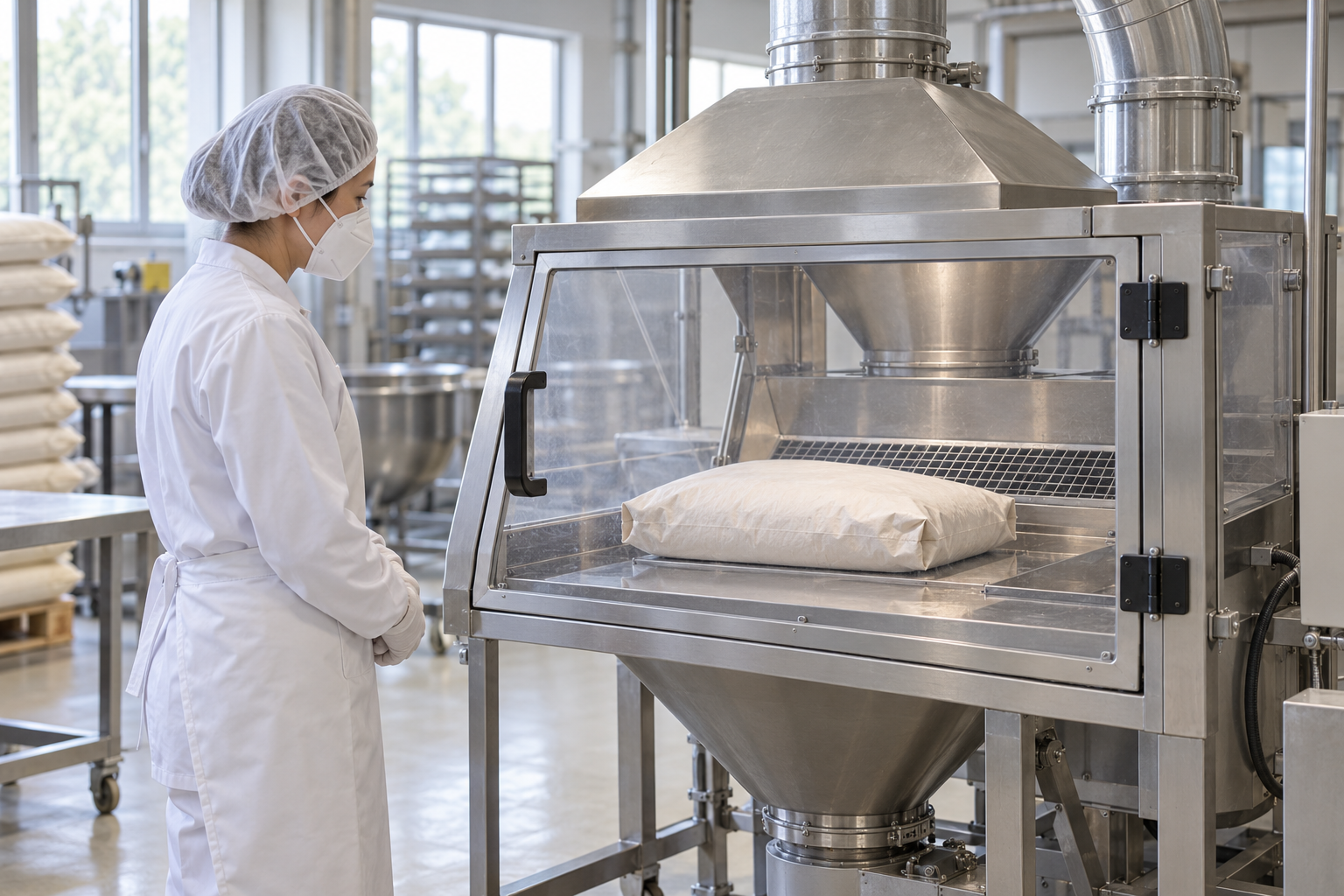
The retained illustration is an AI-generated educational image from the Korean source. It is not an actual incident photograph, approved drawing, equipment certification or proof that the depicted arrangement is safe.
Bag tipping and empty-bag handling must remain within the verified capture arrangement. Fan noise alone does not establish airflow or capture performance at the worker position.
Flour dust can cause respiratory sensitization and can form an explosible dust cloud under suitable conditions. Dust properties, accumulation, ignition sources, electrical classification and collector protection need competent site assessment; this JSA does not design explosion protection.
Normal feeding ends when a blockage needs danger-zone access. Stop supply and refer clearing to authorized hazardous-energy control, including linked machinery and retained material. A long rod does not make running-equipment access safe.
Use the site-approved low-dust cleaning method and equipment suitable for the dust and location. Household vacuums, improvised fans and compressed-air blowdown are not default alternatives. Applicable NFPA provisions and adopted editions must be reviewed separately; they are not presented as universally binding federal law.
Hypothetical decision example
Hypothetical example: flour accumulates in the hopper and the extraction indication leaves its normal range. To meet production, a worker taps the bag and reaches for a rod to clear the blockage. Feed stops and both capture and flow faults are investigated.
The example is fictional; no incident, measurement, inspection or approval is asserted.
Task flow: Match ingredient → Support bags → Check capture → Open bag → Feed hopper → Collect empty bags → Hold abnormal feed → Clean and transfer
5. Hold and proceed decisions
| Condition | Action | Evidence | Proceed when |
|---|---|---|---|
| Capture abnormal | Stop feed and contain access | Hood, airflow indication and maintenance review | Capture restored |
| Hopper blocked | Use separate isolated clearing procedure | Energy and retained-material assessment | Cause corrected |
| New ingredient | Hold old settings | Composition and dust-hazard review | Material accepted |
| Breathing symptoms | Leave exposure and report promptly | Health assessment and exposure review | Return assessed |
Similar observation, different conclusion
| Observation | Supported conclusion | What remains unresolved |
|---|---|---|
| Fan audible | Motor may be operating | Capture at bag opening remains unproved |
| Flour flows again | Material moved | Cause, guarding and dust control unresolved |
6. Roles and supervision
| Role | Responsibility |
|---|---|
| Work supervisor | Coordinate match ingredient, affected operations, stop signals and stage transitions. |
| Technical/equipment reviewer | Verify Product/bag/hopper ID, Dust-control basis, actual instructions and unresolved technical limits. |
| Task crew | Apply the stated controls, report changes and keep actual checks and signatures factual. |
| Inspector/test lead | Connect Residual powder, Collection container to the required acceptance criteria. |
| Receiving authority | Accept the recorded restrictions, Defect and restriction, Product balance and receiver, and follow-up ownership. |
These are responsibility examples, not invented statutory credentials. Verify actual competence, training and authority for the assigned work.
Supervision and handover controls
| Stage | Management controls | Evidence |
|---|---|---|
| Plan review | 1. Assign technical owner2. Close task-specific questions3. Match product and instruction | 1. Product/bag/hopper ID2. Dust-control basis3. Work instruction |
| Competence | 1. Verify required competence2. Assign stop authority3. Set suitable tipping height | 1. Bag weight/reach2. Training and task briefing3. Material route |
| Prestart evidence | 1. Inspect actual equipment2. Link evidence to this stage3. Use designated safe cutter | 1. Cutter/hand position2. Packaging count3. Bag support |
| Change control | 1. Stop and secure the area2. Review affected controls3. Stop further feed | 1. Blockage and material2. Capture/guard condition3. Restoration/restart evidence |
| Shift handover | 1. Identify remaining restrictions2. Confirm receiving responsibility3. Use approved low-dust cleaning | 1. Method/equipment suitability2. Residual dust3. Product balance and receiver |
| Closeout | 1. Record defect disposition2. Archive factual evidence3. Use approved low-dust cleaning | 1. Method/equipment suitability2. Residual dust3. Product balance and receiver |
7. Hold points and record quality
| Hold point | Evidence before release | Actual record |
|---|---|---|
| HP-0 Start | Open identified ordinary flour bags on a supported tipping station and feed a guarded hopper with verified dust capture and a site combustible-dust assessment. | |
| HP-1 Support bags | Bag weight/reach; Support and aids; Floor condition; Material route | |
| HP-2 Open bag | Cutter/hand position; Packaging count; Hood and bag position; Bag support | |
| HP-3 Hold abnormal feed | Blockage and material; Capture/guard condition; Health report; Restoration/restart evidence | |
| HP-4 Clean and transfer | Method/equipment suitability; Residual dust; Defect and restriction; Product balance and receiver |
Hold points are internal evidence gates. They do not establish that a statutory permit exists or has been approved. Recheck affected gates after changes, faults and shift handover.
Record comparison - hypothetical templates
The 16 boxes below identify record elements, not completed checks or approvals. They are static symbols. Link equipment/location, date, actual findings and the separate record reference; preserve unresolved items.
| Record | Insufficient entry | Required record elements |
|---|---|---|
| Match ingredient | "Checked" without supporting facts | □ Product/bag/hopper ID□ Dust-control basis□ Ingredient composition□ Work instruction |
| Check capture | "Checked" without supporting facts | □ Airflow/capture evidence□ Guard/interlock state□ Dust equipment review□ Stop access/function |
| Feed hopper | "Checked" without supporting facts | □ Visible dust/capture□ Hand boundary□ Flow and sound□ Support and workload |
| Hold abnormal feed | "Checked" without supporting facts | □ Blockage and material□ Capture/guard condition□ Health report□ Restoration/restart evidence |
8. Pre-work checks and emergency response
| Check required | Result | Checker/action |
|---|---|---|
| Match ingredient: Product/bag/hopper ID | ||
| Support bags: Bag weight/reach | ||
| Check capture: Airflow/capture evidence | ||
| Open bag: Cutter/hand position | ||
| Feed hopper: Visible dust/capture | ||
| Collect empty bags: Residual powder | ||
| Hold abnormal feed: Blockage and material | ||
| Clean and transfer: Method/equipment suitability |
Stop work
Stop feed for abnormal capture indications, escaping dust, missing guards, blocked flow, burning odor or respiratory symptoms. Do not shake bags aggressively or insert hands or rods into a running hopper.
Emergency response
Stop feed from a safe position. For a dust cloud, burning odor or fire, raise the alarm, evacuate and avoid actions that disperse settled dust; do not open a collector or hopper to investigate. Call 911 for fire, serious breathing difficulty or entrapment and identify flour dust and linked machinery. Respiratory symptoms require leaving exposure and prompt reporting/medical assessment; rescue access to machinery requires controlled energy and the prepared response.
9. Official sources and review limits
Official public-source check: October 12, 2026. The review concerns the selected passages described below, not endorsement of this article.
| Official source | Checked scope and limit |
|---|---|
| OSHA 29 CFR 1910.263 | Bakery flour-handling dumpbins: hood capture, suitable working height/bag support and operator-accessible stopping device in paragraph (d)(3); match actual equipment. |
| OSHA 29 CFR 1910.147 | Covered jam clearing/servicing requires hazardous-energy assessment and isolation, not merely a feed stop. |
| OSHA Combustible Dust | Flour is among dust-form materials that can present fire/explosion hazards; hazard assessment does not itself select certified equipment. |
| OSHA Combustible Dust Standards | Different mandatory standards address aspects of dust hazards; scope-specific review is required. |
| NIOSH Work-related Asthma | Flour/grain dust is identified as a work-related asthma exposure; health guidance, not a task-specific exposure limit. |
| OSHA State Plans | Federal baseline and State Plan coverage reviewed. Confirm the applicable state program and employer coverage; this edition does not establish nationwide compliance. |
Selected public official provisions were checked on October 12, 2026. This is not a complete legal audit. No actual equipment manual, site measurements, engineering calculations, product certification or professional technical approval was supplied. Full paid NFPA/ANSI standards and state/local amendments were not reviewed. Check actual equipment, jurisdiction and project requirements before use.
This is reference content written and revised with AI. It has not been verified or approved by a professional. Review by a suitably qualified professional and required site authorization are necessary before use.
10. PDF use and frequently asked questions
PDF A summarizes core controls; B emphasizes technical failures; C covers supervision, records and handover. Each uses six stages from or aligned with the eight-stage body. All actual risk, measurement, check and signature fields are blank. Use a separate linked record where more space is needed.
Does food-grade mean dust is harmless?
No. Assess inhalation, sensitization and combustible-dust conditions separately from food quality.
Can a respirator replace failed capture?
Do not continue with an unresolved capture fault. Respiratory protection, where needed, requires the applicable program and exposure assessment.
Can I clear a blockage with a rod?
Not as part of normal running feed. Stop and use the authorized isolated maintenance method.
Which vacuum is suitable?
Select equipment through the site dust/fire and location assessment; ordinary appearance or suction strength does not establish suitability.
Has a professional approved this JSA?
This is reference content written and revised with AI. It has not been verified or approved by a professional. Review by a suitably qualified professional and required site authorization are necessary before use.
11. Authorship and revision history
This is reference content written and revised with AI. It has not been verified or approved by a professional. Review by a suitably qualified professional and required site authorization are necessary before use.
| Date/version | Editorial history | Technical approval |
|---|---|---|
| 2026-10-04 | Korean source retained as an unchanged snapshot; source ID fca2f85d-8c21-47f8-9014-00c3cbd2770d | Not asserted |
| 2026-10-12 / US v1.0 | US localization: Retains bag support, opening/folding capture and blocked-hopper case. Adds bakery-specific US dumpbin rules and distinguishes grain-facility scope; no UK exposure limit, arbitrary dust depth or unreviewed NFPA edition is made mandatory. | Not performed |
Source topic: https://smartjsabridge.com/ko/case-study/jsa-flour-bag-hopper-loading
Content group: jsa-flour-bag-hopper-loading