Like-for-like V-belt replacement and alignment/tension adjustment on an accessible fixed belt-driven fan, with electrical and airflow-driven motion controlled before access.
Do not remove guards with uncertain isolation or uncontrolled windmilling. Hold for unidentified belts, damaged sheaves, missing tension criteria, contact, abnormal vibration or overheating.
Reference content written and revised with AI. It has not been verified or approved by a professional. Review by a suitably qualified professional and site approval are required before use.
1. Legal and technical scope
General-industry servicing falls within OSHA 1910.147 where unexpected start-up or stored energy could injure workers; 1910.219 addresses applicable belt and pulley guarding. Construction activity must be assessed under its applicable Part 1926 provisions rather than treating 1910.147 as a universal construction rule.
Determine Federal OSHA or the applicable OSHA-approved State Plan, including public/private employer coverage. State Plans must be at least as effective and can impose different or additional requirements. The actual activity determines construction versus general-industry scope. Manufacturer instructions, consensus standards, project design and site approvals have distinct roles; this page is not a finding of nationwide compliance.
| Basis | Application and limits |
|---|---|
| OSHA 1910.147 | Servicing scope, isolation, stored-energy control, verification and release. |
| OSHA 1910.219 | Applicable power-transmission guarding; actual guard configuration must be assessed. |
| Greenheck USF IOM 479870 | Selected General Safety, V-Belt Drives and maintenance sections: windmilling, belt fit, alignment and recheck. Product example, not universal tension values or legal approval. |
2. Scope and required inputs
Included: Like-for-like V-belt replacement and alignment/tension adjustment on an accessible fixed belt-driven fan, with electrical and airflow-driven motion controlled before access.
Separate review: Running adjustments, speed or sheave changes, shaft or bearing replacement, elevated or confined-space access and hazardous-location design changes require separate review.
| Input | Required evidence |
|---|---|
| Identify drive | Fan and motor IDs; Belt section length and count; Sheave setting history; Model drive instructions |
| Remove guard and belt | Guard support and storage; Adjustment mechanism; Slack belt condition; No remaining motion |
| Align and tension | Tension value and basis; Instrument and span; Alignment evidence; Fastening acceptance |
| Hand over drive | Replacement date and parts; Tension method and results; Test and recheck record; Receiving operator and limits |
Identify belt section, length, matched-set requirements, span, measuring instrument, alignment and motor fastening criteria. Select protection for handling sharp guards and stationary parts. Record the actual manufacturer tension method, units, limits and follow-up interval; hand pressure and reduced noise are not acceptance evidence.
3. Eight-stage JSA
P = likelihood; S = severity; R = risk under the site method; A = acceptance or authorization as defined by the site. Leave these blank until actual assessment and control verification. A low score does not override a legal requirement, product limit or unreleased hold point.
| Job stage | Hazards and effects | Failure factors | Required controls | Site verification | P | S | R | A |
|---|---|---|---|---|---|---|---|---|
| 1. Identify drive | 1. Wrong-belt failure2. Unintended overspeed3. Unequal belt loading4. Unexpected fan movement | 1. Profile chosen by appearance2. Sheave setting changed3. Mixed belt set fitted4. Connected fans overlooked | 1. Verify complete belt identity2. Preserve approved speed3. Use specified belt set4. Map connected duct sources | 1. Fan and motor IDs2. Belt section length and count3. Sheave setting history4. Model drive instructions | ||||
| 2. Isolate and restrain | 1. Remote-start entanglement2. Airflow-driven rotation3. Stored-motion contact4. Unexpected energization | 1. Stop button used alone2. Other fan flow ignored3. Coastdown incomplete4. Isolation unverified | 1. Isolate all start sources2. Control airflow motion3. Wait for full stop4. Verify safe energy state | 1. Isolation points and locks2. Duct and wheel restraint3. Complete stop confirmed4. Authorized worker verification | ||||
| 3. Remove guard and belt | 1. Pinched fingers2. Dropped heavy guard3. Belt cord damage4. Released belt tension | 1. Guard unsupported2. Tension not released3. Belt pried over rim4. Hand near moving sheave | 1. Support removed guard2. Release tension as specified3. Lift slack belt off4. Maintain motion restraint | 1. Guard support and storage2. Adjustment mechanism3. Slack belt condition4. No remaining motion | ||||
| 4. Inspect and replace | 1. Early belt rupture2. Unequal drive loading3. Sheave-edge cuts4. Belt misseating | 1. Worn grooves retained2. Old and new belts mixed3. Damaged parts handled4. Wrong groove engagement | 1. Inspect sheave grooves2. Replace specified full set3. Handle edges safely4. Seat belts without force | 1. Groove wear and cracks2. Set identity and condition3. Contamination removed4. Belt seating | ||||
| 5. Align and tension | 1. Slip heating2. Bearing overload3. Drive vibration4. Motor base movement | 1. Feel used as measurement2. Wrong span or units3. Sheaves misaligned4. Fasteners left loose | 1. Use specified tension method2. Record span and units3. Align shafts and sheaves4. Secure motor adjustments | 1. Tension value and basis2. Instrument and span3. Alignment evidence4. Fastening acceptance | ||||
| 6. Guard and test | 1. Rotating-drive contact2. Loose-tool projection3. Vibration damage4. Guard rubbing | 1. Cover left off2. Tools remain inside3. Fault ignored at start4. Clearance not checked | 1. Restore complete guarding2. Account for tools3. Use controlled test4. Stop for contact or vibration | 1. Guards securely fitted2. Area and tools clear3. Noise vibration and heat4. Test conditions recorded | ||||
| 7. Hold and recheck | 1. Running-adjustment injury2. Repeated belt failure3. Unexpected windmilling4. Unverified restart | 1. Noise treated as acceptance2. Cause not resolved3. Restraint omitted on return4. Recheck not scheduled | 1. Stop and reisolate2. Investigate measured cause3. Restore motion control4. Recheck at specified interval | 1. Fault conditions and cause2. Correction and measurement3. Restored guard and test4. Recheck owner and timing | ||||
| 8. Hand over drive | 1. Wrong setting retained2. Missed early inspection3. Lost component history4. Unreported restriction | 1. Measurements omitted2. Next shift not briefed3. Part numbers absent4. Hold status unclear | 1. Transfer belt and settings2. Assign follow-up check3. Link component records4. Identify remaining holds | 1. Replacement date and parts2. Tension method and results3. Test and recheck record4. Receiving operator and limits |
4. Hypothetical scenario and failure mechanisms
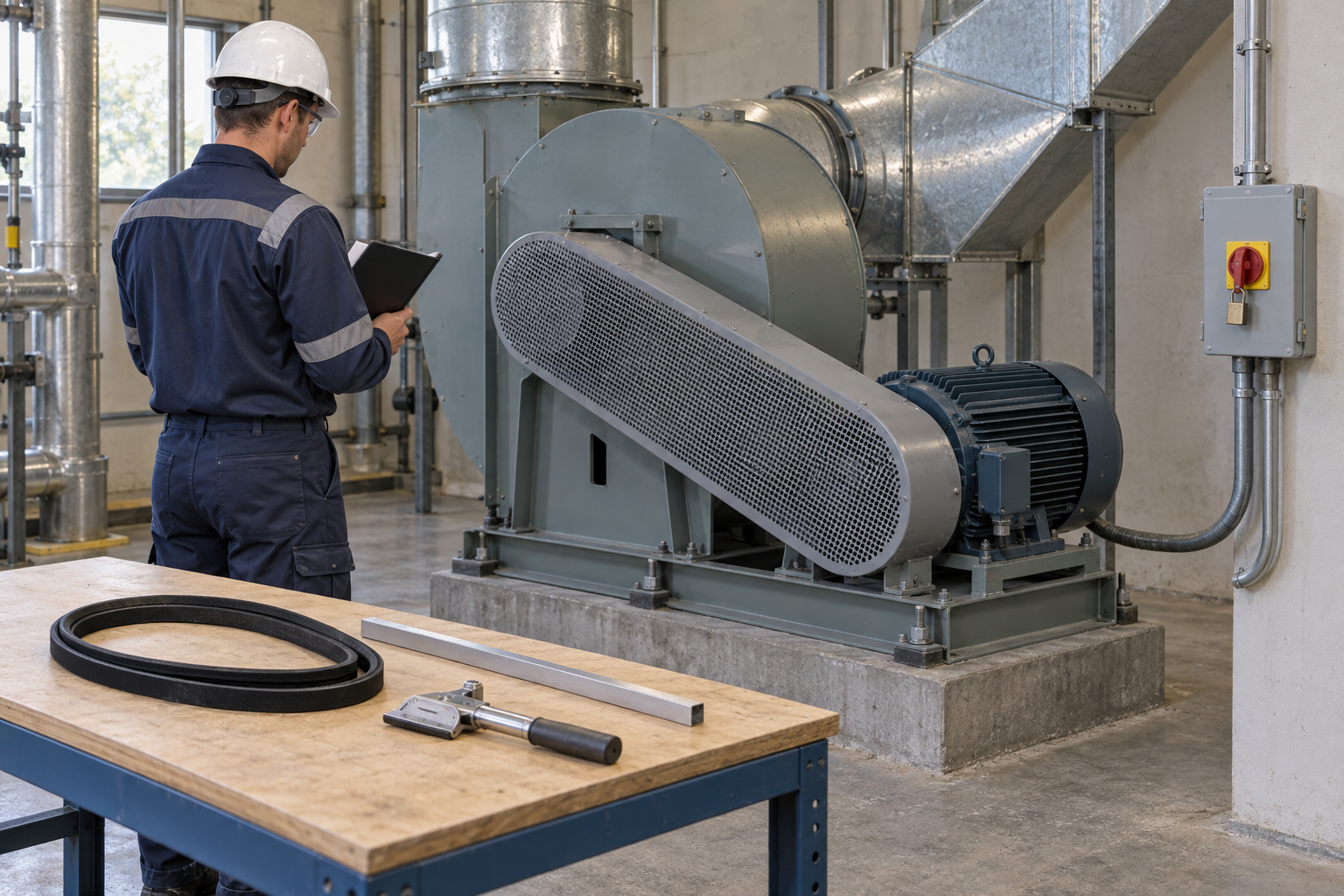 Retained source illustration: an AI-generated educational concept, not a real incident photograph or evidence of equipment suitability.
The following scenario, comparisons and example records are hypothetical teaching material. They do not reproduce actual incidents, measurements, signatures or approvals.
| Item | Hypothetical situation |
|---|---|
| Initial state | A maintenance crew fits replacement fan belts. |
| Change | The worker increases tension until squealing decreases. |
| Failure path | Motor-side vibration increases, but no tension instrument or applicable limit is available. |
| Possible harm | Overtension or misalignment can overload bearings; inspection near an unguarded drive creates entanglement exposure. |
| Barrier | Stop and reisolate, obtain the correct drive data, measure and correct the cause, restore guarding and perform a controlled test with a scheduled recheck. |
An electrically isolated fan can still turn because of another fan or natural airflow in connected ductwork. Assess those paths and use the permitted method of securing the wheel; do not substitute a hand or loose tool for an engineered restraint.
A quieter drive can still be incorrectly tensioned. Record the belt identity, span, method, measured value and units so another maintainer can reproduce the assessment. Too little tension promotes slip and heat; excessive tension can burden shafts and bearings.
Removing tension before removal protects belt cords and prevents improvised levering against a sheave. Inspect the grooves before fitting the specified complete belt set. Preserve the approved speed setting; changing sheave diameter or pitch changes the operating duty.
An energized test and a hands-on adjustment are separate states. Restore the guard and clear people and tools for testing. Before readjustment, stop and reapply the complete energy-control procedure, including external motion. Transfer the model-specific early recheck requirement.
| Decision | Reason and evidence |
|---|---|
| Known facts | The worker increases tension until squealing decreases. |
| Unresolved | Motor-side vibration increases, but no tension instrument or applicable limit is available. |
| Hold reason | Do not remove guards with uncertain isolation or uncontrolled windmilling. Hold for unidentified belts, damaged sheaves, missing tension criteria, contact, abnormal vibration or overheating. |
| Evidence needed | Tension value and basis; Instrument and span; Alignment evidence; Fastening acceptance. |
| Next decision | Stop and reisolate, obtain the correct drive data, measure and correct the cause, restore guarding and perform a controlled test with a scheduled recheck. |
5. Conditional decisions and common errors
| Condition | Action | Evidence | Proceed when |
|---|---|---|---|
| Uncontrolled rotation | Keep guard closed; resolve power and airflow sources. | Isolation boundary and restraint method. | All motion controlled. |
| Worn sheave | Hold belt fitting and obtain approved replacement. | Groove and wear inspection. | Compatible sound parts. |
| Tension basis absent | Hold release; obtain model data and tool. | Span, units and method. | Measured setting accepted. |
| Vibration in test | Stop and reisolate for cause review. | Correction, retest and recheck plan. | Cause resolved. |
| Comparison | Situation A | Situation B |
|---|---|---|
| Power off | Electrical isolation and airflow-driven motion both controlled. | The display is dark but the connected duct can turn the fan. |
| Less noise | Tension, alignment and fastening are measured and acceptable. | Squeal is reduced by adding undocumented tension. |
6. Roles and responsibilities
| Role | Responsibility |
|---|---|
| Work supervisor | Confirm scope, task sequence, exclusion and stop authority. Coordinate identify drive with affected operations. |
| Technical reviewer | Resolve the actual design and equipment limits: Fan and motor IDs; Belt section length and count; Sheave setting history; Model drive instructions. |
| Work crew | Perform remove guard and belt using the approved procedure; report any mismatch before proceeding. |
| Inspector / assessor | Verify Guards securely fitted; Area and tools clear; Noise vibration and heat; Test conditions recorded. Record what was actually checked and what remains unresolved. |
| Release / receiving authority | Confirm Replacement date and parts; Tension method and results; Test and recheck record; Receiving operator and limits. Transfer restrictions and the next permitted stage. |
These are responsibility examples, not invented statutory credentials. Meet the actual training, competent-person, qualified-person and licensing requirements for the assigned work. Anyone may raise a hazard and request a stop; only the designated authority may release the affected stage after evidence is reviewed.
7. Hold points and record comparison
| Hold point | Evidence before release | Confirmation / approval |
|---|---|---|
| HP-0 Start | Scope, jurisdiction, equipment identity, responsible people and emergency arrangements. | |
| HP-1 Isolate and restrain | Isolation points and locks; Duct and wheel restraint; Complete stop confirmed; Authorized worker verification | |
| HP-2 Align and tension | Tension value and basis; Instrument and span; Alignment evidence; Fastening acceptance | |
| HP-3 Hold and recheck | Fault conditions and cause; Correction and measurement; Restored guard and test; Recheck owner and timing | |
| HP-4 Hand over drive | Replacement date and parts; Tension method and results; Test and recheck record; Receiving operator and limits |
Hold points are internal evidence gates. They do not replace statutory permits or actual signatures. Recheck affected gates after a change, abnormal event or shift transfer. The blank record must identify the evidence, person, time, limits and release scope.
| Record | Insufficient record | Record checklist |
|---|---|---|
| Drive | Same size | □ Fan and motor IDs□ Belt section length and count□ Sheave setting history□ Model drive instructions |
| Isolation | Power off | □ Isolation points and locks□ Duct and wheel restraint□ Complete stop confirmed□ Authorized worker verification |
| Setting | Feels tight | □ Tension value and basis□ Instrument and span□ Alignment evidence□ Fastening acceptance |
| Recheck | Quiet now | □ Fault conditions and cause□ Correction and measurement□ Restored guard and test□ Recheck owner and timing |
The □ boxes are static prompts, not saved or interactive approvals. Each checks one record element. A tick alone does not establish suitability or permission to restart. Link equipment IDs and supporting records; retain unresolved matters and the earlier record when conditions change.
8. Site checklist and emergency response
| Check item | Result | Person / action |
|---|---|---|
| Fan and motor IDs | ||
| Isolation points and locks | ||
| Guard support and storage | ||
| Groove wear and cracks | ||
| Tension value and basis | ||
| Guards securely fitted | ||
| Fault conditions and cause | ||
| Replacement date and parts | ||
| Emergency arrangements and unresolved restrictions communicated |
Stop work: Do not remove guards with uncertain isolation or uncontrolled windmilling. Hold for unidentified belts, damaged sheaves, missing tension criteria, contact, abnormal vibration or overheating.
Emergency response: Stop from a safe position and keep clear of the drive. Control electrical supply and wheel motion through the designated response procedure. Call 911 for serious injury. Do not reach into rotating parts or attempt an improvised entanglement rescue while energy remains uncontrolled.
9. Sources and review limits
Official-source review date: October 13, 2026. The following review is limited to the public provisions or selected manufacturer material identified below. It does not establish that any authority approved this article or the actual installation.
- OSHA 1910.147: Servicing scope, isolation, stored-energy control, verification and release.
- OSHA 1910.219: Applicable power-transmission guarding; actual guard configuration must be assessed.
- Greenheck USF IOM 479870: Selected General Safety, V-Belt Drives and maintenance sections: windmilling, belt fit, alignment and recheck. Product example, not universal tension values or legal approval.
- OSHA State Plans: jurisdiction and coverage overview; identify the actual state program before use.
Paid consensus standards and site-specific calculations, manuals, inspection records and product certificates were not independently obtained or verified unless specifically identified. Korean legal citations remain in the preserved Korean source as source history; they are not represented as US legal duties.
10. PDF guidance and FAQ
PDF A covers basic task controls; B examines technical failures; C focuses on supervision, evidence and handover. Each has six rows and three items per main cell. They are complementary extracts: apply all eight body stages and the applicable site procedure. An omitted stage is not permission to omit its controls. PDF HP-0 through HP-4 are worksheet labels; match the event, evidence and authority rather than assuming they match another permit by number.
P/S/R/A, actual measurements, confirmations and signatures remain blank. The PDFs are uncompleted reference worksheets, not issued work permits.
Content group ID: jsa-fan-vbelt-replacement
Is switching off enough?
No. Apply the servicing isolation procedure, verify it and control airflow-driven rotation before opening guards.
Can belts be forced over the rim?
Release tension using the specified adjustment and fit the compatible belt set without levering or forcing it.
Can tension be adjusted while running?
This scope excludes running adjustments. Stop, reisolate and control wheel movement before access.
Is quieter operation proof of correct tension?
No. Use the model and belt-specific measuring method and record the actual acceptance basis.
Has a professional verified or approved this document?
No. This is AI-assisted reference material. Editorial and layout checks are not a physical inspection or professional technical approval. Obtain qualified professional review and required site approval before use.
11. Revision history and authorship
Reference content written and revised with AI. It has not been verified or approved by a professional. Review by a suitably qualified professional and site approval are required before use.
This system has not physically inspected the equipment, structures, ground, atmosphere or worksite. The document does not replace legal advice, manufacturer procedures, engineering design, inspection certificates, qualification evidence, the site risk assessment or an actual work permit.
Before use, a suitably qualified and authorized person must review the actual equipment, loads, methods, protection, inspection and emergency arrangements and resolve open issues. Record the real reviewer, organization, qualifications, delegated authority, reviewed documents, date, signature, exclusions and conditions of approval separately.
| Date | Version | Change | Review status |
|---|---|---|---|
| 2026-09-25 | 1.0 | Korean source revision retained in the source snapshot. | Historical editorial status; not US professional approval. |
| 2026-10-13 | US 1.0 | US localization of the assigned Korean source; task reasoning, educational image and history retained; US scope and sources reviewed. | AI-assisted editorial work; professional approval not performed. |