Pit inspection is a controlled entry task with separate electrical, gravity, access and overhead hazards. This revision retains the original concerns about landing falls, car movement, pulleys and tools, but places verified protection before exposure. A stopped car is not evidence that every hazardous energy source is controlled.
No entry until isolation, movement restraint and access are verified
This is reference content written and revised with AI. It has not been verified or approved by a professional. Review by a suitably qualified professional and site authorisation are required before use.
Stop work
Stop for unexplained movement, unknown energy, damaged locking equipment, unverified support, unsafe access, water near electrical equipment, unsafe atmosphere or lost communication. Leave by the safe route if possible, keep others out and obtain a new release after correction.
1. Legal and technical scope
| Basis | Application limits |
|---|---|
| OSHA — 1910.147 | Official current text; hazardous-energy control and explicit construction exclusion. |
| OSHA — 1910.333 | Opened electrical work-practice rule; control switches are not sole isolation and de-energization must be verified. |
| OSHA — 1926.417 | Opened construction circuit lockout and tagging rule; not the entire construction safety framework. |
| OSHA — elevator pit interpretation | Official interpretation on pit classification and entry to eliminate hazards; read with applicable current rules. |
Determine whether the work is general-industry maintenance or construction. OSHA 1910.147 explicitly excludes construction employment; electrical work practices under 1910.333 have their own scope. Construction electrical circuit lockout/tagging is addressed in 1926.417, with other applicable construction requirements to be assessed.
The OSHA elevator-pit interpretation requires an actual confined-space evaluation. If entry is needed to eliminate hazards or verify elimination, required entry controls apply before that entry. State-plan rules and local elevator codes may add requirements. Full ASME A17.1 and manufacturer instructions were not reviewed; no universal prop or 200 lux mandate is claimed.
2. Scope and required inputs
Included scope
Planned inspection and maintenance inside a identified elevator pit, with the machinery stationary and energy controls maintained. Record the drive type, car and counterweight positions, rescue supply, pit access and model-specific safe working method before releasing entry.
Separate review
Live fault-finding, inspection travel with a person in the pit, suspension or brake replacement, passenger rescue, major dismantling and entry with unresolved atmospheric hazards need separate competent planning and authorization.
| Required input | What to verify |
|---|---|
| Plan pit work | Elevator ID and drive type · Current isolation plan · Other crews informed · Rescue access available |
| Guard access | Landing guard intact · Access method agreed · Anchor and clearance · Ladder and light checked |
| Isolate energy | Isolation points listed · Absence test recorded · Battery source secured · Pressure controls checked |
| Prevent movement | Manual and device ID · Support setup verified · Safe installation method · Refuge remains clear |
| Enter and inspect | Entry conditions met · Lighting for task · Atmosphere plan as needed · Communications tested |
| Exit and restore | All personnel clear · Supports restored safely · Doors and guards secure · Handover recorded |
No elevator model, load rating, refuge dimension or illumination value has been verified here. The actual manufacturer instructions and applicable code edition must determine these parameters. The pit is assessed against the local confined-space definition; its name alone does not decide the classification.
Select head, foot, eye and hand protection for the actual task. Prioritise guarded access; if personal fall protection is needed, verify anchorage, compatibility, available clearance and rescue before exposure. A harness does not protect against a moving car. Electrical PPE requires a separate exposure assessment and does not substitute for isolation.
3. Eight-stage JSA
| Job stage | Hazards and effects | Failure factors | Technical and procedural controls | Site verification | P | S | R | A |
|---|---|---|---|---|---|---|---|---|
| 1. Plan pit work | 1. Car and counterweight2. Unknown rescue supply3. Hidden hydraulic energy4. Unplanned door tests | 1. Wrong elevator identified2. Old isolation drawing3. Other crew not informed4. No recovery arrangement | 1. Match elevator and manual2. Map every energy source3. Suspend conflicting work4. Plan rescue before entry | 1. Elevator ID and drive type2. Current isolation plan3. Other crews informed4. Rescue access available | ||||
| 2. Guard access | 1. Open landing edge2. Unsecured door opening3. Dropped landing tools4. Unsafe ladder transfer | 1. Door opened too early2. Tape used as guard3. No suitable anchorage4. Loose ladder fixing | 1. Guard before opening2. Control landing keys3. Use assessed fall system4. Check ladder from safety | 1. Landing guard intact2. Access method agreed3. Anchor and clearance4. Ladder and light checked | ||||
| 3. Isolate energy | 1. Unexpected car travel2. Battery rescue movement3. Live auxiliary circuit4. Stored fluid pressure | 1. Stop switch alone2. Main switch alone3. Shared lock removed4. No absence test | 1. Lock all mapped sources2. Prove isolation safely3. Control stored energy4. Keep personal protection | 1. Isolation points listed2. Absence test recorded3. Battery source secured4. Pressure controls checked | ||||
| 4. Prevent movement | 1. Car drift or descent2. Counterweight movement3. Failed support device4. Trapping at buffer | 1. Improvised pipe prop2. Support after entry3. Wrong load path4. Brake treated as prop | 1. Use model safety system2. Secure before exposure3. Verify support engagement4. Protect refuge space | 1. Manual and device ID2. Support setup verified3. Safe installation method4. Refuge remains clear | ||||
| 5. Enter and inspect | 1. Slippery pit floor2. Exposed pulley nip3. Low clearance impact4. Poor air quality | 1. Entry before release2. Hands in moving zone3. Standing water ignored4. No space assessment | 1. Release entry at hold point2. Keep machinery isolated3. Assess air and water4. Maintain clear escape | 1. Entry conditions met2. Lighting for task3. Atmosphere plan as needed4. Communications tested | ||||
| 6. Control interfaces | 1. Falling overhead tools2. Unannounced car test3. New worker in pit4. Lost communication | 1. Overhead work resumes2. Remote test command3. Uncontrolled shift change4. No tool restraint | 1. Stop stacked activities2. Keep controller secured3. Handover each isolation4. Stop on lost contact | 1. Shaft work roster2. Controls under custody3. Lock ownership current4. Tool inventory current | ||||
| 7. Correct defects | 1. Damaged isolation device2. Oil or water ingress3. Changed support load4. New task beyond permit | 1. Defect bypassed2. Pump used in live water3. Support altered in pit4. Permit silently extended | 1. Stop and leave safely2. Secure affected area3. Reassess changed scope4. Get competent release | 1. Defect record open2. Water source controlled3. New assessment recorded4. Re-entry authorized | ||||
| 8. Exit and restore | 1. Person left in pit2. Loose tools in shaft3. Support left engaged4. Early restart | 1. Incomplete headcount2. Locks removed by others3. Unsafe support removal4. Door left unsecured | 1. Account for people/tools2. Use manual restore order3. Remove locks by procedure4. Test only after clearance | 1. All personnel clear2. Supports restored safely3. Doors and guards secure4. Handover recorded |
PDF A covers basic task controls; B focuses on technical failures; C covers supervision, records and handover. The article has eight stages with four items per main cell; each PDF has six key stages with three items per main cell. P/S/R/A, measurements, confirmations and signatures remain blank for actual site assessment.
4. Fictional scenario and failure mechanisms
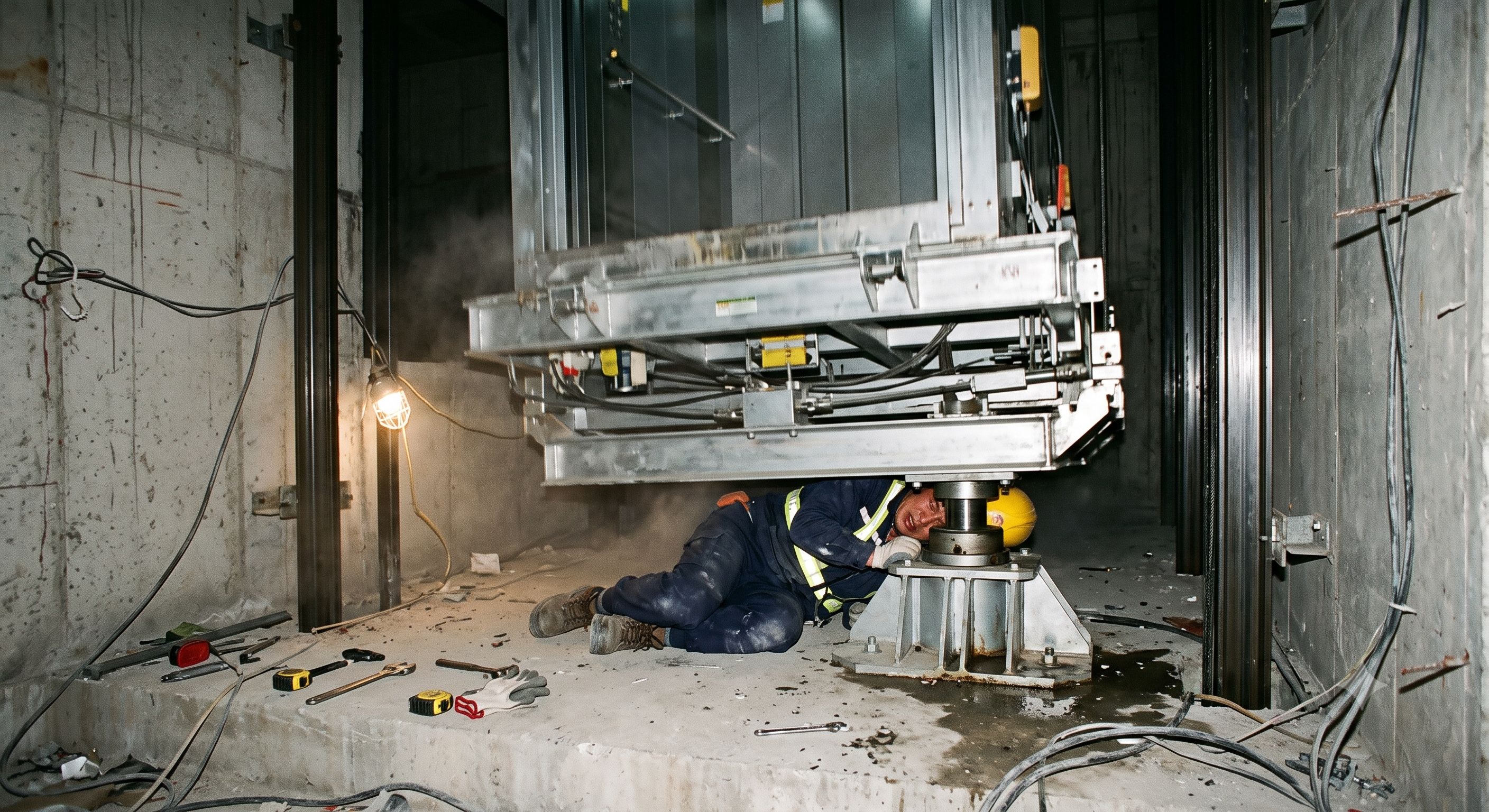
Retained AI-generated educational illustration; not an actual incident photograph.
The scenario and record comparisons are fictional teaching examples, not records of real incidents, measurements, inspections, signatures or approvals.
| Item | Fictional scenario |
|---|---|
| Initial situation | A service crew plans a pit inspection in an occupied office building; maintenance versus construction scope is resolved first. |
| Changed condition | A controls technician requests an automatic operation test without checking the pit entry register. |
| Failure path | The first team relies on the pit stop switch; a rescue battery supply has not been mapped. |
| Possible outcome | A test command or uncontrolled stored energy could move the car into the occupied work zone. |
| Prevention barrier | The entry is held until both teams share an isolation plan and model-specific movement protection is verified. |
Failure mechanisms
A stop switch interrupts a control function. It does not necessarily disconnect mains, auxiliary lighting, battery rescue or other independent feeds. A try-start check does not replace electrical absence-of-voltage testing where exposure to conductors exists.
Electrical isolation does not remove gravitational potential energy. Brake creep, hydraulic leakage or changing counterweight balance can still cause movement. Car direction cannot be inferred merely from the presence of a counterweight.
A safety prop is useful only where the elevator design and approved method permit it. Its rating, engagement and load path matter; improvised pipe stands and entering an unprotected crush zone to fit a prop are unacceptable.
A refuge space, landing barrier and fall system serve different purposes. None allows conflicting overhead work or automatic travel while this stationary maintenance permit is active.
Decision sequence
| Decision stage | What to verify |
|---|---|
| Known facts | Match the elevator ID and scope to the current manual before opening access. |
| Unresolved matters | Map all sources and other crews; treat unknown feeds as a stop condition. |
| Reason to hold | Verify isolation and the approved movement restraint without exposing a person to the danger being controlled. |
| Required evidence | Release entry only after access, air/water assessment, communication and rescue arrangements are ready. |
| Restart decision | Recount people and tools, restore devices in the manufacturer sequence and release testing only after the work zone is clear. |
5. Conditional decisions and common errors
| Condition | Action | Evidence | Proceed when |
|---|---|---|---|
| Unknown supply | Stop entry | Map and secure source | Source verified |
| Unproven restraint | No exposure | Verify model method | Restraint verified |
| Water or lost contact | Leave safely | Correct and reassess | Fresh entry release |
| Testing requested | Keep pit clear | Separate test procedure | Test zone clear |
Similar situations, different decisions
The scenario and record comparisons are fictional teaching examples, not records of real incidents, measurements, inspections, signatures or approvals.
| Comparison | Situation A | Situation B |
|---|---|---|
| Stop switch | Control circuit only; supply may remain | Verified energy isolation plus movement control |
| Mechanical support | A loose prop may miss the load path | Model device engaged before exposure |
| Shift change | A new crew assumes the pit is empty | People, locks and scope handed over |
6. Roles and responsibilities
| Role | Responsibility |
|---|---|
| Work supervisor | Obtain the elevator manual, shutdown window and rescue resources; coordinate the building operator and other trades. Establish federal/state-plan jurisdiction and the applicable maintenance or construction rules. |
| Technical reviewer | Release hold points only against recorded evidence; prevent testing during pit occupancy. |
| Work crew | Apply and retain personal protection under the energy-control procedure; report any uncertainty before entry. |
| Inspector / assessor | Guard the landing and maintain the agreed contact and entry count; do not enter for an improvised rescue. |
| Release / handover authority | Review the actual assessment and outstanding defects before authorizing return to service; do not sign this example as evidence of a completed inspection. |
Supervision, records, handover
| Job stage | Technical and procedural controls | Site verification |
|---|---|---|
| Scope release | 1. Record lift and task2. Check current manual3. Assign isolation owner | 1. Elevator ID and drive type2. Current isolation plan3. Other crews informed |
| Access review | 1. Review guard placement2. Check access arrangement3. Confirm rescue resources | 1. Landing guard intact2. Access method agreed3. Anchor and clearance |
| Energy audit | 1. Trace every supply2. Audit lock ownership3. Review absence evidence | 1. Isolation points listed2. Absence test recorded3. Battery source secured |
| Restraint review | 1. Check model device2. Verify safe setup method3. Record engagement check | 1. Manual and device ID2. Support setup verified3. Safe installation method |
| Entry control | 1. Authorise entry register2. Coordinate other crews3. Control scope changes | 1. Entry conditions met2. Lighting for task3. Atmosphere plan as needed |
| Service handover | 1. Reconcile people/tools2. Witness restoration order3. Record release authority | 1. All personnel clear2. Supports restored safely3. Doors and guards secure |
7. Hold points and record comparison
| Hold point | Evidence before release | Confirmation / approval |
|---|---|---|
| Start | Planned inspection and maintenance inside a identified elevator pit, with the machinery stationary and energy controls maintained. Record the drive type, car and counterweight positions, rescue supply, pit access and model-specific safe working method before releasing entry. | |
| HP-1 Guard access | Landing guard intact · Access method agreed · Anchor and clearance · Ladder and light checked | |
| HP-2 Isolate energy | Isolation points listed · Absence test recorded · Battery source secured · Pressure controls checked | |
| HP-3 Prevent movement | Manual and device ID · Support setup verified · Safe installation method · Refuge remains clear | |
| HP-4 Exit and restore | All personnel clear · Supports restored safely · Doors and guards secure · Handover recorded |
Complete after actual checks. Recheck after changes, defects or shift handover.
Record comparison examples
The scenario and record comparisons are fictional teaching examples, not records of real incidents, measurements, inspections, signatures or approvals.
The boxes are static record prompts, not interactive or saved approvals. A tick does not establish suitability or permission to restart. Record the evidence, person, time and unresolved issues; retain the change history.
| Record type | Insufficient record | Record checklist |
|---|---|---|
| Energy | Only marked “OK” | □ Isolation points listed□ Absence test recorded□ Battery source secured□ Pressure controls checked |
| Support | Only marked “OK” | □ Manual and device ID□ Support setup verified□ Safe installation method□ Refuge remains clear |
| Access | Only marked “OK” | □ Entry conditions met□ Lighting for task□ Atmosphere plan as needed□ Communications tested |
| Release | Only marked “OK” | □ All personnel clear□ Supports restored safely□ Doors and guards secure□ Handover recorded |
8. Site checklist and emergency response
| Check item | Result | Person / action |
|---|---|---|
| □ Plan pit work: Elevator ID and drive type | ||
| □ Guard access: Landing guard intact | ||
| □ Isolate energy: Isolation points listed | ||
| □ Prevent movement: Manual and device ID | ||
| □ Enter and inspect: Entry conditions met | ||
| □ Control interfaces: Shaft work roster | ||
| □ Correct defects: Defect record open | ||
| □ Exit and restore: All personnel clear | ||
| □ Release / handover authority |
Stop work
Stop for unexplained movement, unknown energy, damaged locking equipment, unverified support, unsafe access, water near electrical equipment, unsafe atmosphere or lost communication. Leave by the safe route if possible, keep others out and obtain a new release after correction.
Emergency response
Raise the site alarm, identify the elevator and location, and keep power and movement controlled. Use the prearranged trained rescue team. Do not enter a hazardous pit, release a brake, remove a support or restore power to attempt an improvised rescue.
9. Sources and review limits
2026-10-08
| Source | Scope and limitations |
|---|---|
| OSHA — 1910.147 | Official current text; hazardous-energy control and explicit construction exclusion. |
| OSHA — 1910.333 | Opened electrical work-practice rule; control switches are not sole isolation and de-energization must be verified. |
| OSHA — 1926.417 | Opened construction circuit lockout and tagging rule; not the entire construction safety framework. |
| OSHA — elevator pit interpretation | Official interpretation on pit classification and entry to eliminate hazards; read with applicable current rules. |
This is reference content written and revised with AI. It has not been verified or approved by a professional. Review by a suitably qualified professional and site authorisation are required before use.
10. PDF guidance and FAQ
PDF A covers basic task controls; B focuses on technical failures; C covers supervision, records and handover. The article has eight stages with four items per main cell; each PDF has six key stages with three items per main cell. P/S/R/A, measurements, confirmations and signatures remain blank for actual site assessment.
Content group ID
jsa-elevator-pit
Is the pit stop switch sufficient?
No. It is a control device; map and control hazardous energy and verify the protection required for the task.
Can any pipe stand support the car?
No. Use only the model-specific engineered device and safe fitting/removal method. Never enter an unprotected crush zone to install one.
Is every pit a confined space?
Assess its geometry, access and foreseeable hazards against the applicable local definition. Where entry is needed to eliminate hazards, apply the required entry controls before that entry.
May a test run occur while this JSA is active?
This scope is stationary maintenance. Clear the pit and use a separately assessed test procedure with controlled access and authorization.
Has a professional verified or approved this document?
No. Public sources and editorial, layout and consistency checks were reviewed using AI. No site inspection or professional technical approval has been performed. Obtain appropriate professional review before use.
11. Revision history and authorship
This is reference content written and revised with AI. It has not been verified or approved by a professional. Review by a suitably qualified professional and site authorisation are required before use.
| Date | Version | Change | Review status |
|---|---|---|---|
| 2026-09-08 | Original version unmarked | Original preserved | No professional approval |
| 2026-10-08 | 1.1 | Decisions, records, JSA and PDFs revised | No professional approval |
Original risk scores and acceptability labels are removed because no site assessment occurred. Universal 200 lux, refuge sizes, immediate-entry prop fitting and automatic confined-space claims are replaced by model and site decisions. The scenario is fictional; no investigator finding, fatality or professional validation is asserted.