Pressure washing combines a high-energy jet, reaction force, contaminated spray and a wet electrical environment. Establish the full runoff area as well as the spray boundary before startup.
This is reference content written and revised with AI. It has not been verified or approved by a professional. Review by a suitably qualified professional and required site authorization are necessary before use.
Stop conditions first
Hold for uncertain contaminants, drainage, electrical protection, hose/nozzle ratings or gun stop function. Stop for leaks, uncontrolled jetting, unstable reaction, pedestrian entry or water approaching electrical connections. Never feel for a high-pressure leak.
1. US legal and technical basis
General-industry cleaning on an established facility floor: OSHA 1910.334 covers portable electrical equipment and conductive/wet locations, with applicable walking-surface and exposure controls. Construction cleaning requires a separate 1926 electrical and task assessment.
| Reference | Use and limit |
|---|---|
| OSHA 29 CFR 1910.334 | Portable-equipment inspections and approved equipment in conductive/wet locations; safe plug handling and no repeated reclosure into an unresolved fault. |
| CDC Pressure Washer Safety | Public injury-prevention and prompt medical-attention guidance for high-pressure spray wounds; not a workplace pressure-setting specification. |
| OSHA State Plans | Federal baseline and State Plan coverage reviewed. Confirm the applicable state program and employer coverage; this edition does not establish nationwide compliance. |
Determine whether Federal OSHA or an applicable State Plan governs the employer and work. Standards incorporated into a regulation must be read in their legally applicable edition. Other NFPA/ANSI guidance and manufacturer instructions have distinct roles; they are not automatically federal law.
2. Scope and required inputs
Included
Electric cold-water pressure washing of level ground-floor surfaces outdoors or in a designated adequately ventilated wash area, with known contaminants and an accepted wastewater route.
Separate assessment
Ultra-high-pressure cutting, hot water/steam, engine-powered machines, ladders, confined spaces, pipe cleaning, asbestos/lead removal and cleaning energized electrical equipment are outside scope.
| Input | Evidence needed |
|---|---|
| Assess surface | Surface and contaminant; Drain/recovery route; Floor condition; Method and limits |
| Set boundary | Exclusion boundary; Runoff extent; Hose/walking route; Electrical location |
| Connect and trial | Connections locked; Footing and grip; Trial direction; Water supply state |
| Shut down and transfer | Pressure and disconnection; Drain/floor condition; Waste disposition; Area handover and defects |
Selected public official provisions were checked on October 12, 2026. This is not a complete legal audit. No actual equipment manual, site measurements, engineering calculations, product certification or professional technical approval was supplied. Full paid NFPA/ANSI standards and state/local amendments were not reviewed. Check actual equipment, jurisdiction and project requirements before use.
Select task-appropriate eye, hand, foot, skin and hearing protection from the exposure assessment. Where respiratory protection is necessary, use the applicable respiratory-protection program; PPE does not replace isolation, guarding, support or ventilation.
3. Eight-stage JSA
| Job stage | Hazards and effects | Failure factors | Controls | Site verification | P | S | R | A |
|---|---|---|---|---|---|---|---|---|
| 1. Assess surface | 1. Contaminated spray2. Wastewater spread3. Surface fragments4. Wrong cleaning method | 1. Coating unknown2. Drain route absent3. Loose floor layer4. Pressure guessed | 1. Identify contaminants2. Plan wastewater recovery3. Inspect substrate4. Match permitted method | 1. Surface and contaminant2. Drain/recovery route3. Floor condition4. Method and limits | ||||
| 2. Set boundary | 1. Person hit by jet2. Slip and fall3. Hose trip4. Water reaches power | 1. Spray zone open2. Runoff outside signs3. Hose crosses walkway4. Supply downhill | 1. Exclude spray and runoff zone2. Separate public access3. Route hose and escape4. Protect supply location | 1. Exclusion boundary2. Runoff extent3. Hose/walking route4. Electrical location | ||||
| 3. Inspect equipment | 1. Electric shock2. Hose burst3. Uncontrolled spraying4. Nozzle ejection | 1. Wet damaged lead2. Ratings mixed3. Trigger fault4. Wrong fitting | 1. Check suitable power protection2. Inspect rated hose/nozzle3. Test gun stop/lock4. Match secure connections | 1. Power/connector condition2. Hose and nozzle ratings3. Gun function4. Fitting compatibility | ||||
| 4. Connect and trial | 1. Coupling separates2. Reaction throws operator3. Unexpected jet4. Dry-running damage | 1. Connection pressurized2. Footing poor3. Gun aimed at person4. Water supply absent | 1. Connect without pressure2. Establish stable two-hand stance3. Trial toward safe surface4. Follow startup and water checks | 1. Connections locked2. Footing and grip3. Trial direction4. Water supply state | ||||
| 5. Wash surface | 1. Injection injury2. Flying debris3. Loss of balance4. Chemical aerosol | 1. Jet aimed at body2. Angle/distance unsuitable3. Operator overreaches4. Contaminant changes | 1. Keep jet away from people2. Use permitted nozzle conditions3. Maintain controlled stance4. Monitor spray and surface | 1. Jet direction2. Surface and debris3. Reaction and balance4. Contaminant conditions | ||||
| 6. Move zone | 1. Residual jet discharge2. Wet-floor fall3. Pedestrian exposure4. Hose snag | 1. Trigger held during movement2. Route not checked3. Boundary removed early4. Lead drags through water | 1. Stop and secure gun2. Plan next footing3. Maintain exclusion4. Reposition hose/lead safely | 1. Gun stop/lock2. Floor and next route3. Boundary state4. Hose/lead position | ||||
| 7. Hold leak or fault | 1. Injection injury2. Electric shock3. Pressurized disassembly4. Repeated fault | 1. Leak felt by hand2. Wet plug touched3. Coupling loosened loaded4. Breaker reset repeatedly | 1. Stop and exclude access2. Arrange safe power control3. Release/verify residual pressure4. Repair before controlled retest | 1. Leak/fault location2. Electrical safe state3. Pressure-release evidence4. Repair and trial record | ||||
| 8. Shut down and transfer | 1. Hose release strike2. Slip after reopening3. Polluted drain4. Defective equipment reused | 1. Trapped pressure remains2. Floor still slick3. Waste recovery omitted4. Fault unmarked | 1. Isolate and depressurize2. Verify floor/drainage3. Recover wastewater4. Identify held equipment | 1. Pressure and disconnection2. Drain/floor condition3. Waste disposition4. Area handover and defects |
Actual risk assessments, measurements, checks, approvals and signatures have not been performed. Keep unverified fields blank and link the actual site records. P/S/R/A mean likelihood, severity, site-method risk and site-defined acceptance/authorization; a score cannot waive a required control.
4. Failure mechanisms and hypothetical case
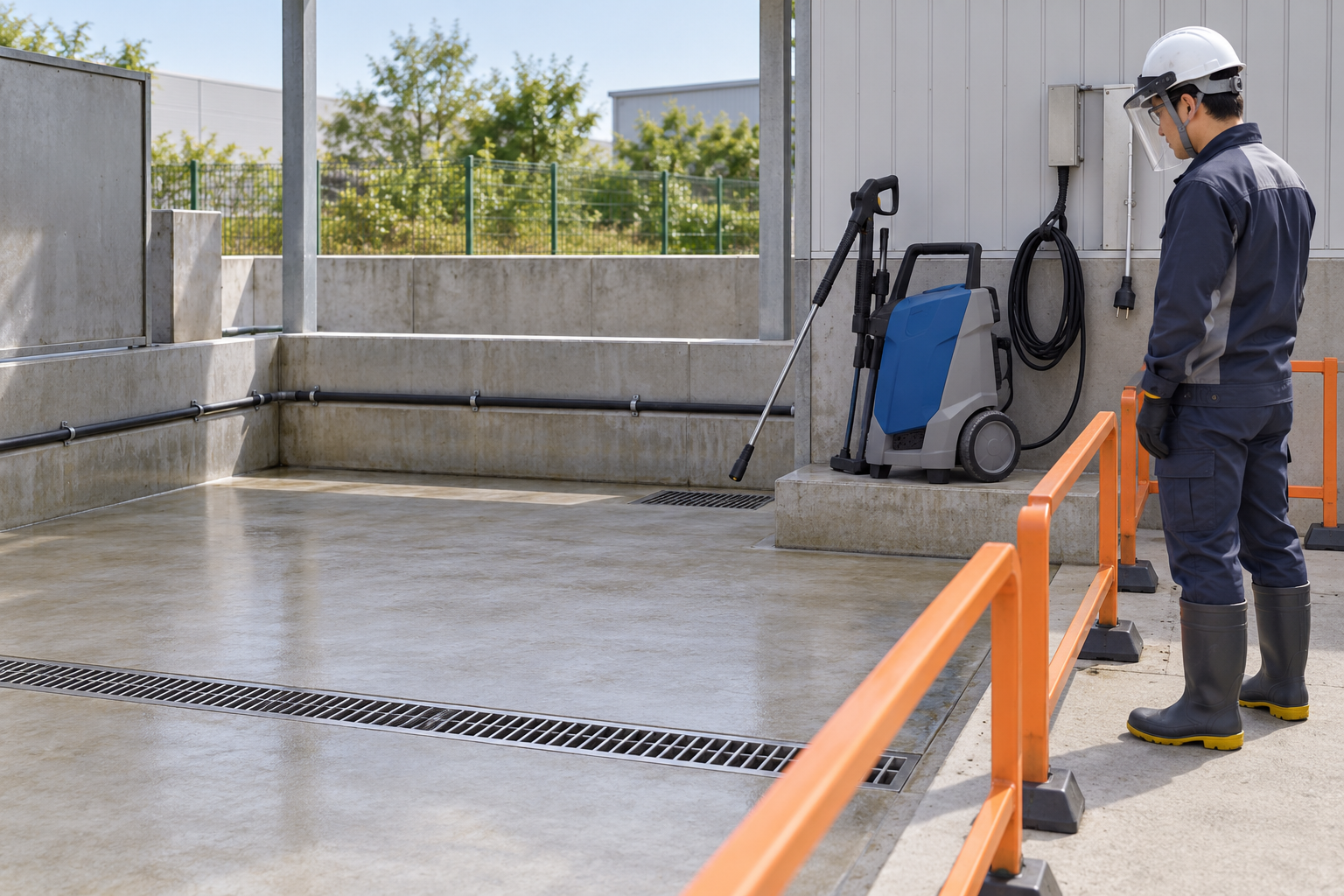
The retained illustration is an AI-generated educational image from the Korean source. It is not an actual incident photograph, approved drawing, equipment certification or proof that the depicted arrangement is safe.
A small surface wound can conceal severe high-pressure injection injury. Do not spray the body, clothing or footwear being worn, and never locate a leak by hand. Suspected injection needs prompt medical assessment with the fluid and pressure information.
Releasing the trigger stops the jet but may leave pressure trapped in the hose. Follow the actual shutdown, isolation, pressure-release and verification method before disconnecting or changing components.
A GFCI is an additional protective device, not permission to use wet connectors, damaged cords or equipment unsuitable for the location. Stop and have a safe electrical disconnection arranged if water reaches the supply; do not touch a wet energized plug.
Hypothetical decision example
Hypothetical example: wash water pools around an extension connection while a fine jet appears at a hose coupling. The operator reaches toward the leak to check it. Spraying stops and electrical and pressure hazards are controlled before inspection.
The example is fictional; no incident, measurement, inspection or approval is asserted.
Task flow: Assess surface → Set boundary → Inspect equipment → Connect and trial → Wash surface → Move zone → Hold leak or fault → Shut down and transfer
5. Hold and proceed decisions
| Condition | Action | Evidence | Proceed when |
|---|---|---|---|
| Fine hose leak | Stop; keep hands away | Pressure release and hose inspection | Defect corrected |
| Water at supply | Exclude access; isolate safely | Electrical and drainage assessment | Supply protected |
| Unknown coating | Hold washing | Contaminant and waste assessment | Scope accepted |
| Work finished | Depressurize and assess floor | Drainage, hose state and slip inspection | Area ready |
Similar observation, different conclusion
| Observation | Supported conclusion | What remains unresolved |
|---|---|---|
| Trigger released | Jet has stopped | Trapped hose pressure remains possible |
| GFCI present | One protective measure exists | Wet connections remain unacceptable |
6. Roles and supervision
| Role | Responsibility |
|---|---|
| Work supervisor | Coordinate assess surface, affected operations, stop signals and stage transitions. |
| Technical/equipment reviewer | Verify Surface and contaminant, Drain/recovery route, actual instructions and unresolved technical limits. |
| Task crew | Apply the stated controls, report changes and keep actual checks and signatures factual. |
| Inspector/test lead | Connect Gun stop/lock, Floor and next route to the required acceptance criteria. |
| Receiving authority | Accept the recorded restrictions, Waste disposition, Area handover and defects, and follow-up ownership. |
These are responsibility examples, not invented statutory credentials. Verify actual competence, training and authority for the assigned work.
Supervision and handover controls
| Stage | Management controls | Evidence |
|---|---|---|
| Plan review | 1. Assign technical owner2. Close task-specific questions3. Identify contaminants | 1. Surface and contaminant2. Drain/recovery route3. Method and limits |
| Competence | 1. Verify required competence2. Assign stop authority3. Exclude spray and runoff zone | 1. Exclusion boundary2. Training and task briefing3. Electrical location |
| Prestart evidence | 1. Inspect actual equipment2. Link evidence to this stage3. Connect without pressure | 1. Connections locked2. Footing and grip3. Water supply state |
| Change control | 1. Stop and secure the area2. Review affected controls3. Stop and exclude access | 1. Leak/fault location2. Electrical safe state3. Repair and trial record |
| Shift handover | 1. Identify remaining restrictions2. Confirm receiving responsibility3. Isolate and depressurize | 1. Pressure and disconnection2. Drain/floor condition3. Area handover and defects |
| Closeout | 1. Record defect disposition2. Archive factual evidence3. Isolate and depressurize | 1. Pressure and disconnection2. Drain/floor condition3. Area handover and defects |
7. Hold points and record quality
| Hold point | Evidence before release | Actual record |
|---|---|---|
| HP-0 Start | Electric cold-water pressure washing of level ground-floor surfaces outdoors or in a designated adequately ventilated wash area, with known contaminants and an accepted wastewater route. | |
| HP-1 Set boundary | Exclusion boundary; Runoff extent; Hose/walking route; Electrical location | |
| HP-2 Connect and trial | Connections locked; Footing and grip; Trial direction; Water supply state | |
| HP-3 Hold leak or fault | Leak/fault location; Electrical safe state; Pressure-release evidence; Repair and trial record | |
| HP-4 Shut down and transfer | Pressure and disconnection; Drain/floor condition; Waste disposition; Area handover and defects |
Hold points are internal evidence gates. They do not establish that a statutory permit exists or has been approved. Recheck affected gates after changes, faults and shift handover.
Record comparison - hypothetical templates
The 16 boxes below identify record elements, not completed checks or approvals. They are static symbols. Link equipment/location, date, actual findings and the separate record reference; preserve unresolved items.
| Record | Insufficient entry | Required record elements |
|---|---|---|
| Assess surface | "Checked" without supporting facts | □ Surface and contaminant□ Drain/recovery route□ Floor condition□ Method and limits |
| Inspect equipment | "Checked" without supporting facts | □ Power/connector condition□ Hose and nozzle ratings□ Gun function□ Fitting compatibility |
| Wash surface | "Checked" without supporting facts | □ Jet direction□ Surface and debris□ Reaction and balance□ Contaminant conditions |
| Hold leak or fault | "Checked" without supporting facts | □ Leak/fault location□ Electrical safe state□ Pressure-release evidence□ Repair and trial record |
8. Pre-work checks and emergency response
| Check required | Result | Checker/action |
|---|---|---|
| Assess surface: Surface and contaminant | ||
| Set boundary: Exclusion boundary | ||
| Inspect equipment: Power/connector condition | ||
| Connect and trial: Connections locked | ||
| Wash surface: Jet direction | ||
| Move zone: Gun stop/lock | ||
| Hold leak or fault: Leak/fault location | ||
| Shut down and transfer: Pressure and disconnection |
Stop work
Hold for uncertain contaminants, drainage, electrical protection, hose/nozzle ratings or gun stop function. Stop for leaks, uncontrolled jetting, unstable reaction, pedestrian entry or water approaching electrical connections. Never feel for a high-pressure leak.
Emergency response
Stop the jet from a safe position and exclude the pressure and wet-electrical area. Do not touch wet energized equipment or an electrically exposed casualty until the source is safely controlled. Seek prompt medical assessment for suspected injection even when the wound is small; call 911 for emergency assistance. Give responders the liquid, pressure, time, contaminant and electrical information. Maintain runoff containment without entering the hazard.
9. Official sources and review limits
Official public-source check: October 12, 2026. The review concerns the selected passages described below, not endorsement of this article.
| Official source | Checked scope and limit |
|---|---|
| OSHA 29 CFR 1910.334 | Portable-equipment inspections and approved equipment in conductive/wet locations; safe plug handling and no repeated reclosure into an unresolved fault. |
| CDC Pressure Washer Safety | Public injury-prevention and prompt medical-attention guidance for high-pressure spray wounds; not a workplace pressure-setting specification. |
| OSHA State Plans | Federal baseline and State Plan coverage reviewed. Confirm the applicable state program and employer coverage; this edition does not establish nationwide compliance. |
Selected public official provisions were checked on October 12, 2026. This is not a complete legal audit. No actual equipment manual, site measurements, engineering calculations, product certification or professional technical approval was supplied. Full paid NFPA/ANSI standards and state/local amendments were not reviewed. Check actual equipment, jurisdiction and project requirements before use.
This is reference content written and revised with AI. It has not been verified or approved by a professional. Review by a suitably qualified professional and required site authorization are necessary before use.
10. PDF use and frequently asked questions
PDF A summarizes core controls; B emphasizes technical failures; C covers supervision, records and handover. Each uses six stages from or aligned with the eight-stage body. All actual risk, measurement, check and signature fields are blank. Use a separate linked record where more space is needed.
May I test a leak with my hand?
No. Shut down, control power and verify pressure release before inspecting by the specified method.
Is a tiny spray wound minor?
Not necessarily. Obtain medical assessment promptly for suspected injection and identify the fluid, pressure and time.
Can pressure be increased until the stain disappears?
Reassess the substrate, contaminant and equipment limits. Surface removal or hazardous dust may require a different plan.
May the area reopen while water is draining?
Only after runoff, slip hazards, cables and hoses have been addressed and the receiving person accepts the area.
Has a professional approved this JSA?
This is reference content written and revised with AI. It has not been verified or approved by a professional. Review by a suitably qualified professional and required site authorization are necessary before use.
11. Authorship and revision history
This is reference content written and revised with AI. It has not been verified or approved by a professional. Review by a suitably qualified professional and required site authorization are necessary before use.
| Date/version | Editorial history | Technical approval |
|---|---|---|
| 2026-09-26 | Korean source retained as an unchanged snapshot; source ID bb0ec353-929c-4382-b1cb-c65b0d73bd35 | Not asserted |
| 2026-10-12 / US v1.0 | US localization: Preserves the Korean electric/cold-water/level-floor boundary and simultaneous hose-leak/wet-connector case. Uses US electrical equipment provisions and CDC injection-wound guidance; does not convert GFCI presence or trigger release into an all-clear. | Not performed |
Source topic: https://smartjsabridge.com/ko/case-study/jsa-electric-pressure-washer-floor
Content group: jsa-electric-pressure-washer-floor