Power-off does not mean cooled oil. Record the measured temperature, units, location and time; elapsed cooling time or touching the container exterior is insufficient. This manual-draining draft retains the HSE reference condition of at most 40°C (104°F), together with applicable equipment and container restrictions.
This reference material was written and revised with AI. It has not been verified or approved by a professional. Review by a suitably qualified professional and required site approval are necessary before field use.
Stop before proceeding
Keep the valve closed if measured temperature, supply isolation, suitable container or spare capacity is unverified. For this manual-draining draft, meet 40°C (104°F) or below and the actual equipment/container limits. Stop for overflow, leakage or blockage.
1. Legal and technical scope
Routine kitchen work is generally assessed under general-industry requirements, including walking-working surfaces and electrical safety. Apply 1910.147 only where the activity is covered servicing; evaluate any cord-and-plug exception on its actual conditions. OSHA restaurant guidance is educational. The retained 40°C (104°F) manual-draining condition comes from UK HSE guidance, not a US legal temperature limit; also satisfy the actual fryer and container instructions.
Confirm whether federal OSHA or an OSHA-approved State Plan covers this employer and worksite; state requirements and public-sector coverage can differ. Apply the task-specific provisions and limitations identified above.
| Basis | Application |
|---|---|
| OSHA 29 CFR 1910.22 | Clean, orderly walking-working surfaces and correction or guarding of hazardous conditions. |
| OSHA 29 CFR 1910.147 | Applicability and control of unexpected energization during covered servicing. |
| OSHA restaurant cooking eTool | Cool oil before handling; oil spills, water contact and thermal exposure. Guidance, not a new numeric draining standard. |
| HSE CAIS17 | Manual draining section: 40°C or below, measurement and suitable collection. UK technical guidance retained as this draft condition, not US law. |
| OSHA State Plans | Official overview of federal and State Plan jurisdiction and differing public-sector coverage, checked 2026-10-12. Individual state rules require a site-specific check. |
2. Scope and required inputs
Included scope
Shut down an electric fryer with a drain valve, isolate its supply, cool and measure the oil, drain it manually into a suitable container, secure the lid and transfer it to designated storage.
Separate assessment
Automatic hot-oil filtration, gas-fired equipment, boil-out cleaning, dismantling blocked drains, hot-oil transport and food-quality decisions require separate procedures.
| Input | Evidence needed |
|---|---|
| Define drain method | Fryer and drain ID; Oil and container data; Collection capacity; Crew and scope. |
| Measure and verify | Temperature units and time; 40°C/104°F plus limits; Container condition; Capacity and dryness. |
| Drain under watch | Flow and collected volume; Valve and leakage; Container stability; Remaining capacity. |
| Store and handoff | Container and location; Fryer state and valve; Receiver and label; Unresolved defects. |
No site measurements, equipment manuals for the actual installation, inspection records or signed technical approvals were supplied. Confirm the applicable requirements and actual product instructions before use; record each criterion with its units, source and equipment or work-area ID.
3. Eight-stage JSA
| Job stage | Hazards and effects | Failure factors | Technical and procedural controls | Site verification | P | S | R | A |
|---|---|---|---|---|---|---|---|---|
| 1. Define drain method | 1. Hot-oil burns2. Container failure3. Wrong filtration method4. Unexpected reheating | 1. Method confused2. Container unverified3. Oil volume unknown4. Crew not informed | 1. Confirm manual drain2. Match receiving container3. Plan staged volumes4. Assign shutdown control | 1. Fryer and drain ID2. Oil and container data3. Collection capacity4. Crew and scope | ||||
| 2. Stop and cool | 1. Residual heat2. Unexpected heating3. Electrical exposure4. Oil spill | 1. Time alone trusted2. Supply still available3. Wet connection4. Access not controlled | 1. Isolate power supply2. Prevent reheating3. Use dry safe access4. Allow measured cooling | 1. Isolation method2. Restart prevention3. Cooling start and area4. Electrical condition | ||||
| 3. Measure and verify | 1. Hot-oil contact2. Container softening3. Overflow4. Water-related splashing | 1. Temperature guessed2. Wrong container3. No spare capacity4. Container wet | 1. Measure oil temperature2. Verify thermal suitability3. Reserve usable capacity4. Use dry clean container | 1. Temperature units and time2. 40°C/104°F plus limits3. Container condition4. Capacity and dryness | ||||
| 4. Set drain outlet | 1. Oil spray2. Container overturn3. Slipping worker4. Accidental valve opening | 1. Loose drain spout2. Unstable placement3. Crowded work area4. Valve unprotected | 1. Fit specified spout2. Support container3. Control access4. Protect valve controls | 1. Spout and direction2. Container support3. Route and floor4. Valve operation | ||||
| 5. Drain under watch | 1. Overflow2. Oil contact3. Container movement4. Uncontrolled flow | 1. Worker leaves2. Poor valve access3. Unstable base4. Collected amount ignored | 1. Watch the full drain2. Keep safe valve access3. Maintain stable support4. Stop at planned volume | 1. Flow and collected volume2. Valve and leakage3. Container stability4. Remaining capacity | ||||
| 6. Close and transfer | 1. Oil release2. Lifting strain3. Dropped container4. Slip and fall | 1. Lid unsecured2. Excess manual load3. Damaged handle4. Wet route | 1. Close valve and lid2. Use handling aid3. Inspect carrying points4. Clear transfer route | 1. Valve closed2. Lid and exterior3. Load and cart4. Route condition | ||||
| 7. Hold blockages | 1. Sudden oil discharge2. Burn injury3. Slipping person4. Repeated leak | 1. Drain probed live2. Cooling assumed3. Spill unguarded4. Repair unchecked | 1. Stop draining2. Keep cooling and isolation3. Guard contaminated floor4. Use planned maintenance | 1. Blockage location2. Oil temperature3. Isolation and spill zone4. Repair verification | ||||
| 8. Store and handoff | 1. Container overturn2. Empty fryer heated3. Oil mixed incorrectly4. Hidden spill | 1. Unstable storage2. State not handed over3. Missing label4. Cleanup incomplete | 1. Use designated storage2. Transfer fryer restrictions3. Label contents and status4. Clean and verify floor | 1. Container and location2. Fryer state and valve3. Receiver and label4. Unresolved defects |
P = likelihood; S = severity; R = risk under the site method; A = the site-defined acceptance/authorization decision. Complete only after actual assessment. Blank cells and checklist prompts are not completed inspections.
4. Fictional scenario and failure mechanisms
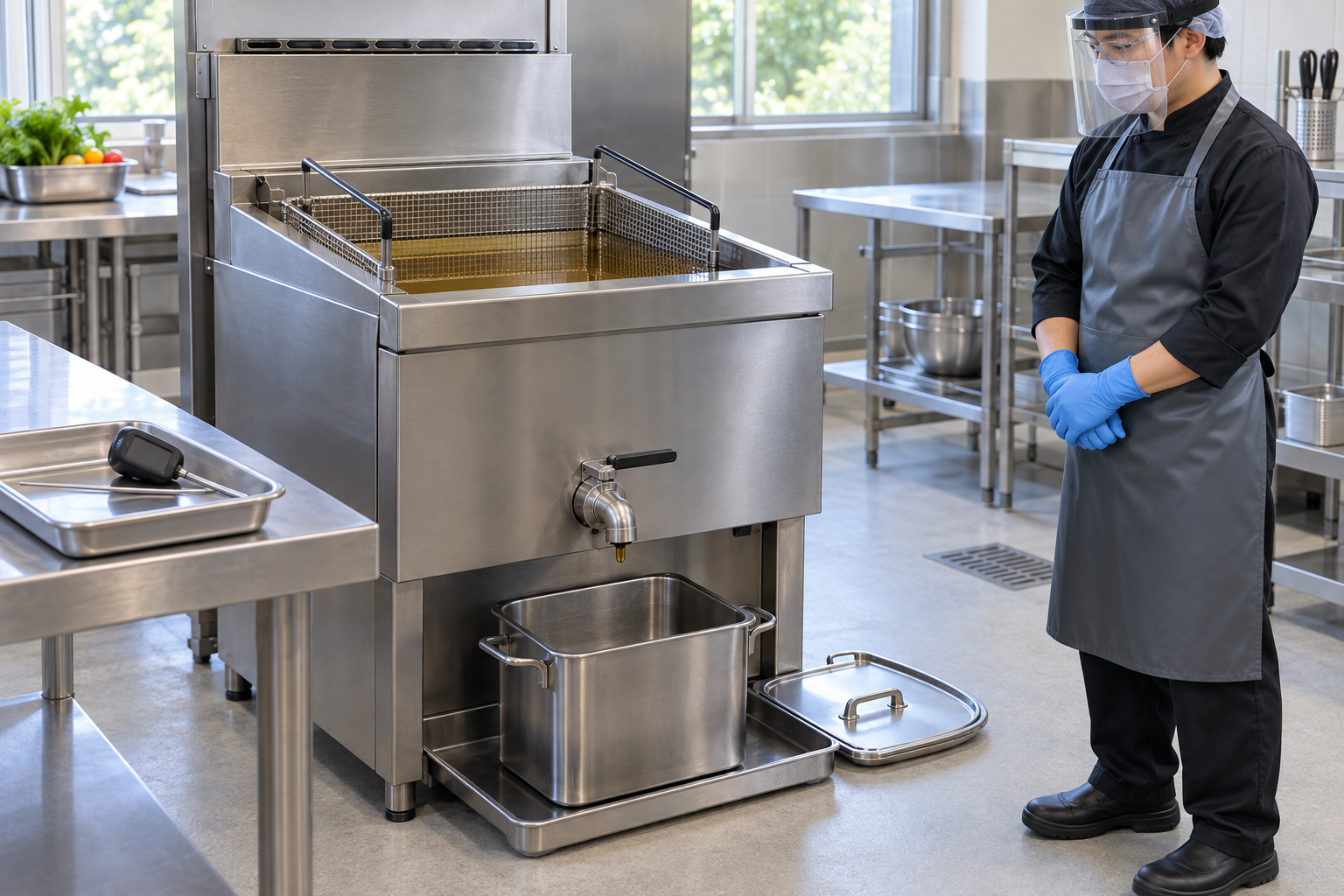
Retained AI-generated educational illustration from the source edition; not a real incident photograph, approved installation drawing or evidence of equipment suitability.
The scenario and record comparisons are fictional teaching examples, not records of real incidents, measurements, inspections, signatures or approvals.
| Item | Fictional scenario |
|---|---|
| Initial | A fryer has been switched off for an hour. |
| Change | The crew has no thermometer and proposes using an empty packaging container. |
| Failure | Time since shutdown is substituted for temperature and container evidence. |
| Outcome | The container may soften, leak or expose a worker to hot oil. |
| Barrier | Keep the drain closed until temperature, container, capacity and transfer conditions are verified. |
Why the controls matter
Power-off does not mean cooled oil. Record the measured temperature, units, location and time; elapsed cooling time or touching the container exterior is insufficient. This manual-draining draft retains the HSE reference condition of at most 40°C (104°F), together with applicable equipment and container restrictions.
Plan the receiving capacity and transport before opening the valve. An old oil package is not automatically suitable for the temperature, weight, handle loads or secure closure needed for collection.
A blocked drain can release oil suddenly if probed or dismantled. Stop and transfer the defect to a controlled maintenance procedure. Draining completion does not establish readiness to reheat an empty or wet fryer.
Decision sequence
| Step | Decision |
|---|---|
| Known | The crew has no thermometer and proposes using an empty packaging container. |
| Unknown | Actual condition, extent of damage and suitability of flow and collected volume, valve and leakage remain to be established. |
| Hold | Time since shutdown is substituted for temperature and container evidence. |
| Evidence | Link flow and collected volume, valve and leakage, container stability, remaining capacity, blockage location, oil temperature to the affected equipment or work area. |
| Next | Keep the drain closed until temperature, container, capacity and transfer conditions are verified. |
5. Conditional decisions and common errors
| Condition | Action | Evidence | Proceed when |
|---|---|---|---|
| Temperature unknown | Keep the drain closed | Measured temperature and limits | Cooling criteria met |
| Container unverified | Select suitable collection | Material, lid and capacity | Container verified |
| Drain blocked | Stop and maintain isolation | Defect and maintenance plan | Controlled repair verified |
| Transfer complete | Check storage and fryer state | Valve, label and restrictions | Handoff accepted |
Similar appearance, different evidence
The scenario and record comparisons are fictional teaching examples, not records of real incidents, measurements, inspections, signatures or approvals.
| Comparison | Supported decision | Insufficient basis |
|---|---|---|
| Condition | Measured temperature and limits | Temperature unknown has not been resolved. |
| Evidence | Defect and maintenance plan | A photograph or a completed-looking task without the relevant inspection record. |
| Release | Handoff accepted | Completion of one step does not release the excluded tasks in section 2. |
6. Roles and responsibilities
| Role | Responsibility |
|---|---|
| Work supervisor | Assign the task boundary, stop authority, interfaces and emergency communication for manual oil draining and transfer from an electric fryer. |
| Technical lead | Confirm Fryer and drain ID; Oil and container data; Collection capacity; Crew and scope. Resolve design and manufacturer limits before work. |
| Authorized crew | Apply Temperature units and time; 40°C/104°F plus limits; Container condition; Capacity and dryness. Stop when the working arrangement changes. |
| Inspector / receiving lead | Review Flow and collected volume; Valve and leakage; Container stability; Remaining capacity. Transfer Container and location; Fryer state and valve; Receiver and label; Unresolved defects. |
Role labels allocate responsibilities; they do not confer a legal qualification. Verify the competence, training and authority required for the actual task.
Record and handoff perspective
| Stage | Record controls | Verification |
|---|---|---|
| Define drain method | 1. Record fryer and drain id2. Record oil and container data3. Record collection capacity | 1. Oil and container data2. Collection capacity3. Crew and scope |
| Measure and verify | 1. Record temperature units and time2. Record 40°c/104°f plus limits3. Record container condition | 1. 40°C/104°F plus limits2. Container condition3. Capacity and dryness |
| Set drain outlet | 1. Record spout and direction2. Record container support3. Record route and floor | 1. Container support2. Route and floor3. Valve operation |
| Drain under watch | 1. Record flow and collected volume2. Record valve and leakage3. Record container stability | 1. Valve and leakage2. Container stability3. Remaining capacity |
| Hold blockages | 1. Record blockage location2. Record oil temperature3. Record isolation and spill zone | 1. Oil temperature2. Isolation and spill zone3. Repair verification |
| Store and handoff | 1. Record container and location2. Record fryer state and valve3. Record receiver and label | 1. Fryer state and valve2. Receiver and label3. Unresolved defects |
7. Hold points and record comparison
| Hold point | Evidence before release | Actual record |
|---|---|---|
| HP-0 Start | Shut down an electric fryer with a drain valve, isolate its supply, cool and measure the oil, drain it manually into a suitable container, secure the lid and transfer it to designated storage. | |
| HP-1 Stop and cool | Isolation method; Restart prevention; Cooling start and area; Electrical condition | |
| HP-2 Measure and verify | Temperature units and time; 40°C/104°F plus limits; Container condition; Capacity and dryness | |
| HP-3 Drain under watch | Flow and collected volume; Valve and leakage; Container stability; Remaining capacity | |
| HP-4 Store and handoff | Container and location; Fryer state and valve; Receiver and label; Unresolved defects |
These are internal hold points, not issued permits. Recheck affected points after a change, fault or shift handoff; link the actual approval record.
Record comparison
The scenario and record comparisons are fictional teaching examples, not records of real incidents, measurements, inspections, signatures or approvals.
The boxes are static record prompts, not interactive or saved approvals. A tick does not establish suitability or permission to restart. Record the evidence, person, time and unresolved issues; retain the change history.
| Record | Insufficient | Record checklist |
|---|---|---|
| Define drain method | "Checked" without target, criteria or result | □ Fryer and drain ID□ Oil and container data□ Collection capacity□ Crew and scope |
| Measure and verify | "Checked" without target, criteria or result | □ Temperature units and time□ 40°C/104°F plus limits□ Container condition□ Capacity and dryness |
| Drain under watch | "Checked" without target, criteria or result | □ Flow and collected volume□ Valve and leakage□ Container stability□ Remaining capacity |
| Store and handoff | "Checked" without target, criteria or result | □ Container and location□ Fryer state and valve□ Receiver and label□ Unresolved defects |
8. Site checklist and emergency response
| Check | Result | Person / action |
|---|---|---|
| □ Define drain method: Fryer and drain ID | ||
| □ Stop and cool: Isolation method | ||
| □ Measure and verify: Temperature units and time | ||
| □ Set drain outlet: Spout and direction | ||
| □ Drain under watch: Flow and collected volume | ||
| □ Close and transfer: Valve closed | ||
| □ Hold blockages: Blockage location | ||
| □ Store and handoff: Container and location | ||
| □ Emergency access and handoff restrictions |
Stop work
Keep the valve closed if measured temperature, supply isolation, suitable container or spare capacity is unverified. For this manual-draining draft, meet 40°C (104°F) or below and the actual equipment/container limits. Stop for overflow, leakage or blockage.
Emergency response
Stop transfer, isolate the affected area and activate the site response. Call 911 for injury or fire. Do not add water to burning oil or carry a hazardous container through occupied areas; only trained personnel should use the designated fire equipment.
9. Sources and review limits
Public-source review: 2026-10-12. Official regulation pages and specific technical references are distinguished below; no agency or manufacturer has approved this content.
| Source | Reviewed scope and limitation |
|---|---|
| OSHA 29 CFR 1910.22 | Clean, orderly walking-working surfaces and correction or guarding of hazardous conditions. |
| OSHA 29 CFR 1910.147 | Applicability and control of unexpected energization during covered servicing. |
| OSHA restaurant cooking eTool | Cool oil before handling; oil spills, water contact and thermal exposure. Guidance, not a new numeric draining standard. |
| HSE CAIS17 | Manual draining section: 40°C or below, measurement and suitable collection. UK technical guidance retained as this draft condition, not US law. |
| OSHA State Plans | Official overview of federal and State Plan jurisdiction and differing public-sector coverage, checked 2026-10-12. Individual state rules require a site-specific check. |
No site measurements, equipment manuals for the actual installation, inspection records or signed technical approvals were supplied. Confirm the applicable requirements and actual product instructions before use; record each criterion with its units, source and equipment or work-area ID.
10. PDF guidance and FAQ
PDF A covers basic task controls; B focuses on technical failures; C covers supervision, records and handover. The article has eight stages with four items per main cell; each PDF has six key stages with three items per main cell. P/S/R/A, measurements, confirmations and signatures remain blank for actual site assessment.
Content group
jsa-electric-fryer-oil-draining
How long must oil cool?
Time alone is insufficient. Measure it and satisfy the retained 40°C (104°F) guidance condition and actual equipment/container limits.
Is 40°C an OSHA limit?
No. It is the HSE manual-draining reference used in this draft, not a US statutory limit.
Can an empty oil package collect drained oil?
Only if its suitability for the actual temperature, contents, weight and closure has been established.
Does draining permit immediate reheating?
No. Prevent empty heating and follow the separate cleaning, drying, valve and refill procedure.
Has a professional approved this JSA?
This reference material was written and revised with AI. It has not been verified or approved by a professional. Review by a suitably qualified professional and required site approval are necessary before field use.
11. Revision history and authorship
This reference material was written and revised with AI. It has not been verified or approved by a professional. Review by a suitably qualified professional and required site approval are necessary before field use.
Korean source created 2026-09-26. This US edition adapts the Korean source; earlier editorial revisions do not constitute professional approval of this edition.
| Date | Edition | Change | Review status |
|---|---|---|---|
| 2026-10-12 | 1.0 | US localization: preserve task judgments; replace Korean legal applicability with scoped US references. | AI editorial and output checks; no professional technical approval. |