Moving one intact closed drum of known contents and weight with a dedicated compatible manual drum truck over a level indoor route. Confirm the exact drum material, rim, closure and securing method.
Stop for unknown contents, mass or material; incompatible securing geometry; leakage, bulging, corrosion or rim damage; restraint slip; wheel obstruction; excessive force; or uncontrolled rocking.
Reference content written and revised with AI. It has not been verified or approved by a professional. Review by a suitably qualified professional and site approval are required before use.
1. Legal and technical scope
For general-industry handling, OSHA 1910.176 addresses clear routes and safe material storage; hazardous-chemical information, labels and SDS access fall under applicable 1910.1200 requirements. These rules do not certify a particular drum truck. Construction work requires applicable Part 1926 provisions. The actual spill determines whether emergency-response requirements apply; ordinary operators are not automatically qualified responders.
Determine Federal OSHA or the applicable OSHA-approved State Plan, including public/private employer coverage. State Plans must be at least as effective and can impose different or additional requirements. The actual activity determines construction versus general-industry scope. Manufacturer instructions, consensus standards, project design and site approvals have distinct roles; this page is not a finding of nationwide compliance.
| Basis | Application and limits |
|---|---|
| OSHA 1910.176 | Clearances, aisles, housekeeping and stable storage; not a drum-clamp specification. |
| OSHA 1910.1200 | Chemical identification, labels, SDS and training within the applicable hazard-communication scope. |
2. Scope and required inputs
Included: Moving one intact closed drum of known contents and weight with a dedicated compatible manual drum truck over a level indoor route. Confirm the exact drum material, rim, closure and securing method.
Separate review: Opening or decanting drums, leaking or bulging containers, severe corrosion, unknown substances, powered clamps, hoisting, stairs, slopes and vehicle loading require separate assessment.
| Input | Required evidence |
|---|---|
| Identify drum | Drum ID and label; Mass and fill state; Material and rim condition; Leak and closure check |
| Prepare route | Floor and thresholds; Visibility and clearance; Traffic controls; Landing area ready |
| Move and turn | Drum remains secured; Rocking and load response; Operator effort acceptable; Route remains clear |
| Hand over | Drum ID and location; Final container condition; Truck defect status; Receiving person and limits |
Confirm drum mass, contents, material, rim geometry, truck rating and the exact securing method. Assess the level route, operator effort and destination stability. Select hand, foot and chemical protection from the actual handling and substance assessment; no universal manual-force limit is assigned.
3. Eight-stage JSA
P = likelihood; S = severity; R = risk under the site method; A = acceptance or authorization as defined by the site. Leave these blank until actual assessment and control verification. A low score does not override a legal requirement, product limit or unreleased hold point.
| Job stage | Hazards and effects | Failure factors | Required controls | Site verification | P | S | R | A |
|---|---|---|---|---|---|---|---|---|
| 1. Identify drum | 1. Unknown-chemical exposure2. Truck overload3. Container failure4. Unexpected residue exposure | 1. Label missing2. Mass estimated3. Bulge or corrosion ignored4. Empty assumed harmless | 1. Identify contents and SDS2. Confirm loaded mass3. Inspect intact closure and rim4. Check residue hazards | 1. Drum ID and label2. Mass and fill state3. Material and rim condition4. Leak and closure check | ||||
| 2. Select truck | 1. Clamp disengagement2. Drum deformation3. Wheel or frame failure4. Excess manual force | 1. Wrong drum geometry2. Plastic rim not approved3. Truck rating unknown4. Damaged wheels used | 1. Match approved container type2. Verify securing geometry3. Check truck capacity4. Inspect wheels and frame | 1. Allowed material and shape2. Rating and model instructions3. Clamp and lock condition4. Wheel and frame inspection | ||||
| 3. Prepare route | 1. Threshold impact2. Drum overturning3. Pedestrian collision4. Blocked safe landing | 1. Damaged floor2. Tight turn ignored3. People share narrow path4. Destination not ready | 1. Use clear level route2. Check turning space3. Separate pedestrians4. Prepare stable destination | 1. Floor and thresholds2. Visibility and clearance3. Traffic controls4. Landing area ready | ||||
| 4. Secure and tilt | 1. Hand or foot crush2. Drum separates from truck3. Unexpected weight shift4. Operator strain | 1. Lock not engaged2. Contact shallow3. Body used to catch drum4. Wrong tilt technique | 1. Follow securing sequence2. Verify full engagement3. Keep body clear4. Use approved handling method | 1. Clamp contact and lock2. Stable truck support3. Hands and feet clear4. Controlled tilt response | ||||
| 5. Move and turn | 1. Liquid-shift instability2. Drum falls3. Back or shoulder strain4. Collision on blind turn | 1. Abrupt turn or stop2. Restraint loosens3. Excess force continued4. Forward view blocked | 1. Move at controlled pace2. Monitor restraint3. Stop on excessive force4. Keep travel view clear | 1. Drum remains secured2. Rocking and load response3. Operator effort acceptable4. Route remains clear | ||||
| 6. Land and release | 1. Drum rolls or drops2. Finger crush3. Container tipping4. Truck sudden movement | 1. Uneven landing surface2. Restraint released early3. Drum not self-supporting4. Feet in landing zone | 1. Place on stable level base2. Confirm independent stability3. Release in specified order4. Keep feet clear | 1. Upright stable drum2. Destination condition3. Release sequence4. Truck clear of drum | ||||
| 7. Stop on leak | 1. Chemical spread2. Exposure during cleanup3. Further container damage4. Fire from hazardous contents | 1. Transfer continued2. Unknown spill approached3. Drum raised by hand4. Ignition hazards ignored | 1. Stop ordinary handling2. Restrict affected area3. Notify trained response4. Follow substance-specific plan | 1. Material and location2. Leak and container state3. Exclusion and response owner4. Recovery method approval | ||||
| 8. Hand over | 1. Wrong-location storage2. Damaged truck reuse3. Unrecorded container defect4. Unresolved spill risk | 1. Drum identity lost2. Clamp fault not tagged3. Damage verbally omitted4. Receiving person absent | 1. Record drum placement2. Quarantine faulty truck3. Transfer observed defects4. Confirm receiving responsibility | 1. Drum ID and location2. Final container condition3. Truck defect status4. Receiving person and limits |
4. Hypothetical scenario and failure mechanisms
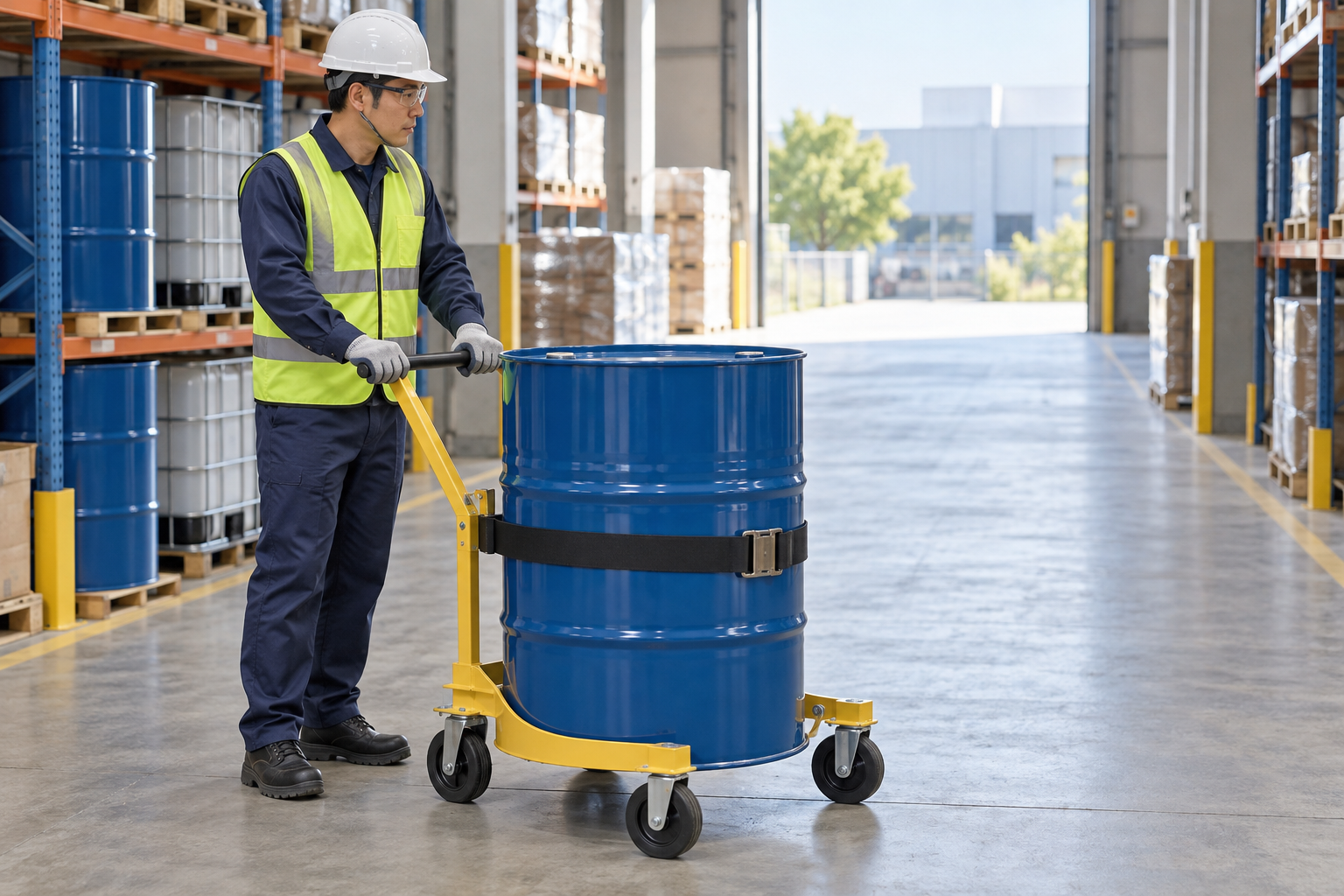 Retained source illustration: an AI-generated educational concept, not a real incident photograph or evidence of equipment suitability.
The following scenario, comparisons and example records are hypothetical teaching material. They do not reproduce actual incidents, measurements, signatures or approvals.
| Item | Hypothetical situation |
|---|---|
| Initial state | A worker selects the truck normally used for steel drums. |
| Change | A plastic drum of the same nominal capacity has only shallow contact with the rim clamp, which slips during tilting. |
| Failure path | Nominal volume is mistaken for compatibility while rim shape and stiffness differ. |
| Possible harm | The drum can separate from the truck, crush a foot or release its contents. |
| Barrier | Stop movement, keep clear and establish a safe stable state. Compare the drum with the truck manufacturer limits and change to a compatible handling method before restarting. |
Volume does not establish mass, rigidity or grip compatibility. Steel and plastic rims can behave differently. Match the actual container and fill state to the truck limits; a loose improvised strap does not approve an incompatible clamp.
Liquid movement changes the load response during turning and stopping. Use a controlled pace and a clear level route. Stop when force or rocking cannot be controlled rather than using the body as a counterweight.
A drum must be independently stable in the intended location before its securing device is released. Keep hands and feet outside pinch areas; catching or propping a falling drum is not a planned control.
An apparently empty drum can retain hazardous residue. Labels and SDS information inform handling and emergency response. A leak changes this from ordinary transfer to a substance-specific response, with responders trained and equipped for that scope.
| Decision | Reason and evidence |
|---|---|
| Known facts | A plastic drum of the same nominal capacity has only shallow contact with the rim clamp, which slips during tilting. |
| Unresolved | Nominal volume is mistaken for compatibility while rim shape and stiffness differ. |
| Hold reason | Stop for unknown contents, mass or material; incompatible securing geometry; leakage, bulging, corrosion or rim damage; restraint slip; wheel obstruction; excessive force; or uncontrolled rocking. |
| Evidence needed | Drum remains secured; Rocking and load response; Operator effort acceptable; Route remains clear. |
| Next decision | Stop movement, keep clear and establish a safe stable state. Compare the drum with the truck manufacturer limits and change to a compatible handling method before restarting. |
5. Conditional decisions and common errors
| Condition | Action | Evidence | Proceed when |
|---|---|---|---|
| Drum unknown | Hold transfer and identify contents and weight. | Label, SDS and mass basis. | Container and contents identified. |
| Clamp slips | Stop and select compatible equipment. | Truck limits and drum-rim evidence. | Full approved engagement. |
| Force excessive | Stop and reassess route, wheels and handling method. | Floor, load and equipment assessment. | Movement safely controllable. |
| Drum at destination | Confirm stable independent support before release. | Base, upright state and restraint sequence. | Drum stable without truck. |
| Comparison | Situation A | Situation B |
|---|---|---|
| Same volume | Mass, material, rim and securing method are compatible. | The drum is assumed to fit because its capacity matches. |
| Drum on truck | The specified attachment is fully engaged and remains secure. | The rim merely rests on the hook. |
6. Roles and responsibilities
| Role | Responsibility |
|---|---|
| Work supervisor | Confirm scope, task sequence, exclusion and stop authority. Coordinate identify drum with affected operations. |
| Technical reviewer | Resolve the actual design and equipment limits: Drum ID and label; Mass and fill state; Material and rim condition; Leak and closure check. |
| Work crew | Perform prepare route using the approved procedure; report any mismatch before proceeding. |
| Inspector / assessor | Verify Upright stable drum; Destination condition; Release sequence; Truck clear of drum. Record what was actually checked and what remains unresolved. |
| Release / receiving authority | Confirm Drum ID and location; Final container condition; Truck defect status; Receiving person and limits. Transfer restrictions and the next permitted stage. |
These are responsibility examples, not invented statutory credentials. Meet the actual training, competent-person, qualified-person and licensing requirements for the assigned work. Anyone may raise a hazard and request a stop; only the designated authority may release the affected stage after evidence is reviewed.
7. Hold points and record comparison
| Hold point | Evidence before release | Confirmation / approval |
|---|---|---|
| HP-0 Start | Scope, jurisdiction, equipment identity, responsible people and emergency arrangements. | |
| HP-1 Select truck | Allowed material and shape; Rating and model instructions; Clamp and lock condition; Wheel and frame inspection | |
| HP-2 Secure and tilt | Clamp contact and lock; Stable truck support; Hands and feet clear; Controlled tilt response | |
| HP-3 Land and release | Upright stable drum; Destination condition; Release sequence; Truck clear of drum | |
| HP-4 Hand over | Drum ID and location; Final container condition; Truck defect status; Receiving person and limits |
Hold points are internal evidence gates. They do not replace statutory permits or actual signatures. Recheck affected gates after a change, abnormal event or shift transfer. The blank record must identify the evidence, person, time, limits and release scope.
| Record | Insufficient record | Record checklist |
|---|---|---|
| Drum | Looks empty | □ Drum ID and label□ Mass and fill state□ Material and rim condition□ Leak and closure check |
| Truck | Same drum size | □ Allowed material and shape□ Rating and model instructions□ Clamp and lock condition□ Wheel and frame inspection |
| Travel | Moved successfully | □ Drum remains secured□ Rocking and load response□ Operator effort acceptable□ Route remains clear |
| Leak | Only a little spill | □ Material and location□ Leak and container state□ Exclusion and response owner□ Recovery method approval |
The □ boxes are static prompts, not saved or interactive approvals. Each checks one record element. A tick alone does not establish suitability or permission to restart. Link equipment IDs and supporting records; retain unresolved matters and the earlier record when conditions change.
8. Site checklist and emergency response
| Check item | Result | Person / action |
|---|---|---|
| Drum ID and label | ||
| Allowed material and shape | ||
| Floor and thresholds | ||
| Clamp contact and lock | ||
| Drum remains secured | ||
| Upright stable drum | ||
| Material and location | ||
| Drum ID and location | ||
| Emergency arrangements and unresolved restrictions communicated |
Stop work: Stop for unknown contents, mass or material; incompatible securing geometry; leakage, bulging, corrosion or rim damage; restraint slip; wheel obstruction; excessive force; or uncontrolled rocking.
Emergency response: Do not approach, plug or right a leaking or fallen drum without substance information and a reviewed response. Restrict access and notify the site emergency team with the material, location and container condition. Call 911 for injury, fire or a dangerous uncontrolled release; only trained and equipped personnel may conduct the required response.
9. Sources and review limits
Official-source review date: October 12, 2026. The following review is limited to the public provisions or selected manufacturer material identified below. It does not establish that any authority approved this article or the actual installation.
- OSHA 1910.176: Clearances, aisles, housekeeping and stable storage; not a drum-clamp specification.
- OSHA 1910.1200: Chemical identification, labels, SDS and training within the applicable hazard-communication scope.
- OSHA State Plans: jurisdiction and coverage overview; identify the actual state program before use.
Paid consensus standards and site-specific calculations, manuals, inspection records and product certificates were not independently obtained or verified unless specifically identified. Korean legal citations remain in the preserved Korean source as source history; they are not represented as US legal duties.
10. PDF guidance and FAQ
PDF A covers basic task controls; B examines technical failures; C focuses on supervision, evidence and handover. Each has six rows and three items per main cell. They are complementary extracts: apply all eight body stages and the applicable site procedure. An omitted stage is not permission to omit its controls. PDF HP-0 through HP-4 are worksheet labels; match the event, evidence and authority rather than assuming they match another permit by number.
P/S/R/A, actual measurements, confirmations and signatures remain blank. The PDFs are uncompleted reference worksheets, not issued work permits.
Content group ID: jsa-drum-trolley-transfer
Can one truck handle every drum of the same volume?
No. Verify weight, material, rim geometry and the specified securing system.
May a small leak be moved to the storage area first?
Stop the ordinary transfer and use the substance-specific response procedure. Do not improvise movement or cleanup.
Should a falling drum be caught or immediately stood upright?
Keep clear. Control access and obtain a suitable recovery method after contents, damage and further movement are assessed.
Has a professional verified or approved this document?
No. This is AI-assisted reference material. Editorial and layout checks are not a physical inspection or professional technical approval. Obtain qualified professional review and required site approval before use.
11. Revision history and authorship
Reference content written and revised with AI. It has not been verified or approved by a professional. Review by a suitably qualified professional and site approval are required before use.
This system has not physically inspected the equipment, structures, ground, atmosphere or worksite. The document does not replace legal advice, manufacturer procedures, engineering design, inspection certificates, qualification evidence, the site risk assessment or an actual work permit.
Before use, a suitably qualified and authorized person must review the actual equipment, loads, methods, protection, inspection and emergency arrangements and resolve open issues. Record the real reviewer, organization, qualifications, delegated authority, reviewed documents, date, signature, exclusions and conditions of approval separately.
| Date | Version | Change | Review status |
|---|---|---|---|
| 2026-09-25 | 1.0 | Korean source revision retained in the source snapshot. | Historical editorial status; not US professional approval. |
| 2026-10-12 | US 1.0 | US localization of the assigned Korean source; task reasoning, educational image and history retained; US scope and sources reviewed. | AI-assisted editorial work; professional approval not performed. |